Skip to content
DevMeme
3149 of 7435
Three-Day Debugging Saga Ends with Hackerman and Three Lines of Code
Debugging Troubleshooting Post #3469, on Jul 28, 2021 in TG

Three-Day Debugging Saga Ends with Hackerman and Three Lines of Code

Why is this Debugging Troubleshooting meme funny?

Level 1: Big Search, Tiny Fix

Imagine you spent all week looking for your lost house key. You search everywhere – under the couch, in every drawer, even in your car – feeling more and more upset because you just can’t find it. After three days of searching, you finally check the pocket of a jacket hanging in the closet, and… there’s the key! It turns out the solution was super simple and right there the whole time, but it took you forever to discover it. You feel a huge wave of relief and a bit of triumph, like “Yes, I did it!” even though finding a key in a pocket isn’t exactly superhero work. That’s exactly what this meme is joking about, but with computer code: a programmer spends days trying to fix a broken program, and in the end the fix was just adding a few little lines of code. It’s funny because it’s a lot of effort for a small result, and when it finally works, the programmer feels as cool as a movie hacker hero. It’s a way to laugh about how something so simple can be so hard to find, and to celebrate that happy moment when the big problem is finally solved by a tiny fix.

Level 2: Debugging Detective Work

Let’s break down what’s happening in this meme in simpler terms. In software development, a bug is a mistake or problem in the code that causes things to go wrong (the program might crash or give wrong results). Debugging is the process of finding and fixing that bug – kind of like being a detective for computer code. The meme describes a situation where a programmer spent three whole days (imagine working from Monday to Wednesday!) trying to figure out why their program was misbehaving. That’s a long time, and it implies the bug was really hard to track down. Maybe the program was throwing confusing error messages, or the bug would only show up under very specific conditions. The developer probably tried everything: reading error logs (files or messages that report what the program was doing), adding extra print statements in the code to trace its behavior, checking each part of the system one by one, and even asking coworkers for fresh ideas. This phase can be frustrating and tiring – hence tags like DebuggingPain and DebuggingFrustration – because nothing seems to make the problem go away.

Now comes the punchline: after all that effort, the actual solution was just three lines of code. In coding, “lines of code” literally means lines in the text of the program. So “fix it with 3 lines” means the programmer only needed to add or change three lines to resolve the bug. That’s tiny! Modern programs often have thousands or even millions of lines, so a 3-line change is like tightening one little screw to fix a huge machine. For example, the bug might have been fixed by doing something as simple as:

# Before: This code had a bug if 'data' was None (nothing).
result = process(data)

# After: We add 3 lines to fix the bug.
if data is None:
    data = default_value()    # 1: Provide a default if data is missing
result = process(data)        # 2: (existing line, now works because data is valid)
print("Done!")                # 3: Maybe log that we finished, just as an extra (for example)

In this hypothetical fix above, the programmer discovered that data could sometimes be None (meaning nothing was there), which caused process(data) to crash. The fix was to check for that condition and handle it – which we did in a couple of simple lines. Once those lines were added, the program ran without errors. It feels almost magical: such a small change making a big difference.

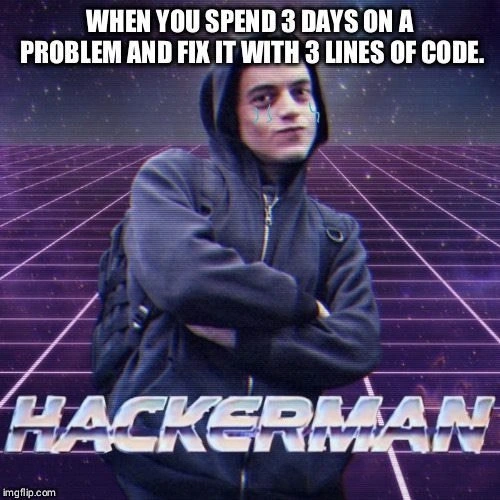
The meme uses the “Hackerman” image to celebrate this moment. Hackerman is a popular Internet meme character: a young guy in a hoodie, arms confidently folded, standing in front of a retro 1980s-style neon grid background. The word “HACKERMAN” in bold, shiny chrome letters is plastered at the bottom. This over-the-top image comes from a comedy action short film where that character is a superhacker. In developer communities, we use this image humorously whenever someone does something that makes them feel like an “elite hacker”, even if it’s actually pretty ordinary. It’s tongue-in-cheek. Here, solving a tough bug with a tiny code change makes the developer feel ultra-smart, so the Hackerman meme is a perfect fit to express that feeling. The top text in the meme – “WHEN YOU SPEND 3 DAYS ON A PROBLEM AND FIX IT WITH 3 LINES OF CODE” – is written in big bold Impact font (common for meme captions) to set up the scenario. By pairing it with the Hackerman image, the meme is saying: after a three-day battle with a stubborn bug, fixing it with just three lines makes you feel like the coolest hacker on the planet. It’s funny because typically “cool hackers” in movies break into high-security systems or do something high-stakes, whereas here our “hack” was simply to squash a bug in our own code – not quite Hollywood material, but emotionally it feels just as awesome at that moment.

For a junior developer or someone new to coding, this meme is very relatable and also a bit educational. It’s basically telling you: don’t be surprised if you spend a long time debugging something, and the answer turns out to be a tiny fix. This happens to everyone, even experienced pros. Maybe you accidentally used the wrong variable name, or you forgot a tiny step in a setup. The bug might hide from you for days, but once you find it, the change in the code is minimal. You learn to both laugh and cheer when this happens. Laugh because “I can’t believe it was something so small all along!”, and cheer because “Yes! I finally found it and fixed it!” It’s a mix of embarrassment and pride, which is actually a common emotional cocktail in programming. The term “three-line fix” gets thrown around in dev teams to mean a very small code change that has a big impact. Often, senior developers will reassure juniors that spending a lot of time on a problem only to solve it with a small fix is normal – it doesn’t mean you’re a bad programmer; it just means the problem was sneaky. This meme reinforces that shared understanding in a humorous way.

Also, notice the retro 80s aesthetic of the image (the neon grid and spacey background). This style is deliberately dramatic and nostalgic, reminding viewers of old-school hacker movies or video games. It makes the moment of fixing a bug feel like a scene from a cool sci-fi movie. In reality, when you fix a bug at 2 AM, you might just quietly sigh in relief, push the code, and go to bed. But in your head – especially when you share the story with friends the next day – it feels like you had a cinematic “hack victory” moment. By using Hackerman imagery, the meme playfully exaggerates a programmer’s internal celebration into something visible and funny. It’s classic DeveloperHumor: take a mundane coding experience, and frame it as an epic win.

Level 3: Odyssey to One-Liner

The meme humorously captures a classic DebuggingFrustration scenario: spending 72 hours chasing a mysterious bug, only to solve it with a few trivial lines of code. This contrast is the punchline. In real developer life, it’s surprisingly common to embark on an epic debugging odyssey through stacks of logs, call stacks, and code diffs, each hour convinced the issue lurks in a different layer of the system. Perhaps you’ve torn apart the database queries, blamed a third-party API, or even muttered “it’s always DNS” in desperation. After days of systematic troubleshooting (and maybe a few Rubber Duck Debugging sessions talking to a rubber duck on your desk), the eureka moment arrives: the root cause was something deceptively simple, like a missing null check or a single misconfigured parameter. You add a few lines – maybe resetting a variable or off-by-one correction – and suddenly everything works. The entire bug saga collapses into a tiny patch: three lines of code. The absurdity that such a minuscule fix ends a multi-day saga is exactly why developers smirk at this meme. It’s a form of technical irony that every engineer recognizes.

This scenario is a rite of passage in software development. It highlights the disproportionate effort often required to identify an issue versus the effort to fix it. In complex systems, the symptom of a bug might surface far from its actual cause. You can spend days sleuthing through microservice calls or chasing phantom stack traces, feeling like a detective in a crime thriller where every clue is a red herring. For example, imagine an intermittent crash in a large application – logs point everywhere and nowhere, developers form theories from memory leaks to race conditions, only to discover in the end it was a simple null pointer exception in one function. The fix? Add three lines to check for null and provide a default value. Bug solved. It’s almost comedic how anti-climactic that final commit can be compared to the drama of the hunt.

The meme uses the flamboyant “Hackerman” persona – a hooded figure in front of a neon grid – to satirically crown the developer as an elite hacker for achieving this hard-won victory. The retro ’80s aesthetic (purple grid background and chrome text) parodies how one feels internally: like a coding superhero who just performed some high-level cyber sorcery. It’s tongue-in-cheek because writing three lines is obviously not wizardry, yet after days of feeling stumped and borderline incompetent, finally cracking the problem does feel like a heroic triumph. In a dev’s mind, resolving a nasty bug can trigger the same rush of accomplishment as if they just hacked the Gibson (to borrow an old hacker-movie reference). The top caption in bold Impact font – “WHEN YOU SPEND 3 DAYS ON A PROBLEM AND FIX IT WITH 3 LINES OF CODE” – is both celebration and self-mockery. On one hand, it acknowledges the painfully long debugging session (something any coder reading this has likely endured, evoking empathetic groans). On the other, it exaggerates the victory, humorously elevating those humble three lines to legendary status.

From a senior engineer’s perspective, this meme also nods at deeper truths in software engineering. First, it emphasizes that debugging is often harder than coding. Writing the initial code might have taken an hour, but understanding why it failed can take days because you’re effectively reverse-engineering your own or someone else’s thought process. It also reflects on the nature of modern bugs: many are subtle and hidden in plain sight. A single logical error or a tiny omission can ripple through the system and manifest as weird behavior elsewhere. The time to localize that bug is what takes days – the fix itself is often just correcting that one oversight. This is why we have sayings like “Finding the bug is 99% of the work, fixing it is the other 1%.” The humor lands because it’s true. Every experienced developer has war stories of bug hunts that consumed days or weeks, ending with a one-liner change. The meme condenses all those war stories into one relatable snapshot.

There’s also an implicit critique of our tools and processes. With all our fancy IDEs, profilers, and automated tests, why do such simple bugs still eat up days? Part of it is the human element – confirmation bias and assumptions can lead us to overlook the obvious. You might assume “No, that variable could never be null here” and not check it initially. Or perhaps logs were too noisy or missing at just the right spot, so it took adding extra print statements (console.log/printf debugging, anyone?) to finally spotlight the issue. Sometimes the system itself fights back: the bug might only appear in production but not in your staging environment, forcing a maddening game of cat-and-mouse. The protracted struggle is what makes the final simplistic fix feel so incredible – and a bit absurd.

Finally, the emotional rollercoaster is key to why this meme resonates across the DeveloperHumor universe. After three days, a developer is likely exhausted, doubting their skills, perhaps regretting all their career choices. Then the breakthrough happens and it’s like the sun suddenly shines in the office at 3 AM. Elation! Relief! In that moment, you do feel like “Hackerman,” master of the digital realm, even if all you did was set a flag or increment an index. The meme captures that triumphant coding victory feeling. It’s a form of catharsis – laughing at ourselves for how dramatically we swing from despair to euphoria over something as small as three lines of code. And as any cynical veteran coder might add with a smirk, those three lines will probably introduce another bug down the road, kicking off the next saga... but hey, let’s savor this win for now. 🎉

Description

The image uses the classic ’Hackerman’ meme template: a hoodie-clad figure with folded arms stands in front of a purple, neon-grid background that fades into a starry sky, evoking an 80s retro-futuristic aesthetic. Bold white uppercase impact-font text at the top reads, "WHEN YOU SPEND 3 DAYS ON A PROBLEM AND FIX IT WITH 3 LINES OF CODE." Centered at the bottom is large chrome-styled text that says "HACKERMAN." The composition conveys the triumphant feeling developers get after a protracted debugging session suddenly resolves with a tiny patch, humorously equating ordinary bug-fixing with elite hacking prowess

Comments

13
Anonymous ★ Top Pick 72 hours of war-room Slack threads, Grafana archaeology, and strace spelunking, all to submit a three-line patch - senior engineering: where the RCA doc is bigger than the diff
  1. Anonymous ★ Top Pick

    72 hours of war-room Slack threads, Grafana archaeology, and strace spelunking, all to submit a three-line patch - senior engineering: where the RCA doc is bigger than the diff

  2. Anonymous

    The real hack wasn't the three lines of code - it was convincing yourself those three days of architectural diagrams, design patterns research, and Stack Overflow deep-dives were 'necessary context gathering' rather than elaborate procrastination before adding a simple null check

  3. Anonymous

    The real 'Hackerman' move isn't spending three days on a problem - it's having the architectural foresight to avoid the problem entirely. But we all know that wisdom only comes after you've already spent three days debugging why your distributed system's consensus algorithm was failing because someone hardcoded 'localhost' in a config file that was supposed to be environment-aware. The three-line fix? Moving it to an environment variable, adding proper service discovery, and wondering why you didn't just use the existing infrastructure abstraction layer in the first place

  4. Anonymous

    Three days tracing the call stack, three lines exposing the API contract violation no one documented. Hackerman's tears: pure architecture catharsis

  5. Anonymous

    Senior dev flex: three days to reproduce a distributed race; three-line PR - add a lock, set UTC, delete the cache - merged as “minor refactor.”

  6. Anonymous

    Three days of distributed tracing later, the patch was three lines - add a guard clause, invalidate the cache, and write a 700-word postmortem to justify a 9-byte diff

  7. @paul_thunder 4y

    Pure software development

  8. @nuntikov 4y

    More like professional retard

    1. @Johnny_bit 4y

      sometimes those 3 lines are really hard to find or are complex enough that it's actually worth 3 days of work.

      1. @RiedleroD 4y

        System.out.print("\033[32m"); System.out.print("Sucess!"); System.out.println("\033[0m");

    2. @kostikdodik 7mo

      Sorry dude, but this is the most junior opinion I ever heard.

  9. Deleted Account 4y

    The workers on some big machine understood that their big machine is broken. They called a master, he said "here is the work for 1000$". The workers paid him, he just pressed three buttons on the machine and it worked again. The workers asked "why was the price so high, you just pressed three buttons?", and he answered "1$ for pressing and 999$ for understanding which buttons I should press"

    1. @dsmagikswsa 4y

      The worker doesn’t Know his value though

Use J and K for navigation