When the new hire insists your legacy codebase is trash and fixable
Why is this LegacySystems meme funny?
Level 1: Grandma’s Recipe
Imagine your grandmother has a very old, stained recipe book that she’s used to bake a special cake for many years. One day, a young aspiring chef comes along, looks at the faded handwriting and the messy notes in the margins, and says, “This recipe is terrible! I’m going to throw it out and make a much better cake from scratch.” Grandma just smiles quietly. She knows that old recipe book may look messy and outdated, but it’s full of secret ingredients and little tricks that make the cake turn out just right. The young chef is so sure they can easily do better – they have new ideas and new tools, after all. But what they don’t realize is how many little details and hard-learned lessons are written in that old recipe. Grandma’s slight smirk is the knowing look of someone who’s seen this happen before. She isn’t angry; she just knows the youngster is about to learn how hard it actually is to recreate something that seems “so bad” from the outside. In the end, the new chef might discover that making a perfect cake isn’t as simple as they thought – and maybe, just maybe, that old recipe wasn’t so bad after all.
Level 2: Greenfield Dreams
This meme highlights a common scenario during a developer’s onboarding process (when a new person joins the team). The new hire arrives with fresh eyes and a ton of enthusiasm. When they first encounter the existing codebase – especially if it’s a big, older legacy codebase – their reaction is often shock and frustration. They see old sections of code that look messy or outdated and think, “Why is it like this? I could rebuild this whole thing correctly if they let me!”
Let’s clarify some terms here. Legacy code generally means the old code that’s already in use, the backbone of the current system. It might have been written years ago using older technologies or patterns. It probably lacks thorough tests and up-to-date documentation. To a newcomer, it can look like a spaghetti mess of confusing logic. They might find functions hundreds of lines long, odd variable names, or // TODO: fix this comments from 2014. All these are signs of technical debt – basically, shortcuts and kludges added over time. Technical debt accumulates when the original developers had to solve immediate problems quickly (like meeting a deadline or patching a production bug) and planned to tidy up later. Often, “later” never came, so the messy solution stayed in the code.
Seeing this, the new developer quickly concludes that the code quality is poor. It’s not following the clean architecture or neat design principles they learned about. It’s common at this stage for a new team member to suggest major changes. They might say, “Why don’t we just rewrite this whole application? I can make it much better.” This is where the idea of greenfield vs. brownfield projects comes in. A greenfield project means starting from scratch on a brand-new field (imagine building on an empty green field with no existing structures). The new hire is dreaming of a greenfield scenario with no legacy baggage: new tools, new code, everything done “the right way” from day one. In contrast, the reality is they’ve joined a brownfield project – they have to build on an existing foundation full of legacy code and past decisions. Working in a brownfield environment is more challenging because you can’t ignore all the existing constraints.
What the eager newcomer doesn’t see immediately are all the reasons the legacy code got to be that way. Over years, dozens of developers worked on it under different circumstances. Features were added incrementally, often under tight timelines. Bugs were found and fixed one by one. The code evolved to handle lots of real-world scenarios. In fact, many quirks in that code exist to handle specific edge cases or business rules. The new dev may not know that a seemingly weird function is there to deal with, say, a regulatory requirement or a rare condition that only happens once in a blue moon. For example, there might be a strange piece of logic that handles leap years or time zone oddities. A newbie might think, “This is over-engineered, let’s simplify it,” and remove it, only to have the app crash or behave incorrectly when that rare scenario kicks in (like on February 29th of a leap year!). In other words, a lot of that ugliness is there because it keeps the system correct and running when weird things happen.
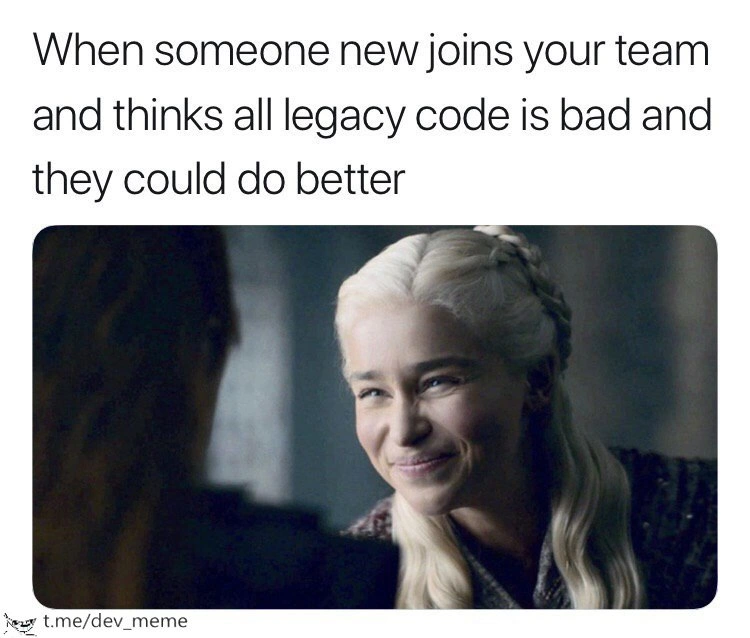
There’s also a human dynamic at play here. When a new joiner says “all this legacy code is bad,” the existing team members can feel a bit defensive (understandably). It’s like someone walking into a workshop and calling all the old tools junk. The people who have been maintaining that system might think, “Hold on, if it were so easy to fix, we would have done it already.” The veteran developer in the meme image giving the side-eye is basically reflecting that sentiment. They’re skeptical — not because they don’t want better code, but because they know the problem is trickier than it looks. They might have tried parts of this rewrite before and learned it wasn’t simple.
As a new developer gains experience (and perhaps tries to fix a few “simple” things that turn out to be not-so-simple), they start to understand why the team is cautious. A complete rewrite means reproducing everything the old system does, without breaking anything, and usually without a lengthy downtime. It’s a huge risk. Instead, what most teams do (and what the new hire will likely learn) is refactoring – improving the code gradually, piece by piece. For instance, adding tests around a critical module and then cleaning it up safely, or replacing one old component with a newer one while the rest of the system stays running. These incremental improvements are safer in a business environment. The onboarding period for the new dev might include learning how to make such changes without jeopardizing the whole product.
This is a classic bit of developer humor because it happens so often. Early in your career, you look at an old system and dream of rebuilding it flawlessly. It’s that youthful confidence of a newcomer who hasn’t been burned by production failures yet. Then reality hits — maybe the first time they deploy a “small improvement” and something unexpectedly breaks, they realize there were hidden dependencies. It’s a learning moment. Over time, that same new hire will start to appreciate why the code is the way it is, even if it’s not ideal. They might even add a few not-so-pretty fixes of their own (thus continuing the cycle of technical debt in a small way). And eventually, when the team dynamics shift and an even newer person joins and says “Who wrote this garbage?”, guess who will be the one smirking? The once-new hire, now a seasoned member, will be the one with the knowing smile. The meme is funny because it’s true — today’s greenfield idealist is tomorrow’s grizzled maintainer.
Level 3: Rewrite vs Reality
We see it all the time: a new developer joins the team, skims the codebase for a week, and announces that the entire architecture is awful. To them, it's obvious our legacy system is a mess and they could do so much better with a fresh start. Meanwhile, the veteran devs exchange knowing looks across their monitors. The meme’s image (a platinum-haired figure smirking in a dim room) captures this perfectly: a slight smile of disbelief, the side-eye of skepticism. It's the look a battle-hardened developer gives when a newcomer brashly claims they'll fix years of code with a quick rewrite.
The new hire sees thousands of lines of tangled logic and wonders, “Who wrote this junk?” They assume the previous developers were clueless. In reality, that legacy code has been battle-tested in production for a decade. Those weird-looking functions and oddball variable names hide countless bug fixes and hidden business rules earned through hard knocks. Sure, the code isn’t pretty. It’s riddled with technical debt – quick-and-dirty patches piled up over years of tight deadlines. But ripping it all out in one go is like trying to replace an airplane engine mid-flight while your customers are still on board.
The newcomer’s greenfield fantasy – "let's rebuild everything from scratch with the latest tech" – sounds enticing. In theory, a clean slate means no ugly hacks, no outdated patterns, just pure modern code quality. In practice? It's a recipe for disaster more often than not. Why? Because that "trash" code holds a decade’s worth of bug fixes, user quirks, and domain knowledge. Throw it out, and you throw out all that hard-earned stability. Rewriting an entire legacy system isn’t a weekend refactor; it’s a multi-year slog to re-implement features users already rely on (and you better not break anything mission-critical in the meantime). Experienced devs recall horror stories of big rewrites that went off the rails. Remember Netscape? They tossed their browser code to start fresh, and Internet Explorer promptly ate their lunch. One veteran engineer famously wrote that rewriting code from scratch is the single worst strategic mistake a software team can make – wisdom lost on fresh hires brimming with confidence.
So when the new dev confidently suggests a full rebuild, the team lead often chuckles and says something diplomatic like, “Let's hold off and start with smaller improvements.” Translation: we’ve seen this movie before, and we know how it ends. The humor here comes from how predictable this pattern is. The new joiner’s confidence is sky-high, but the veteran’s patience is paper-thin. To illustrate, let's compare their mindsets:
| New Hire’s Bold Idea | Veteran Dev’s Inner Monologue | Reality Check |
|---|---|---|
| “This code is trash. I’ll rewrite it from scratch.” | (rolls eyes) “That’s what the last 3 juniors said…” | That “trash” code handles countless edge cases the rewrite will miss. |
| “Let’s use the newest Framework-X, it will solve everything!” | Recalls five failed framework migrations. “Another shiny tool, huh?” | New tech = fresh bugs + months reimplementing features the old system already has. |
| “We’ll rebuild it in 2 months, easy.” | Suppresses laughter. “Oh, sweet summer child…” | Six months later: project overrun, missing features, and management is panicking. |
| “Whoever wrote this had no clue what they were doing.” | Sips coffee. “Kid, I wrote that at 3 AM during a crisis.” | Code isn’t ugly by accident – it survived insane deadlines and real-world chaos. |
As this table shows, newbies often underestimate the complexity while seasoned developers have learned to be wary whenever someone utters “full rewrite.” In corporate culture, if a system is running and making money, a risky rebuild is hard to justify. Managers prefer stability over a sweeping redo; from their perspective, a rewrite is an investment with high uncertainty – it delays new features, might introduce fresh bugs, and doesn’t immediately add value for customers. There’s a reason we joke that legacy code is code that works. It might be held together with duct tape odd hacks and ancient frameworks, but hey, the business is still running.
And truth be told, every senior dev was once that overconfident newbie. It's almost a rite of passage in DeveloperCulture – you start out thinking all old code is bad and you’re the hero who will fix it, and eventually you earn your scars (and humility) by maintaining a real system. Fast forward a year: that same new hire will likely be defending the system they now understand, giving side-eye to the next greenhorn who calls their code garbage. The cycle continues. The veteran’s smirk in the meme practically whispers, “You know nothing, new dev,” – a playful twist on a famous fantasy show line – because every experienced engineer can feel in their bones just how naive that confidence really is.
Description
The meme is a single-panel image with the caption at the top in black sans-serif text, reading: "When someone new joins your team and thinks all legacy code is bad and they could do better". Beneath the text is a dimly lit scene from a popular fantasy TV show: two characters face each other across a dark room; the foreground figure is shown from behind while the background figure (long platinum-blonde hair, braided) is in profile and their face has been intentionally blurred for anonymity. The unimpressed side-eye conveys veteran developers’ skepticism toward overconfident newcomers. Bottom-left corner shows the watermark "t.me/dev_meme". Technically, the meme highlights the tension between maintaining legacy systems - often laden with hidden business rules and accumulated technical debt - and the common belief of new team members that a full rewrite would be simple. It humorously reflects real-world code quality trade-offs, knowledge transfer challenges, and the cultural clash between green-field optimism and battle-hardened maintenance work
Comments
21Comment deleted
Sure, go ahead and rewrite the “trash” COBOL module - just ping me when your shiny microservice accurately handles the 1983 daylight-saving payroll edge case before the nightly batch closes $2 billion in invoices
Give them six months and they'll be defending that same code in architecture reviews, explaining why touching it would destabilize three different payment gateways and a compliance system nobody fully understands anymore
Ah yes, the classic Dunning-Kruger deployment pattern: junior dev arrives, sees 10-year-old codebase handling $10M/day in transactions with 99.99% uptime, and immediately suggests a complete rewrite in the hot new framework they learned last weekend. Six months later, after discovering why that 'ugly' error handling exists (production incident from 2019), why the database has those 'weird' indexes (query that used to take 45 seconds), and why there's a comment saying 'DO NOT REMOVE THIS SLEEP' (race condition that only manifests under load), they finally understand: legacy code isn't bad code that survived - it's battle-tested code that survived *because* it handled every edge case that tried to kill it. The smirk isn't smugness; it's the senior engineers waiting for the inevitable 'oh... OH' moment when the new hire realizes that 'spaghetti code' is actually a carefully woven safety net of hard-won lessons
Every newcomer wants a rewrite - until they meet the cronjobs, compliance audits, and 47 partner APIs baked into that “bad legacy,” at which point it magically rebrands into “the system of record.”
That smile? It's the quiet joy of knowing their 'clean rewrite' will rediscover why we nested those six if-statements in 1998
The bravest architecture proposal is “let’s rewrite it,” right up until they discover parseInvoice() also negotiates three partner SLAs, a COBOL mainframe, and the auditor’s blood pressure
why not rewrite it from scratch ? Comment deleted
First, the legacy code problem itself usually means it's a fucking huge project and understanding all its algorithms to plan the better ways of reimplementing them is not an easy task. Especially if most of the functionality is redundant/unused, but you still need to sort out what you need from what you don't without breaking anything. Second, this job will take a lot of time and effort — time and effort that instead could be devoted to implementing new features or fixing bugs. And it's very likely that customer will choose the latter rather than the former. Comment deleted
chill bruh , it was a joke 😂 Comment deleted
sometimes it is true, depending on what do we mean by "legacy". code which is 10+ years old is "bad" (according to modern standards) more often than some 2-3 years old "legacy" Comment deleted
There's a great analogy on legacy code Comment deleted
(for foreigners) A FASTFOOD RESTAURANT OPENED THAT SELLS FRENCH FRIES ONLY @ YEAR AFTER DECIDED TO ADD BURGERS TO MENU @ BURGERS ARE FRIED IN A FRY MACHINE BECAUSE IT'S EASIER LIKE THAT FOR COOKZ @ NEW JUNIOR COOK JOINS THE TEAM @ LOSES HIS FUCKING MIND ABOUT BURGERS BEING FRIED IN A FRY MACHINE @ BEING INSTRUCTED TO NOT GET CURIOUS AND TOUCH WHAT WORKS JUST FINE @ IN A YEAR THE JUNIOR COOK JUMPS TO A NEW KEBAB CAFE AS A KEBAB COOK @ FRIES KEBABS IN A FRY MACHINE Comment deleted
Love it Comment deleted
Nice one. Comment deleted
Mb they see Comment deleted
Coz legacy is always gross Comment deleted
Even mine Comment deleted
Lmao Comment deleted
yeah, you better remake it now Comment deleted
too late Comment deleted
it's too late Comment deleted