Skip to content
DevMeme
3142 of 7435
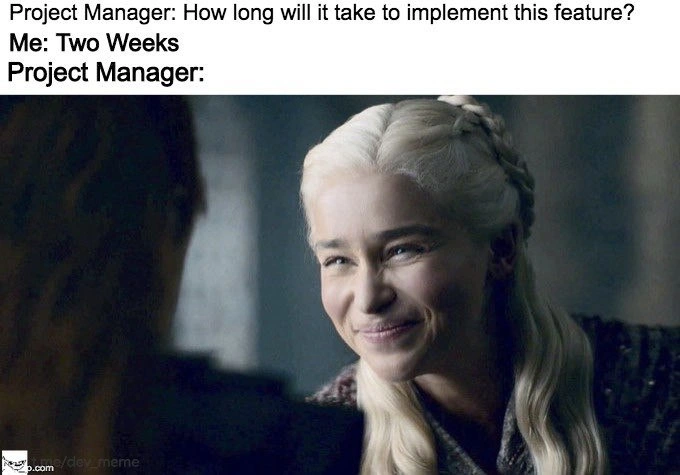
When your standard “two-week” estimate meets the PM’s icy stare
Agile Post #3461, on Jul 26, 2021 in TG

When your standard “two-week” estimate meets the PM’s icy stare

Why is this Agile meme funny?

Level 1: It Always Takes Longer

Imagine a kid telling their mom, “I’ll clean my entire room in 10 minutes, I promise!” The mom has heard this before. She just gives the child a knowing look, the kind that says, “Sure you will…” 😏. Of course, an hour later the room is still only half-tidy. This meme is the grown-up, office version of that story. The developer is like the kid eagerly saying they’ll finish a big task super fast (“two weeks!” sounds quick and neat), and the Project Manager is like the mom who knows from experience that these things always take longer than the excited promise. The funny part comes from that shared understanding: we laugh because we’ve all been the kid who thought a huge job was “no big deal,” and we’ve also been the parent (or friend) who just knows it’s not gonna happen that quickly. In the end, it’s humor about optimism meeting reality – someone says “piece of cake, done in no time!” and the other person simply raises an eyebrow, already expecting the “uh-oh, this will take longer” outcome. It’s a gentle reminder that big jobs are almost never as easy as we hope, and that knowing smirk from the Project Manager (or the mom) is what makes us grin.

Level 2: The Two-Week Sprint

Stepping down a notch, let’s explain the joke in simpler terms. This meme is about estimating time for software work and how those estimates often clash with reality. In a software team, a Project Manager (PM) is the person responsible for planning and deadlines — they ask developers how long things will take so they can schedule and coordinate. A developer (the “Me” in the meme’s text) is the person who actually writes code to build a feature (a feature is just a new function or improvement in the software, like adding a button or a new report).

Now, in the dialogue at the top of the meme, the PM asks: “How long will it take to implement this feature?” and the developer confidently answers: “Two weeks.” Why two weeks? Well, in many software companies that follow Agile methods (like Scrum), work is organized into short cycles called sprints. A common sprint length is two weeks. So saying “two weeks” might feel natural — it basically means “I can get it done in one sprint.” It’s also a bit of a running joke: if a programmer isn’t sure or wants to give a safe answer, they often say “two weeks” almost as a default. It’s a meme in itself within software circles (you’ll hear it referenced in DeveloperHumor threads a lot).

The funny (or not-so-funny) thing is that these time estimates are frequently too optimistic. Building software isn’t just writing a few lines of code. You have to write code, then test it to make sure it works, fix the bugs (errors) you find, perhaps integrate it with other parts of the system, and finally deploy it (release it to users). Each of those steps can reveal unexpected challenges. So a task you hoped to finish in 14 days can easily stretch to 20 or 30 days once real life intervenes. New developers often discover that what they thought was a day’s work can take a week after all the polishing and debugging.

Meanwhile, the Project Manager has a job: keeping the project on schedule. They often have to report to other stakeholders or customers about when something will be ready. So they really care about that “two weeks” answer. If the dev says two weeks, the PM might plan around that, expecting the feature to be ready by then. If it isn’t, the PM has a problem — maybe other plans get delayed or a client gets upset. That’s why the PM in the meme is giving a hard, skeptical stare. The look basically says, “I’ve heard ‘two weeks’ before, and I’m not convinced.” It’s a bit like when someone has promised you something quickly in the past and didn’t deliver, so now you don’t trust overly simple promises.

Let’s talk about the image itself: The bottom part is a reaction image from a popular TV series Game of Thrones. The woman with silver-blonde hair (Daenerys Targaryen in the show) is used here to represent the Project Manager. In the show, Daenerys is a strong, no-nonsense queen (with dragons!🐉) who expects things to go her way. The meme uses her facial expression — kind of a cold, knowing stare — to mimic how a PM might look at a developer who just gave an iffy estimate. It dramatizes the situation: the PM is not yelling or arguing; she’s just silently skeptical, as if thinking, “Really? Only two weeks? Are you sure about that?”

For a junior developer or someone new to project work, this meme is also a gentle warning. Time estimation is hard, even for experienced folks. There’s even a lot of humor and horror stories in the industry about it. For example, a developer might genuinely believe a task is small (“maybe a few days of work”), but then integration tests fail or the code needs refactoring, and suddenly that task slips into the next week or beyond. This is why teams often use story points or t-shirt sizes (abstract measures of effort) instead of exact days for estimates — it’s an admission that we’re not great at predicting exact time.

The top text of the meme sets up the familiar scenario (PM asking for a timeline, dev replying “two weeks”), and the punchline is the image of the PM’s reaction. It resonates with anyone who’s been in that meeting room or Zoom call where a developer casually says “should be done in a couple of weeks” and the project manager immediately raises an eyebrow. It’s a form of ProjectManagementHumor. Both sides feel a bit of deadline pressure: the dev might feel pressure to give a short estimate (to seem efficient or please the boss), and the PM feels pressure to question that estimate (to avoid unrealistic deadlines and surprises later). The mismatch between the dev’s optimism and the PM’s cautious realism is exactly what makes this scene funny and so relatable.

In simpler terms, the meme highlights a common communication gap: developers might underestimate (not on purpose, but out of optimism or inexperience), and managers have learned to expect the worst. The phrase “two weeks” has become an inside joke among programmers — often, when someone asks “How long will that take?”, you’ll hear a joking answer, “Eh, two weeks!” followed by laughter, because everyone knows that’s the go-to guess and that it usually means “actually, who knows?” 😅.

So, this meme is basically teaching us with humor: be careful with quick estimates. If you’re new, don’t be surprised if your “easy two-week task” turns into a month of work. And if you’re a PM, you’ve probably learned not to take “two weeks” at face value without digging deeper. The skeptical look from Daenerys (the PM) is the punchline that brings it all together — it’s the face of someone who has been burned by trusting “two weeks” before, and isn’t falling for it again.


Level 3: Breaker of Estimates

At the highest level, this meme skewers the perennial two-week estimate in Agile software development. It’s a scenario every seasoned engineer and Project Manager (PM) knows too well:

Project Manager: "How long will it take to implement this feature?"
Developer: "Two weeks."
Project Manager: [skeptical Daenerys glare]

Why is this funny (and painfully true)? Because in the real world of software, time estimation is a notorious black art. Developers often optimistically claim “two weeks” for almost any new feature – not necessarily to deceive, but because two weeks is conveniently the length of a typical Scrum sprint and feels like a safe, minimal timeframe. It’s like an O(1) estimation algorithm that returns a constant answer every time, regardless of input complexity. To a PM, though, that answer sets off alarm bells. They’ve seen the “two weeks” promise go up in flames before, so when a dev casually shoots from the hip with that magic number, the PM’s internal reaction is, “Here we go again…”

In agile theory, each sprint (often two weeks) should produce a potentially shippable increment of software. The developer saying "two weeks" is essentially claiming, “I can design, code, test, and deploy this new feature in one sprint.” But experienced PMs know that’s rarely how reality plays out. Maybe the feature has hidden scope creep (“Oh, we forgot it needs a settings panel and email integration”), or perhaps integration tests and code reviews will uncover unexpected bugs. Hofstadter’s Law wryly states: “It always takes longer than you expect, even when you take into account Hofstadter’s Law.” In practice, that “two-week” task often balloons to 3, 4, or more weeks once all the real-world complications kick in. The humor here comes from that universal discrepancy between developer optimism and project manager realism.

Let’s break down the unspoken dialogue happening in this meme. The dev’s mindset: If I give a long estimate, I’ll get pushback or endless questions, so let’s just say two weeks — it sounds reasonable. The PM’s mindset: I’ve managed projects long enough to smell wishful thinking. Two weeks? This dev must be underestimating again. It’s a classic case of misaligned expectations and a bit of a poker game. The developer hopes to avoid conflict with a quick answer, while the PM is already calculating the risk of an unrealistic deadline.

Consider real scenarios: A PM might be juggling a roadmap or client commitments, so they treat “two weeks” as a promise. They’ll mark the calendar, inform stakeholders, and expect results by that date. Meanwhile, the developer might have meant “two weeks of actual coding if everything goes right” — which rarely accounts for testing, code reviews, deployments, or Murphy’s Law kicking in. By day 10, when those inevitable blockers appear (e.g. legacy code fights back, or another emergency task preempts this one), everyone remembers that confident “two weeks”. Cue the PM’s icy stare turning into a fire-breathing inquiry: “You said two weeks!” 😅

The meme’s image choice brilliantly amplifies this tension. The Game of Thrones queen (Daenerys Targaryen, the platinum-haired “Mother of Dragons”) represents the PM. She’s giving a silent, side-eyed glare that says “I don’t believe you” as clearly as if she’d spoken. In the show, Daenerys expects loyalty and results — much like a PM expects accurate estimates. Her skeptical smirk in the meme screams “Your optimism amuses me… but you better not be wrong.” It’s an AgileHumor twist on a “boss battle” stare-down. The developer (off-screen in the meme) is like a knight nervously promising the queen a victory in short order, and the queen is deciding whether to trust this bravado or send in her dragons. 🐉 In an engineering context, those “dragons” could be the extra meetings, status reports, or overtime that descend when a deadline is in jeopardy.

From a senior engineer’s perspective, this meme is too real. We’ve all witnessed the stand-offs in sprint planning or backlog grooming: a feature request comes in hot, the dev (maybe under pressure) says the fateful words “two weeks”, and the room goes quiet as the PM raises an eyebrow. The humor digs at project management culture and the disconnect between ideal agile planning versus actual outcome. It also pokes fun at the cliché — “two weeks” has become an almost mythical estimate in software lore, much like “it works on my machine” for bug excuses. There’s even a famous running joke that no matter what you ask a programmer, the answer is always “two weeks.”

Let’s illustrate the disconnect in a quick table:

Developer’s Promise PM Hears (Expectation) Reality (Two Weeks Later)
“It’ll take two weeks.” “Great, in 14 days it’s done.” “Umm… we’re almost done, need a bit more time.”

In other words, the dev’s time estimation was a feel-good guess, whereas the PM treated it as a solid commitment. The deadline pressure mounts as day 14 approaches, and if the feature isn’t ready, that initial optimism turns into awkward explanations. The meme gets a laugh because everyone in the industry recognizes this pattern. Seasoned teams actually try to avoid the “two-week trap” by using story points, buffering their estimates, or openly acknowledging uncertainty. But the joke persists because, despite all training and experience, even senior devs occasionally blurt out “two weeks!” with a straight face — and immediately get that look from the PM.

In summary, at this advanced level we’re appreciating the meme’s commentary on Agile estimation pitfalls and the age-old dance between hopeful developers and skeptical project managers. It’s a shared wink among tech veterans: we laugh because we’ve been on both sides of that exchange, and we know exactly what that icy stare means.

// A not-so-scientific estimation function:
function getEstimate(feature) {
  // Always returns "Two Weeks" regardless of feature complexity
  return "Two Weeks";
}

The code above jokes that our estimation approach is constant-time – always outputting the same answer. It’s a tongue-in-cheek way to say that sometimes, no matter the task, the reflex is to reply with “two weeks.” This meme makes light of that reflex and the healthy skepticism it earns. In the end, the humor comes from collective experience: every developer learns that “two weeks” is easy to say on day one and much harder to deliver by day 14, and every PM has the battle scars to prove it.


Description

Top white banner with black text reads: "Project Manager: How long will it take to implement this feature? Me: Two Weeks Project Manager:". Below the text is a still from a fantasy TV series: in the foreground (left) a blurred, brown-haired figure listens; in sharp focus on the right sits a silver-haired queen (Daenerys-like) turning her head, giving a silent, skeptical glare. Lighting is dim, medieval-hall tones of grey and blue, reinforcing the tense atmosphere. The meme captures the perennial software-engineering joke that every feature magically fits into a two-week sprint, while project managers know this optimism means schedule risk. It satirizes agile estimation, deadline pressure, and PM-developer negotiation familiar to senior engineers
Comments

20
Anonymous ★ Top Pick PM’s glare translates to: “Last time your ‘two weeks’ became three sprints, a Terraform state migration, and a post-mortem that spawned its own backlog.”
  1. Anonymous ★ Top Pick

    PM’s glare translates to: “Last time your ‘two weeks’ became three sprints, a Terraform state migration, and a post-mortem that spawned its own backlog.”

  2. Anonymous

    After 20 years in the industry, I've learned that 'two weeks' is just developer for 'I haven't looked at the codebase yet, but I'm optimistic about the absence of legacy dragons, dependency hell, and the inevitable scope creep that happens when stakeholders discover what they actually wanted halfway through sprint 3.'

  3. Anonymous

    Ah yes, the classic two-week estimate - the software engineering equivalent of 'it's just a small change.' Every senior engineer knows this triggers the PM's internal multiplier algorithm: take the estimate, apply Hofstadter's Law recursively, add a sprint for 'unforeseen integration challenges,' factor in the inevitable scope expansion when stakeholders see the demo, and account for that one legacy service nobody's touched since 2015 that will absolutely need refactoring. The PM's smile isn't skepticism - it's the battle-hardened wisdom of someone who's seen 'two weeks' become 'Q3 roadmap item' enough times to know that behind every confident estimate lies a Pandora's box of technical debt, undocumented dependencies, and that one critical API that's rate-limited in ways the documentation conveniently omits

  4. Anonymous

    Two weeks on the happy path; the PM’s critical path adds security review, cross‑team APIs, and the release freeze, transpiling it straight into next quarter

  5. Anonymous

    I say "two weeks"; PM translates: happy-path dev time * pi for dependencies, + SOC2 and change control, / the shared QA env - ETA: next quarter

  6. Anonymous

    Software estimates obey Heisenberg: pin down the feature, watch 'two weeks' expand into a black hole of refactoring

  7. @ZgGPuo8dZef58K6hxxGVj3Z2 4y

    "You get 2 hours"

  8. @BuHoGPaD 4y

    Oh okay, so if we assign 2 more programmers and you guys try really hard - we can release it tomorrow, right? RIGHT?

    1. @azizhakberdiev 4y

      Task: Two cars started moving together from A to B, with equal speed 60 mph. How much time does it take to reach B which is 120 miles away from A for both cars PM: 1 hour

      1. @BuHoGPaD 4y

        Correct

        1. @A3WAE 4y

          They both start moving from A

          1. @BuHoGPaD 4y

            *gasp* NO WAY!

    2. @neopulsar 4y

      This estimate was already with two more programmers

  9. @OmarProgrammers 4y

    هممم

    1. @beton_kruglosu_totchno 4y

      english pls

      1. @OmarProgrammers 4y

        Hmmmm

    2. @Serj7755 4y

      No, you cannot blow up that

      1. @OmarProgrammers 4y

        Why? 😕

        1. Deleted Account 4y

          you speak arabic so you must be a terrorist. lame joke edit: there might be a pun

          1. @OmarProgrammers 4y

            very

Use J and K for navigation