When 732,106 compiler warnings becomes the ultimate developer dirty talk
Why is this CodeQuality meme funny?
Level 1: Dirty Code, Simple Laughs
Imagine your friend proudly says, “I baked cookies in a kitchen with 732,106 dirty dishes lying around, and I still served them to guests!” It sounds gross and risky, right? You’d normally expect people to be upset or disgusted, not impressed. But this meme pretends that saying something so bad is actually exciting. It’s funny because it mixes up a love scene with a very unlovable habit (messy, careless coding).
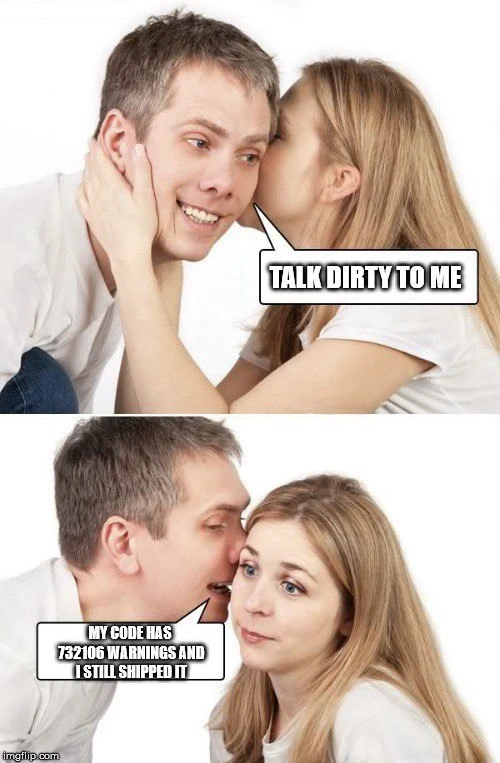
In the picture, a woman says, “Talk dirty to me,” which usually means she wants to hear something naughty and exciting. The man then whispers something totally unexpected: “My code has 732,106 warnings and I still shipped it.” In everyday terms, that’s like saying “I broke all the rules and got away with it.” It’s a silly surprise! Normally, having a lot of warnings or problems in your work is bad – like having a huge mess that you didn’t clean up. But he brags about it like it’s the coolest thing. The funny part is the absurd mismatch: it’s taking a romantic moment and twisting it with nerdy programmer talk about doing a really sloppy job. Even if you’re not a programmer, you can sense that “732,106 warnings” is an exaggerated, crazy number of problems. Hearing someone be proud of that is like hearing a student proudly say, “I got 732,106 red marks on my homework and I still turned it in!” You’d laugh because it’s obviously a joke – nobody would really be happy about so many mistakes.
So, at the simplest level, the meme makes us laugh by being ridiculous. It’s funny to imagine a person being turned on by something that is actually a terrible idea. It’s the surprise and the wrongness that make it humorous. Even if you don’t know about coding, you can relate: it’s like someone bragging about never cleaning their room or never fixing anything, and another person reacting like “Ooh, say that again!” It’s just so silly that you can’t help but chuckle.
Level 2: Technical Debt Tease
This meme shows a couple whispering to each other in a romantic way, but instead of actual romance, they’re talking about programming. The top panel’s caption, “TALK DIRTY TO ME,” is the woman asking for something provocative. In the bottom panel, the man delivers the “dirty” line: “My code has 732,106 warnings and I still shipped it.” For a developer, that line hits like a scandalous confession. Here's why it's a big deal, broken down in simpler terms:
Compiler Warning: When programmers write code, they use a compiler (for languages like C, C++ or Java) or a linter/interpreter (for languages like Python, JavaScript) to turn their code into a running program. A warning is a message from these tools saying “Hmm, this doesn’t look quite right. It might cause a problem later, but I’ll let it slide for now.” For example, if the code does something odd but not outright illegal – like using a variable that was never used, or comparing different data types – the compiler warns you. It’s basically the computer going, “Are you sure about that?”
Warnings vs Errors: An error stops the show – if your code has an error, it won’t even build or run until you fix it. A warning, on the other hand, won’t stop the program from compiling. It’s a heads-up. Good developers treat warnings seriously, often fixing them or at least understanding them. There’s even a common best practice: “treat warnings as errors,” meaning configure your build to refuse to run if there are warnings. That’s how much warnings matter for code quality. So bragging about ignoring them is like bragging you drove with your eyes closed and still made it home. 😅
732,106 Warnings?!: That number is huge to the point of being absurd. Even large projects usually don’t have that many. This implies a few things: the project could be enormous (millions of lines of code), the code might be really old or messy (so it triggers a lot of warnings), or the team completely gave up on cleanup. Sometimes warnings can multiply – e.g., a bad pattern repeated everywhere can produce tens of thousands of warnings. But 732k is basically saying, “our codebase is an utter mess.” It’s a hyperbole (exaggeration) to be funny, but not entirely far-fetched in the worst cases. There are horror stories of code that, when run through a strict linter, produces pages upon pages of complaints.
Shipped to Production: “Shipped it” means they delivered the code to users — it went live in production, the real-world environment where customers or the public use the software. Normally, you’d clean up problems before this stage. Shipping code with one or two warnings is already a bit lazy; shipping code with hundreds of thousands of warnings sounds downright reckless. It suggests the team skipped a ton of cleanup. In a professional CI/CD pipeline (Continuous Integration/Continuous Deployment system), there are often checks that might fail a build if there are too many warnings or any critical issues. Here, apparently, those checks were either turned off or non-existent. It’s like a safety inspector ignoring half a million red flags and stamping “Approved” on a project.
Technical Debt: This term means “problems we postpone fixing now, which will cause more work later.” Every warning that isn’t addressed can turn into technical debt. It’s like not fixing a small leak in your roof — if you ignore 1 leak, maybe it's okay for now, but ignoring 732,106 leaks? The house is going to collapse! The meme’s guy is essentially saying, “I have a mountain of unfinished fixes and potential bugs, and I went live with all of them intact.” It’s both shocking and humorous. Shocking because any trained developer knows those warnings could hide serious bugs; humorous because it’s portrayed as a seductive achievement. It flips a negative (sloppy code) into a boast as if it’s something attractive.
Code Quality and Spaghetti Code: With so many warnings, the code likely has a lot of issues and code smells. A code smell is a hint that something might be wrong in the code’s structure (like a funky odor hints something’s rotten). One famous kind of bad code is spaghetti code – code that’s tangled and messy, hard to follow (like a bowl of spaghetti). If you have that many warnings, there’s probably some spaghetti in that code base. High-quality code usually has 0 warnings, or very few that are unavoidable. Teams often strive to keep warning counts low because each warning is a clue to a possible bug or at least confusing code. When someone brags about a huge warning count, it’s like jokingly bragging about never cleaning your room – it’s funny in a facepalm way because it’s not a good thing.
Meme Format: This stock photo of a couple whispering is a common meme format. Typically, one person says “Talk dirty to me” (meaning “say something naughty that will excite me”), and the other person responds with something unexpected that is “dirty” in a nerdy or obsessive way. Here the twist is that “dirty” is interpreted as “dirty code” talk. So instead of a sexy whisper, it’s a programmer’s cringe-worthy secret. The woman’s face in the second panel looks a bit shocked or concerned, which adds to the humor—like even she can’t believe how outrageous that is. The text is in bold, white-on-black capital letters, a style used to make sure the captions stand out in memes (often using the Impact font for that classic meme look).
So basically, at this level, the meme jokes that a developer’s idea of being risqué or rebellious is bragging about horrible coding practices. It highlights a common developer humor theme: taking something that’s bad practice (like ignoring warnings or writing bad code) and presenting it ironically as a point of pride or kink. Developers find it funny because it’s a hyperbolic way to laugh at something that, in real life, causes a lot of headache. It’s both cathartic (we laugh so we don’t cry about those big warning logs) and a nod-nudge among coders — we’ve seen this kind of thing, and we know it’s ludicrous.
Level 3: The Great Wall of Warnings
In the world of software development, seeing 732,106 compiler warnings scroll by in a build log is the stuff of nightmares. Yet this meme turns that nightmare into a bragging right. The humor hits experienced devs right in the gut: it's basically saying "Our CodeQuality is so bad, it's sexy". Why is that funny? Because every senior engineer knows that treating warnings like background noise is a recipe for disaster — it's pure TechnicalDebt with a sly grin. Think about what 732,106 warnings really means: a codebase probably so large and neglected that the warning count looks like a phone number. It's a BuildSystem horror story; any sane Continuous Integration (CI/CD) pipeline would have blown a fuse long before hitting that number. But here, the very fact that the code still shipped to Production despite the blaring sirens is the scandalous punchline.
Let's unpack the dirty details. Compiler warnings are messages your compiler or linter spits out to say, "Hmm, this looks fishy, but I'll allow it." They’re like the check-engine light of coding: not an immediate failure (that would be a compiler error), but definitely not something to ignore. Accumulating over seven hundred thousand of them is like ignoring the check-engine light so much that you’ve got a dashboard Christmas tree. Seasoned devs see that and immediately think: Where were the quality gates? Many teams use -Werror (treat warnings as errors) specifically to prevent this situation. Here, clearly, someone flipped those safety switches off. It's the programming equivalent of removing the smoke detectors because you’re tired of the noise. 🚨
This meme resonates because it’s a shared secret of sloppy software shops. We've all heard tales of projects where builds spew warnings by the thousands — deprecated functions, unchecked types, unused variables galore — yet management says “Ship it anyway, the demo is tomorrow!” Each ignored warning is a small code smell hinting at a deeper problem. One or two benign warnings ("variable unused") might be harmless, but at 732,106 you know critical stuff is being missed. Imagine pages upon pages of things like "possible null pointer dereference", "deprecated API", "signed/unsigned mismatch". At that volume, any truly serious warning (say, one that indicates a potential segfault or security flaw) is a needle lost in a haystack of negligence. This is how spaghetti code happens – ignoring issues until the structure becomes a tangled mess.
From a senior perspective, the joke is double-edged. On one side, it's hilarious in a dark way: the idea that someone finds a massive warning count enticing is pure developer humor absurdity. It's like a dare — "I code without seatbelts, baby." On the other side, it triggers PTSD for anyone who's had to maintain such a minefield. The meme hints at a reckless bravado: "Yeah, the codebase is practically screaming in pain, but it's running (for now), and that’s hot." It's funny because it's so wrong — a flirtation with chaos that everyone knows will end in tears when the on-call phone starts ringing at 3 AM. In short, the meme magic comes from mixing romantic dirty talk with the ultimate nerdy transgression: shipping garbage code and living to tell the tale. The experienced dev laughs, then immediately feels a shiver — because they've seen how that story ends.
Description
Two - panel stock-photo meme of a young couple whispering, faces blurred. In the top image the woman leans toward the man’s ear; a bold white-on-black caption reads “TALK DIRTY TO ME.” In the bottom image the positions are reversed and the man whispers back while a caption over him states “MY CODE HAS 732106 WARNINGS AND I STILL SHIPPED IT.” The humor comes from equating romantic ‘dirty talk’ with a shocking confession of terrible build hygiene - ignoring over seven-hundred-thousand compiler or linter warnings and pushing the code to production anyway. It riffs on code quality, technical debt, and the reckless satisfaction some teams take in shipping regardless of warning counts, a scenario senior engineers recognize as a future maintenance nightmare
Comments
10Comment deleted
Disabling -Werror, piping 732,106 compiler warnings to /dev/null, and tagging it v1.0.0 - because risk-based deployment is our love language
The only thing more impressive than shipping code with 732,106 warnings is convincing yourself they're all just 'informational' - after all, if the compiler really cared, it would have made them errors, right?
732,106 warnings? That's not technical debt - that's a technical mortgage with a subprime interest rate. At that scale, you're not ignoring warnings anymore; you've achieved warning-driven development where the compiler output is just ambient noise. The real flex isn't shipping despite the warnings - it's that your CI/CD pipeline didn't timeout parsing the log file, and your monitoring system didn't flag the deployment as a DDoS attack on your logging infrastructure
Nothing says seasoned engineering like turning off -Werror, scattering // eslint-disable-next-line, raising the Sonar gate past 732106 warnings, and calling the pipeline green
Enterprise quality gate: lint job allow_failure: true - 732,106 WARNs shipped; the only blocker is the release date
732 warnings? That's compiler foreplay - shipping's the climax where tech debt gets intimate
Half of the warnings usually come from external libraries Comment deleted
Found a node dev Comment deleted
focking disgusting Comment deleted
When u work with Visual Studio Code and using venv Comment deleted