Skip to content
DevMeme
3141 of 7435
Asking for variable i but mom serves a null pointer dereference
Bugs Post #3460, on Jul 26, 2021 in TG

Asking for variable i but mom serves a null pointer dereference

Why is this Bugs meme funny?

Level 1: Not What I Wanted

Imagine you’re a kid who really wants a yummy chocolate chip cookie. You ask your mom, “Can I have a cookie from the store?” She replies, “No, we have cookies at home.” But when you get home, the “cookie” waiting for you is actually a piece of burnt toast. Not at all what you had in mind, right? It’s disappointing and a little absurd – you expected something sweet and safe, but got something completely wrong and unpleasant.

That’s the feeling this meme is poking fun at. The developer (like the kid) asked for something simple and nice – a basic little variable named i. But what they ended up with was like the coding version of that burnt toast – a big error called a “null pointer dereference” that makes the program crash. The huge gap between what was wanted and what was given is so ridiculous that it makes you laugh. It’s funny in the same way as getting toast instead of a cookie: such a big letdown that you can’t help but chuckle at it.

Level 2: Pointer Crash Course

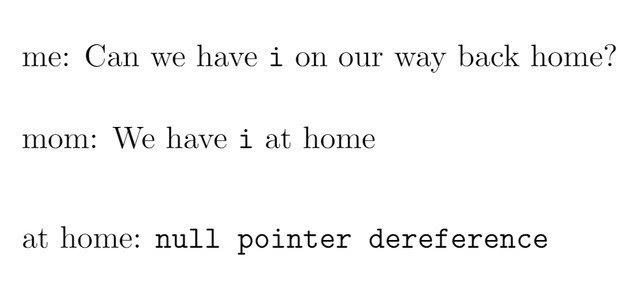
Let’s break down the joke step by step. The meme text reads:

me: Can we have i on our way back home?
mom: We have i at home
at home: null pointer dereference

In the language of internet memes, “we have X at home” means the thing you have at home is a bad or cheap version of what you wanted. Here, the thing the kid wants is i – which in programming usually refers to a simple integer variable (commonly used as a loop index). The “i at home” turns out to be null pointer dereference – which is definitely not what you hoped for! It’s like asking for a treat and getting a trick instead.

Now, what is a null pointer dereference in real terms?

  • Variable i: In programming, especially in C, i is often just an integer number. For example, int i = 5; means we have a variable i storing the number 5. It’s as basic and harmless as a variable gets.
  • Pointer: A pointer is a variable that holds a memory address instead of a direct value. Think of it like a slip of paper with a house address on it – it tells you where to find something in memory. For instance, int *p; in C declares a pointer p that can point to an int. If we do int j = 10; p = &j;, then p now holds the address of j (it “points” to j).
  • Null pointer: This is a pointer that isn’t pointing to any valid place. In C, we use the term NULL for this. It’s like an address pointing to nowhere (often represented by the address 0). It basically means “this pointer isn’t set to anything.”
  • Dereference: Dereferencing a pointer means accessing the value at the address the pointer refers to. In code, if p is a pointer, then *p is the value at the address p points to. So if p points to j, *p would give us j’s value.
  • Null pointer dereference: This is what you get if you try to use *p when p is NULL. In our analogy, it’s like taking that address slip that says “nowhere” and trying to go there to find something. The computer attempts to access memory at address 0 (which it should never do), and the result is a serious error. In technical terms, the program will crash with a segmentation fault because you reached into memory that’s off-limits.

Here’s a tiny C code example to illustrate:

int *ptr = NULL;           // ptr is a pointer that currently points to nothing
int value = *ptr;          // ERROR: trying to use ptr, but ptr is NULL
// The line above will cause a runtime crash (segmentation fault) 
// because we dereferenced a null pointer.

If you run a program like that, it will likely stop immediately with a message like Segmentation fault (core dumped). That message is basically the operating system saying “you tried to use an invalid memory address, so I shut the program down.” This kind of error is a classic software bug, and if it happens you’ll be stuck doing some serious debugging to figure out what went wrong. In a low-level language like C or C++, it’s one of those mistakes you learn to avoid the hard way.

So in the meme, when Mom says “We have i at home” and the “at home” version is a null pointer error, it’s highlighting exactly this kind of bug. The joke is that i is a super simple, innocent thing to ask for, but a null pointer dereference is a nasty surprise to get instead. It’s basically saying: even something as basic as a little variable can go very wrong if pointers get involved and you aren’t careful! For someone just learning to code, it’s a funny reminder that not everything you ask for in programming comes out the way you expect.

Level 3: Segfault at Home

This meme riffs on the classic “Mom, can we have X? – We have X at home” format, but gives it a geeky twist. The setup is familiar: a kid asks for something desirable, and the parent insists they already have it at home (which everyone knows means it’s going to be a lousy substitute). Here, the desirable thing is as humble as it gets – the variable i (that ubiquitous loop counter every programmer writes a million times) – and the lousy substitute waiting “at home” is a null pointer dereference.

For an experienced developer, this punchline lands with a mix of humor and mild horror. It’s taking the simplest possible request in coding (just give me a basic integer variable) and turning it into one of the nastiest surprises in a low-level codebase (a pointer error that crashes the program). The dialogue could almost be an allegory for a code review gone wrong:

  • Dev: “Can I just use a normal integer here for this loop?”
  • Lead: “No need, we have an i defined in the legacy utility header – use that.”
  • Reality: The i at home wasn’t an int at all but a misused pointer, and boom – segmentation fault.

It’s funny because it’s absurdly relatable. We’ve all seen situations where a quick fix or a bit of technical debt masquerades as a solution, only to bite us later. The meme’s final reveal – printed in bold for emphasis – null pointer dereference – basically shouts: the thing you relied on is not just subpar, it’s a complete show-stopper! Seasoned engineers laugh (or groan) because they have battle scars from exactly this kind of bug.

Chasing down a null pointer crash is the epitome of a debugging nightmare. The program doesn’t politely explain what went wrong – it just vanishes or prints Segmentation fault (core dumped). Then you’re combing through logs or firing up a debugger to pinpoint where it blew up. Often, it turns out to be something small that was overlooked. Maybe a variable i was never initialized properly, or a pointer was supposed to point to an array but got set to NULL instead. Those “oh no” moments – where a tiny oversight leads to a big failure – are practically a rite of passage in low-level programming.

The plain monospace text of the meme and its matter-of-fact delivery (“at home: null pointer dereference”) drive home how unglamorous and stark such bugs are. And any C/C++ programmer knows exactly what a null dereference implies: likely a dreaded segfault that can bring down your whole app. It’s the kind of inside joke among developers that draws a knowing smirk — something funny because it’s true.

In short, asking for i but getting a null pointer is a comical exaggeration of how a simple plan can go terribly wrong in code. It reminds experienced devs of all those times they thought everything was fine… until – surprise! – that one null pointer appeared and the whole thing came crashing down. It’s both a joke and a gentle reminder: even the smallest variable can hide a big problem if you’re not careful.

Level 4: The Billion-Dollar Mistake

At its core, the punchline null pointer dereference invokes one of low-level programming’s most notorious pitfalls – so infamous that its very concept has been dubbed the “billion-dollar mistake.” The term comes from Sir Tony Hoare, who introduced the notion of a null reference in 1965 and later regretted it due to the countless bugs and system crashes it caused over decades. In C family languages (like C and C++), a pointer is essentially a memory address. A null pointer is a special value (typically the address 0x0) representing “no valid location.” But dereferencing it (trying to access the memory at that address) crosses into forbidden memory territory.

Modern operating systems and hardware actively guard address 0. They mark the page at memory address 0 as off-limits specifically to catch mistakes like this. So, when a program attempts to access memory at NULL, the CPU triggers a fault – the dreaded segmentation fault. This term “segmentation fault” harks back to early memory management (where memory was divided into segments) – accessing outside an allowed segment would immediately fault. A null pointer lies in that no-man’s-land of memory, so the moment you do *ptr when ptr = NULL, the processor effectively slams the brakes and raises an exception. The program is terminated on the spot (often outputting a terse Segmentation fault (core dumped) message).

From a language perspective, dereferencing a null pointer is classified as undefined behavior in C/C++. “Undefined” means the language spec provides no guarantee what will happen – the outcome could be a crash, or (in absurd cases) it might even appear to work by random luck, or cause bizarre side effects. This unpredictability is what makes memory errors among the nastiest runtime errors in existence. In practice, thanks to OS safeguards, a null dereference reliably crashes immediately on most systems – arguably a mercy, since the alternative might be corrupting memory silently.

This deep technical reality is why memory-safety has become a critical focus in programming language design. Decades of bugs (with null pointer dereferences as prime culprits behind countless crashes) led to safer approaches. For instance, languages like Java and C# won’t directly segfault on a null reference – they throw a NullPointerException that can be caught (the program doesn’t outright vanish unless unhandled). Even more robust, modern systems programming languages like Rust eliminate null references entirely in safe code, using option types to force the programmer to handle the “null or not” case at compile time. These innovations directly combat the legacy of the null pointer problem, aiming to prevent that one stray pointer from bringing down a whole system.

So the meme’s dramatic final line – null pointer dereference – isn’t just random tech jargon. It’s evoking this whole saga of low-level memory handling and its sharp edges. It humorously exaggerates a simple request for i (a tiny integer) turning into one of the most infamous fatal errors in computing. For seasoned engineers, it’s a wink to the hard fact that even a single mismanaged pointer can crash everything – a trivial ask with a massively disproportionate consequence, rooted in the very design of our computing machinery.

Description

Plain white background with monospaced black text mimicking the classic “Mom, can we have X? - We have X at home” meme template. The lines read exactly: “me: Can we have i on our way back home?”, “mom: We have i at home”, and finally “at home: null pointer dereference” where the last phrase is bold-like due to a thicker font weight. The joke riffs on low-level C-style programming: instead of getting a simple loop counter variable i, the unlucky developer ends up with a fatal null pointer dereference, evoking runtime crashes and segmentation faults. It humorously highlights memory-safety bugs, debugging nightmares, and the pain of pointer misuse that seasoned engineers recognize all too well

Comments

7
Anonymous ★ Top Pick Asked the codebase for a nice clean loop variable called “i”; turns out someone #defined i as (*((int*)0)) - because in this shop even counting to ten is undefined behavior
  1. Anonymous ★ Top Pick

    Asked the codebase for a nice clean loop variable called “i”; turns out someone #defined i as (*((int*)0)) - because in this shop even counting to ten is undefined behavior

  2. Anonymous

    After 20 years in the industry, I've learned that 'i' at home is always either uninitialized, pointing to freed memory, or somehow both simultaneously in that one legacy module nobody wants to touch but is critical to production

  3. Anonymous

    The real tragedy isn't the null pointer dereference - it's that after 40 years of C/C++, we're still debugging the same 'i' that our predecessors fought with in the 1980s. At least Rust's borrow checker would've caught this at compile time, but then we'd just be arguing about lifetimes instead of segfaults. Progress, I suppose

  4. Anonymous

    Because someone 'optimized' an int into an int* in 2009, 'i at home' is nullptr - and your SLA is SIGSEGV

  5. Anonymous

    Mom's 'i' at home: the imaginary unit that derefs to a real segfault - every C dev's childhood trauma

  6. Anonymous

    Asked for i, got *i; turns out “i at home” was nullptr - our for-loop implements fail‑fast the C way: segfault at iteration zero

  7. @RiedleroD 4y

    not me, that's for sure

Use J and K for navigation