Career ladder jumps: junior, lead, and the inevitable full-stack deity
Why is this Juniors meme funny?
Level 1: Skipping to the Top
Imagine a kid who just learned how to ride a bike without training wheels. They’re super excited and maybe even wearing a shiny new helmet and outfit, feeling like a big deal. Next, picture that a week later, this kid enters a local bike race and because they practiced a bit, they start calling themselves the team leader of their age group. It’s a jump, but hey, they did improve! Now for the funny part: by the end of the month, after a couple more rides, the same kid is running around telling everyone they’re the “God of cycling”, acting like they can win the Tour de France tomorrow. 😄 We can all laugh because it’s clearly a huge exaggeration – you don’t go from beginner to world-champion (or “god”) just like that. It takes time and experience to truly become great at something. The meme is doing the same thing with programmers: first you’re new and a bit show-offy, then you’re a team leader, and suddenly you declare yourself the all-powerful master of coding. It’s silly and funny because in real life nobody becomes the ultimate expert overnight, and bragging that you did is just like that kid thinking they’re the best cyclist on Earth after a few bike rides.
Level 2: Title Inflation 101
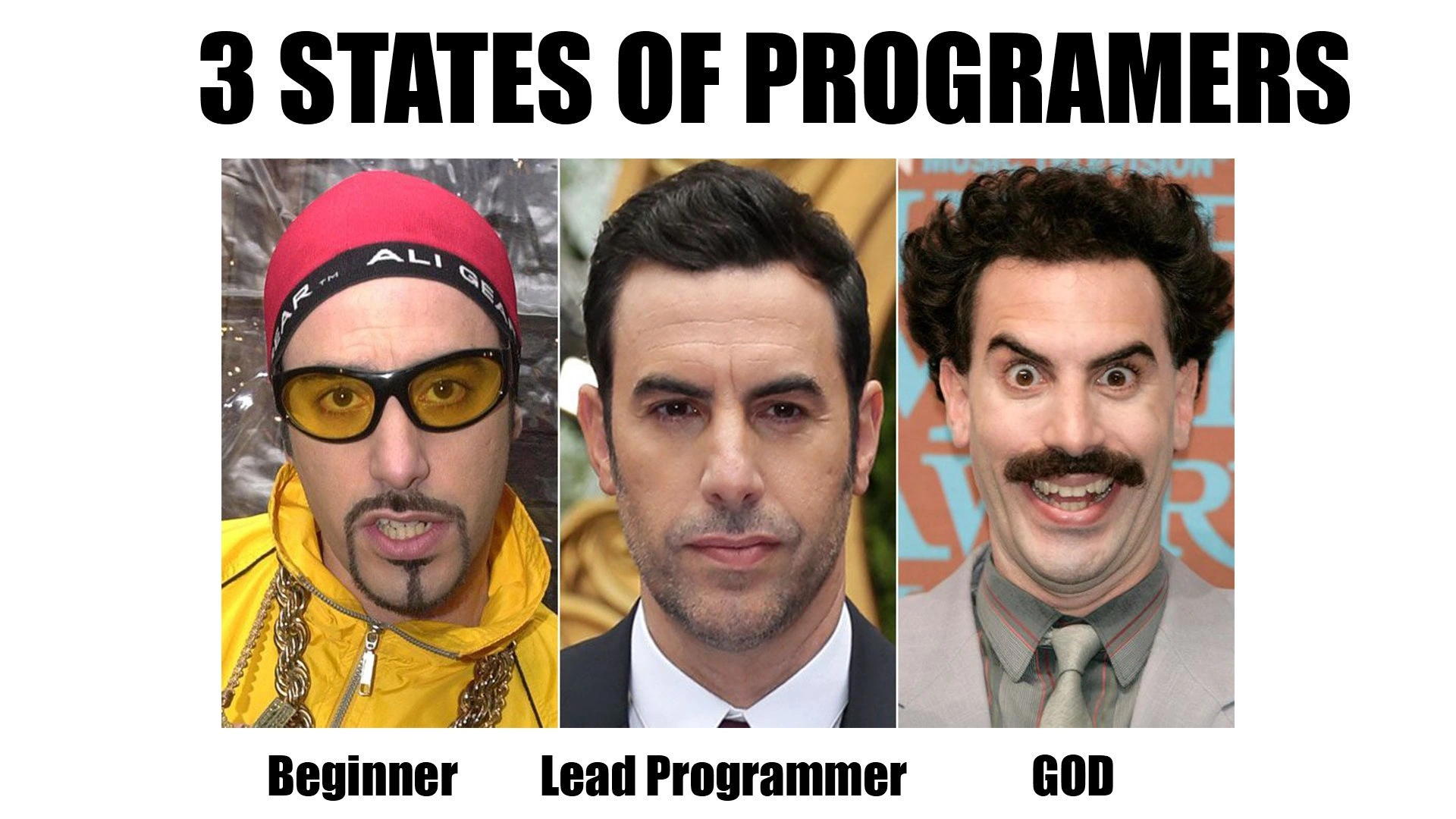
Let’s break down the three labels in this meme and what they mean in the real world of software development:
Beginner – This is your classic Junior Developer. Think of someone who is just starting their coding career. They might have learned programming in a bootcamp, college, or online tutorials, and now they’ve landed their first job or internship. A beginner is usually full of enthusiasm and new technology hype. In the meme’s left panel, the beginner is decked out like a wannabe cool kid (bright clothes, gold chains) – that’s a comic way to show a newbie developer who wants to look competent, maybe by using a lot of trendy buzzwords and the latest frameworks, but hasn’t built real-world experience yet. We’ve all met the junior dev who proudly calls themselves a “full-stack developer” after making a personal project with React and Node.js. They’re eager and confident, but still have a lot to learn about writing maintainable code and debugging systems in the wild.
Lead Programmer – This title usually refers to a senior developer who leads a team or project. In many companies, a Lead or Tech Lead is responsible for guiding other developers, making high-level design decisions, and ensuring the project is on track. They often have several years of experience (writing code, seeing projects fail and succeed, possibly mentoring juniors). The meme’s middle image (sharp suit and tie) represents how a lead developer is more mature and polished compared to the beginner. It’s a bit stereotypical – not every lead dresses in a suit – but it symbolizes professionalism and a step up in responsibility. A Lead Programmer knows the development process beyond just writing code: they plan sprints, do code reviews, coordinate with other teams (like QA or product managers), and have a big-picture view. This role is usually achieved after proving oneself as a strong Senior Developer. So, in a normal career ladder, you’d go: Junior Developer -> Intermediate -> Senior Developer -> Lead Developer -> etc. The meme humorously skips those middle steps and assumes you jump right to “Lead” once you’re done being a novice. It’s making fun of how some people or companies hand out a Lead title quickly. For example, in a tiny startup, the only developer might call themselves the “Lead” by default. Or a relatively new coder might get a fancy title to appease them, even if their experience is still growing. In reality, being a lead means you’ve seen enough messy code and odd bugs to guide others away from trouble – it’s not just a title, it’s a skill set earned over time.
“GOD” – Okay, so no real company is going to list “God” as a job title (at least we hope not!). This is the meme’s exaggerated way to label an all-powerful, all-knowing developer. In tech lingo, we often jokingly call someone who is amazingly skilled a “wizard”, “rockstar”, or “guru”. The meme jumps even beyond those to “GOD” to really drive home the satire. If we map this to real roles, this might correspond to something like CTO (Chief Technology Officer) of a company, a Principal Engineer, or a Software Architect – basically the people at the very top of the technical ladder who are seen as experts in almost everything. The phrase “full-stack deity” (from the meme title) is a play on “full-stack developer”. A full-stack dev works on both front-end and back-end, as mentioned, whereas a “full-stack deity” implies someone who can do literally anything in tech with godlike prowess (frontend, backend, database, cloud, you name it). Of course, that’s not humanly possible to the extent the word “deity” suggests! The rightmost image (with the wild grin) is a ridiculous character – that’s on purpose. It’s illustrating that calling a programmer God is absurd and laughable. In real life, even the most experienced developers have weaknesses and learn new things all the time. So the “GOD” label is pure satire. It might also hint at something we call a “god complex” – when someone thinks too highly of their abilities. Some senior folks can act like know-it-alls, and the meme pokes fun at that by literally naming them God. Essentially, this panel is saying, “And finally, here’s the developer who thinks they’re omniscient – isn’t that just hilarious (and a little scary)?”
Now, what is title inflation? This term means giving a job a more important-sounding title than it probably deserves, often to make someone or the company seem more impressive. In the developer world, title inflation is pretty common. For example, a company might call a lone IT person the “Chief Engineer” or a recent graduate “Lead Developer” just because they don’t have many layers in their organization. It sounds great on a résumé, but it can be misleading. If everyone is a Lead or Senior without the years of experience to back it, the titles start losing meaning. The meme is a case of extreme title inflation: going from Junior straight to Lead, and then beyond any normal scale to GOD. It’s highlighting how some people skip normal progression.
Think about it this way: in most professions (like medicine, law, or even something like playing an instrument), you wouldn’t trust someone to be at the very top without many years of practice. In programming, however, because the industry is fast-paced and there’s a bit of a gold rush vibe, you sometimes see very young or new programmers with inflated titles. Some startup founders call themselves CTO at 19, or a developer with a year of experience might label themselves “Software Architect” on LinkedIn. They might be talented, but normally those titles suggest a depth of experience. The meme mocks this by introducing a totally facetious title – “Programmer GOD” – that luckily we don’t actually see on LinkedIn! (Though you might catch someone jokingly calling themselves a “Code Ninja” or “Open Source Wizard” 🥷✨.)
Another concept here is the career ladder (or career progression framework). Many companies have well-defined ladders: for example, Level 1 Engineer (junior), Level 2 (mid-level), Level 3 (senior), Level 4 (staff), etc., sometimes going up to distinguished engineers. Each step comes with expectations about skills and impact. The meme condenses the ladder to just three rungs and makes the top rung intentionally ridiculous. This is satire: using exaggeration to critique something. The critique is that some organizations (or individuals) basically act as if there are only newbies, leads, and then “the ultimate expert”. The absence of a mid-level or senior stage in the meme is the whole joke – it’s pointing out that jumping from beginner to leader is unrealistic, and calling anyone “God” is over-the-top.
For a junior developer or someone early in their career, the takeaway from the meme (besides the chuckle) is to be aware of ego and hype in our industry. Titles are not everything. You might work somewhere where you get a fancy title quickly – that doesn’t automatically make you an all-knowing dev (and that’s okay!). Conversely, you might not get a big title until much later, even if your skills are strong. The meme reminds everyone not to take these labels too seriously. What really matters is continuous learning and experience. Even the so-called “gods” of programming are constantly debugging and Googling errors like the rest of us. In fact, the funniest part for many experienced folks is that the moment someone believes their own “God” hype, reality (in the form of a nasty production bug or a failed deployment) usually comes around to keep them humble. The best developers, no matter what their title, stay curious and modest because technology has a way of surprising you.
So, in plain terms: the meme is a cartoonish diagram of programmer seniority levels, poking fun at how some people inflate their importance. Beginner = new coder (flashy but still learning). Lead Programmer = seasoned coder leading others (competent and professional). “GOD” = a joke title for someone who acts like they know everything (which no one truly does). It’s a lighthearted reminder that in the real world, expertise comes in degrees, not in an on/off switch from newbie to all-knowing. And if you ever encounter someone actually referring to themselves as a coding “God”… you’ll know to laugh, because you’ve seen this meme. 😉
Level 3: God Mode Career Ladder
At the most technical (and cynical) level, this meme highlights an absurd career ladder compression in software development. The title "3 STATES OF PROGRAMERS" (typo and all) jokingly treats career levels like a minimal state machine: you have a Beginner state, a Lead Programmer state, and apparently an absorbing state called GOD. There’s no memory of any Senior Developer, Architect, or other intermediate states – it’s as if someone wrote the promotion logic with a comically naive algorithm:
// Pseudo-code for rapid title promotion (satire)
function promote(dev) {
if (dev.title === "Beginner") {
dev.title = "Lead Programmer";
} else if (dev.title === "Lead Programmer") {
dev.title = "GOD"; // Next stop: omniscience 🙄
}
}
This tongue-in-cheek code snippet mirrors what the meme implies: title inflation on overdrive. In reality, software careers usually progress through multiple levels (Junior, Mid-level, Senior, Staff, Principal, etc.). By contrast, the meme hops straight from writing your first "Hello World" to leading a team, and then skips right to omnipotence. Experienced devs recognize this pattern from certain startups and résumés: a developer lands one impressive project and suddenly they’re Lead Engineer, stick around a bit longer and they crown themselves the Full-Stack God of the company. It’s an exaggeration of LinkedIn title flexing – where every other developer is a self-proclaimed “ninja”, “guru”, or in this case, literal deity. The humor bites because we’ve all seen that one-person “team” who gives themselves a grandiose title after 18 months on the job.
The choice of images amplifies the satire. All three panels feature actor Sacha Baron Cohen’s wildly different personas, which is a joke in itself about identity and appearance:
- The Beginner (left panel) is portrayed as Ali G, a character decked in a bright yellow tracksuit, oversized gold chains, and tinted glasses. He’s the swaggering newbie who just learned to code in a shiny new framework and brags about being a
10x developernow. He’s flashy and over-confident, but any seasoned engineer can tell he’s more style than substance – like a junior dev who know a lot of buzzwords but hasn’t debugged a real production issue yet. - The Lead Programmer (middle panel) appears as a clean-cut professional in a suit and tie. This represents the polished “serious” developer who has climbed into a leadership role. They’ve traded the newbie flash for corporate credibility. In Sacha Baron Cohen terms, it’s like the actor dropping the goofy costume and suddenly looking like a legit businessman. This is the phase where a developer has fought through enough late-night outages and spaghetti code to actually lead projects. They might have the title Team Lead or Senior Developer, focusing on code reviews, architecture decisions, and mentoring others. Compared to the first guy, this one knows what he’s doing (and probably cringes at his own early-career swagger).
- The final “GOD” stage (right panel) uses Cohen’s Borat character with the infamous wide-eyed grin and absurd enthusiasm. Borat, a clueless but confident persona, is an ironic stand-in for the “all-knowing” developer. The meme labels him GOD, framing the idea that some developers (or organizations) elevate their senior engineers to mythical status. The joke is that Borat clearly isn’t a god—he’s a complete goofball. Likewise, the notion of a “Full-Stack God” in development is comically overblown; even the most senior engineers are human, with specializations and blind spots. Making Borat the face of the code deity mocks the very idea that any programmer could be infallible or all-knowing. It’s a reminder that behind grandiose titles often lies just a regular (if eccentric) person.
The full-stack deity concept here is a sardonic spin on the full-stack developer ideal. A full-stack developer is someone who can work on both the front-end (user interface, what you see in the browser) and the back-end (server logic, databases) of an application – basically handling the entire technology “stack.” In recent years, companies have sought these “jack-of-all-trades” coders and sometimes glorified them as unicorns. The meme pushes that glorification to a ridiculous extreme: after “Lead Programmer,” the next step is being capable of everything everywhere – hence, a developer so skilled they’re godlike. This satirizes tech culture’s tendency to use grandiose labels. Think of those job postings asking for a “Rockstar programmer who codes 12 languages and administers databases in their sleep.” It’s funny because the expectations are absurd – no single mortal truly excels at all aspects of modern software development to divine levels. (Even the mythical “10x Engineer” has limits – and often 10x the ego 😏.)
Seasoned developers also see in this meme a reflection of real organizational absurdity. In some companies, titles are cheap – you might meet a “VP of Engineering” who’s employee number 3 at a tiny startup, or a “Lead Architect” who’s fresh out of a coding bootcamp but happened to design the only app the team maintains. This job_band_bloat (creating inflated or excessive job titles) is often driven by HR or startup culture wanting to attract talent with fancy labels instead of competitive salaries. So we end up with situations where a Junior Developer leaps to Lead not because they achieved industry-leading mastery, but because, for example, the team grew from 1 to 2 people (someone has to be “Lead,” right?). The meme captures that sudden leap and then one-ups it: after Lead, why not just declare yourself Architect of the Universe while you’re at it?
For veteran engineers, there’s an element of “I’ve seen this movie before.” We remember being Beginners who thought we knew it all after making a flashy app work. Later, as Leads or Seniors, we learned the hard way that there’s a lot we don’t know (cue the late-night debugging sessions and the humbling code reviews). The idea of a third stage, GOD, gets a laugh because it’s the God complex in tech taken to cartoonish heights. It satirizes those who, after some success, act as if they have nothing left to learn – the ones who might reject others’ ideas because “trust me, I’ve reached enlightenment in JavaScript.” The Borat image perfectly embodies how foolish that looks from the outside.
In short, the meme is a witty critique of title inflation and ego in the developer world. It resonates with senior devs because it combines painful truth with absurdity: the industry does sometimes anoint “gurus” far too quickly, and seeing that exaggerated as a jump from Beginner to GOD is both funny and a little too real. We laugh, and maybe wince, because we’ve encountered “god-tier” LinkedIn warriors before – and we know that in tech, as in life, nobody is truly omnipotent, no matter what their business card says.
Description
Meme in a white frame with bold black top text reading "3 STATES OF PROGRAMERS" (misspelled). Beneath, three equal vertical head-shot panels. Left panel, caption "Beginner", shows a figure in a bright yellow tracksuit and oversized gold chains - flashy but unrefined. Center panel, caption "Lead Programmer", shows a neatly groomed person in a dark suit, white shirt and tie - corporate polish. Right panel, caption "GOD", depicts an individual in a dated grey suit, striped shirt, unruly hair - an absurd elevation to omniscience. The image satirizes software-engineering title inflation: careers leap from junior to lead and then straight to mythical all-knowing status, highlighting how some orgs compress leveling frameworks and how devs glorify themselves on résumés and LinkedIn

Comments
9Comment deleted
Careful - once the org promotes you past ‘Lead’ to ‘God’, your class officially becomes a God Object and architecture review throws a segmentation-fault level exception
After 15 years, you realize the real 10x multiplier isn't writing more code - it's knowing which meetings to skip, which abstractions to avoid, and that the most elegant solution is often 'very nice, high five!' to whatever works in production
The 'God' tier isn't the one who writes the cleverest code - it's the one who deletes 4,000 lines and closes the ticket
The progression is accurate: beginners think they're revolutionizing software with their first React component, lead programmers have seen enough production incidents to dress professionally for the inevitable war room calls, and god-tier engineers have achieved such deep system understanding that they've transcended sanity - they know exactly which legacy COBOL module will break if you breathe on it wrong, and they've made peace with the chaos
HR models the ladder as a DFA {beginner, lead, god}, but in practice it’s an NFA with epsilon transitions into staff+, EM, principal, and “production firefighter,” and the only path to god is a 3am page fixed by a one-line SQL hotfix nobody will ever document
Beginner counts LOC; Lead counts MTTR; ‘God’ counts how many features they convinced Product not to build
Beginners flex with cargo-cult code; leads enforce it in PRs; gods just `rm -rf /` and pray for backups
Borat approves Comment deleted
I don't get it. Who is shown in the third picture? Comment deleted