Skip to content
DevMeme
3718 of 7435
Scolding npm, yet still running “npm install” out of habit
PackageManagement Post #4057, on Dec 18, 2021 in TG

Scolding npm, yet still running “npm install” out of habit

Why is this PackageManagement meme funny?

Level 1: Force of Habit

Imagine a kid’s parent who always complains about how too many sweets are bad. One day the parent sees the kid reaching for a cookie and shouts, “No, no more cookies!” But a minute later, without even thinking, the parent themselves grabs a cookie and hands it to the kid, then says, “Oops… force of habit.” It’s funny because the parent knew they shouldn’t do it, yet they did it automatically. This meme is just like that, but with a programmer and their tool. The programmer keeps saying “I won’t use this tool so much, it causes trouble!” but then immediately uses it out of habit. The humor comes from that little moment of oops-I-did-it-again, which anyone can relate to when we try to break a habit and slip up without thinking.

Level 2: Muscle Memory Modules

Let’s break down the joke in simpler terms. npm (Node Package Manager) is the default tool developers use to manage dependencies in Node.js (JavaScript) projects. When you run npm install, it grabs all the libraries your project needs (listed in a file like package.json) and downloads them into a folder called node_modules. Over time, developers noticed that even simple projects can pull in a huge number of packages – this is often jokingly referred to as dependency hell when managing them becomes chaotic. For example, installing one library might bring along ten other helper libraries as dependencies. This can lead experienced JavaScript folks to gripe about bloat, security worries, and having too many moving parts.

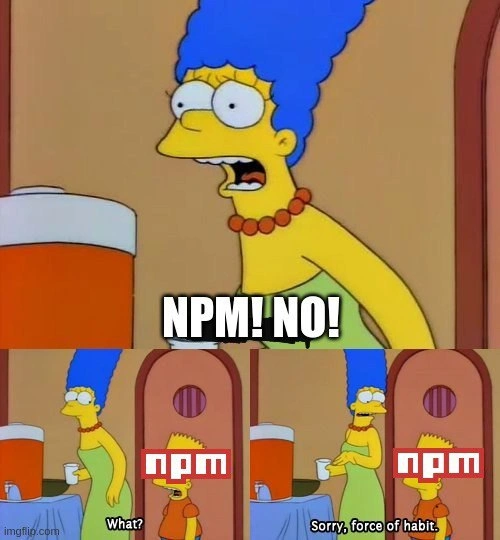
In the meme, Marge shouting "NPM! NO!" represents a developer’s conscious decision to avoid adding yet another dependency or using npm in a way they might regret later. It’s like saying, “I shouldn’t keep doing this – it causes problems.” The Simpsons characters make it extra expressive: Marge is wide-eyed and alarmed, mirroring a dev’s frustration with npm ("Not again, npm!"). Lisa’s face is covered by the red npm logo, meaning Lisa is standing in for npm itself or a project’s dependence on npm. When Lisa (npm) innocently asks, “What?”, and Marge immediately hands her a cup saying, "Sorry, force of habit," it illustrates the developer giving in to the routine. In real development life, that’s the moment when, despite all your complaints, you open your terminal and run npm install on autopilot because it’s the quickest way to get things working.

Key terms here: “force of habit” means doing something without thinking because you’ve done it so often – for JavaScript devs, typing npm install at the start of a project is practically reflex. This reflects Developer Experience (DX) issues where devs feel friction with their tools (maybe npm was slow or had some hiccups in the past), yet they stick with it out of familiarity. Many package managers have come and gone (Yarn, pnpm), but a lot of folks still default to npm because it’s what they know best. The meme is poking fun at how even senior developers (who should know better or have strong opinions) fall into this habit loop. They might scold npm in chat or discussions – maybe blaming it for a broken build or saying there are too many packages – but moments later you’ll see them using the exact tool they criticized. It’s a lighthearted call-out of the “do as I say, not as I do” scenario in programming. In summary, the image humorously highlights the gap between what developers say about managing dependencies and what they actually do when starting or fixing a project.

Level 3: Install Instinct

At the highest technical level, this meme humorously encapsulates the love-hate relationship experienced devs have with npm (the Node.js Package Manager). The scene is playing out an internal conflict: part of us (Marge in the meme) is a battle-scarred senior developer yelling "NPM! NO!" – essentially scolding the tool for all the pain it’s caused (think Dependency Hell, supply-chain vulnerabilities, endless update churn). Yet mere seconds later, the same Marge persona is reflexively pouring a drink for Lisa-with-an-npm-logo and apologizing, "Sorry, force of habit." This perfectly captures the npm_install_reflex: despite all the gripes about JavaScript tooling friction, many of us still default to running npm install without a second thought.

Why is this contradictory behavior so relatable? Dependency sprawl is a known headache in Node.js projects – our node_modules directories can swell to thousands of packages. Seasoned devs rant about how one npm install pulls in an entire galaxy of sub-dependencies (sometimes including absurd ones like a 5-line function packaged as its own library). We crack jokes about left-pad (that tiny removed package that once broke the internet) and roll our eyes at how DeveloperExperience_DX suffers when build times crawl due to bloat. In theory, we resolve to be better: “No more random packages for simple tasks! NPM, NO!” In practice, however, the convenience and muscle-memory of npm install often win. It’s a classic case of knowing the architectural pitfalls (unverified transitive dependencies, version conflicts, massive disk usage) yet repeatedly falling into them because that’s the path of least resistance in the moment.

On a deeper level, this reflects how entrenched npm is in the Node ecosystem’s culture. Alternatives like Yarn or pnpm exist and seniors loudly champion them at conferences or on Twitter. But even those evangelists, in private moments, occasionally catch themselves typing npm init -y && npm install when kicking off a quick project. Old habits die hard in tech – especially habits baked into our command-line workflow. The meme’s Simpsons format cleverly anthropomorphizes npm as a family member you constantly scold but ultimately indulge. Marge = the veteran developer’s rational side (fed up with DependencyHell); Lisa (with npm’s logo) = the ever-present reality of Node projects that you end up taking care of anyway. The humor lands because it’s too true: years of frustration boiled into a knee-jerk “No!” followed by immediate capitulation to the routine. It’s essentially highlighting the PackageManagement paradox – we complain about our tools’ shortcomings but remain undeniably dependent on them. The next time you see a dev furiously tweeting “npm is the worst!” only to push a project full of package-lock.json updates, just remember Marge pouring that drink for npm-Lisa. Technology might advance, but our force_of_habit often outruns our better intentions.

Description

A three-panel Simpsons meme is shown. Top panel: Marge, eyes wide and arm outstretched toward a big orange beverage cooler, yells the caption “NPM! NO!” in bold white impact font. Bottom row has three narrow frames: in the first, Marge pours a drink; in the second, Lisa’s face is covered by a red npm logo as she asks, “What?”; in the third, Marge hands the cup to the npm-headed Lisa while the subtitle reads, “Sorry, force of habit.” The meme pokes fun at senior JavaScript developers who vocally complain about the Node Package Manager yet instinctively reach for it whenever they start a project. It highlights dependency sprawl and the muscle memory of typing “npm install” despite better intentions

Comments

8
Anonymous ★ Top Pick We keep telling audit to stop yelling about 600 vulnerable transitive packages - right after this one last ‘npm i’
  1. Anonymous ★ Top Pick

    We keep telling audit to stop yelling about 600 vulnerable transitive packages - right after this one last ‘npm i’

  2. Anonymous

    The new junior dev asked how to left-pad a string, and I had to physically restrain myself from typing 'npm install' before remembering we're still in therapy from the last time someone unpublished a package

  3. Anonymous

    Other parents flinch at the stove; JS devs flinch at any sentence containing the word 'install'

  4. Anonymous

    After years of debugging 'npm ERR!' messages at 2 AM, seeing those three letters triggers a Pavlovian response in senior engineers - even when they're just trying to open kitchen cabinets. It's not paranoia if node_modules really is 500MB of transitive dependencies you didn't ask for

  5. Anonymous

    You swear off new deps, but your fingers type `npm i` - now you’ve adopted 1,600 transitive packages, two postinstall scripts, and a faint left-pad déjà vu

  6. Anonymous

    After left-pad and event-stream, 'npm install' isn't a command; it's supply-chain roulette, and my hands auto-reach for a lockfile and a private registry

  7. Anonymous

    After 15+ years of npm hell, even 'Mmm, donuts' autocorrects to 'npm audit fix'

  8. @gotboredanyway 4y

    Lmao

Use J and K for navigation