The Humbling Experience of a Simple Mistake
Why is this Debugging Troubleshooting meme funny?
Level 1: Batteries Not Included
Think of it like this: you have a toy car that isn’t moving, no matter what you do. You spend all afternoon pushing its buttons, checking its wheels, and getting upset that it’s not working. After a long time, you suddenly realize the battery was never put in. The car wasn’t broken at all – it just never had power to start with! You’d probably feel pretty silly, right? Maybe you’d laugh and say “I can’t believe I didn’t check that first!”
That’s exactly what happened in this coding meme. The programmer was trying to fix something that wasn’t actually running, just like the toy car without a battery. They felt frustrated something was wrong, then embarrassed when they discovered the simple reason. It’s funny because we’ve all done something like this: forgetting a basic step and then feeling a mix of relief and silliness when we figure it out. In the end, it teaches us to always check the obvious things first – whether it’s putting batteries in a toy or calling a function in code.
Level 2: Did You Call It?
Let's break down what’s happening in this meme in simpler terms. In programming, a function is a reusable piece of code that performs a task. To make a function do its job, you have to call or invoke it (which means writing its name followed by () and any required inputs). If you don't call a function, it just sits there doing nothing, no matter how perfectly written it is. A unit test is a small program or function designed to test one specific thing in your code (like checking that an add(2,2) function really returns 4). When we run our tests (often using a test runner tool), each test function is supposed to execute and verify some behavior.
In the scenario from the meme, the developer wrote a test function but forgot to call it (or set it up so the test runner calls it). That means the test never actually ran. It's as if a teacher prepared an exam question but never handed out the paper to the students – no one ever took the test, so you won't get any answers! The developer spent two hours debugging, which means they were trying to find a bug (an error) in the code. They probably inspected the code inside the test, added print statements, and tried to figure out why the test wasn't passing. But all that time, the test code wasn’t running at all, so of course nothing was happening. This is why the meme is funny to programmers: the big “mystery bug” turned out to be that the test wasn’t even executing, a simple oversight. It’s a classic CodingMistakes moment.
For a newcomer (or even an experienced coder on an off day), it's easy to assume "I wrote the test, so it must be running." Many testing frameworks automatically discover and run test functions, but only if you follow their conventions. For example, in Python’s pytest, any function that’s meant to be a test should be named starting with test_. If you named it something like check_add instead of test_add, the framework will quietly skip it. In other cases, you might write a test function in your code but forget to actually call it manually. Here, the developer likely ran the test file thinking everything inside it would execute, but the specific test function was never triggered. No function call = no action.
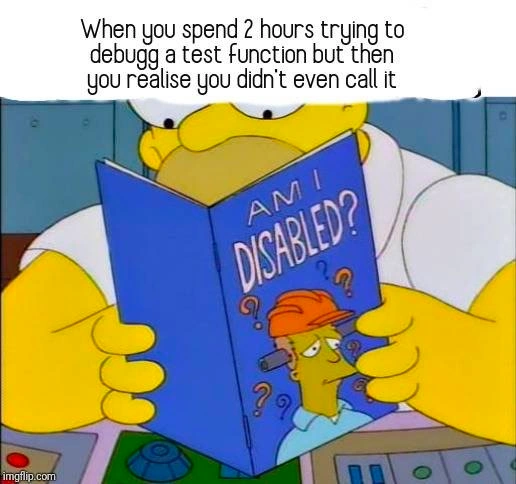
When they finally realized the oversight (“you didn't even call it”), it’s a huge facepalm moment. Homer Simpson reading a book titled “Am I Disabled?” is a humorous way to show how the developer feels: they start questioning their own intelligence for missing such a basic thing. In reality, making mistakes like this is super common when debugging. We often get so deep into solving a problem that we overlook the simple checks. The key lesson for a junior developer (or honestly anyone) is: always make sure your code is actually running when you test it. It sounds obvious, but as this meme shows, even pros can forget! Next time something weird is happening (or nothing is happening), double-check that you actually called the function or that your test is being picked up by the test runner. It might save you hours of confusion. And remember, it’s all part of the DeveloperHumor and learning process—no need to feel too bad, just learn and laugh it off!
Level 3: Chasing Phantom Bugs
Imagine pouring over logs and stepping through a debugger for two hours, convinced there's a sly bug in your code. The punchline? That bug never existed because the code never ran! This meme highlights a classic DebuggingFrustration: a developer spends ages troubleshooting a unit test only to discover the test function was never invoked in the first place. Homer Simpson sitting at a control panel reading an "AM I DISABLED?" manual perfectly captures that coder’s facepalm moment of self-doubt. It's a mix of DebuggingPain and dark humor—realizing you were the glitch all along.
In a proper unit testing scenario, a test function that isn't called is essentially a ghost. You can obsess over every line inside it, but if you never actually execute it, nothing happens—no failures, no logs, no clues. This is the ultimate phantom bug hunt: chasing an issue that isn't there. Seasoned developers have a cheeky acronym for such cases: PEBKAC (Problem Exists Between Keyboard And Chair), meaning the error was human, not code. We've all been there. Maybe the test wasn't added to the test suite, or the function didn't have the expected name so the test runner skipped it (e.g., forgetting the @Test annotation in JUnit or not prefixing the name with "test_" for a Python pytest UnitTesting framework). In some cases, the function was defined but never called anywhere in the code. No call, no execution – it's that simple, and that maddening.
Let's say you wrote a function and a test for it, but the test never ran:
def add(a, b):
return a + b
def test_add():
# This is our test function
result = add(2, 2)
assert result == 4
# ...but oops, we never actually call test_add() or let a test runner discover it
If you run this file as-is, you'll get zero output – not even an error – because test_add() was never invoked. Meanwhile, you're scratching your head wondering why there’s no green checkmark or fail message. In a real test suite, forgetting to call a test (or mis-registering it) can happen subtly. For example, JUnit will silently skip any method without @Test, and pytest ignores functions that don’t start with test_. The code sits there idle while you examine it under a microscope. It’s like diligently checking the wiring of a lamp when it’s not even plugged in. No wonder Homer’s asking himself if he’s “disabled” (i.e., incompetent)—the situation makes you question your own abilities. This kind of CodingMistakes triggers instant imposter syndrome: “How could I, a supposedly experienced dev, miss something so obvious?”
Beyond the embarrassment, there's a silver lining: once you realize the issue, the fix is embarrassingly simple (just call the function!), and you’re reminded that even experts make silly mistakes. It's a rite of passage in DeveloperHumor folklore. The next time you find yourself debugging in circles, take a step back and ask the obvious: “Did I actually run the code I’m testing?” Even the most battle-hardened engineers have to learn this humility. After all, chasing phantom bugs is a lot like being Homer at the console with that book—it’s better to laugh at yourself and then go call that function (d’oh!).
Description
The image is a meme based on a still frame from the animated TV show 'The Simpsons'. It shows the character Homer Simpson sitting at a control panel, looking intently at a blue book he is holding. The book's cover is prominently displayed, with the title 'AM I DISABLED?' written in large, capital letters, surrounded by question marks. Above the image, a caption reads: 'When you spend 2 hours trying to debugg a test function but then you realise you didn't even call it'. The humor is derived from the intense feeling of self-doubt and foolishness that a developer experiences after wasting a significant amount of time on a problem caused by a trivial and fundamental oversight. Forgetting to call a function is a classic, frustrating, and universally relatable mistake in programming. The meme perfectly captures the moment of realization and the subsequent questioning of one's own competence, making it highly resonant with developers of all experience levels who have inevitably found themselves in similar situations
Comments
7Comment deleted
The first rule of debugging is to check if the code is plugged in. The second is to spend two hours convinced it's a complex race condition before realizing you forgot the first rule
After three hours knee-deep in Spring proxies and stack traces, I finally found the bug: my test was annotated with @Disabled - turns out the only thing under test was my self-esteem
The same developer who meticulously mocks every dependency, writes comprehensive test assertions, and achieves 100% code coverage, but forgets to add the test to the test suite runner
After two hours of debugging a test function that never ran, you realize the real test was your ability to question your own sanity. The function wasn't broken - it was Schrödinger's test: simultaneously passing and failing because it existed in a superposition of 'written but never invoked.' At least you can now add 'expert in debugging non-executing code' to your résumé, right next to 'proficient in rubber duck philosophy' and 'advanced practitioner of the sunk cost fallacy.'
20+ YoE and still tracing ghosts: the test failed because it was never summoned - pure lazy evaluation gone wrong
I instrumented logs, added tracing, and tuned the profiler before noticing pytest collected 0 items - apparently my test function wasn’t called and neither was I
My “failing” test wasn’t calling the function - apparently my AAA pattern is Arrange, Assert, Apologize