Achieving 100% Code Coverage with Zero Effort
Why is this Testing meme funny?
Level 1: Participation Trophy
Imagine you get to make your own test in school, and you decide to ask yourself, “Is 0 equal to 0?” You answer “Yes, of course,” and then give yourself a 100% score on that “exam.” Then you run around proudly showing off your perfect grade. 🏆 Sounds silly, right? You didn’t actually prove you learned anything new – you just picked the easiest question in the world.
That’s exactly what’s happening in this picture. The programmer wrote a super easy check (basically “does a thing equal itself?” which is always true) and then celebrated like they beat a video game on the hardest level. It’s funny because the celebration is way out of proportion to the tiny amount of real work or testing done. In real life, it would be like cleaning one toy off your floor and claiming your whole room is perfectly clean. Everyone can see it’s an empty victory – a pretend win. The meme makes us laugh because it shows how goofy it is to feel like a hero just because a number says “100” when we know that nothing was actually tested or proven.
Level 2: Trivial Test, Perfect Score
Let’s break down what’s happening in simpler terms. The code in the screenshot is a Mocha/Chai test file written in JavaScript. Mocha is a popular test runner for JS, and Chai is an assertion library that lets you write readable tests. In Mocha, you define a test case with it(description, function). For example:
import { expect } from "chai"; // Import Chai's expect assertion
import "mocha"; // Import the Mocha testing framework
it("Should equal 0", () => {
expect(0).to.equal(0); // This assertion checks that 0 === 0
});
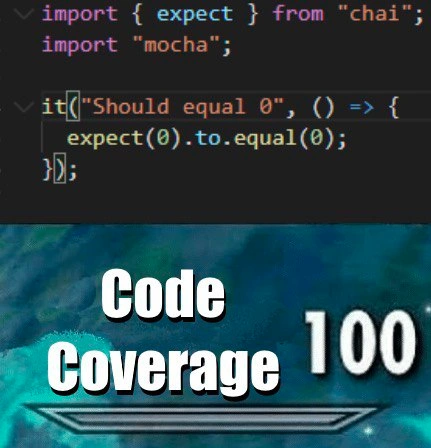
This snippet sets up a test named "Should equal 0". Inside, it uses Chai’s expect function to assert that 0 is equal to 0. This is a unit test, but it’s clearly a joke – it doesn’t test any real code or logic from an application. It’s just checking a basic fact of math (zero equals zero), which will always be true. In other words, it’s a no-op test: it performs an assertion that can never fail. That’s why we call it a trivial assertion or a dummy test.
Now, what’s code coverage? It’s a measure of how much of your code gets executed when you run your test suite. Typically, a coverage tool tracks which lines or branches of your program are run by the tests and computes a percentage. 100% coverage means the tests executed every line of the code at least once. It’s one indicator (a quality metric) of thorough testing. However, coverage doesn’t tell you what the tests assert or how effective they are – it just tells you that code ran during the test. In our meme’s scenario, because the test is so minimal, one can imagine the only code being “tested” is this file itself or some trivial function. By running even a do-nothing test on every bit of code, the coverage report can show 100% – a perfect score on paper.
The bottom half of the meme mimics a video game HUD (Heads-Up Display). It shows the words “Code Coverage” above a big 100 and a full progress bar, styled like a health or XP bar in games. This visual implies the developer’s testing “stat” is maxed out to the brim, as if they achieved a high score or full health. It’s a satire of quality metrics: the developer feels like they got an S-rank in testing just because the number says 100%. In reality, writing a real unit test means checking some functionality of your code – for example, if you had a function that adds numbers, you’d test that add(2, 2) really returns 4. But here, we’re essentially testing nothing useful.
For someone newer to coding, the humor comes from understanding that unit testing and code quality aren’t just about numbers and percentages. You could have 100% test coverage by covering every line with tests, but if those tests are like this one – trivial and not actually verifying the program’s behavior – then that 100% doesn’t guarantee your code is bug-free or well-designed. Experienced developers often warn: don’t chase coverage for its own sake. This meme is a lighthearted way to show why: you might end up with a great looking score (like a game high-score) for doing basically nothing meaningful. It’s testing humor that anyone who has used metrics like coverage in development can chuckle at, and it highlights the difference between quantity of tests vs. quality of tests.
Level 3: 100% Coverage, 0% Confidence
At first glance, this meme hilariously contrasts a trivial JavaScript unit test with a triumphant video game HUD. The top half shows real test code using the Mocha framework and Chai assertions: a single it block where the test literally checks if 0 is equal to 0. This trivial assertion is a guaranteed pass – a tautology that can never fail. Yet in the bottom half, we see a flashy “Code Coverage 100” status bar, as if the developer unlocked a legendary achievement. The humor hits experienced developers right away: 100% code coverage has been attained, but no meaningful behavior was tested! It’s a satire of inflated metrics in Testing and CodeQuality that every seasoned engineer has groaned about.
This juxtaposition underscores the illusion of quality that raw metrics can create. Code coverage is supposed to measure how much of the code is executed by tests – ideally high coverage means your tests touch all parts of the code. In practice, though, not all coverage is equal. You can hit 100% by executing every line, yet still miss every bug if the tests don’t assert the right things. Here, the developer wrote the minimum viable test (checking a constant equals itself) and scored a perfect 100%. It’s like bragging you beat the final boss when you actually fought a training dummy. Veteran developers recognize this as a classic anti-pattern: focusing on the number instead of the substance. We’ve all seen managers enforce a 90% or 100% coverage target as a proxy for quality. Inevitably, teams game the system – writing no-op tests or checking obvious truths – to make the report happy. The result? Coverage becomes a meaningless number, a coverage illusion of safety while real bugs slip through untested paths.
The meme’s caption even riffs on a popular Spider-Man line: “You know, I’m something of a unit tester myself.” This tongue-in-cheek reference paints the picture of a smug developer proudly identifying as a unit testing guru after writing one superficial test. It’s poking fun at that over-confident moment we might recognize – treating a single test success like a video-game victory royale. For a senior engineer, the message is crystal clear (and comically relatable): 100% coverage != 100% tested. Real quality comes from meaningful tests, not just hitting stats. In other words, chasing coverage for its own sake is as absurd as celebrating a full health bar when you never actually fought the game’s enemy. The meme cleverly reminds us that a high score on a bad test is just that – an empty score. Better to have robust tests with lower coverage than a perfect 100% that proves nothing.
Description
The image is a two-panel meme that satirizes the pursuit of software testing metrics. The top panel displays a screenshot of a code editor with a JavaScript unit test. The code imports testing libraries 'chai' and 'mocha' and contains a single test case: `it("Should equal 0", () => { expect(0).to.equal(0); });`. This test is a tautology, meaning it tests a statement that is always true (that 0 equals 0) and therefore provides no actual value in verifying code functionality. The bottom panel uses the popular meme format from the video game 'The Elder Scrolls V: Skyrim,' which typically shows a skill leveling up to its maximum. In this variation, the text reads 'Code Coverage 100'. The joke is that while the meaningless test does nothing to ensure the quality of the software, it successfully 'covers' the code it's supposed to test, allowing a developer to achieve a perfect 100% code coverage metric. This highlights a common criticism in software development: metrics like code coverage can be easily 'gamed' or manipulated, leading to a false sense of security about code quality. It resonates with experienced engineers who know that high coverage does not always correlate with well-tested, reliable software
Comments
7Comment deleted
Some teams chase 100% code coverage. I prefer 100% 'doesn't-wake-me-up-at-3am' coverage. The metrics for that are harder to game
We hit 100% coverage with one `expect(0).to.equal(0)` - product thinks it’s rock-solid, mutation testing thinks it’s performance art
After 15 years of watching teams game coverage metrics, I've learned that '100% code coverage' is just another way of saying 'we've successfully tested that true equals true across our entire codebase' - meanwhile, the actual business logic remains as mysterious as a quantum superposition until production collapses it into a bug report
Ah yes, the classic '100% coverage' flex achieved by asserting that mathematical constants equal themselves. This is the testing equivalent of padding your resume with 'proficient in breathing' - technically true, impressively useless. Senior engineers know that coverage metrics without meaningful assertions are just expensive lies we tell management. The real test of a test suite isn't whether it covers every line, but whether it would actually catch the bug that takes down production at 3 AM. This test wouldn't catch anything except maybe a fundamental breakdown in the JavaScript runtime's understanding of equality - at which point, we have bigger problems than code coverage
100% coverage achieved: proving 0==0 covers all sins while the actual features remain gloriously untested
100% coverage via expect(0).to.equal(0); the dashboard is green, and confidence is still an untested branch
100% coverage via expect(0).to.equal(0) is the QA equivalent of pinging /healthz and calling it observability; mutation testing would turn this suite into confetti