Skip to content
DevMeme
731 of 7435
The Bug Report That Defies All Logic
Bugs Post #829, on Nov 18, 2019 in TG

The Bug Report That Defies All Logic

Why is this Bugs meme funny?

Level 1: When Pikachu Knocks Out Your TV

Imagine you’re at home and your big brother is playing a new Pokémon game on his console. Suddenly, the little box that makes your TV smart (so you can watch cartoons on Netflix or YouTube) starts acting all crazy. The screen goes black, the box resets, comes back… then goes black again, over and over. It’s like the TV box caught a cold just because your brother started his game! It sounds like magic or a prank: how could a video game in one device make a completely different device (the TV’s streaming box) go bonkers?

Think of it this way: both devices are kind of “talking” through invisible radio waves on the same Wi-Fi. It’s as if the Pokémon game started shouting a weird phrase in a language that the TV box unfortunately understands just enough to get confused and faint. Like if someone yelled a spell in a room and, by bad luck, it made another person fall asleep. The developer who built that TV box never expected this would happen – it’s a total surprise, like a one-in-a-million weird trick. That’s why it’s funny (in a silly way): it’s such a ridiculous accident! But it’s also a bit scary for the people who make these devices, because it means sometimes gadgets can affect each other in crazy unexpected ways. In simple terms, the Pokémon game was doing something innocent, but to the TV box it was like a secret code to crash. It’s a big oops in the tech world, and the poor developer responsible had to rush to fix the TV box so that Pikachu can’t knock it out again.

Level 2: A Wild Bug Appeared!

Let’s break down what happened in simpler terms. We have two completely different gadgets: a Roku streaming device (a small box or stick that plugs into your TV to stream video over the internet) and a Nintendo Switch console running Pokémon Sword/Shield (a popular video game). Normally, these two wouldn’t interact at all – one is for TV apps like Netflix, the other is a game system. But they do share something: your home Wi-Fi network. When devices are on the same network, they can “hear” each other’s network traffic (kind of like being in the same room and overhearing someone else’s conversation).

Now, a bug is a mistake or flaw in software that causes it to act in ways the programmer didn’t intend. In this case, there was a bug in the Roku’s software (its firmware, which is basically the operating system software running on that device). This bug made the Roku respond very badly to a certain message or signal that was being sent over the Wi-Fi. Think of the firmware as the Roku’s brain – and it had a particular edge case (a super-rare situation) that it wasn’t prepared to handle. The result? That unhandled situation caused the Roku to crash (like when a program on your computer freezes or quits unexpectedly).

When the Roku crashes, it doesn’t know what else to do but reboot (turn off and on again) to try to fix itself. But here’s the kicker: as soon as it boots up and reconnects to Wi-Fi, it sees that same weird network message again (because the Nintendo Switch game is still sending it), and boom – it crashes again. This cycle of crashing and restarting is what we call a boot loop. The Roku was basically stuck in an endless loop of turning on and off. That’s why the meme text says the Roku devices “enter a boot loop.”

So where is that weird network message coming from? It turns out the Pokémon Sword/Shield game had some kind of network feature – possibly it was searching for other players nearby or sending out a “hello” signal to see if anyone else is playing for trades/battles. It was sending something innocuous for the game, but the Roku’s buggy firmware misinterpreted or choked on it. This is what we call a cross-device network issue – one device (the Switch/game) is unintentionally causing problems in another device (the Roku) just by being on the same network.

For a junior developer or someone new to troubleshooting, imagine the confusion here. If you were the developer on on-call duty (meaning the person responsible for urgent problems off-hours), you’d get reports like “our Roku keeps rebooting whenever the Switch is on.” Your first thought might be “that…makes no sense.” You’d have to use debugging skills to figure it out: maybe start by reproducing the scenario in a lab (turn on a Switch with Pokémon in the office, have a Roku on the same router, and watch what happens). You’d check the Roku’s system logs (records of what it was doing internally) to see why it’s crashing. Perhaps the logs would show an error in the network module right before reboot. That’s a clue! Then you might use a network monitoring tool to capture what the Switch is broadcasting. Bit by bit, you’d piece together that the Switch sends a certain type of network packet that, due to a mistake, the Roku just doesn’t know how to handle, and instead of failing gracefully, it just falls over.

For someone early in their career, this is a crash course (no pun intended) in DebuggingTroubleshooting under weird conditions. You learn that sometimes a ProductionIssue isn’t caused by your last code change or your servers at all – it could be something external and unexpected. It’s also a lesson in robust programming: make your device or app handle unexpected input without collapsing. After all, you can’t easily control what other devices do on a shared network. As crazy as it sounds, two completely unrelated systems might interact in surprising ways. This incident became a bit of TechHumor legend because of how ridiculous it felt: a Pokémon bug crashing a TV gadget. It’s the sort of story that’s funny after it’s solved, but in the moment, every engineer involved was probably tearing their hair out trying to figure out what was going on. Talk about relatable pain for anyone who’s had to debug a wild, unforeseen issue in production!

Level 3: Morning Boot Loop Blues

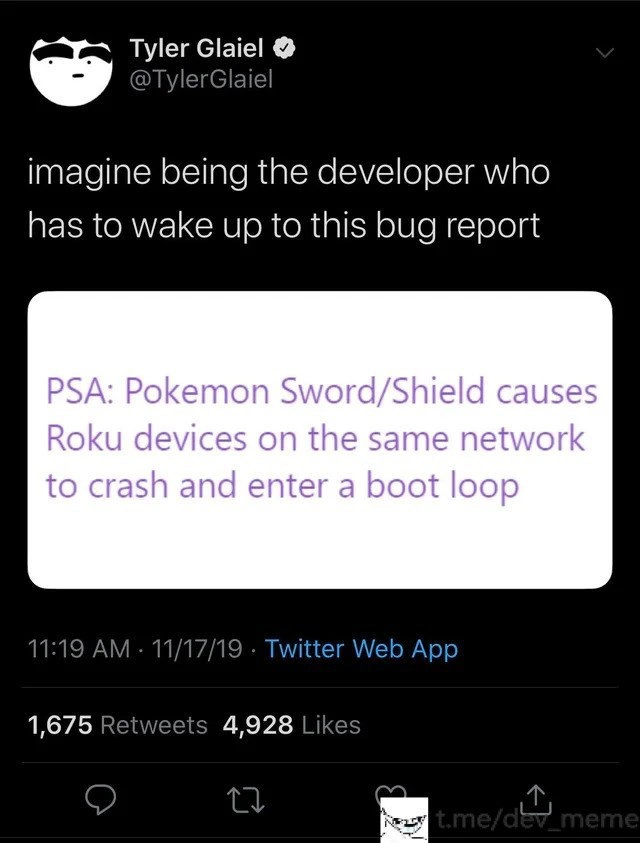
“Imagine being the developer who has to wake up to this bug report.” – The horror, the horror!

This tweet perfectly captures a developer’s nightmare scenario: getting jolted awake by an urgent message that reads something like, “PSA: Playing Pokémon Sword/Shield on the same Wi-Fi causes all Roku devices to crash and reboot endlessly.” Your first reaction might be: No way. It sounds absurd, like a prank or a misunderstanding. A Pokémon game on a Nintendo console bricking streaming devices? That’s the stuff of folklore or an extremely cruel QA test. But as reports flood in, you realize it’s very real – and you’re the poor soul on call. This is on-call hell, the kind of ProductionIncident that engineers swap like ghost stories: “Remember the Pokémon bug of 2019? Yeah, I drew the short straw that day.”

The humor (tinged with pain) in this meme comes from how bizarre and implausible the situation is. In the world of software bugs, we expect things like memory leaks, off-by-one errors, maybe an occasional “it’s always DNS” issue. But cross-device network issues where one product inadvertently nukes another? That’s a special class of EdgeCase. It’s the kind of incident that makes a developer rub their eyes in disbelief in the early morning and wonder if they’re still dreaming. Debugging frustration doesn’t even begin to cover it – how do you even start troubleshooting something that reads like a bad crossover episode of two unrelated tech ecosystems?

From a seasoned developer’s perspective, a few things stand out. First, the timing: Pokémon Sword/Shield was a huge release (mid-November 2019, right when this tweet was made). So you likely have tens of thousands of people booting up the game on their Switches that weekend. Suddenly, support tickets and Reddit posts start popping up: “Every time I play the new Pokémon, my Roku TV keeps restarting!” The correlation is strong and spooky. For the developer on call, this is a fire drill. You’ve got a ProductionIssue affecting potentially all Roku devices in the field (millions of units) whenever they share a network with this game. The urgency is through the roof. This isn’t just a bug, it’s a service outage on a massive scale – triggered by a freaking video game. Cue the war room scenarios.

Inside the company, imagine the scramble: DevOps and engineers are spinning up every logging tool they have to see what happens right before these Roku crashes. Customer support is frantic, the comms team might be drafting a “Known Issue” statement. And the developers? They’re grabbing a Nintendo Switch and a copy of Pokémon Sword or Shield as fast as possible (if they can find one – it’s a popular release!). It’s almost comical: picture a bunch of Roku engineers huddled around a Switch, saying “Alright, fire up that Charizard raid and let’s watch the logs.” Normally, debugging a reboot loop means connecting to the device’s debug port, checking kernel panic messages or crash dumps. Those dumps might be cryptic, but maybe they hint at a networking subsystem failure. Someone probably exclaims, “Why on earth is our box crashing when it sees a Pokémon on the network?!” – a sentence no developer expects to say in their career.

The senior folks will recall other weird production incidents: like that time a single malformed packet took down a server (hello, Ping of Death in the ’90s), or when an IoT lightbulb firmware update accidentally knocked whole Wi-Fi networks offline. There’s a grim camaraderie in these stories. They all underscore how fragile systems can be in unexpected ways. As one cynical veteran might quip, “Well, it’s not DNS this time – apparently it’s Pikachu.” 😅 (Because in dev culture, when something inexplicable goes wrong, we jokingly blame DNS. But even DNS can’t be scapegoated for Poké-caused boot loops!)

Once the immediate “wake up and panic” phase passes, the developer has to methodically troubleshoot. This is where experience comes in handy. A senior engineer might suspect some kind of network protocol clash or a fringe bug in the Roku’s firmware. They’d start by isolating the environment: put a Roku and a Switch on a test network, replicate the issue, and then capture network traffic and device logs. When they finally see the cause – maybe some bizarre multicast packet or an overloaded input that the Roku never handled – there’s a mix of relief and exasperation: Relief that they can now work on a fix, and exasperation that such a silly oversight made it to production. It’s that relatable pain of discovering a bug that’s both obvious in hindsight and utterly ludicrous in foresight. Everyone in the dev team is likely thinking, “How did we miss this?” and simultaneously, “Who on Earth would ever predict this scenario?!”

The broader industry chuckle here is also about the scope of responsibility. Roku’s devs are now dealing with a bug caused by someone else’s product (Nintendo’s game) – something completely out of their domain. It highlights the interconnected nature of tech: your code doesn’t run in a vacuum, it’s in the wild, sharing environments with countless other devices and software. In an era of smart homes, cross-device interactions are a new frontier of bugs. As a result, this story is a cautionary tale: always code defensively. Because if you don’t, a wild bug might appear and it could be carrying a Master Ball to capture your sanity. In the end, the meme’s humor comes from our empathy for that developer and the sheer absurdity of the situation, mixed with a bit of schadenfreude – we’re laughing because it isn’t us, but we know one day it could be. OnCallNightmares like this keep seasoned devs both humble and ever so slightly paranoid.

Level 4: Multicast Malfunction

At the packet level, this incident smells like a textbook case of an unexpected network broadcast triggering a latent firmware bug. The Nintendo Switch running Pokémon Sword/Shield likely sends out some multicast or broadcast packets on the local Wi-Fi network – perhaps searching for other players or advertising its presence. Normally, devices like a Roku ignore or quietly process such routine network chatter. But here, one of those unexpected WiFi packets was effectively a digital stick of dynamite for Roku’s system software. The embedded firmware in the Roku had a flaw: when it tried to parse or respond to that particular packet, things went terribly wrong.

Deep in the Roku’s network stack, a function probably encountered input it didn’t anticipate. Think of something like a buffer overflow or an unhandled exception in C code running on the device’s OS. For example, if the Pokémon game broadcasted a device name or message that was longer or oddly formatted beyond what the Roku’s programmer anticipated, it could overflow a fixed-size buffer or trip an assertion. A contrived snippet in an embedded C context might look like:

char gameName[24];
// Firmware assumes names are <24 chars. But Pokemon sends 32 chars.
int len = recv_packet(gameName, sizeof(gameName));
if(len > sizeof(gameName)) {
    // Oops, no proper bounds check, overflow occurs here
    crash_and_reboot();  // Hypothetical function that triggers reboot
}

Here the Switch’s Pokémon Sword/Shield might be broadcasting something like “PikachuPartyInviteExtraordinaire” (just an illustrative guess) that’s too long or oddly encoded. The Roku firmware, lacking a guard, crashes when handling it. And because the Switch keeps broadcasting (or the network condition persists), the poor Roku reboots, reconnects to Wi-Fi, sees the same packet again, and immediately crashes again. This creates the dreaded boot loop: a cycle of death and rebirth for the device. In systems theory, this is essentially a liveness failure – the Roku can’t stay alive long enough to do anything because an external stimulus is killing it over and over.

The truly vexing part for a developer is diagnosing this. It’s a cross-device, cross-vendor interaction: nothing in Roku’s QA tests would have included “Have a Nintendo Switch spam the network”. This bug hides in the intersection of two unrelated systems, a classic edge case nobody saw coming. To debug it, an engineer would need to capture network traffic (with a tool like Wireshark) to see what on earth the Switch is saying on the network. They might discover some MDNS/SSDP packet or a weird wireless protocol message right before each crash. Once they identify the offending pattern, they’d likely find a mistake in the Roku’s code (maybe a mis-implemented network discovery service or a fragile UPnP handler). The fix could involve tightening input validation (e.g., handle longer names safely, ignore malformed packets, etc.), essentially teaching the Roku to gracefully handle that “Pokémon packet” instead of throwing a tantrum.

From a theoretical standpoint, this illustrates how complex emergent behaviors can arise in distributed systems: here we have an unintended network coupling. In a way, the Switch inadvertently performed a mini denial-of-service on Roku by exploiting a vulnerability no one knew was there. It’s a sobering reminder that even simple devices like streaming sticks run a full network stack with all the associated state machines and parsing logic – and any undefined behavior in those can be kicked off by the most innocuous external input. As an engineer reading this, you simultaneously cringe and marvel: cringe because you know a single unchecked condition caused a cascade, and marvel because it’s almost comically absurd that a video game could remotely destabilize a media player without any direct connection except shared Wi-Fi. This is the kind of deep technical mystery that for a brief moment turns the morning into a scene from a distributed systems horror story.

Description

The image is a screenshot of a tweet from user Tyler Glaiel (@TylerGlaiel). The tweet's main text reads, 'imagine being the developer who has to wake up to this bug report'. Below this, an embedded text box with a light purple background contains a public service announcement (PSA) that states: 'PSA: Pokemon Sword/Shield causes Roku devices on the same network to crash and enter a boot loop'. The tweet's timestamp is '11:19 AM - 11/17/19' and it shows engagement metrics of '1,675 Retweets' and '4,928 Likes'. A watermark for 't.me/dev_meme' is partially visible at the bottom. The humor stems from the sheer absurdity and improbability of the bug. There is no obvious reason why a video game on a Nintendo Switch should affect a Roku streaming device simply by sharing a local network. This represents a developer's worst nightmare: a 'spooky action at a distance' bug where cause and effect are so disconnected that the debugging process would be a monumental challenge. For senior engineers, it's a deeply relatable scenario that evokes the dread of investigating inexplicable, complex interactions between seemingly unrelated systems, likely involving obscure networking protocols or broadcast storms
Comments

7
Anonymous ★ Top Pick This isn't a bug, it's a cross-platform turf war over network dominance. Your first debugging step isn't Wireshark, it's hosting a mediation between a Pikachu and the Roku remote
  1. Anonymous ★ Top Pick

    This isn't a bug, it's a cross-platform turf war over network dominance. Your first debugging step isn't Wireshark, it's hosting a mediation between a Pikachu and the Roku remote

  2. Anonymous

    Sev-0: Pokémon Sword emits a rogue mDNS opcode Roku interprets as “factory_reset”, proving once again that undefined behavior is the only true cross-platform API

  3. Anonymous

    The only thing worse than debugging your own distributed system is discovering your game accidentally became one - and it's DDoSing TVs through what's probably aggressive mDNS announcements that Roku's network stack couldn't handle

  4. Anonymous

    This is the kind of bug that makes you question everything you thought you knew about network isolation and device boundaries. A Pokemon game crashing Roku devices on the same network? That's not just crossing the streams - that's a masterclass in unintended consequences that probably involves some aggressive mDNS broadcasting or SSDP discovery gone horribly wrong. Somewhere, a Nintendo network engineer woke up to this tweet, stared at their coffee, and thought 'How is that even physically possible?' before spending the next 72 hours in Wireshark hell. It's the kind of heisenbug that makes you realize your 'impossible' edge cases are just waiting for the right combination of consumer electronics to prove you catastrophically wrong

  5. Anonymous

    SSDP multicast from a Switch game boot-looping IoT: the ultimate 'works on my network' fail across the LAN

  6. Anonymous

    Pokémon on a Switch boot-loops Roku; apparently a malformed multicast packet and a trusting UDP parser beat any APT - new threat model: the kid on the couch

  7. Anonymous

    When your UPnP/SSDP parser trusts the LAN, every neighbor’s Switch becomes a chaos monkey - good luck writing that RCA

Use J and K for navigation