Horse-Powered Train: jQuery in a React World
Why is this Frontend meme funny?
Level 1: Horse-Drawn Ferrari
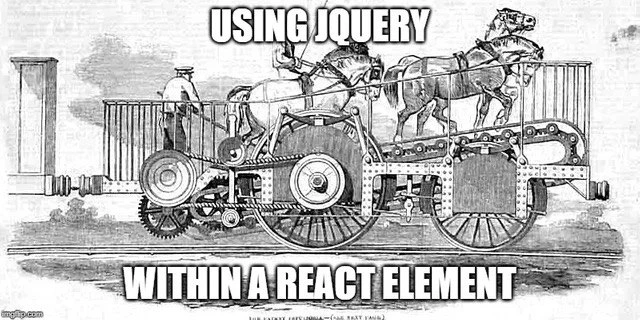
Imagine you have a super fancy sports car, but instead of using its powerful engine, you tie a horse to the front to pull it. 🐴🏎️ It sounds silly, right? The car is brand new and really fast, but using a horse to make it go defeats the whole purpose of having a car engine. This picture is funny for the same reason: it shows an old-fashioned solution powering a modern machine. In other words, someone took an old tool (a horse) to run a new high-tech vehicle (a locomotive train engine). It looks crazy and over-complicated, and that’s why it makes people laugh – it’s like mixing two things that just don’t fit together, all to solve a problem in the wackiest way possible.
Level 2: DOM Tug-of-War
The meme text flat-out spells the joke: “USING JQUERY … WITHIN A REACT ELEMENT.” For a junior developer or someone new to front-end, let’s break down why that combination is noteworthy (and funny). First, jQuery is a popular JavaScript library from the late 2000s that made it easier to interact with web pages. jQuery’s hallmark is the $ function, which lets you select elements from the HTML DOM (Document Object Model) and do things like change text, styles, or handle user clicks with simple commands. For example, with jQuery you might write $('#title').hide() to quickly hide an element with id “title”. It was beloved for smoothing over browser bugs and offering a quick way to make web pages interactive back when the web was simpler and less structured. It’s the “horse” in our story – dependable, strong, but a bit old-school in 2019’s context.
React, in contrast, is one of the modern JavaScript frameworks (technically a library) for building rich user interfaces, especially in what we call Single Page Applications (SPAs). In an SPA, instead of loading new pages all the time, the site dynamically updates the existing page based on user interactions – this is React’s specialty. React introduced a new component-based approach: you build UIs by composing components (think of them like Lego blocks of code for each part of the interface). React uses something clever under the hood called the Virtual DOM – essentially a lightweight copy of the DOM in memory. When your app’s state changes, React updates this virtual model and figures out the minimal, efficient changes needed in the real DOM to reflect the new state. This means as a developer, you typically don’t manually touch the actual DOM elements; you just tell React what the UI should look like for a given state (this is the declarative style of programming). React will handle how to make it so in the browser. It’s like you declare “I want a list of items here” and React ensures the DOM shows that list, adding or removing <li> elements as needed behind the scenes.
Now, mixing jQuery with React – why is that seen as an issue? The short answer: they have very different approaches to doing the same thing (updating the user interface), and using them together can cause conflicts and confusion. jQuery is thoroughly imperative: you directly manipulate the DOM elements whenever you need to change something, like telling each horse exactly when and where to step. React is declarative: you re-render components with new data, and React diffs the changes, kind of like an automatic engine adjusting the wheels. If you use jQuery within React, you’re basically taking manual control inside an automated system. It’s a bit like two people trying to drive one car at the same time. For instance, if a React component renders a <div> and then you use jQuery to addClass('hidden') on that <div> to hide it, React itself might not know that <div> was hidden. Later, if React decides to re-render that component (say, because some state updated), it might generate the <div> in its original, visible state again – effectively undoing the jQuery change. This can make the UI behavior unpredictable.
There’s also the matter of code clarity and maintenance. One big selling point of modern frameworks like React (or Angular/Vue) is that they provide a structured way to organize code: UI updates happen through React’s state and props, and there’s a known life-cycle for when components mount, update, and unmount. When you inject jQuery into that flow, you bypass those conventions. Suddenly, someone maintaining the code has to remember, “Oh right, this part of the UI isn’t updating via React’s state at all – there’s a jQuery plugin tweaking it directly.” That’s what we call an anti-pattern in frontend development – a practice you generally want to avoid because it breaks the expected pattern of how things should be done. It introduces technical debt: a kind of metaphorical “debt” you incur by choosing an easier or quicker fix now that you’ll have to pay back later with extra work or headaches. Using jQuery in a React codebase is often a quick fix or a carry-over from legacy code. It might solve an immediate problem (e.g., “we need this slideshow widget and there’s a jQuery plugin for it, just drop it in!”), but later on, other developers will struggle with the unwieldy combo, or you’ll have bugs when updating React or the jQuery library. It’s a bit of a maintenance nightmare – like having to feed and care for the horses (jQuery) and maintain the locomotive engine (React) in one vehicle.
Why would anyone do this then? There are a few common reasons:
- Legacy code: Perhaps the project started years ago with jQuery, and as it evolves, the team decides to use React for new features. During the transition, some old jQuery routines or plugins still stick around inside React components because rewriting them in React immediately would have been too costly or time-consuming.
- Existing plugins/libraries: jQuery has a huge ecosystem of plugins (for date pickers, modals, tooltips, etc.). In some cases, a React equivalent either wasn’t available at the time or wasn’t as mature, so developers shoehorn the jQuery plugin into the React app as a stop-gap.
- Familiarity: A developer might be new to React and fall back to what they know – jQuery – to accomplish a task quickly. If someone hasn’t fully embraced React’s way of thinking, they might instinctively reach for
$()to manipulate something because “hey, that’s how I know to do it from before.” It’s like muscle memory from the previous generation of tools.
The meme’s imagery – horses pushing a hi-tech train – emphasizes how backwards or inefficient this pairing feels. React is capable of doing everything jQuery can through its own mechanisms (event handling, DOM updates, animations via CSS-in-JS or React libraries, etc.). Including jQuery is redundant, and it introduces complexity rather than reducing it. In modern frontend projects, you typically choose one approach: either you go all-in on a framework like React, or if you’re keeping it simple or legacy, you might stick to jQuery. Blending them means you now have two engines running your page, which often is over-engineering the solution. Over-engineering means you’ve made something more complicated than necessary for the task at hand – like building an elaborate treadmill contraption for horses instead of just using a fuel engine that’s already there.
From a junior dev perspective, if you encounter code that uses ReactDOM.render(...) to mount a React component, and then inside that component’s code you see jQuery’s $('.some-selector'), that’s a red flag. It doesn’t automatically mean the code won’t work, but it means you need to pay extra attention. You’ll likely have to deal with two different coding patterns and be cautious about things like updating the DOM in the right order. Many teams establish guidelines to avoid mixing these, precisely to prevent the kind of confusion and bugs that can arise. Think of it as two chefs in one kitchen working on the same dish – if they’re not perfectly in sync, one might be adding salt while the other already plated the food.
In summary, “Using jQuery within a React element” became a bit of an inside joke about doing something the hard or wrong way in frontend development. It highlights a legacy workaround that betrays the elegance of the modern solution. The reason experienced devs smirk at it is because they know exactly the kind of headaches this causes, and they’d prefer to either update that jQuery code to React or avoid that mix altogether. The meme cleverly captures this sentiment with a visual gag: an advanced locomotive (modern frontend) absurdly rigged up to run on literal horse power (outdated method). It’s frontline Frontend Humor about legacy code and tech debt that even newer developers can understand once they know the context.
Level 3: jQuery Horsepower
At first glance, the meme’s Victorian locomotive contraption is a perfect metaphor for mixing old and new tech. Imagine a state-of-the-art React frontend (the locomotive) being powered by good old jQuery (the horses on a treadmill). This absurd engine design hits home for senior front-end developers who have seen this kind of anachronistic tech stack in the wild. It humorously illustrates a framework mismatch: React is a modern, component-based UI library relying on a Virtual DOM “engine”, while jQuery is an older, low-level tool that directly manipulates the actual DOM. Using jQuery inside a React component is like bolting a horse treadmill onto a locomotive – it technically can move things forward, but it’s clunky, redundant, and a bit ridiculous from an architectural standpoint.
Behind the humor lies a commentary on imperative vs declarative programming paradigms in frontend development. jQuery encourages an imperative style: you directly tell the browser how to change the UI step-by-step (e.g., “find this button and hide it now”). React, on the other hand, uses a declarative style: you describe what the UI should look like given some state, and React figures out the DOM changes for you (like “the button is hidden if isVisible is false”). When a developer shoves jQuery into React’s world, they’re effectively inserting an imperative “treadmill” inside a declarative “engine room”. The two approaches can work at odds. For example, if jQuery directly manipulates a DOM element that React also manages, React’s Virtual DOM diff might later overwrite those changes because React wasn’t aware of them. It’s a tug-of-war on the DOM: jQuery yanks an element one way, React’s re-render yanks it another. Seasoned devs chuckle (or groan) at this because they know it leads to fragile code and weird bugs, much like a horse-powered train likely has interesting reliability issues.
This meme also winks at the reality of technical debt and legacy integration. Often, teams adopt React for new development but still have legacy jQuery plugins or snippets they can’t entirely escape. Rather than rewriting that perfectly good (albeit old) jQuery date picker or carousel from scratch, someone might drop it into a React component “just for now”. Bam – you’ve got horses hitched to your shiny new locomotive. Sure, it moves, but now you have to maintain a hybrid system. Every senior frontender knows the pain of debugging a React app where, deep inside a component, a wild $(...) jQuery call is loose, doing mysterious DOM things outside React’s knowledge. It’s the kind of frontend antipattern that triggers war stories: “Remember that time we found a jQuery UI widget hidden in our React code causing random DOM glitches? Good times.” The visual of an elegant train clattering along on literal horse power perfectly captures that feeling of an over-engineered hack. It’s both funny and painfully relatable – the codebase equivalent of a steampunk Frankenstein.
To illustrate how this happens, consider a React component that tries to use jQuery on a DOM element it renders:
import React, { useEffect, useRef } from 'react';
import $ from 'jquery';
function LegacyPoweredButton() {
const buttonRef = useRef(null);
useEffect(() => {
// 🐴 Using jQuery to imperatively manipulate a React DOM node
$(buttonRef.current).text('Click me (powered by jQuery)');
$(buttonRef.current).on('click', () => {
alert('This click handled by jQuery!');
});
// Imagine more jQuery plugins being initialized here...
}, []);
return <button ref={buttonRef}>Regular React Button</button>;
}
In this snippet, the React component renders a <button> and then, in useEffect, uses jQuery ($) to change the button’s text and attach a click handler. This is analogous to putting horses on a treadmill to run the train’s wheels. It works, but now two systems are in play: React rendered the button and thinks it controls it, but jQuery swoops in to directly modify it. If later the React state changes and the component re-renders, React will regenerate the button (with the original text “Regular React Button”), wiping out the jQuery text change. The jQuery event handler might survive or might get lost if the DOM node is replaced. The developers now must coordinate between React’s lifecycle and jQuery’s direct DOM manipulations, which is as finicky as synchronizing horses with an engine. No surprise, this can lead to race conditions, stale UI state, or “why isn’t my onClick firing?” confusion. Seasoned devs have learned that if you treat React’s render output as sacrosanct and avoid outside interference, life is easier. So encountering jQuery inside React is a warning sign that the app’s architecture has a makeshift, legacy-powered subsystem. It screams technical debt: a solution that made sense under time pressure or legacy constraints, but will cause maintenance headaches down the road.
Ultimately, the meme gets a laugh (and a wince) from experienced developers because it exaggerates a real-world scenario. It’s a gentle roast of those projects where the new SPA framework is in place, yet the team can’t fully let go of the old habits and libraries. The result is a monstrous hybrid — an app that’s part modern React locomotive, part old-school jQuery haywagon. Anyone who’s spent late nights untangling such a system can appreciate the absurdity. Using jQuery within a React element feels as backward as driving a train with horses: yes, it’ll move, but everyone who sees it will ask “Wait, why on earth are we doing this?!”
Description
A black-and-white, historical-style illustration depicts an absurd piece of machinery on a railway track. It's a train car powered by two horses walking on an internal treadmill, which is connected by gears and belts to the wheels. White text with a black outline is superimposed on the image, with 'USING JQUERY' at the top and 'WITHIN A REACT ELEMENT' at the bottom. The meme humorously critiques the practice of using jQuery, a library for direct DOM manipulation, inside a React component. React's architecture is based on a virtual DOM, where it controls rendering and updates. Introducing jQuery to manipulate the DOM directly undermines React's state management and performance optimizations, creating a clumsy, inefficient, and bug-prone anti-pattern, much like powering a modern train with a horse treadmill
Comments
7Comment deleted
Using jQuery in a React component is the ultimate vote of no confidence in the virtual DOM. It's like saying, 'I've seen your declarative state management, and I'd rather trust these two horses to get me there.'
Ship it: React’s concurrent renderer reconciling a DOM that $('#modal').toggle() already mutated - nothing like speculative rendering on top of century-old horsepower
When the senior dev who "doesn't trust frameworks" finally agrees to use React but insists on bringing their 2009 jQuery plugins along because "they've never let me down."
Mixing jQuery's direct DOM manipulation with React's virtual DOM is like attaching a horse-drawn carriage to a Tesla - technically possible, but you're bypassing every architectural decision that made the modern approach valuable. You'll spend more time debugging reconciliation conflicts and state desynchronization than it would've taken to just write proper React components. The real kicker? Your code reviews will feature the phrase 'but it works on my machine' more often than a Windows 95 compatibility discussion
Using $(el) inside useEffect is like bolting a horse treadmill onto the reconciler: it moves, but you pay later in ghost handlers, desynced state, and 3am hydration tears
jQuery in React: imperative DOM thrashing meets declarative bliss - like assembly inlining a React hook, pure masochistic elegance
Using jQuery inside React is bolting a horse to a locomotive: the DOM moves, then StrictMode runs twice and the reconciler swears the hoofprints are “uncontrolled.”