When the Documentation Was Written in a Different Season
Why is this Documentation meme funny?
Level 1: Mixed Signals
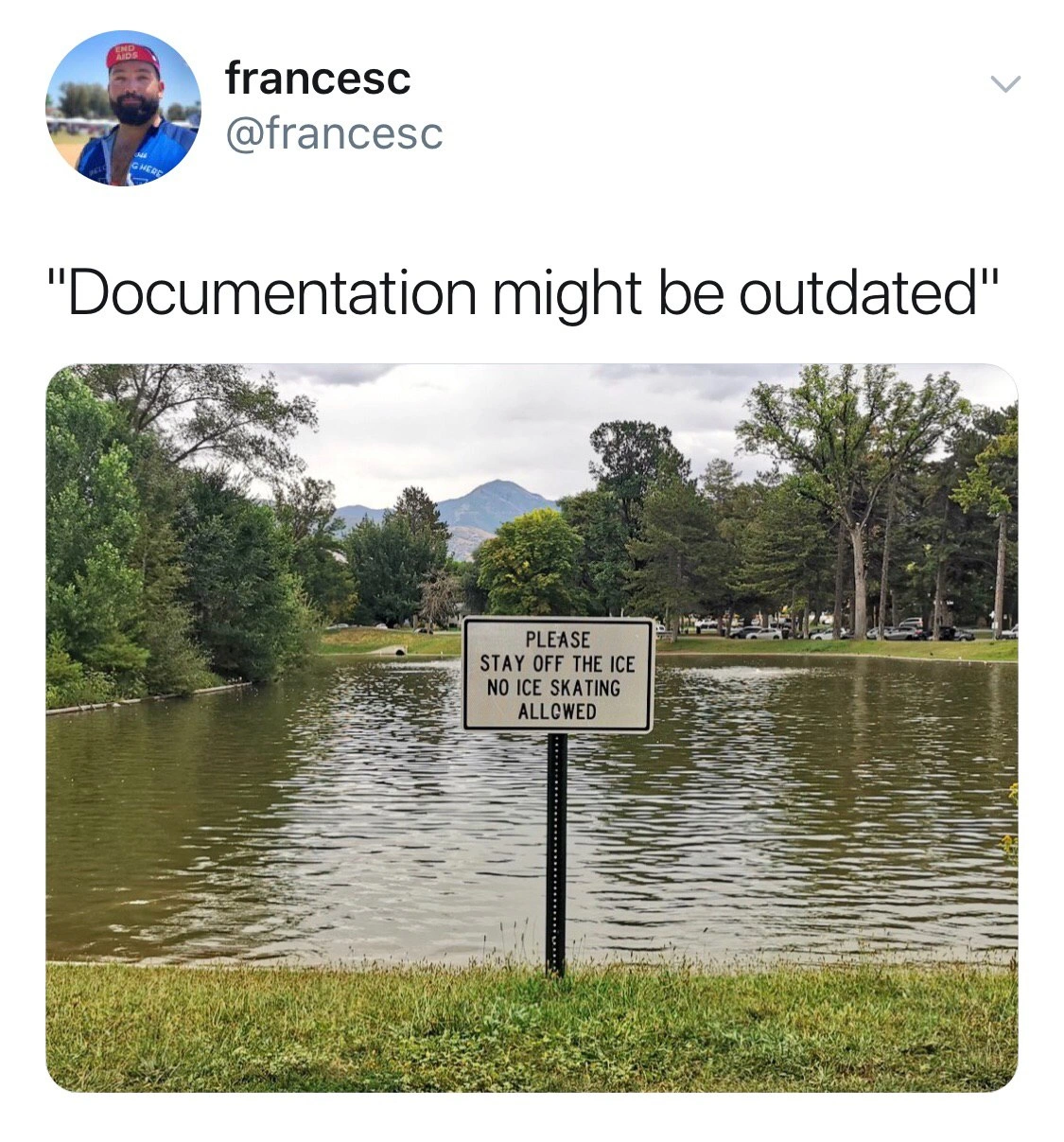
Imagine you go to a pond on a hot summer day, and there’s a big sign that says “No skating on the ice!” You’d probably look at the water and think, “Huh? What ice?” It’s funny because the rule on the sign doesn’t match the world you see – there’s just water, no ice at all. This is like when you read instructions or rules that were made for a long time ago and nobody updated them. It’s confusing and a little silly. The sign is giving you the wrong warning. In simple terms, the joke is showing how silly it is when instructions don’t match reality. Just as you wouldn’t worry about ice skating in July, a developer shouldn’t have to worry about old problems that no longer exist. The picture makes us laugh because it’s a clear case of someone forgetting to change a warning, and we all know how goofy that feels when it happens.
Level 2: Outdated Warnings
Think of software documentation as all the written guides, README files, and comments that tell developers how to use or maintain code. Good documentation is like clear signage: it warns about dangers, explains how to do things safely, and sets expectations. But sometimes these signs (or docs) don’t get updated when things change. Outdated documentation happens when the codebase or environment has moved on, but the instructions still reflect old information. In the meme’s image, the sign that says “No Ice Skating Allowed” is a bit like a README file that hasn’t been edited after a big update. The sign warned skaters in winter when the pond had ice; that made sense at the time. But now it’s summer (no ice at all), so the warning is unnecessary and even confusing. This mismatch is exactly what developers mean by documentation being outdated or stale.
For a junior developer, encountering outdated docs can be perplexing. Imagine you read a project’s README.md (the main guide in many code projects) and it tells you to run a command or use an API that no longer exists. You might spend hours trying to follow those steps, only to realize the code changed and the docs didn’t. It’s a common DeveloperExperience issue: the experience of using the software is frustrating because the guidance is wrong. This is often considered a type of technical debt (TechDebt). Normally, technical debt refers to shortcuts in code that we’ll “fix later,” but it also includes documentation that wasn’t updated. It’s a “debt” because eventually someone has to pay the cost (in time and effort) to correct it. Outdated docs are like an old map – at one point it was accurate, but now roads have moved.
Let’s break down the analogy: the signage vs reality gap. The sign in the photo literally reads:
PLEASE
STAY OFF THE ICE
NO ICE SKATING ALLOWED
This would be perfectly reasonable in January if the pond were frozen solid! It’s warning people not to skate on thin ice for their safety. In software, an equivalent might be documentation that says “Don’t use Module X because it’s unstable” (a fair warning in early versions). Now fast forward to July: the pond is just water with ducks swimming; there is no ice. Likewise in code, maybe Module X has been fixed or removed entirely in the latest version. The old warning remains like a ghost. This obsolete README analogy is clear: an instruction intended for an earlier state is left hanging around in a later state where it no longer applies.
Some terms here: DocumentationWoes just means problems or frustrations with documentation (like this scenario). DocumentationGap refers to the gap between what the docs say and what the actual situation is. And DX (Developer Experience) is a term for how easy and pleasant it is for developers to get things done – good, up-to-date docs = good DX, while outdated docs = bad DX. When you encounter a sign or note that’s clearly out of date, it’s both funny and annoying. Funny, because it’s obviously wrong given what you see; annoying, because if you hadn’t looked carefully, you might have believed it and wasted time. That’s why this meme resonates with developers: it’s a relatable situation where expectations (set by documentation) and reality (the running software or environment) do not match.
For example, say you join a new team and their wiki page for setting up the project mentions steps for a database that they don’t even use anymore. You try to follow along, but nothing works as described. Eventually a teammate says, “Oh yeah, we switched to a different database last year – that doc is outdated.” You realize you’ve been reading “the no-ice-skating sign in summer.” The documentation wasn’t maliciously wrong; it was just never updated. Now you’ve learned to always double-check the date or version of docs. Maybe you even help update the README so the next person isn’t misled. In summary, outdated warnings in documentation are like signs for a danger that’s not there: a source of confusion and a reminder that things change, and instructions must change with them.
Level 3: Docs Frozen in Time
In this meme, a tweet by @francesc shows a park sign still warning “STAY OFF THE ICE – NO ICE SKATING” in the middle of summer. It’s a perfectly absurd analogy for outdated documentation in software projects. The physical sign is a form of documentation that made sense last winter, but now it’s July and the pond is liquid. Likewise, a project’s README or API docs might sternly warn about conditions or bugs that were true in a past release but have long since melted away. This humorous scenario highlights a classic case of DocumentationWoes: instructions that no longer match reality. Seasoned developers immediately recognize the signage vs reality gap here as the same DocumentationGap they’ve seen in code. The DeveloperExperience suffers when you’re scratching your head over warnings that feel about as real as skating on a summer pond.
Out-of-sync documentation is basically a form of TechDebt. Just as leaving a winter sign up all year is easier than updating it, engineering teams sometimes neglect to update docs after rapid code changes. The result? Misaligned expectations. New developers read the docs and expect “ice,” but the running software has changed seasons. This can lead to confusion, wasted effort, or even errors if someone tries to follow steps that are no longer valid. A senior engineer might chuckle (or sigh) at this because they’ve been there: reading obsolete READMEs that sternly prohibit doing something that’s actually perfectly fine now. We laugh at this DocumentationHumor because it’s painfully relatable — a shared RelatablePain across the industry.
To illustrate, consider the disparity between what documentation warns and what the code actually does:
| Documentation Warns (Outdated) | Actual Reality (Current) |
|---|---|
| “Please stay off the ice.” – Implies a frozen hazard that was relevant months ago. | It’s midsummer. The pond (or production environment) has no ice at all. The hazard is long gone. |
“Call initLegacy() before starting the app.” – README insists on an old initialization step. |
The latest version removed that function entirely. Following the doc would cause an error (nothing to skate on). |
Such inconsistencies are a hallmark of neglected docs. Experienced devs often develop a sixth sense for this: if a warning in docs feels oddly out of place, they double-check the code or change log. They know documentation can rot if not maintained, much like a sign left unchanged through the seasons. In fact, one running joke is that the only up-to-date documentation is the code itself (the ultimate source of truth). This meme nails that feeling: the sign’s caution is technically correct… at one point in time. But now it’s just comedic noise, much like an outdated comment or wiki page that no one removed after a refactor. The photo perfectly captures the essence of DocumentationHumor in tech: we encounter “important” guidelines that, in reality, have become irrelevant relics.
Why does this keep happening? Teams get busy; features ship fast; who has time to go back and update the manual? It’s the same reason a park might leave a “No Ice Skating” sign up year-round — procedural inertia or oversight. Removing or updating it is low priority until someone points out the absurdity. In software, updating docs often doesn’t feel urgent, especially if the people who know the changes assume “everyone on the team knows about it.” Over time, these outdated notes accumulate as documentation TechDebt. When new folks join or external developers use the API, they hit these misleading instructions, leading to frustration and lost productivity. It’s a hit to DeveloperExperience_DX: nothing says “welcome to the codebase” like a guide that sends you on a wild goose chase! Senior devs have learned to approach docs with a hint of skepticism, much like you’d eye a “CAUTION: ICE” sign during a heatwave. The humor in the meme comes with a sigh of recognition — we’ve all been that swimmer in July reading about ice.
Description
A screenshot of a tweet from user 'francesc' with the caption '"Documentation might be outdated"'. Below the text is a photograph of a placid lake surrounded by lush green grass and trees, under a cloudy sky. In the foreground, there is a white rectangular sign on a black post. The sign reads in all caps: 'PLEASE STAY OFF THE ICE NO ICE SKATING ALLOWED'. The humor comes from the stark contrast between the sign's warning and the obvious lack of ice on the lake, perfectly illustrating how documentation can become completely irrelevant and disconnected from the actual state of a system. It's a visual metaphor for encountering instructions or comments in a codebase that describe a feature or behavior that was changed or removed long ago
Comments
7Comment deleted
I trust the documentation about as much as I trust a 'TODO: fix this later' comment from 2012. Both are technically present, but functionally, they're just fossils
That sign is basically our onboarding wiki: “whatever you do, don’t touch the CVS lockfiles” - we’re knee-deep in Kubernetes, but sure, I’ll watch out for ice in July
This is the README still insisting you need Docker Desktop when the entire team switched to Colima six months ago after the licensing change
This is the software equivalent of finding a README that says 'just run npm install' on a project that migrated to pnpm three years ago, has a .nvmrc requiring Node 18, needs Docker Compose v2 syntax, and oh by the way, you'll need to manually provision seven AWS resources first because the Terraform configs were never committed. The sign isn't wrong per se - there probably *was* ice at some point - it's just that nobody bothered to update it when the entire lake decided to become a different phase of matter. Much like that Confluence page from 2019 that's still the top Google result for your internal API, confidently describing endpoints that were deprecated before your current tech lead even joined the company
Like Swagger specs post-refactor: warns of endpoints that 404'd seasons ago
Documentation: a cache of reality with a TTL of “last winter” - hence the “no ice skating” warning in summer prod
Documentation is an eventually consistent cache of production - writes happen in winter, reads in July