The Self-Approving Pull Request
Why is this VersionControl meme funny?
Level 1: Giving Yourself a Trophy
Imagine you just finished a school project and, without any teacher or classmates checking it, you stand up and give yourself a big gold trophy saying “Best Work Ever!” That’s what’s happening in this meme. In programming, when people write code, they usually let a friend or teammate look at it before it becomes part of the main app or game – kind of like asking a friend to check your homework. Usually, someone else saying “Great job, it’s correct!” is what makes it official. But in this picture, the developer skipped that step and just decided on their own that their work was awesome and put it in the final product.
It’s funny because it’s so self-congratulatory – the person is basically patting themselves on the back. Normally, getting a medal or a trophy feels good because it comes from someone else recognizing your effort. If you just give it to yourself, it doesn’t quite count – it’s silly! So the meme is joking that this programmer opened a request for review (which is supposed to be checked by others), but then immediately approved it and merged it without waiting for anyone. It’s like writing a story and declaring it the winner of a contest that you also judged. Everyone can laugh at how goofy that is, because we know the whole point was to get a second opinion. In simple terms: the developer is giving themselves the prize without playing by the normal rules, and that little cheeky shortcut is what makes it humorous and relatable.
Level 2: DIY Code Review
Let’s break down what’s happening here in practical terms. In software teams using Git (a popular version control system), developers manage code changes through a process of branching, pull requests, and merges. A Pull Request (PR) is basically a request to merge code from one branch into another (often into the main code branch). When you open a pull request, it’s customary to have other team members perform a code review: they read through the code changes, make comments, ask questions, and ultimately approve or request modifications. This ensures code quality and catches mistakes early. On GitHub, when someone approves your pull request, it’s like getting a green light that says “another set of eyes has checked this; it looks good to merge.”
In a normal workflow, the steps look like:
- Open a Pull Request: You, the developer, push your code changes to a new branch and create a PR. Maybe you give it a descriptive title like “Add feature X” and a summary of what it does.
- Await Review: Your colleagues (or project maintainers) get notified. One or more of them will review the code. They might point out an issue (like “hey, this function can crash if input is null”), suggest improvements, or in the best case, say “LGTM” (Looks Good To Me).
- Incorporate Feedback: You make any needed changes. This back-and-forth continues until reviewers are satisfied.
- Merge: Someone (often not the original author, depending on policy) clicks the “Merge” button on the PR, integrating the changes into the main codebase. Success! The code is now officially part of the project.
Now, what the meme describes is basically skipping steps 2 and 3. The same person who opened the PR immediately does the merge. It’s like hitting fast-forward on the process: Open PR → Merge → Done. There’s no peer feedback at all. This is generally considered a code_review_anti_pattern for team projects. Why? Because the whole point of a PR is to get another person’s eyes on the code. When the reviewer is the author, you lose the benefit of an independent check. It’s akin to writing a novel and publishing it without anyone proofreading it — risky! The tag self_merge_pr precisely names this scenario: it’s a pull request merged by its own author.
For a junior developer or someone new to VersionControl workflows, here are a few key terms and why this scenario is abnormal:
- Git: The tool that manages versions of code. It lets multiple developers work on a codebase, each on their own branch, then merge changes together. It keeps history of changes (commits) and can highlight differences (diffs) between commits.
- GitHub: A popular platform built on Git. It provides a nice interface for collaboration. On GitHub (and similar platforms like GitLab or Bitbucket), a pull request is how you propose integrating your changes. It comes with discussion threads, reviewer assignment, and checks (like automated tests) that run before merging. Think of a pull request as a “merge proposal with a discussion forum attached.”
- Code Review: The practice of examining someone’s code changes. Reviewers look for bugs, readability, adherence to style guidelines, and whether the changes make sense. They might spot something the original coder didn’t think about. It’s a quality control step and also a learning opportunity for everyone involved.
- Approval: In the context of a PR, an approval is a formal “thumbs up” from a reviewer. On GitHub, reviewers can submit reviews that Approve or Request Changes (or just Comment). Projects often require at least one or two Approve reviews before the PR can be merged.
- Merge: To merge means to apply the changes from the PR branch into the target branch (often the main branch). After merging, the feature branch’s code becomes part of the main codebase. Merging typically is the last step after approvals. If two sets of changes touched the same part of code in conflicting ways, a Merge Conflict can happen, which requires manual resolution. Proper communication and review can help avoid merge conflicts or handle them smoothly – one more reason having others involved is good.
When one person does all these steps alone (opens the PR, reviews it, and merges it), it’s usually because of one of a few reasons: maybe it’s a solo project (so there truly is no one else to review), or perhaps it’s a time-sensitive hotfix that needs to go out immediately, or unfortunately, the developer bypassed the rules. In team settings, bypassing code review is discouraged because it can allow bad code to slip in unnoticed. Many teams set up branch protection on GitHub so you actually cannot merge your own pull request without someone else’s approval or at least a review from a different account. This meme highlights in a lighthearted way what not to do: treating the code review process as a mere formality where you give yourself the green checkmark.
For someone new: if you ever see a teammate do this or feel tempted to merge your own PR without review, know that it’s usually done with a wink and some context. Maybe you comment on your PR “Self-approving due to urgency” if it’s absolutely necessary. But as a rule of thumb, having someone else review your code is like having a safety net. They might catch a mistake you overlooked, or simply confirm that your change makes sense. Skipping that net is like walking a tightrope without looking – you might be fine, but it’s not a good habit. The humor of the meme comes from the fact that every developer understands the itch to just quickly merge something you worked hard on, and the absurd self-congratulation that goes with it. It’s essentially the GitHub version of giving yourself a round of applause in an empty room.
Level 3: Merge Without Peer
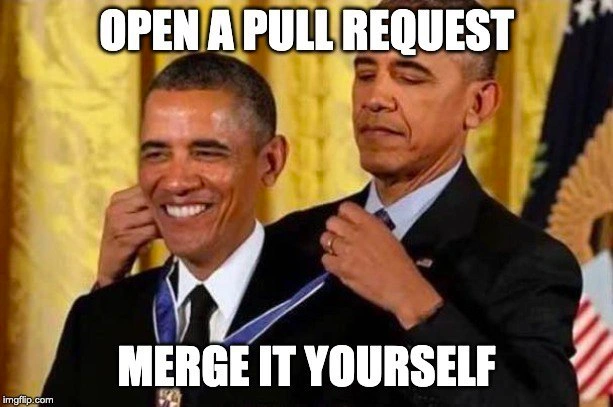
This meme is a nod to the code review process gone comically wrong. In a healthy development workflow, opening a Pull Request on a platform like GitHub signals “Hey team, please review my code changes.” It's meant to invite peers to critique and approve your work. But here, the developer does a solo act: they open the PR and then immediately merge it themselves. The image of President Obama awarding a medal to himself perfectly visualizes this scenario — the developer is both the author and the congratulator, literally giving themselves a pat on the back via the big "Merge" button. This self-congratulatory loop is funny because it violates an unspoken rule of collaborative programming: don't be your own reviewer.
Why is that a rule? Because doing a code review on your own code is like proofreading your own essay — your brain tends to skip over mistakes since it already knows what it intended. In real teams, peer review is there to catch bugs, enforce quality standards, and spread knowledge. The humor here comes from the shared experience of developers who have seen (or done) this anti-pattern. Maybe it was a rushed Friday deployment where nobody else was around, or a small project where you are the only contributor. Either way, merging your own PR is essentially bypassing the safety net. It's a workflow shortcut (or more bluntly, a bypassing_code_review move) that most of us know is risky, yet DeveloperHumor reminds us that it happens.
Inside many organizations, there are safeguards to prevent exactly this scenario. For example, repositories often have branch protection rules requiring at least one approval from someone other than the author before you can merge. These rules exist because they know the temptation of “self-approve and ship it” is real when deadlines loom or confidence is high. The meme’s text “OPEN A PULL REQUEST — MERGE IT YOURSELF” is basically saying “I filed the paperwork and stamped it approved all by myself.” It’s the programming equivalent of writing an exam and then grading it A+ on your own. Seasoned devs chuckle (and cringe) at this because we've seen how it can backfire: unchecked code might introduce a nasty bug or MergeConflict that a second pair of eyes could have spotted. It’s a “reward” that can turn into a 3 A.M. on-call hotfix medal of shame later.
In short, the meme pokes fun at the self_merge_pr phenomenon – a proud but dubious moment in a developer’s life. It captures the absurdity of skipping the crucial peer review step and essentially saying “Looks good to me! (I wrote it, of course it looks good)”. As a joke follow-up, developers often quip: “Don't forget to approve it yourself first 😉.” In other words, if you’re going to give yourself the medal, you might as well rubber-stamp your own code review too. The sarcasm highlights that this practice is as tongue-in-cheek as the meme itself. Everyone gets a laugh because it’s a scenario that walks the line between confident and foolhardy — and we’ve all been there at least once.
Description
This meme uses the popular format of former U.S. President Barack Obama awarding a medal to himself. In the image, a smiling Obama is receiving a medal, which is being placed around his neck by a more serious-looking Obama standing behind him. White text with a black outline is superimposed over the image. The top text reads 'OPEN A PULL REQUEST', and the bottom text says 'MERGE IT YOURSELF'. The joke satirizes the practice of a developer opening a pull request - a formal request for code review - and then immediately merging it without waiting for feedback or approval from peers. This action completely defeats the purpose of a code review, which is to catch bugs, improve code quality, and share knowledge. It's a humorous take on a developer shortcut that's often seen as a sign of arrogance or poor team collaboration
Comments
7Comment deleted
Some call it bypassing code review. I call it achieving consensus in a team of one
Branch protection requires two reviewers, so I made a second GitHub account called “ComplianceBot” - LGTM, ship it
The same developer who wrote "// TODO: add proper error handling" three years ago and just marked the PR as "ready for review" with two approving thumbs up from their own alt accounts
The eternal struggle of the senior engineer: championing rigorous PR review processes in architecture meetings while secretly maintaining a personal fork with branch protection disabled for 'emergency hotfixes.' We've all been that person who writes comprehensive CONTRIBUTING.md guidelines about mandatory peer reviews, then at 11 PM realizes we have merge permissions and the deploy window closes in an hour. It's the engineering equivalent of being both the cop and the criminal - preaching CODEOWNERS files and required approvals by day, then discovering git push --force --no-verify works just fine when nobody's watching
Open a PR, merge it yourself - branch protection set to “honor system”; CI pins the medal, the bot signs the audit log, and the bus factor politely remains 1
Self-merging a PR is basically running Raft with one voter - liveness solved, safety optional
Checks and balances? In a one-dev repo, it's unanimous self-governance every merge