Programmer Says One Hour Bug Fix But Needs Reminders Every Two Hours
Why is this Bugs meme funny?
Level 1: Are We There Yet?
Imagine you’re on a long car ride and you tell your family it’ll take about an hour to reach the destination. Now picture a little kid in the back seat who asks, “Are we there yet?” every five minutes along the way. It doesn't matter that you already gave an answer — the constant asking isn’t going to make the car go any faster. In fact, it just makes the driver a bit annoyed and distracted. In this meme’s scenario, the programmer is like the driver trying to “get to the destination” (which is fixing the bug), and the manager is like that impatient kid repeatedly asking if you’ve arrived (if the bug is fixed). The meme is humorously saying: if someone already told you how long something will take, trust them and let them do it. Keep calm, sit back, and we’ll get there when we get there. Constantly asking “Is it done now?” doesn’t help anyone — just like asking “Are we there yet?” over and over doesn’t shorten the trip. That’s why it’s funny: because deep down we all know it’s true, yet we can easily see ourselves (or others) doing the exact same silly thing out of impatience.
Level 2: Bugging the Debugger
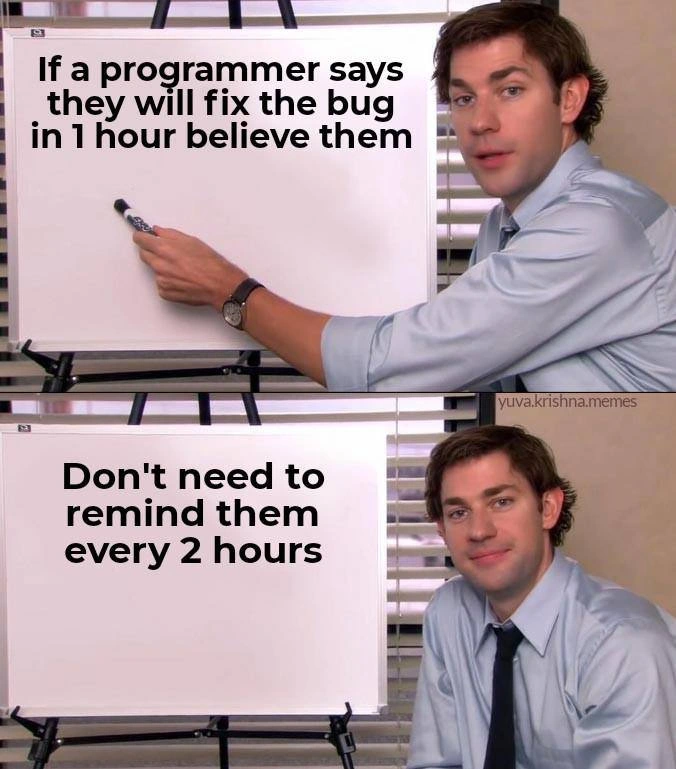
This meme delivers a simple lesson about trust during the bug-fixing process. It shows Jim Halpert (a character from The Office) pointing to a flip chart, which is a popular meme format for presenting an obvious truth. The message on the board basically says: if a developer tells you a bug will be fixed in one hour, believe them. And the follow-up joke is: you don’t need to keep asking them about it every two hours. In plainer terms, it’s telling managers or anyone waiting on a fix, “Don’t keep nagging; the programmer’s got it under control.”
Let’s unpack the scenario in a straightforward way. First, what’s a bug? In software, a bug is a mistake or problem in the code that causes the program to malfunction or produce a wrong result — maybe the app crashes, or a feature isn’t working the way it should. Debugging (or troubleshooting) is the process of finding what’s causing that problem and then fixing it. Sometimes a bug can be something simple that you spot right away, and other times it’s like a little mystery you have to solve by searching through the code.
Now, when something breaks and needs fixing, managers often ask developers for an estimate: “How long do you think it will take to fix this?” That estimate is often called an ETA (estimated time of arrival, meaning roughly how long until it’s done). In the meme’s case, the developer said it would take about one hour to fix the bug. That’s their best guess, based on what they know at the start.
Here’s where the joke comes in. A manager with a micromanaging streak might not just sit back and wait quietly for that one hour to pass. Instead, they might check in repeatedly — like every 30 minutes or, as the meme exaggerates, every 2 hours — asking “Is it done yet?” or “How’s it going now?” The meme pokes fun at that behavior. The top line is basically saying “trust the programmer’s word,” and the bottom line humorously adds “don’t hover over them or keep asking for updates.”
The phrase “manager polling loops” in the title is a play on words mixing a management habit with a programming concept. In programming, a polling loop is when code repeatedly checks if something has happened yet. Imagine writing a loop that goes, “Are we there yet? No? Check again. Still no? Check again...” over and over. That’s polling: the code is constantly asking for a status instead of waiting to be told the result. It can be inefficient because it uses a lot of unnecessary checks when nothing has changed. Now apply this idea to a manager who messages a developer every so often for an update. The manager is essentially running a manual polling loop: “Ask for status, wait a bit, ask again, wait, ask again…” Experienced developers find this analogy funny because in software we know that polling in a tight loop is usually a bad idea — and it’s just as counterproductive when a person does it in real life.
Why is constant checking bad in real life? Because when a programmer is fixing a bug, they need time to focus and think. If they are interrupted often, they lose that focus. In tech terms, each interruption forces a context switch for the developer’s brain. That’s like if you’re in the middle of solving a tricky puzzle and someone taps you on the shoulder every few minutes to ask how it’s going. You have to stop, answer them, and then it takes a moment to remember where you were in the puzzle when you try to get back to it. All those little pauses add up, making the whole problem take longer to solve. So if a developer said “I need an hour,” but instead of being left to concentrate they have to stop and update people multiple times, that hour might stretch into much more.
The meme’s advice is pretty clear: once you’ve been given a timeline for a fix, be patient. Trust that the person is working on it. Communication is important, yes — the developer should let the manager know if the issue turns out to be bigger than expected, or if it’s resolved sooner. But constant “Did you fix it yet?” messages don’t help the fix happen any faster. In fact, they can do the opposite by breaking the developer’s flow. Most programmers want to fix the bug as quickly as possible too (nobody likes a critical bug hanging over their head or a project being stuck), so they have every incentive to get it done promptly. They don’t need extra reminders; what they need is the breathing room to concentrate.
Think of it this way: if your mom is baking a cake and she says it’ll be ready in an hour, asking her every 5 minutes “Is the cake done yet?” isn’t going to make it bake faster. She might even get a little annoyed and tell you to wait patiently. Similarly, in a team, if a developer says “I should have this sorted out in about an hour,” the best course is to let them work for that hour. If two hours go by and you haven’t heard anything, it’s reasonable to check in once and see if everything’s okay or if they need help. But messaging them every few minutes or even every half-hour for status updates will likely just distract them. That’s why this meme strikes a chord with so many programmers — it humorously highlights a truth that everyone in software development learns sooner or later: constant interruptions = slower progress.
For someone new to the industry, the key takeaway is that trust and patience really improve teamwork. When you’re the developer, it’s important to communicate realistic timelines and update your team if things change. And when you’re the manager or the person waiting on the result, it’s important to give your developers the space to do their work without unnecessary pressure. The meme makes this point in a funny, relatable way — essentially saying “we know you mean well by checking in, but please, we heard you the first time!”
Level 3: Polling vs Productivity
We've all been there: you confidently give an optimistic bug fix estimate of one hour, and then dive into the code to troubleshoot. Minutes later, your manager starts doing what feels like a while loop of status checks. This meme nails that scenario with a dose of sarcasm. In the classic Jim Halpert whiteboard format (from The Office, a meme where Jim presents a simple truth on a flip chart), the top panel reads: "If a programmer says they will fix the bug in 1 hour, believe them." The bottom panel completes the thought: "Don’t need to remind them every 2 hours." To a seasoned engineer, the humor is immediate. It's pointing out how micromanagement and over-eager manager expectations actually backfire. After all, if it truly only takes one hour to fix a bug, why on earth would you need to check every two hours? That contradiction highlights the absurdity: either the initial 1-hour estimate was overly hopeful (we've all low-balled a bug fix ETA under pressure), or the manager just can't resist hovering, effectively doubling the timeline with needless check-ins.
From a technical lens, the manager's behavior is analogous to a polling loop in computing — continuously checking a condition instead of waiting for a notification or result. Polling is a well-known anti-pattern when misused: it wastes resources and introduces overhead. Here, the manager repeatedly asking “Is it done now?” is like a program that hammers a flag in memory every few seconds to see if a task is finished. Both are inefficient. In code, we'd prefer an event-driven approach or a callback (let the process notify us when it's done) to avoid burning CPU cycles. In the office, the smarter approach would be letting the developer notify the manager when the fix is ready, rather than constant manual checks.
Every time the manager "polls" the developer, the developer is forced into a context switch. In operating systems, a context switch is when the CPU switches from one task (or thread/process) to another, incurring overhead to save and load state. For a person, a context switch means losing your train of thought. The programmer has to drop their mental model of the problem — variables, code paths, hypotheses — and attend to the interruption. Later, when they return to the code, they must re-load all that context in their brain to continue the debugging. It's like the memory cache gets cold each time. As a result, the "one-hour" fix can easily turn into two or three hours. Not because the bug was impossible, but because the process was slowed down by breaks in focus. Whatever small time it takes to answer a quick question, it often costs significantly more time to rebuild the state of mind needed to solve a complex problem.
Let's put that in pseudo-code for clarity:
while (!bugFixed) {
manager.checkStatus(); // Manager "polling" for an update
developer.pauseDebugging(); // Developer stops to answer the ping
// ... Each context switch like this adds delay to the fix ...
}
In this snippet, the task isn't getting completed any faster. In fact, the loop of constant queries (checkStatus()) actively prevents progress by diverting the developer's attention. It's as if the manager wrote a piece of code that inadvertently slows down the very outcome they want. There's a darkly comic truth here: the manager’s well-intentioned updates behave like an inefficient busy-wait that consumes the one resource you can't parallelize – focused developer time.
For an experienced dev, this meme triggers painful flashbacks and knowing chuckles. Many of us have lived through the “any update?” nightmare. Maybe it was that production outage at 3 AM where every executive kept jumping on the call asking for status. Maybe it was a critical bug during a demo, and you told the project manager “give me an hour” – only to have them start pinging you 30 minutes in, then again at the 1-hour mark, then every hour after, as the fix turned out more complex than anticipated. It’s both DeadlinePressure and stakeholder expectations combined: higher-ups want reassurance, so managers feel they must constantly check in. But from the developer's perspective, each "Just checking if you're done yet" is like hitting the brakes repeatedly while trying to race to the finish line. It’s counterproductive and frankly stress-inducing. The more anxious the stakeholders get, the more they interrupt the person actually digging through the code, and the longer the whole ordeal takes. It's a vicious circle that this meme bluntly calls out.
There's also an implicit commentary on trust and communication. The line "If a programmer says they will fix the bug in 1 hour, believe them" really means: you asked your expert for an estimate, so trust their expertise. Constantly questioning or reminding them implies you don't trust that estimate or their work ethic. It creates needless pressure. Good communication in a tech team means setting expectations and then letting people do their jobs. Of course, estimates can be wrong – especially with tricky bugs, unexpected complications can arise (there's even a known adage, Hofstadter’s Law, which says: “It always takes longer than you expect, even when you take into account Hofstadter’s Law.”). But harping on the developer mid-way doesn't make the fix go any faster. If anything, a seasoned programmer will pad their estimates next time or become more vague just to avoid this situation. The meme's second line, "Don't need to remind them every 2 hours," is basically telling managers to stop the unnecessary follow-up. The developer hasn’t forgotten the task – it's literally their top priority until it's done.
Another layer of the humor is the role reversal. Usually, it’s managers who give lectures about timelines and efficiency, but here the developer (through Jim Halpert’s memetic presentation) is schooling the manager. The straightforward, almost elementary tone on the flip chart – which might as well say "Trust us and let us work" – highlights how basic this principle is. It’s almost like telling a kid not to tap on an aquarium glass: obvious to most, but apparently not to the one doing it. The meme format's deadpan delivery reinforces that feeling of “I shouldn’t have to spell this out.”
"Thank you so much for reminding me about that bug again – I almost forgot I was working on it," said no programmer ever.
That imaginary quote above captures the snarky truth: developers don’t need extra reminders for something they’re already racing to fix. We find it funny because it’s true – the only thing a reminder accomplishes is giving the developer a new interruption to deal with. The bug certainly isn’t going to magically resolve because someone asked about it one more time. Every developer knows this, and deep down, every good manager knows it too.
In the end, the meme resonates because it highlights a very real workplace dynamic in a clever, concise way. It's venting a common frustration with a hint of irony. The lesson being served (with a smile) to all the non-coders and anxious bosses out there is: trust your developers and give them space. If you want that bug fixed faster, don't turn your anxiety into their distraction. In software development – especially when debugging tricky issues – a little patience goes a long way. After all, a watched pot never boils, and a programmer under constant watch rarely codes faster. The quickest way to see results is to step back and let the experts do what they do best.
Description
A two-panel meme using the 'Jim Halpert Explains' format from The Office. In the top panel, Jim points to a whiteboard that reads 'If a programmer says they will fix the bug in 1 hour believe them'. In the bottom panel, Jim smirks knowingly at the camera with the text 'Don't need to remind them every 2 hours'. Watermark: yuva.krishna.memes. The joke plays on the universal developer experience of underestimating bug fix timelines -- the programmer says 1 hour, but they really mean an indeterminate amount of time, and being reminded about it every 2 hours is both unnecessary and annoying because they're already painfully aware they've blown past the estimate
Comments
10Comment deleted
A programmer's '1 hour' is Schrodinger's estimate -- it's simultaneously almost done and nowhere close until you observe the git blame
A 1-hour estimate is just the developer's optimistic TTL for their sanity before the ticket gets re-cached in their brain with a much higher complexity score
If you really want to accelerate the fix, just keep interrupting - context switches compile faster than code, right?
After 20 years in the industry, I've learned that 'one hour' in developer time follows the same logarithmic scale as MongoDB's eventual consistency - it'll happen eventually, just don't ask when, and definitely don't poll for status every 2 hours like you're implementing a naive retry mechanism on a distributed lock
The real bug isn't in the code - it's in the estimation algorithm that converts 'developer hours' to 'stakeholder hours' without accounting for the exponential complexity factor of legacy codebases, undocumented dependencies, and the inevitable discovery that the 'simple fix' requires refactoring three layers of abstraction written by someone who left the company five years ago
Polling an engineer every two hours is busy-waiting on a human thread; per Little's Law, WIP rises and MTTR only gets worse
That 1-hour bug fix? It's the gateway to a 1-week excavation uncovering three latent race conditions and a legacy API call nobody remembers
Every “quick status?” is a user‑space spinlock around my debugger - now your one‑hour fix has a starvation bug
I haven't said when exactly that 1 hour will commence. Comment deleted
no need* Comment deleted