Skip to content
DevMeme
6450 of 7435
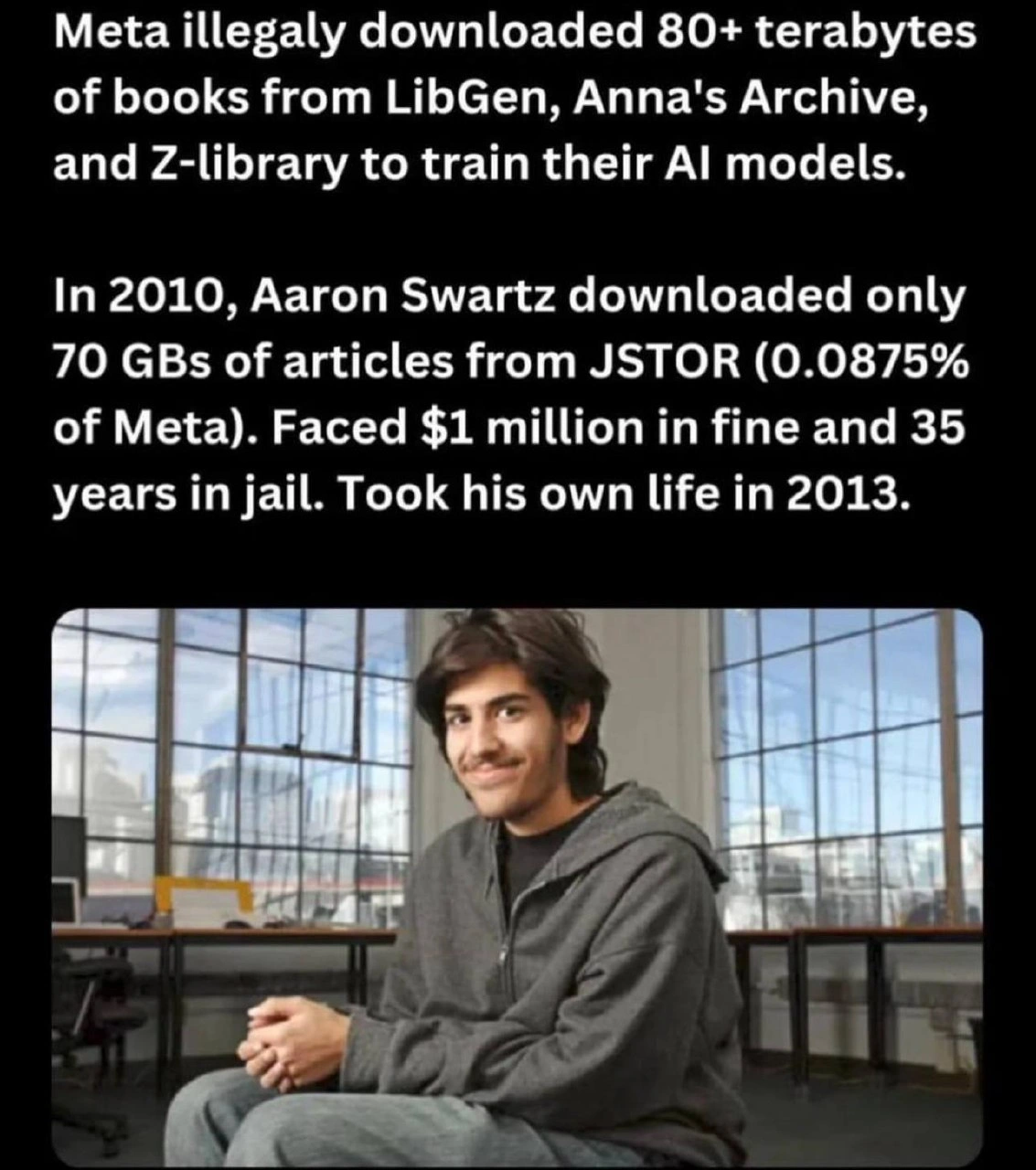
Meta Downloaded 80TB From LibGen While Aaron Swartz Faced Prison for 70GB
DataPrivacy Post #7071, on Aug 23, 2025 in TG

Meta Downloaded 80TB From LibGen While Aaron Swartz Faced Prison for 70GB

Why is this DataPrivacy meme funny?

Level 1: Big Kid vs Little Kid

Imagine two kids in a school library. One is a small, kind kid who loves sharing knowledge; let’s call him Aaron. The other is a rich older kid who runs the school’s tech club; we’ll call him Big Co. One day, Aaron quietly makes a copy of one textbook from the library because he wants to share it with friends who can’t get the book. It’s like he takes 1 out of 1000 pages of the library’s books. He knows maybe he’s bending the rules, but he truly believes it’ll help others learn. The librarians find out and get really, really angry. They call his parents, the principal – even the police – and poor Aaron gets in huge trouble. They say he stole books and threaten to expel him or worse, even though he didn’t do it for money or break any locks to do it.

Now, Big Co – the older kid – comes along with a giant trolley and copies almost every single book in that same library. He uses the school’s fancy copier overnight to duplicate whole shelves worth of books (far more than Aaron did!). What does Big Co do with all those copies? He’s not handing them out directly; instead, he’s feeding them into a big machine he built that “reads” all the books to become super smart. The next day, Big Co announces at school assembly that his machine can answer any question because it read the entire library. Everyone cheers for this amazing invention. The teachers are impressed, the principal gives him an award for innovation. Hardly anyone asks, “Hey, where did you get all the material to feed your machine?” And Big Co certainly doesn’t mention that he basically photocopied the whole library without asking.

So in this little story:

  • The little kid (Aaron) took a tiny bit and tried to do a good thing (share knowledge), but got punished harshly.
  • The big kid (Big Co) took an enormous amount (way more than the little kid) for his own project, and he got praise and rewards.

That feels really unfair, right? It’s like if you swiped one cookie from the jar because you were hungry and got scolded, but your older sibling grabbed the whole jar to start a bake sale and everyone applauded their entrepreneurship. The meme is pointing out that kind of unfairness in real life: sometimes when a regular person breaks a rule, they get in trouble, but if a powerful person (or company) breaks a bunch of rules and calls it innovation, they get a pat on the back. It’s a simple idea of fairness that anyone can understand. That’s why this comparison hits home – it’s showing a big double standard using a story of two very different “data grabbers.” The little guy suffers, the big guy wins, and we’re left feeling that’s just not right.

Level 2: The Download Double Standard

At a more beginner-friendly level, let’s break down the key references and why this meme packs a punch. It contrasts two situations:

  • Aaron Swartz’s JSTOR incident (2010)Who is Aaron Swartz? He was a talented young programmer and activist. Among other things, he co-authored the RSS 1.0 spec at 14, helped build Reddit, and was passionate about free access to information. JSTOR is a digital library of academic journal articles, but it’s behind a subscription paywall (universities pay for access, but ordinary people often can’t afford it). Aaron believed knowledge should be shared, so he decided to download a large number of JSTOR articles using an automated script. Think of it as writing a small program to log into JSTOR through MIT’s network and save all the PDFs of research papers to a hard drive. In simpler terms, he was scraping JSTOR’s database – grabbing lots of data quickly without permission. The tool mentioned, wget, is a basic command-line utility to download files from the web. You can point wget at a site and it will fetch the content for you; add some flags, and it can even recursively download everything it finds. Aaron’s method was akin to using wget or a similar script to essentially perform a bulk download of JSTOR’s content (about 4.8 million articles, totaling ~70 gigabytes).

    What happened to him? He got caught. MIT’s network noticed someone was pulling a ton of data. Aaron was identified, and he returned the hard drives with the articles, hoping to just let it go. But the case was taken up by U.S. prosecutors. They charged him with multiple felonies under computer misuse and wire fraud laws (the CFAA being the main one). The charges were very serious – theoretically up to 35 years in prison and a huge fine. Aaron wasn’t doing this for money; it was an act of civil disobedience for open access. Still, the law treated it as if he’d hacked into a bank vault. The stress and intimidation of that prosecution led him to tragically commit suicide in 2013. In the developer community and beyond, Aaron Swartz is remembered as a martyr for open knowledge and his case is cited whenever discussing reform of anti-hacking laws. So, in short: a 70 GB academic article download by one idealist = potential felony and a life destroyed.

  • Meta’s book data scraping for AI (2020s)What is Meta? It’s the company formerly known as Facebook, one of the tech giants (alongside Google, Amazon, etc.) often valued around a trillion dollars. Meta, like other big players, is racing to create advanced AI models. One popular approach is to make a “foundation model”, which means a very large machine learning model trained on a broad swath of data (like text from books, websites, articles, you name it). The meme claims Meta illegally downloaded 80+ terabytes of books from sites like LibGen, Anna’s Archive, and Z-Library. Let’s unpack those: these are online repositories that host enormous collections of books and papers, for free, but not exactly legally. They’re kind of pirate libraries. LibGen (Library Genesis) and Z-Library have millions of e-books – novels, textbooks, research papers – uploaded by users, bypassing publishers’ paywalls. Anna’s Archive is more of a search index that helps find books across those libraries. These sites are beloved by students, researchers, and readers who can’t afford all those books or who want everything in a digital stash. But they’re also constantly under legal fire from publishers and authorities because they distribute copyrighted works without permission. In fact, Z-Library’s domains have been seized multiple times by the FBI, and some people behind it got arrested. So, these are not approved, legitimate sources; they operate in a legal grey zone for the sake of information freedom.

    Now, Meta downloading 80 terabytes from these sites means they basically vacuumed up the content of millions of books. To appreciate the scale: 1 terabyte is 1024 gigabytes. So 80 TB = 80×1024 GB = about 81,920 GB. Compare that to Aaron’s 70 GB – Meta’s haul is over a thousand times larger. If 70 GB is a large university library’s worth of papers, 80 TB is like every book in dozens of major libraries, combined. This data would be used to train their AI models – essentially to teach an AI to “read” and absorb knowledge from all those books. AI training doesn’t keep the books in a human-readable way; instead, the text is processed into a mathematical form (like tokenized and turned into huge matrices of numbers) so the AI can learn patterns in language. Still, to get that data into the training pipeline, Meta had to obtain it in the first place – hence the meta_data_scraping effort. It’s extremely likely they didn’t get explicit permission from each copyright holder of those books; they just grabbed it. The meme flat-out says “illegally downloaded” because LibGen and similar are not authorized distributors – so taking from them is knowingly sourcing copyrighted text without approval.

    What happened to Meta for doing that? As far as public knowledge goes: nothing. No high-profile lawsuits, no FBI raids. In fact, many AI companies and research groups do similar large-scale scraping. For example, OpenAI (the folks behind GPT-3/4) trained on huge swaths of the internet, including sites like Common Crawl data, Wikipedia, forums, and possibly copyrighted books and articles. There weren’t immediate legal consequences for that either (though now some authors and artists are filing lawsuits). The point is, big companies are gathering massive datasets – sometimes copying things that, if you or I copied and distributed, would clearly violate copyright. They justify it with the idea that training an AI is a transformative use of the data (the AI doesn’t just spit the books back page by page, it learns from them). There’s an ongoing AIEthicsConcerns debate and legal debate around this: is it okay to use copyrighted material to train an AI without permission or compensation? Laws haven’t clearly answered that yet in many countries. But to date, corporations have done it largely without punishment.

So the “double standard” is: one person downloads a relatively small chunk of data to openly share knowledge and is treated like a criminal, whereas a corporation downloads an enormous trove of data (for profit-driven research) and it’s treated as normal R&D. The meme emphasizes that disparity by quoting the numbers and outcomes side by side. The absurd humor hits you when you realize 70 GB vs 80 TB – and the one who took 0.08% of what the other did got the full wrath of the law. It makes you question fairness in enforcement. Why was Aaron’s act seen as so terrible, while Meta’s act barely made a blip on the legal radar?

Several factors might explain this in simpler terms:

  • Visibility and Power: Aaron was an easy target – an individual using MIT’s network openly. Meta operates behind closed doors; their data scraping was internal, likely kept quiet until results (the AI model) were out. Companies have more power to do things under the radar. And if they’re caught, they have legal teams to argue their case.
  • Intent and Narrative: Aaron’s downloads threatened an established academic publishing system and he intended to release those articles for free (which publishers hated). Meta’s narrative is “we’re advancing AI technology.” Even if both involve unauthorized copying, one story sounds like theft to authorities, the other sounds like innovation. Big companies are good at framing their actions in a positive light.
  • Law and Policy Lag: Back in 2010, massive data scraping was less common; Aaron’s act stood out. In the 2020s, web scraping is everywhere – search engines do it, AI needs it – and laws haven’t kept up. There’s something called fair use (in the US) which sometimes lets you use copyrighted material in limited ways for purposes like commentary, research, etc. Companies claim training AI is a form of research or transformative use. Maybe that argument holds, maybe not, but it’s not been definitively settled in court for AI training. Meanwhile, the CFAA (the law used against Aaron) is very broad about “unauthorized access” to computer systems. Aaron plugged a laptop into an MIT closet and wrote a script to download stuff – that was deemed unauthorized access to JSTOR’s service. Meta downloading from LibGen might also be “unauthorized,” but who would press charges? The content owners (publishers) would have to go after Meta, a behemoth with arguably infinite legal defense money. It’s a tougher battle than going after a single guy.
  • Outcome Focus: Aaron was planning to share the files (it’s implied he wanted them in the wild for free access). Meta isn’t sharing the raw books with the public; they’re using them internally. If Meta had dumped 80 TB of books publicly, you can bet lawsuits would rain down. But since they just used the books to train an AI, and they’re not redistributing those PDFs, it’s less straightforward legally. It’s more like they read all the books but didn’t publish them. Aaron essentially was going to publish JSTOR’s library for free. That difference – sharing vs internal use – also helped Meta fly under the radar.

For a junior developer or someone new to these concepts, a few definitions:

  • Web scraping: This is when a program automatically visits webpages and extracts information or downloads files. It’s like a super-fast, tireless web browser that can save everything. wget is a basic scraping tool for files; there are also libraries like BeautifulSoup in Python for parsing HTML, etc.
  • Dataset for AI training: AI models, especially in machine learning and deep learning, learn from examples. A foundation model like a large language model needs an enormous text dataset to learn patterns of language. Companies gather these datasets by crawling websites, scraping databases, using public data dumps, and apparently even tapping into pirate archives if necessary. Here, the dataset in question was books and articles – useful because they contain high-quality, long-form text on many topics.
  • LibGen / Z-Library: Think of these as giant online libraries that don’t check if the book is copyrighted or not. They’re illegal from a copyright standpoint, but they exist because many people (like Aaron did) believe knowledge should be accessible. If you’ve ever heard of Sci-Hub for research papers – similar idea, but Sci-Hub is for journal articles specifically, while LibGen covers books too.
  • CFAA: The Computer Fraud and Abuse Act, a U.S. law from the 1980s initially meant to go after serious computer break-ins. Over time, it’s been used in cases like Aaron’s to prosecute broad “unauthorized access” – even if you just violated a site’s terms of service or, like him, downloaded content in a way the owners didn’t like. It’s considered overly harsh by many in tech, because it can turn relatively harmless digital mischief into federal crimes.

This meme also touches on TechHistory and attitudes in CorporateCulture. Aaron Swartz’s story is now history every young developer should know: it showed how not to handle an act of civil disobedience in the digital age and sparked debates about reforming how we treat data sharing. On the other hand, the corporate behavior (Meta’s scraping) reflects a common internal culture: big companies often operate by the mantra “if it’s not explicitly illegal and everyone else is doing it, do it – we’ll sort it out later.” That’s why this meme is labeled under AIHypeVsReality and AIHumor too – it’s calling out that hype by comparing it to a very human story.

The humor here is definitely on the darker, ironic side. It’s not a haha-joke, it’s more of a sardonic head-shake. You might not laugh out loud, especially knowing one story ends tragically. Instead, you smirk or sigh at the absurd imbalance. For a junior dev, it’s eye-opening: it says “Look, the tech industry loves to call itself disruptive and revolutionary, but sometimes it just means playing by different rules if you’re powerful.” The meme essentially uses a simple data point comparison to make you question the ethics: Why was 70 GB seen as a heinous act, but 80 TB is celebrated? It encourages you to learn the context: one was an AIEthicsConcern disguised as progress, the other was an open_access_movement act mislabeled as theft.

In summary, at this level, the meme is teaching you about the Download Double Standard in tech: small fish gets fried, big fish swims free. It’s a crash course in why people talk about fairness and ethics in AI and data. You learn who Aaron Swartz was and why his story matters, and you learn that behind shiny AI models are sometimes some shady data practices. It’s both a history lesson and a current events lesson wrapped in one meme.

Level 3: Hyperscale Hypocrisy

At the senior engineering level, this meme highlights a striking copyright double standard in the tech world. It contrasts two data-download events separated by a decade: one by an idealistic individual, the other by a trillion-dollar corporation. The humor (tinged with outrage) comes from how the same act – mass-downloading content with a tool like wget – is labeled “felony” when a lone hacker does it, but applauded as building a “foundation model” when a big company does it at hyperscale.

In 2010, programmer-activist Aaron Swartz used an automated script (imagine a glorified wget loop) to download roughly 70 GB of academic articles from JSTOR (a paywalled journal archive) via MIT’s open network. His goal was rooted in the open_access_movement – to liberate knowledge locked behind paywalls. For this act of bulk downloading (effectively scraping JSTOR’s database without formal permission), he was indicted under the Computer Fraud and Abuse Act (CFAA). He faced up to 35 years in prison and $1 million in fines. The prosecution’s zealous response sent shockwaves through the developer community and academia. Aaron’s downloads were a mere 0.0875% of what the meme alleges Meta pulled, yet the legal hammer came down hard. The tragedy is well-known in TechHistory: under immense pressure and fearing a grossly unjust punishment, Aaron took his own life in 2013. He became a symbol of the fight for open information and an example of how harshly the system can treat an individual who challenges the status quo. Many veteran developers remember this painfully – it’s a cautionary tale of legal_inequality and prosecutorial overreach.

Fast forward to the AIIndustryTrends of the 2020s: corporations are in a gold rush to build ever larger AI/ML models. The hottest buzzword is “foundation model” – a euphemism for gargantuan neural networks (like GPT or Meta’s own LLaMA series) pretrained on everything they can ingest. These models are so data-hungry that teams quietly scavenge the internet for massive text corpora. Enter LibGen, Anna's Archive, and Z-Library – well-known shadow libraries hosting millions of pirated e-books and academic texts (basically the Napster of books). According to the meme (riffing on real rumors in AI circles), Meta “illegally downloaded 80+ terabytes” of books from these sources to feed their AI. 80 TB is an eye-popping number – that’s over 1.1 million times the size of Aaron’s JSTOR stash. It’s like comparing a single bookshelf to the Library of Congress. And yet, despite grabbing text on a mind-boggling scale (presumably without authors’ or publishers’ consent), Meta faces zero public legal consequences. In fact, they get to boast about how comprehensive their training data is, and the industry hails their resulting AI as groundbreaking. The once-illicit act of “I used wget to copy a bunch of copyrighted stuff” has been rebranded as “we built a state-of-the-art foundation model.” This is the AIHypeVsReality the meme calls out: the hype paints these models as high-tech marvels, but in reality a part of their “secret sauce” is essentially massive-scale data scraping of unlicensed content.

Why is this AIEthicsConcerns scenario funny to a seasoned dev? It’s dripping with irony: the exact behavior that ruined a young activist’s life is now standard practice for Big Tech R&D. It’s an open secret in CorporateCulture that data is power, and the usual motto is "ask forgiveness, not permission." Large firms employ teams of lawyers and lobbyists to ensure that what would be blatant copyright infringement for you or me sits in a legal grey area for them. They might argue that using data for ai_training_datasets is “transformative” fair use (since the AI doesn’t outright republish the text, just “learns” from it). Or they bank on the fact that enforcement is lax and lawsuits are slow-moving compared to the breakneck pace of AI development. Historically, we’ve seen similar patterns: e.g. Google Books in the mid-2000s scanned millions of library books without initial permission – an act that drew lawsuits, but ultimately Google negotiated a settlement and even won a fair use judgment for their snippet view. When you’re a giant, you can often negotiate or litigate your way through the repercussions of data-scraping after the fact. An individual like Aaron didn’t have that luxury – he was made an example of, likely because he threatened a revenue model (academic publishing) without the shield of a corporate entity. It’s a stark reminder of how legal_inequality plays out: one rule for the meta_data_scraping megacorps, another for the lone hacker in a closet at MIT.

The meme’s text explicitly juxtaposes the cases with cold numbers and outcomes, which senior devs recognize as a devastating indictment of tech’s double standards. Let’s put it in a blunt tabular form:

Actor Data Downloaded Outcome
Aaron Swartz (2010, activist) ~70 GB of JSTOR articles (academic papers) Indicted for felony under CFAA; faced 35 years in prison and ~$1M fine. Tragically, died by suicide during legal battle.
Meta (2023, corporation) ~80+ TB of e-books from LibGen/Anna’s Archive/Z-Library (mixed copyrighted books) No charges or official sanctions. Data quietly used to train a lucrative AI “foundation model”. Company praised for AI innovation.

In plain terms, 70 GB is a tiny speck of data by today’s standards, whereas 80 TB is gargantuan (over a thousand times more). Yet the smaller act resulted in an FBI raid and multi-count felony indictment, while the larger one gets a corporate press release about advancing AI capabilities. The meme’s dark humor plays on this absurd inversion of justice. It’s the tech equivalent of “steal a little and they throw you in jail, steal a lot and they call you a king”. Seasoned engineers have seen similar scenarios where scale and clout completely change the narrative. It’s cringe-laughable because it’s true.

From a systems perspective, there’s even technical irony in how simple the core action is. wget is a humble command-line tool that any junior dev can use to fetch files from the web. It doesn’t distinguish between “noble” or “illicit” uses – it will happily download whatever URL you point it at. Aaron’s script likely boiled down to a loop of HTTP requests much like a wget -r (recursive download) of JSTOR’s article PDFs. Meta’s engineers, on the other hand, probably wrote sophisticated distributed crawlers to parallelize the download of 80+ TB, but conceptually it’s wget on steroids. The meme’s title “When wget turns felony into ‘foundation model’” is a tongue-in-cheek way of saying: run wget as a lone wolf in 2010, and you’re branded a criminal; run a beefed-up wget behind corporate firewalls in 2025, and you’re an AI pioneer. Here’s a pseudo-code illustration for the contrast:

# Aaron's approach circa 2010 (simplified example)
wget -r -np -P ./JSTOR_dump "http://jstor.org/archives/*.pdf"
# ^ Recursively download PDFs from JSTOR to a local folder.

# Meta's approach circa 2025 (tongue-in-cheek pseudo-code)
for site in libgen annas_archive z_library; do
    wget -r -np -P /mnt/training_data "$site"
done
# ^ Mass download entire mirror sites of book libraries in parallel, yielding tens of terabytes.

(Comments: -r means recursive, -np means don’t ascend to parent directories. In reality, Meta’s data pipeline is more complex, but at heart it’s the same idea.)

This snippet is facetious, but it shows how a meta_data_scraping operation at corporate scale is basically the same kind of web crawling that got Aaron into life-ruining trouble. The difference is one of scale, intent, and power. Meta can distribute this task across data centers with hundreds of machines, merrily bypassing any pesky robots.txt rules (notice the -np and possibly -e robots=off flags – a crawler’s way of saying “ignore restrictions”). They have the storage to hoard 80 TB of text and the compute to actually use it for training a gigantic neural network model (which itself might be billions of parameters, trained on clusters of GPUs or TPUs). In contrast, Aaron was one guy with a laptop and some hard drives, downloading 70 GB over MIT’s network to possibly do a one-time dump. To a senior engineer, the raw technical feat of grabbing 80+ TB is impressive but not innovative per se – it’s the will (or audacity) to do it that sets Meta apart, backed by tons of hardware and legal cover. The absurdity that tickles (or irks) us is that the ethical line for data gathering is so easily bent when it’s a corporation doing it in the name of AI progress.

There’s also an underlying commentary on AIHypeVsReality and AILimitations: these AI foundation models are hyped as magical “reading the whole internet” brains, yet what they ingest includes outright pirated content. The reality is a bit seedy – models like these might inadvertently become repositories of copyrighted text. (Indeed, one DataPrivacy concern is that a large language model can potentially spit out verbatim paragraphs from its training data, meaning it could regurgitate copyrighted paragraphs if prompted cleverly. That’s a known issue with memorization in AI models.) So Meta and others have to walk a fine line: touting their model’s broad knowledge while downplaying questions about where that knowledge came from. Engineers who follow AIIndustryTrends see the pattern: first gather data by any means necessary, then deal with the ethical/legal fallout later. It’s a very CorporateCulture approach — reminiscent of the Facebook-era motto “Move fast and break things,” except now it’s “Move fast and scrape things (we’ll settle later).”

Historically, the meme also evokes the story of information freedom vs. corporate control. Aaron Swartz’s case became a rallying cry for reforming outdated computer crime laws and for the open_access_movement to scholarly knowledge. It’s tragic that an individual’s noble act was treated as a dangerous crime. Meanwhile, the corporate hoarding of information (even if nominally to create new AI capabilities) gets far less scrutiny. Long-time tech observers can’t help but see parallels to earlier double standards: for instance, Napster in 1999 was crushed for peer-to-peer music sharing, but a decade later Apple and Spotify built billion-dollar businesses distributing the same music (albeit legally licensed – after the fact, the industry adapted). Similarly, Google’s web crawler has copied billions of web pages (that’s how search works) and we largely accept it, but when a person tries to do something similar outside the sanctioned channels, it’s suddenly unacceptable. The meme zooms in on this one-sided enforcement: it’s essentially saying “Look, a single developer’s small-scale data download was treated as grand theft, but a tech giant’s data grab at 1,000x scale is celebrated as progress.” This resonates as both dark humor and justified cynicism among senior devs who’ve seen how rules often bend for the big players. It underscores an uncomfortable truth: AIEthicsConcerns aren’t just about model bias or alignment, but also about how the data is obtained and whether we’re okay with corporations getting a pass on practices that would ruin ordinary people.

In summary, the meme is funny-not-funny to experienced developers because it points out the hyperscale hypocrisy in our industry. It satirically asks: when does using a simple tool like wget go from being a crime to being the cornerstone of a billion-dollar AI? The bitter answer: apparently when you have trillions in market cap and a phalanx of lawyers. It’s a nod and a sigh at the legal_inequality and copyright_double_standard we’ve come to recognize. The foundation of some “revolutionary” AI systems turns out to be built on the very behavior that was once vilified – but now it’s behind corporate walls, repackaged as innovation. Every senior dev who’s lived through the Aaron Swartz story and now sees the AI data land grab will appreciate the meme’s point: technology might advance, but ethical consistency sure hasn’t.

Description

A black background image with white text stating: 'Meta illegaly downloaded 80+ terabytes of books from LibGen, Anna's Archive, and Z-library to train their AI models. In 2010, Aaron Swartz downloaded only 70 GBs of articles from JSTOR (0.0875% of Meta). Faced $1 million in fine and 35 years in jail. Took his own life in 2013.' Below the text is a photograph of Aaron Swartz, a young man with brown hair sitting in what appears to be an office or workspace with large windows. The image highlights the stark double standard between how large corporations and individuals are treated for similar actions involving downloading academic/literary content

Comments

25
Anonymous ★ Top Pick Scale your crimes to enterprise level and they become 'innovation' -- apparently the only difference between a felon and a Fortune 500 is the number of terabytes
  1. Anonymous ★ Top Pick

    Scale your crimes to enterprise level and they become 'innovation' -- apparently the only difference between a felon and a Fortune 500 is the number of terabytes

  2. Anonymous

    So downloading 70GB gets you 35 years in prison, but downloading 80TB gets you a keynote speech about the future of AGI. The scaling isn't just for the data

  3. Anonymous

    Pro tip: if your wget --mirror command might violate copyright, just precede it with a multibillion-dollar IPO - apparently it converts SIGKILL into SIGKUDOS

  4. Anonymous

    The real difference between 'move fast and break things' and 'information wants to be free' is apparently a few billion dollars in market cap and a legal department that could populate a small city

  5. Anonymous

    Ah yes, the classic 'move fast and break things' vs 'download papers and break your life' dichotomy. Meta scrapes 80TB of copyrighted books for their LLMs and gets a stern finger-wagging, while Aaron Swartz downloads 0.0875% of that from an academic database and faces the legal equivalent of a DDoS attack from the DOJ. It's almost like there's an inverse relationship between your legal liability and the number of zeros in your market cap. The real irony? Meta's models will probably hallucinate more accurate legal advice than what Aaron received. At least we now know the exact exchange rate: 1 terabyte of corporate AI training data ≈ 0.0000875 activist downloads in terms of prosecutorial enthusiasm

  6. Anonymous

    Scale your scrape to exabytes and it's 'innovation'; stay at gigabytes and it's a felony

  7. Anonymous

    Compliance severity seems to follow a power law with market cap: at 80TB it’s “innovation,” at 70GB it’s “indictment” - must be one of those scaling laws ML folks love

  8. Anonymous

    In tech, if it fits on a laptop it’s CFAA; if it needs a data lake it’s “pretraining” - apparently the Authorization header scales with market cap

  9. @anonusernametg 10mo

    This is exactly why I hate AI companies and their immunity against laws

  10. @SpYvy 10mo

    That's literally insane

  11. @c1513960df74449e831a04fea9d0dcfc 10mo

    That why some "tech" company, lawyer more than developer

  12. @Essonaby 10mo

    Quod licet Iovi, non licet bovi

  13. @Diletant_786 10mo

    punishment might have been equally divided into meta workers) Aaron was only one

  14. @DavidGarciaCat 10mo

    An employee must do what they are told to do, otherwise they could use their jobs This is entirely a management decision, and should be the Chiefs who take care of the consequences

  15. アレックス 10mo

    Don’t forget he founded Reddit, which allowed unlimited free speech until they killed him and then took it over and ruined it.

  16. アレックス 10mo

    He also helped cracked Blu-ray lockdown codes.

  17. アレックス 10mo

    And invented RSS

  18. アレックス 10mo

    And was an early advocate of torrenting and Bitcoin

  19. アレックス 10mo

    And invented the Creative Commons license

  20. アレックス 10mo

    And helped defeat the Stop Online Piracy Act

  21. アレックス 10mo

    And helped found the Internet Archive

  22. アレックス 10mo

    🕯️😔

  23. @Strangerx 10mo

    How on Earth could be legal to download from LibGen as Piracy Library Website and at the same time illegal to download from JSTOR website as "not-for-profit organization helping the academic community use digital technologies to preserve the scholarly record and to advance research and teaching in sustainable ways"?

  24. @SamsonovAnton 10mo

    https://youtu.be/iNyFPdlRww8 https://youtu.be/-v35TIkvaYA https://youtu.be/uQrc1ReOoFY

  25. @sandor73 9mo

    To be fair, meta is taking its own life too. It just takes a while.

Use J and K for navigation