The 'Did I Just Break Production?' Glance
Why is this Juniors meme funny?
Level 1: Midnight Snack Mistake
Imagine you sneak into the kitchen late at night to grab a cookie from the cookie jar. It’s dark and everyone else is asleep. You reach for a cookie, and crash! – you knock the jar off the counter. Cookies everywhere, maybe a broken jar, the works. You freeze, eyes wide, heart pounding. Uh-oh. You know this mess is because of you. Now you’re standing there at 2 AM, holding your breath and glancing around to see if anyone heard the noise. You’re hoping you can clean it up quietly without waking your parents and getting in trouble. That exact “I messed up, but maybe no one will notice if I fix it fast” feeling is what this meme is about. In the meme, the developer is the kid and the “broken cookie jar” is a software problem they caused. The funny puppet with the side-glance perfectly shows the face you’d make in that moment of silent worry. It’s a mix of guilt and hope that nobody saw. Even if you’re not a programmer, you know that nervous feeling when you’ve made a mistake and really, really hope it flies under the radar long enough for you to make it right.
Level 2: Hope Nobody Saw That
Let’s break this down in simpler terms. This meme is describing a programmer who finds out very late at night that something is broken on the live site – and realizes it’s their fault. In developer lingo, the live site or app is called production. That’s the environment where real users interact with the software, as opposed to a test or development environment. A bug is a mistake or flaw in the code that causes the software to act in unexpected ways (errors, crashes, weird behavior – all the fun stuff). So when we say “your own bug is running in production,” we mean that a piece of bad code you wrote is now causing trouble in the real-world system. And of course it happens at 2 AM, when you’d much rather be sleeping.
Now, why is the developer awake at 2 AM to notice this? Many software teams have an on-call rotation. Being on-call means one programmer is responsible for responding to any urgent issues with the software outside of normal hours. If something breaks in the middle of the night, the on-call developer’s phone will buzz or an alert will go off. It’s literally their job to wake up and put out the fire. In this meme, the implication is that the developer is on-call and got alerted about a problem – or maybe they just happened to catch it while no one else did. Either way, it’s an after-midnight incident. The phrase “When you silently notice…” suggests the person has spotted the issue but hasn’t announced it to anyone yet. They’re kind of sitting there thinking, “Uh-oh, I see a problem... hope nobody else saw that (because I might be in trouble).”
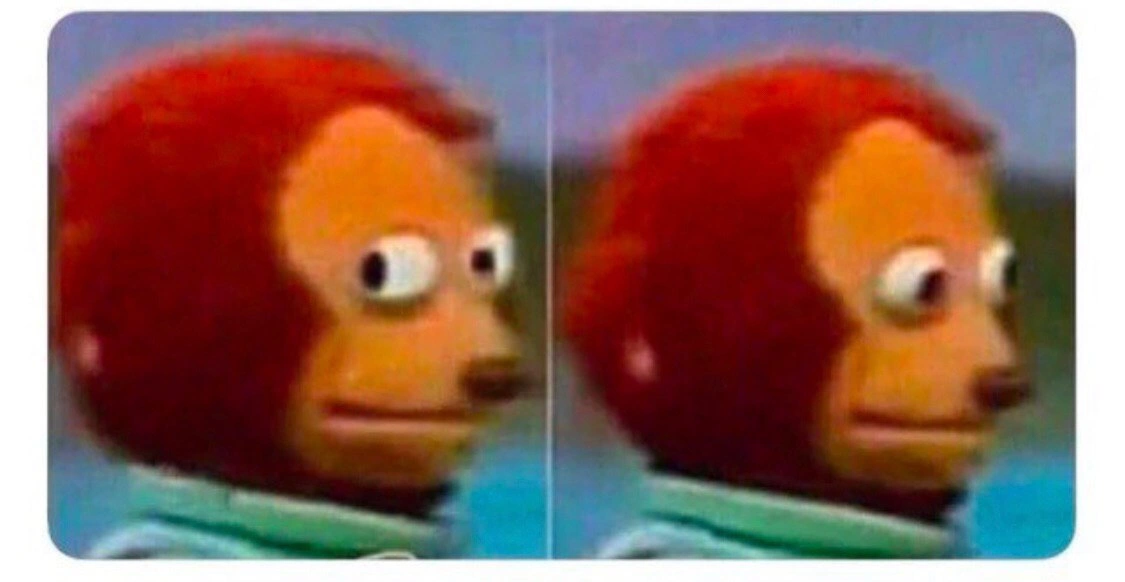
The two-panel puppet image is a popular meme format used to wordlessly convey that awkward, guilty feeling. In the first panel, the puppet looks straight ahead, trying to appear calm or normal. In the second panel, its eyes dart to the side in a nervous way, like someone caught in a lie or someone who just realized they messed up. Developers love using this meme to joke about moments of panic or embarrassment in coding. Here it’s used for that exact moment a dev spots their own error in the live system. The puppet’s expression = the developer’s face when they read an error log and recognize the culprit.
If you’re newer to software, imagine pushing an update to a website and everything looks fine at first. But later that night, the phone rings because the website is malfunctioning. You open your laptop, check the logs (records of what the software is doing), and see a big fat error message. Maybe something like “NullPointerException in OrderProcessor.java:42” (which is a fancy way of saying your code tried to use something that wasn’t there – a common programming mistake). Your heart sinks as you recall, “Oh, I wrote the OrderProcessor code… and I see line 42 in that error... oh no, that’s on me.” It’s a sinking feeling. The meme captures that exact split-second of realization.
So what does the developer do in that situation? Usually, debugging begins immediately. Debugging means investigating and fixing the issue. They might also feel a shot of adrenaline – nothing wakes you up faster than seeing your work causing an incident. Often the dev will try to fix the bug right then and there, especially if it’s hurting users. They might temporarily turn off a feature or roll back (undo) their code change to stabilize things. All the while, they’re likely feeling embarrassed and anxious. It’s late, they’re tired, and now they have to clean up a mess they inadvertently made. The puppet’s side-eye embodies that “I hope I can quietly fix this before anyone notices it was me” sentiment.
This humorous scenario is very relatable in the software world. Even early-career developers quickly learn that a bug can show up at the worst time. It’s like a universal rule. The term ProductionBugs just refers to bugs that make it out into the live product. Nobody wants to have one of those, but it happens to everyone eventually. And when it does, you feel exactly like that puppet: a bit frozen, a bit guilty, and definitely wide awake! The reason this meme is funny to developers is because it’s true – we’ve all had an “Oh no...” moment when we realized we did something wrong. Instead of crying about it, devs turn it into a joke we can all nod and laugh at. It’s a way of saying “hey, it happens to the best of us” and sharing the pain through humor.
Level 3: Never Deploy on Friday
It’s 2:00 AM in the production environment, and your code decides now is the perfect time to throw a surprise party (the crashing kind). The red-headed puppet’s wide-eyed side-eye is basically you, the on-call developer, staring at the logs and slowly realizing the bug wreaking havoc is one of your own. In a war-weary developer’s mind, there’s a darkly humorous rule of thumb: never deploy on Friday. Why? Because Murphy’s Law practically guarantees that a Friday push will have you staring at a ProductionIncidents dashboard in the wee hours, just like this meme. The combination of calm-then-alarmed puppet faces perfectly captures that internal panic snap when you recognize exactly which commit (yours!) introduced the issue now biting at 2 AM.
This meme hits a nerve because it satirizes a scenario every experienced dev knows too well. You might be the unlucky engineer on on-call duty, awakened by pager alerts and a flood of error logs. Or maybe you’re just an insomniac developer checking on your live site for peace of mind – and instead you find a furious exception screaming in the logs. Suddenly, cue the puppet side-eye. You freeze, heart pounding, thinking: “Please don’t let this be my code... oh no, it is my code.” The humor is tinged with trauma: we laugh because we’ve all been that wide-eyed puppet, discovering our own mistake at the worst possible time.
Why 2 AM? Production bugs have a devious habit of hiding until off-hours. Perhaps the nightly batch job or cron task just kicked in, finally hitting that neglected edge case in your code. Maybe a memory leak has been quietly building up all day and only now crashes the server. Or that one debug flag you forgot to turn off is spamming logs and paging the on-call team. The industry patterns being satirized here include Murphy’s Law of Software: if something can go wrong in production, it will – and usually at 2 AM when you’re bleary-eyed. It’s essentially an OnCallNightmares rite of passage.
The unspoken developer dance in this situation is equal parts triage and CYA. First, you skim the metrics and logs to confirm the issue. Perhaps you crack open the Kibana/ELK console or Grafana charts: is latency spiking? Error rates off the chart? Yup, there it is. You find the stack trace and see a familiar function name from last afternoon’s commit. At this point, the puppet’s deadpan look of quiet horror is a mirror to your soul. You’re thinking, “Can I fix this real quick before anyone notices?” Maybe you SSH into a server to apply a hotfix or tweak a feature flag to stop the bleeding. You’re essentially trying to debug and patch in stealth mode.
Of course, if users are impacted or the site is down, there’s no real hiding it – you’ll have to wake up your team and possibly initiate an incident response. But the meme assumes that awkward moment before anyone else knows, when you have a fleeting chance to be the silent hero (or at least avoid public shaming). The humor is that developers often deny or downplay issues at first – “Hmm, the site seems fine to me! cough” – while frantically working behind the scenes to fix their own bug. It’s a mix of guilt, DebuggingFrustration, and sheepishness.
The shared trauma runs deeper: we’ve all seen seemingly innocent code turn into a production pumpkin after midnight. It might be an if condition that fails on a new day, a hard-coded date that expired, or an overlooked race condition that only appears under real user load. These are classic BugsInSoftware that slip past tests and lie in wait. The experienced devs reading this meme are nodding knowingly because they’ve lived through the exact situation. They’ve had that side-eye moment checking the blame in git to see who wrote the offending code, while internally going “please don’t be me… oh no, it was me.”
In summary, the meme humorously encapsulates a core reality of software development: no matter how senior or careful you are, eventually you ship a bug that comes back to haunt you in production. And when it does, it’ll feel just like that puppet’s expression – a frozen, “uh-oh” stare into the abyss, hoping no one else saw what you just saw. It’s funny because it’s true, and every developer with a pager or an on-call rotation has been there. The next morning, you’ll joke about it with the team (after the fix and the caffeine), but at 2 AM, all you can do is channel your inner puppet, silently freak out, and get to work fixing the mess you made.
[02:13:45] ERROR OrderService - NullPointerException in processOrder()
at com.myapp.orders.OrderProcessor.handleOrder(OrderProcessor.java:42)
(Seeing a familiar error like the above in the dead of night can make a developer’s eyes go wide, just like our side-eye puppet. Line 42 throwing a NullPointerException? Yep, that’s your code alright…)
Description
This image features the popular 'Awkward Look Monkey Puppet' meme, presented in its classic two-panel format. On the left, a red puppet with prominent, wide-open eyes stares directly forward with a neutral, almost vacant expression. In the panel on the right, the puppet's eyes have shifted dramatically to the side, creating a look of intense nervousness, guilt, and apprehension. This meme is a cornerstone of internet and developer culture, perfectly encapsulating the feeling of being caught in an awkward or incriminating situation. For experienced developers, it's the visual representation of that heart-stopping moment of silent panic after executing a command that might have catastrophic consequences, such as merging faulty code, seeing a CI/CD pipeline fail immediately after a push, or watching a senior engineer type 'git blame' on a file you just edited
Comments
7Comment deleted
It's the face you make when you've been debugging for an hour only to realize the 'bug' was that you were editing the wrong config file the whole time
That 2 AM side-eye when your ‘one-line optimization’ turns the primary database into a full-table-scan generator and you’re calculating if CloudWatch’s 5-minute aggregation window is long enough for plausible deniability
When the architect who insisted on "eventual consistency" discovers the finance team has been double-charging customers for three months
When the PM asks if we can 'just quickly add one more feature' before the Friday deployment, and you're already mentally calculating the blast radius of what could possibly go wrong in production over the weekend
That slow head turn when product says “just make it multi‑region” and you remember we have a single write‑master, local‑time timestamps, and a queue that assumes exactly‑once - CAP called, it wants a reality check
Localhost: pristine bliss. Prod traces: the N+1 query ghost from that refactored ORM haunts eternally
Incident bridge: “We didn’t change anything.” ArgoCD: OutOfSync ×12 since 16:58 - me doing the puppet side‑eye while grepping for DEBUG=true in prod