A Field Guide to Tech Company Stereotypes
Why is this CorporateCulture meme funny?
Level 1: Office Zoo
Imagine a tech company as a big group project with lots of different kinds of helpers, just like a school project or a team game. Every person has a special job, and it can feel a bit like a zoo or a circus with all the unique characters! 🦁🤹
There’s the big boss (CEO) – kind of like the team captain – who loves big surprises and saying “let’s do something huge!” even if everyone else starts worrying. The money guard (CFO) is like a parent who says, “we can’t buy too many treats, or we’ll run out of allowance.” Then we have the idea booster (Growth Hacker) who does clever tricks to get more people to like our project, almost like a magician trying to impress an audience. The friendly front desk (Customer Support) people are the ones who talk to our “customers” (or classmates/neighbors) and keep them happy, even when they’re upset – they’re super patient and brave, like friendly guards calming everyone down.
The project guide (Project Manager) is that one friend who always claps their hands and says, “Come on, guys, let’s finish this, how hard can it be?!” They make sure everyone is doing their part, though sometimes they make it sound easier than it really is. The coders (Developers) are like the builders with their own secret language – they write the instructions that make the app or game work. They often wear funny t-shirts and talk about video games or comics, kind of like the quirky kid in class who has cool but unusual hobbies. They’re not building bridges or robots, but they build the stuff you see on your screen, so they’re a special kind of engineer.
We also have an office helper (Office Ninja), a person who quietly makes everything nice – they bring snacks, sharpen the pencils, book meeting rooms, and you might not notice them, but without them, everyone would be hungry and lost. They’re like the classmate who always has extra supplies and helps organize the pizza party. The artist (Designer) is a shy hero who makes things look pretty and easy to use – like the friend who draws the posters and designs the team T-shirt. They don’t shout about their work, but everyone says “wow, this looks awesome!” when they see it.
Don’t forget the social media friend – that’s the one always on Instagram or making funny GIFs to tell the world about our project. They’d be like the school reporter, spreading the news and getting everyone excited (sometimes using just pictures and memes!). And in the background, we have the servers, which aren’t people at all but super-important computers that run everything. They’re like the power source that’s always on, day and night, so the lights of our online world never go out. We cheer them on, even though they don’t have feelings – “Go servers, go!”
Finally, there’s the HR lady – think of a camp counselor or teacher’s aide who makes sure everyone is getting along and nobody quits the team. She plans fun little things (maybe cupcakes or a team game) so people stay happy and don’t fight or give up. She’s rare in a small group, but very special because she keeps the peace and tries to keep us all together like one big family.
All these different people (and machines!) work together to run a tech company, just like different animals in a zoo or players on a team. The meme cartoon shows them in a silly way – exaggerating what they’re like – to make us laugh. It’s funny because you can imagine all these characters in one office: one is shooting Nerf toy darts, another is drawing on sticky notes, someone’s tracking money carefully, and someone’s answering ten phone calls with a smile. It’s a WorkplaceHumor scene that says: it takes all kinds of folks to keep the engine running!
And guess what – in the picture they forgot the tester (QA), the person who checks for mistakes. It’s like if no one tastes the soup before serving it – you only find out it’s too salty when the customers take a sip! The little joke “No QA - no mistakes” is like saying if no one is checking, we pretend everything is perfect. Of course, that’s not really true, but it’s a playful poke at how some teams rush forward fast.
So, a tech company is basically a bunch of very different people working together: the dreamers, the planners, the builders, the helpers, and more. It’s funny to see them as cartoon characters, but it also shows that everyone has a role. Just like a zoo needs all kinds of animals or a school play needs actors, directors, and stagehands – a tech team needs all these roles to succeed. And when they all do their thing (even if chaotically), the engine of the company keeps running, and maybe, just maybe, they make something great (with plenty of giggles and snacks along the way!).
Level 2: Meet the Team
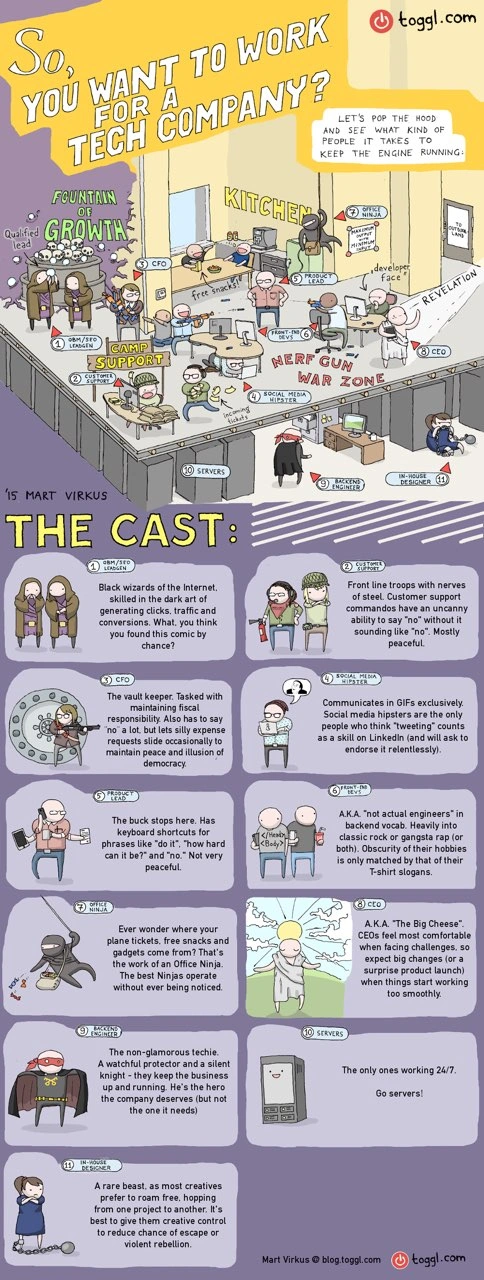
This meme is an infographic parody that introduces us to a typical startup team, spotlighting different job roles with a comedic twist. If you've just started in tech (or plan to), here's a breakdown of who these people are and why it's funny:
Growth Hacker: A fancy term in startups for a marketing specialist who focuses on quick growth of users or sales. Think of them as creative marketers/analysts who try unconventional tricks (or "hacks") to make the user base skyrocket. The joke calls them “black wizards of the Internet,” implying they use mysterious online magic for clicks and conversions. In reality, a growth hacker might run lots of experiments—like tweaking a signup page or email campaign—to find what makes more people come and stay. The fountain_of_growth in the image shows how the company treats growth like the magic fountain everyone wants to drink from. It’s funny because sometimes growth hackers promise almost magical results, and other team members (especially engineers) are skeptical of that hype.
Customer Support: These are the folks who talk to users every day, helping fix problems and answering questions. The meme portrays them as battle-hardened “front line troops” in CAMP SUPPORT. Why? Because dealing with angry or confused customers can feel like combat! They need “nerves of steel” to stay calm and helpful. The humor is in exaggeration: picturing support reps as commandos defusing a bomb (the bomb being an upset customer). And the line about saying "no" without sounding like "no" – that’s a real support skill. For example, if a user asks for a refund they can’t have, a good support rep will phrase it so nicely that the user isn’t as mad. It's a tough job, and calling them troops is a nod to how crucial and brave support teams are in a company.
CFO (Chief Financial Officer): The person in charge of the company’s money. They manage budgets, salaries, investments – basically the vault keeper of funds. In the cartoon, the CFO is teased as someone who’s always cautious and often says "no" to spending. Why is that funny? In startups, teams often want the latest tools, more staff, or fun events, and the CFO is the one who has to say “we can’t afford that”. The joke suggests the CFO even has to practice a bit of democracy – meaning sometimes they let others vote or have a say, but usually, they have the final word because money talks. To a newcomer, just know the CFO is like the strict parent making sure the company doesn’t go broke buying everyone new MacBooks. The humor is that while others dream big, the CFO worries about the bank account – not a glamorous job, but very important.
Social Media: This role handles the company’s presence on Twitter, Facebook, Instagram, etc. The meme jokingly calls them people who “communicate in GIFs” and endorse relentlessly. That means they’re constantly hyping the company’s product and often use funny images or memes (GIFs) to engage the online community. Social media hipsters (as tagged) are stereotyped as being super tuned-in to internet culture – maybe a bit too much for their coworkers’ taste. If you’ve ever met someone who replies only with memes or trending slang, you get the idea. In a tech company, the social media manager’s job is to make the company look cool and responsive online. The rest of the team might lovingly tease them because while developers speak in code, social media folks speak in memes. It’s an interesting contrast and that’s where the WorkplaceHumor comes from: they literally speak different languages at work (code vs GIFs).
Project Manager (PM): The organizer and task-master of projects. A PM makes sure everyone knows what to do and that things get done on time. The infographic jokes that this person has keyboard shortcuts for phrases like “do it”, “how hard can it be?”, and “hurry up”. 😅 This is a light roast of PMs seeming bossy or underestimating the work. In truth, PMs often ask developers to deliver features quickly, and sometimes they might not realize how complex it is under the hood. “How hard can it be?” has become an ironic phrase in tech, because usually when someone says that, it turns out to be very hard indeed! So, this joke resonates with developers who have been pressured to finish something ASAP, clicking those imaginary PM shortcuts. Still, PMs are essential – they keep the project moving and ensure communication flows. The humor just shows how their push for speed can sound comical to the people in the trenches writing code.
Developers: The programmers who write the code for the product. The meme calls them “not actual engineers” – which is a sarcastic jab. In some industries, people joke that software devs aren’t “real” engineers like mechanical or civil engineers. DeveloperHumor often embraces this joke self-deprecatingly. The infographic also points out how devs have obscure hobbies and funny T-shirts. Stereotypically, a lot of developers are nerdy in wonderful ways – they might be into niche games, sci-fi, or techie hobbies like Arduino projects. And they love wearing T-shirts with coding jokes or geeky references (like a shirt saying “;;$ i++” or a GitHub octocat). The obscurity proportional to T-shirt slogan means: the weirder the hobby, the weirder (or more inside-joke) their shirt. For a junior just entering the field, you’ll notice this culture – lots of devs bond over gaming, meme shirts, and inside jokes about programming. The meme lovingly pokes fun at that culture, and also at the little insecurity behind “not an actual engineer”, as if what we do isn’t real engineering (it is, of course, but imposter syndrome is common). Basically, developers in this comic are portrayed as the quirky core of the company – proud nerds who code all night, fuelled by coffee and obscure enthusiasm.
Office Ninja: Also known as the Office Manager or administrative assistant, though “ninja” sounds much cooler! This person handles all sorts of office logistics: booking plane tickets for travel, stocking free snacks in the kitchen, and even providing things like earplugs (open offices get noisy, after all). They operate behind the scenes, so the meme gives them a stealthy ninja theme. For someone new to office life, imagine the Office Ninja as the go-to problem solver: need a new keyboard? They’ve got one. Organizing a team lunch? They’ll schedule it. The reason it’s funny is that tech companies love playful titles – calling the office admin a ninja is very startup-y. And it’s true, when they do their job well, you hardly notice; everything just runs smoothly as if by magic. Only when they’re away do you realize how much they actually do! The humor and respect combined here show that even though this role isn’t about coding or product, it’s super important for keeping everyone sane and the “engine running.”
CEO (Chief Executive Officer): The head honcho, the person in charge of the whole company. The CEO in the cartoon is nicknamed “The Big Cheese” (a silly old phrase for “the boss”) and is shown loving big challenges like surprise product launches. In startups, CEOs are often founders – very passionate and sometimes a bit unpredictable. The joke here is that CEOs feel most comfortable during chaos – like when they suddenly decide on a “mega” challenge. For example, a CEO might announce, “We’re launching a new feature next week at a huge event!” while everyone else quietly panics about whether that’s possible. 😅 If you’re junior, picture the CEO as the captain of a ship: they set direction and rally everyone. But in startup culture, captains sometimes steer into storms on purpose, believing it’ll motivate the crew. The humor comes from the fact that what excites the CEO (big bold moves) often means lots of stress for the team scrambling to execute that vision. Yet, that energy can also be inspiring – it’s a double-edged sword. The meme affectionately mocks CEOs for loving to “push the big red button” and create dramatic scenarios.
In-House Designer: The creative mind who designs the product’s look, feel, and user experience (UX). “In-house” means they are a full-time employee (not a freelancer), dedicated to the company’s design needs. The infographic calls this person “the non-glamorous tech” and “a watchful protector and silent knight.” This is a playful way to say the designer is like a silent superhero. They might not be in the spotlight like the CEO or constantly interacting like support, but they are always guarding the quality of the product’s visuals and branding. Non-glamorous tech implies they don’t always get flashy recognition, even though they make things look good. The silent knight part could be referencing Batman (who was called “the silent guardian” in movies) – an inside nod that designers quietly save the day. For instance, if a user interface was ugly or confusing, a designer swoops in and fixes it, saving users from a bad experience. For someone starting out, it’s important to know designers collaborate closely with developers and PMs, but often they work a bit separately (in their “cave” or design corner) to craft icons, layouts, and logos. The meme is showing love to designers by framing them as heroic, albeit in a tongue-in-cheek way.
Servers: Not people, but the actual computers (hardware or cloud machines) that run the application or website. In the drawing, the servers are treated as part of the team – “the only ones working 24/7.” This is both a joke and literally true: servers never sleep. When you deploy code to production, these machines handle users’ requests day and night, even when everyone else is home binge-watching Netflix. The “Go servers!” cheer in the text is funny because we usually thank teammates at all-hands meetings, not inanimate objects. But tech insiders like to anthropomorphize (give human traits to) servers since we rely on them so much. Plus, it hints at the ops/IT crew: while not explicitly in the cartoon, someone is often on-call making sure those servers stay healthy. If you’re new, just know that servers are as critical as any team member – if a server crashes, the website/app can go down. So the meme humorously includes them as characters, as if to say "Props to these tireless workers." It’s a subtle nod to the importance of infrastructure in a company that not everyone acknowledges day-to-day.
HR Lady (Human Resources): HR is the department that handles hiring, onboarding, benefits, resolving workplace issues – basically anything to do with the employees’ well-being and company policies. The cartoon calls her “a rare beast” which is a cheeky way to note that many small startups don’t have an HR at first, or maybe just one person (often, yes, it’s a lady – HR tends to have more women, so the meme plays on that). It says she “provides creative control to reduce chance of escape or violent rebellion.” In simpler terms, HR tries to keep employees happy so they don’t quit (escape) or revolt (get super angry at management). This includes giving some creative control or perks to staff – like fun team outings, flexible work hours, or the freedom to pick cool projects occasionally – to maintain morale. The humor here is exaggerating HR’s role as if employees are wild animals that might escape or rebel if not carefully managed. 😅 It’s making fun of the fact that startups can be stressful, so HR’s job is kind of to keep everyone calm and committed. For someone early in their career, understand that HR might organize things like feedback sessions or handle disputes between coworkers, all with the goal of keeping the “zoo” running smoothly. Calling her a “rare beast” also implies HR has to be tough and special to handle all the crazy stuff that happens in a fast-paced company (like hiring 50 people in a month, or dealing with a spontaneous CEO idea that affects policies).
Now, notably absent from this lineup is QA (Quality Assurance) – the testers who check for bugs. The commenter points it out: in this meme’s world, apparently no QA means no mistakes! This is ironic humor. Obviously, bugs still exist if you have no QA; it’s just that no dedicated team is catching them. In many startups, developers themselves test their code, or issues are found by users and reported to that brave customer support team. So leaving QA out is a jab at how some companies skip formal testing to move faster. It’s a wink-wink joke to those in the know: “If nobody is officially testing, we can pretend our software is perfect... until it crashes.” For a junior dev, the lesson is that QA is crucial, even if this cartoon jokingly ignores it. The fact that the commenter said "No QA - no mistakes" shows an inside WorkplaceHumor where people jokingly act like not seeing a bug means it’s not there. But every experienced team member knows that’s just burying your head in the sand – and it often leads to those legendary late-night fix sessions.
Overall, each “cast” member in the infographic represents a role_based_caricature in a tech company, and the humor comes from exaggerating their stereotypes. If you work in tech, you’ll meet characters like these (maybe not as cartoonish, but close!). The free snacks in the KITCHEN, the nerf_gun_war_zone where coworkers play with toy darts, the sticky note Revelation board for ideas – these are all nods to real startup life. Startups pride themselves on being fun and unconventional at work, but that also means sometimes it feels like a circus of personalities. This infographic simply captures that in a fun, visual way. After seeing this, you’ll probably start noticing these dynamics in your own workplace or team projects – who knew office culture had so much comedy gold? 😉
Level 3: Menagerie of Misfits
The infographic paints a tongue-in-cheek floor-plan of a modern startup, essentially an office zoo where each species (role) has its own habitat and quirks. Experienced devs immediately recognize these DeveloperStereotypes and CorporateCulture caricatures because they've lived them. Let's tour this tech-company menagerie and decode the humor in each archetype:
Growth Hackers – Dubbed the "black wizards of the Internet," these folks conjure user acquisition tricks that feel like arcane magic. The cartoon's Fountain of Growth with a “Qualified Growth Hacker” pokes fun at the growth_hacker_stereotype: an almost mystical marketer bending analytics and SEO to summon clicks, traffic, and conversions. Seasoned engineers smirk because they've seen growth hackers chasing virality with
dark artsA/B tests and email campaigns at 3 AM. It's a satirical nod to how startups obsess over growth above all (often even above product quality). The veteran view: growth hackers can work wonders, but sometimes their experiments add technical load or questionable metrics – as if channeling growth from a mythical fountain that might be poisoned with technical debt.Customer Support – Labeled “front line troops with nerves of steel,” support agents are depicted as battle-worn commandos camped in a corner (CAMP SUPPORT). This is an IndustryInJokes truth: support teams really are the brave first responders to user meltdowns. They have an uncanny ability to say "no" without sounding like "no," defusing frustrated customers like bomb experts. A senior dev knows that when a new bug hits production at midnight, it's Support that holds the line with empathetic GIFs and calm reassurance (while frantically pinging developers on Slack). The humor lies in calling them commandos in a Nerf gun war zone – a playful exaggeration of how they dodge angry fire (user complaints) all day. It's a salute to those who keep things peaceful when the software is anything but peaceful.
CFO – The Chief Financial Officer is drawn as "The vault keeper... balancing fiscal responsibility." In the cartoon, this role likely hovers near stacks of cash or budgets, denying frivolous expenses. This ManagementHumor targets the stereotype of the CFO as the perpetual party pooper clutching the purse strings. Seasoned engineers grin at lines like “has to say 'no' to money requests and occasionally practice democracy” – hinting how CFOs often veto new tool purchases or extra headcount, unless you formally justify ROI (hence the “democracy” joke). The cynical truth: every fancy standing desk or extra QA hire has to pass the CFO’s scrutiny. In startup lore, CFOs often get portrayed as necessary killjoys, ensuring the burn rate doesn’t burn down the company. The meme nails that balancing act with comedic exaggeration: the CFO as a medieval vault guard letting you spend only when dragons (investors) approve.
Social Media – The caricature here is the ultra-hip social_media_hipster who "communicates in GIFs exclusively" and "endorses relentlessly." This is poking fun at the SocialMedia manager archetype in tech companies – the person who speaks Twitter, memes, and TikTok trends fluently, but whose job other teams sometimes misunderstand. Senior developers chuckle at this because they’ve seen the gap: while engineers discuss
O(n^2)optimizations, the social media team is live-tweeting release notes with the perfect GIF. The meme highlights that disconnect: the GIF-only dialect and constant hashtag endorsement of the product can seem like a foreign language to the devs. Yet, as trivial as tweeting might seem to an engineer, they know a single well-placed meme from the social media guru can make the company blow up (in followers, hopefully not in flames). The role is both satirized and celebrated as the relentless cheerleader of the company – a bit detached from the code, but vital for hype.Project Manager (PM) – Ah, the PM: depicted with a keyboard shortcut for phrases like "do it", "how hard can it be?" and "hurry up". This is classic Management_PMs and DevTeamDynamics humor. Every senior dev has experienced that one project manager whose optimistic timelines border on fantasy. The cartoon’s PM spamming “🚀 just get it done” shortcuts is a hilarious exaggeration of pushy project oversight. It’s too real when the meme quips that the PM is “not very peaceful” – we’ve all cringed at the "how hard can it be?" line, knowing full well a seemingly small feature hides a rabbit hole of refactors. The keyboard shortcuts gag implies PMs dish out pressure so routinely, they’ve automated it. Experienced engineers know PMs serve an important role herding cats (developers) and keeping projects on track, but the joke here is about MeetingHumor and pressure: endless status meetings, JIRA tickets with unrealistic deadlines, and that ever-present question about why it’s not done yet. In other words, the PM tries to keep the engine running on schedule – sometimes by flooring the gas pedal and ignoring the smoke from under the hood.
Developers – Described as “A.K.A. ‘not actual engineers’… obscurity of their hobbies is proportional to their T-shirt slogans.” This one hits close to home for devs. The phrase "not actual engineers" riffs on a real-world tension: in some circles (say, old-school hardware or civil engineers), software developers aren’t seen as “real” engineers – a cheap shot that engineers love to jokingly reclaim. The meme embraces that by labeling developers this way, turning a put-down into a badge of honor. It’s prime DeveloperHumor, acknowledging how devs revel in niche hobbies (from obscure indie games to home-brewed kombucha robotics) and wear witty tees like
Eat, Sleep, Code, Repeator jokes in binary. The more arcane the hobby or shirt, the more elite the developer cred – that’s the stereotype. A battle-scarred coder laughs because, yeah, the guy in theThere’s no place like 127.0.0.1shirt probably does spend weekends soldering a custom keyboard or speedrunning retro games. By calling devs “not actual engineers,” the meme also jabs at the insecurity/imposter syndrome many devs have, despite being the ones who actually build the product. It highlights a communication gap too: developers often feel misunderstood by management (just as real wizards might by muggles). And importantly, devs in startups frequently juggle multiple roles – coding by day, on-call by night, sometimes doing QA and firefighting production issues in between (since, notice, there’s no separate QA in this lineup!). Their portrayal as lovable, nerdy gremlins with inside jokes on their shirts is a nod to the vibrant subculture devs share within a company.Office Ninja – The “plane tickets, free snacks and earplugs” fairy of the office. This role is officially an Office Manager or admin, but calling them ninja fits because their work is critical yet often unnoticed (stealthy). The cartoon describes them as the ones mysteriously making travel, snacks, and even earplug amenities appear – exactly the unsung heroics that keep a startup livable during crunch time. Veterans know that behind every productive dev team is an Office Ninja who booked their last-minute flight to the conference, refilled the cold brew, and stocked Advil for the all-nighter aftermath. The meme’s humor is in framing mundane office support as a shadowy martial art: the best ninjas operate without being noticed. It’s both a joke and a truth: when things don’t fall apart (supplies are there, bills paid, team event organized), you might forget someone orchestrated it – until the day they’re out sick and chaos erupts. This panel resonates with anyone who’s seen a well-oiled startup office vs. a chaotic one with no Office Ninja. It gently ribs the tendency of tech culture to label everything fancifully (calling admin staff “ninjas” or “rockstars”), but it’s also giving credit where it’s due: these folks fight fires you never knew about with a smile and stealth.
CEO – Titled “The Big Cheese,” drawn basking in a literal spotlight of glory. The CEO caricature feels most alive during “mega challenges (surprise product launch).” Oh do senior devs know this story: the CEO who promises a huge new feature or a sudden launch event out of thin air, throwing the whole company into fire-drill mode. This is classic StartupCulture satire. CEOs are often visionary and thrive on high-stakes hustle – “comfortable during chaos” – whereas everyone else might be quietly panicking. The meme shines humor on that disparity: the CEO standing triumphantly in sunlight while the DevTeamDynamics around him might be frantic. Engineers grin (or groan) remembering when the boss dropped a bombshell like “We’re pivoting to blockchain AI, demo next week!” The nickname “Big Cheese” itself is comedic corporate lingo, reinforcing the CEO as the grand pooh-bah who sometimes is a bit detached from the day-to-day grunt work. And yet, this panel isn’t just mocking – it’s acknowledging a real dynamic. The best startup CEOs inspire and absorb risk, but the stereotype here is the adrenaline-junkie leader whose surprise challenges keep everyone on their toes (and occasionally, on the verge of nervous collapse). For a veteran, it’s a wry reminder that behind every “overnight success” demo was a team pulling an all-nighter because the Big Cheese moved the goalposts on a whim.
In-House Designer – Shown as a “non-glamorous tech” with a superhero flair: “a watchful protector and silent knight.” This is a playful nod to designers being the Batman of the office: working in the shadows (often late nights with Illustrator or Sketch), quietly ensuring the product doesn’t look like it was built in a cave by developers (who might gladly ship UIs with Comic Sans if left unchecked 😅). The humor here is that designers in tech are often one-person departments (hence a lone knight), doing vital creative work that the company loves to showcase after it’s done, but not always involving them early enough. The veteran perspective sees a truth: designers often protect the brand and user experience – stopping devs from using clashing colors, or PMs from squeezing 10 buttons on a screen – yet they rarely get the glory internally. “Non-glamorous” is ironic because design is literally about visual appeal; what it means is designers usually aren’t as hyped as engineers or growth hackers, but the moment the UI looks funky, everyone calls in the design knight to save the day. The silent protector bit hints at how designers also navigate office politics quietly – they fight for good UX often without making noise, lest the PM says “no time for polish, just ship it.” In short, the meme affectionately casts the in-house designer as the underrated hero keeping the product classy while the rest of the startup zerg rushes toward the next deadline.
Servers – Depicted likely as a quiet server rack humming away in a corner: “The only ones working 24/7. Go servers!” Every seasoned techie smirks at this because it’s blatantly true: the servers_24_7 (whether physical or cloud instances) are literally laboring around the clock. This panel anthropomorphizes the servers, cheering them on as if they are underappreciated coworkers. It’s funny because in startup culture, people celebrate human team members with titles and perks, but rarely do we stop to thank the actual machines that don’t get free snacks or weekends off. The veteran insight: behind that humor is a reminder of ops and reliability. Servers do churn non-stop, and when they hiccup at 2 AM, guess who gets the call? That’s right – the on-call developer (or sysadmin) jolted awake by monitoring alerts. So the darkly comic subtext for an experienced dev: “Go servers! (Please keep going... so I can sleep).” It also subtly acknowledges the DevOps/IT folks who keep those servers running – though they aren’t explicitly drawn, a senior audience knows someone is patching those servers at odd hours. The meme’s cheerful tone (“Go servers!”) is like a rallying cry that even the machines are part of the zany startup cast. It highlights that in tech, not only humans but technology itself plays a character in the daily drama – and often a reliable one (until it's not, and then it's always DNS, as the Cynical Veteran in me would mutter).
HR Lady – Described as “a rare beast… provides creative control to reduce chance of escape or violent rebellion.” This one had every jaded engineer spit-take their coffee. It’s roasting the CorporateCulture strategy of HR in startups: acting as the zookeeper who must keep all these wild techie animals reasonably happy and not at each other’s throats. The “rare beast” phrasing is twofold funny: first, many startups delay hiring HR until chaos forces it, so a competent HR manager truly is a rare sight early on; second, it hints at how HR people need a unique blend of skills (empathy, authority, patience) to survive among eccentric techies. Providing creative control to prevent escape/rebellion refers to HR initiatives like hackathons, 20% time, flexible hours, or letting developers decorate their desks with Death Star models – little freedoms that keep morale up so folks don’t mutiny or quit en masse. A veteran dev knows these tactics well: the surprise pizza parties, the “we hear you” surveys, the off-site team building where you do trust-falls – all orchestrated to channel employee frustration into safe outlets. The “chance of escape” quip underscores retention issues; without HR smoothing things over (handling conflicts, burnout, questionable manager decisions), startups can become pressure cookers. So this caricature is part loving poke (HR as a cryptid wrangling nerds) and part candid truth: HR’s job in a tech company often is to humanize the workplace just enough that the nerds don’t realize how crazy things are and jump ship. The meme using a somewhat medieval tone (beasts, rebellion) fits the theme of a startup as an unruly kingdom requiring careful governance.
As any grizzled engineer reading the infographic will note, there's one important character missing from "The Cast": QA (Quality Assurance). No testers in sight! 🙈 This omission is itself a wry joke well-known in StartupCulture: many fast-moving tech companies either neglect QA or dump the job on developers and users. The top comment nails it – “No QA - no mistakes.” It's a sarcastic mantra meaning if you have no QA team to find bugs, you can blissfully pretend there are none (until production explodes). DeveloperHumor often includes this dark joke because too many of us have lived it: deploying on Friday with minimal testing and praying no mistakes surface. Naturally, the absence of QA in the meme’s cast speaks volumes to senior devs – it highlights that startups often prioritize growth (note the fountain), features, and flashy roles over the unsexy work of testing. And when bugs inevitably slip through, who faces the 3 A.M. fallout? The developers and those steel-nerved support commandos, that’s who. It’s a loop of “move fast, break things, apologize later”. The Cynical Veteran inside us appreciates that the meme implicitly recognizes this dynamic by what it leaves out.
In summary, this cartoon map is a sardonic StartupCulture snapshot that any experienced tech worker can appreciate. Each role is exaggerated just enough to be funny, but not so much that it loses truth. The DevTeamDynamics and communication gaps (like PM vs Dev, CEO vs reality, growth vs quality) are all put on display. The free snacks in the KITCHEN, the nerf_gun_war_zone, the sticky-note “Revelation” board – these are background gags that complete the scene of a modern tech company where idealism meets chaos. The humor lands because it’s painfully relatable: we laugh seeing our coworkers (and ourselves) in these comic mirrors. As a battle-scarred dev, I’m grinning – and maybe just a tad concerned that someone let a sketch artist into our office unnoticed, because this is uncomfortably accurate! 😅
Description
An infographic comic titled 'So, you want to work for a tech company?' by Mart Virkus for Toggl. The top half is a detailed isometric illustration of a chaotic tech office, featuring a 'FOUNTAIN OF GROWTH' filled with skulls labeled 'Qualified lead,' a kitchen with 'free snacks!,' and a 'NERF GUN WAR ZONE.' Various employees are depicted in their stereotypical roles. The bottom half, under the heading 'THE CAST:', provides humorous descriptions for eleven roles. For example, 'FRONT-END DEVS' are 'A.K.A. "not actual engineers" in backend vocab,' the 'BACKEND ENGINEER' is a 'watchful protector and a silent knight,' and the 'SERVERS' are 'The only ones working 24/7.' The comic satirizes the culture and archetypal roles within a typical startup, from the 'black wizard' SEO leadgen to the chained 'in-house designer,' offering a cynical but relatable overview for anyone in the industry
Comments
7Comment deleted
This chart is missing the most critical role: the Senior Engineer who's the sole owner of a legacy monolith, kept happy with a mechanical keyboard and a promise to one day rewrite it all in Rust
Notice how the servers are the only cast members working 24/7 - just like the senior engineer’s cronjob that’s kept the monolith alive since 2012 while the rest of the org fires Nerf darts and tweets GIFs about ‘shipping fast.’
The best part about being a senior engineer is explaining to the CEO why their "surprise product launch" idea needs more than the QA team we don't have to test the microservices we haven't finished migrating from the monolith we swore we'd deprecate three years ago
This comic perfectly captures the unspoken org chart: interns generate the traffic, customer support masters the art of diplomatic rejection, the CFO pretends fiscal responsibility is a team sport, and the CEO communicates exclusively in reaction GIFs. Meanwhile, backend engineers insist they're 'not actual engineers' (despite architecting distributed systems), DevOps operates in the shadows like Office Ninjas (because nobody notices infrastructure until it breaks), and frontend devs perpetually brace for design overhauls mid-sprint. The real MVPs? The sysadmins keeping everything running and the servers that never sleep - because in tech, the only constant is that production issues don't respect work-life balance
Conway’s Law in one poster: the kitchen is shared mutable state, the Nerf zone provides eventual consistency, and the only component with an SLA is the server closet
Founder's COBOL monolith: the ultimate unrefactorable service that's been 'temporarily' critical since the Eisenhower administration
Accurate org diagram: the only node with a real SLO is “servers,” while everyone else optimizes OKRs for Nerf accuracy and the CTO spends the error budget keeping the Fountain of Growth from DDoSing the monolith