Skip to content
DevMeme
1545 of 7435
The Infinite Loop of 'Just One More Bug'
Bugs Post #1726, on Jun 19, 2020 in TG

The Infinite Loop of 'Just One More Bug'

Why is this Bugs meme funny?

Level 1: Endless Whack-a-Mole

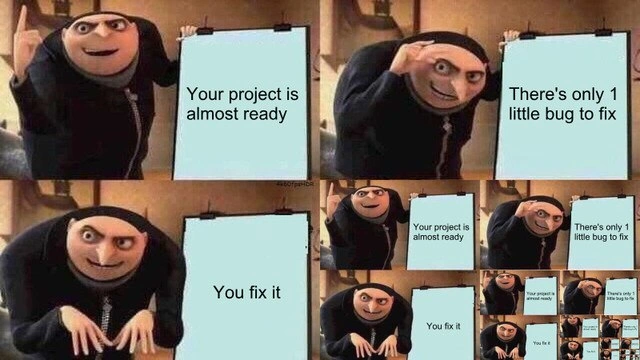
Imagine you’re playing a carnival game where little moles pop out of holes, and you have a mallet to hit them. You smack one mole down, feeling victorious... but then two more moles pop up elsewhere! You whack those, and now three more appear! 😫 No matter what you do, the game never quite ends because new problems keep popping up as soon as you solve one. This meme is joking about that same idea, but with fixing computer problems (bugs) instead of moles. The character (Gru) thinks his work is almost finished – he just has one tiny problem left to solve. He solves it, feeling happy for a second, but then he discovers that solving it caused or revealed a new problem. His surprised, defeated look in the last panel is like saying, “Uh-oh, here we go again...” The picture repeating smaller and smaller around him means he keeps getting caught in this never-ending cycle. It’s funny in a cheeky way because anyone who’s tried to fix something (even outside computers) knows that one thing fixed can sometimes make another thing go wrong. The meme takes that feeling to the extreme – making us laugh at how fixing one “little” thing can turn into an endless game of whack-a-mole with problems. It’s a silly way to say, “Sometimes, solving a small problem isn’t the end – it’s just the beginning of a whole new adventure of fixes!”

Level 2: Fix One, Break Two

For those newer to coding, let’s break down what’s happening here. In software, a bug is a flaw or error that makes the program behave in ways it shouldn’t. Debugging is the process of finding and fixing those bugs. Now, you’d think fixing a bug is the happy end of the story — but often fixing one problem can accidentally cause another. We call these regression bugs: when a new code change regresses (i.e., reverses) a previously working feature into a broken state. It’s like solving one issue and then discovering that something else that used to work has now stopped working. This meme is exaggerating that feeling. The text on Gru’s chart goes from “Your project is almost ready” to “There's only 1 little bug to fix” to “You fix it,” and then Gru looks shocked and defeated in the final panel. Surrounding that, the meme shows smaller and smaller copies of the same sequence, implying it keeps happening again and again. In other words, every time you fix that one last bug, something new breaks, putting you back at “almost ready, just one more bug” forever.

Why would fixing one bug spawn new bugs? In real projects, code isn’t isolated — parts of the system depend on each other in ways you might not realize until something goes wrong. Maybe that “little bug” was actually preventing the program from reaching a piece of code that also has a bug. Once you fix the first thing, the program runs a bit further and — oops — hits another error. This is common in complex systems or when there’s hidden technical debt (which means the code has some shaky design or quick-and-dirty implementations from the past that make new changes risky). It’s also common when you’re making a fix at the last minute without time for thorough testing. You might hear a teammate or boss casually say “just a minor tweak here…” but even a minor tweak can have unintended side effects.

To put it simply, software can be like a Jenga tower: all the pieces (code modules) stack together. Remove or change one piece (fix a bug), and other pieces can fall (new bugs appear). Good developers write unit tests and integration tests to catch these issues early, but tests don’t always cover every weird scenario (especially with deadline pressure and LastMinuteChanges flying around). The Gru meme is DeveloperHumor that dramatizes this situation — it’s funny to programmers because we’ve all confidently said “I’ll just fix this one thing” only to spend the rest of the day (or night) fixing the fallout from that one thing. It’s a relatable pain.

To see this in action, consider a tiny pseudocode example:

# Initially, the project has one known bug.
bugs = ["small rounding error"]
print(f"Project almost ready, just {len(bugs)} little bug to fix...")

# Fix the one bug:
bug = bugs.pop()
fix(bug)  # let's assume this function fixes the bug
print(f"Fixed '{bug}' bug. 🚀 All done, right?")

# Unfortunately, fixing that uncovers two new bugs:
new_bugs = ["report export crash", "email notification glitch"]
bugs.extend(new_bugs)
print(f"Oh no, now there are {len(bugs)} new bugs: {bugs}")

In this toy example, we started with one bug ("small rounding error"). We fixed it, great! But then we discover two more bugs (report export crash and email notification glitch) that were hiding or caused by that fix. Now we have more bugs than we started with. This is obviously simplified, but it mirrors real life. Maybe fixing a rounding error changed how data is formatted, which broke the report exporter that expected the old format, and also revealed a glitch in email notifications that use those reports.

The Gru meme’s gru_meme_format (from Despicable Me) is typically used to show someone’s plan failing spectacularly. Here, developers repurposed it to joke about the plan of finishing a project after a tiny bug fix, only for that plan to fail as the fix leads to a new bug cycle. It’s basically the programmer’s version of “for every action, there is an equal and opposite reaction”. If you’re a junior developer, don’t be discouraged — this doesn’t mean every bug fix will explode on you. It just means you should be thorough: write tests, think about what else could be affected, and be wary when someone says “it’s a trivial change.” Software has a funny way of making simple things complicated when you least expect it. The meme is a lighthearted reminder to expect the unexpected in Debugging_Troubleshooting.

Level 3: Infinite Regression

At the most technical level, this meme captures a dreaded debugging nightmare: the infinite bug cycle. It’s a darkly comic take on how a "quick fix" can spiral into cascading regressions. In theory, every bug fix should bring a project closer to done. In practice, touching one part of a complex system often unravels two other parts. The image uses the Gru presentation format recursively to visualize an infinite loop of bug fixes — a perfect metaphor for a bug that spawns more bugs, ad infinitum. Seasoned developers know this pattern all too well: fix one thing, break two others. It’s software’s version of the mythical Hydra: cut off one head, and two more grow in its place.

Why does this happen? Technical debt and high system complexity are usually the culprits. That "one little bug" lives in a fragile, interconnected codebase where hidden dependencies lurk. You patch a seemingly isolated issue, but that fix changes some behavior or timing, and suddenly an edge-case that was dormant comes alive as a brand new problem. This is the realm of regression bugs: solving bug A inadvertently resurrects bug B (which was supposedly fixed ages ago) or creates a brand-new bug C. It’s a vicious cycle often triggered by last-minute changes under pressure. The meme nails this with the infinitely nested panels — it’s like a visual recursion of regret. Each smaller Gru is another round of “almost ready, just one bug… oops.”

Let’s be honest, the phrase “there’s only 1 little bug to fix” is practically a red flag among developers. It’s often a well-meaning manager or client expressing stakeholder expectations that the hardest part is over. Meanwhile, the battle-hardened engineer is bracing for impact, knowing that last-minute changes can be a minefield. We’ve all lived the scenario: the project is 99% done, you just need to fix that tiny login glitch before launch. You fix the null pointer in the login logic… and suddenly the entire user profile module starts misbehaving because it relied on the old buggy behavior. Surprise! Now you have two more issues to fix overnight.

Stakeholder: "It’s just one tiny bug, you can knock it out before we go live, right?"
Developer (internally): "One tiny bug... sure. And when I'm done, pigs will fly in formation."

The humor here is equal parts DeveloperHumor and RelatablePain. It’s funny because it’s true – every dev has confidently said “got it, just one bug left,” only to trigger an avalanche of unexpected failures. This meme format (Gru’s plan backfiring on the flip chart) is especially apt: originally, Gru smugly outlines a plan that collapses by the final panel. Here, the plan is finishing the project after fixing one bug, and the backfire is the infinite series of new bugs. Each smaller copy of the panel in the image represents another round of despair. The light-blue text boxes and recursive layout even resemble a hall of mirrors, hinting at how fixing one bug can reflect into multiple new problems. In a way, it’s a form of software karma or Murphy’s Law of coding: anything that can go wrong will go wrong — and probably because of that “small” fix.

This endless bug-fix loop underscores how complex software systems really are. Modern applications have so many modules and integrations that a tiny change can have non-obvious ripple effects (hello, butterfly effect of code). If the codebase has poor separation of concerns or lacks solid tests, one bug fix might break an assumption in another module. Often, these “one little bugs” were the glue accidentally holding shaky code together. Remove the bug, and the cracks show. It’s a TechDebt trap: earlier quick fixes and shortcuts come back to haunt you at the worst time. Senior engineers chuckle (or more likely groan) at this meme because they’ve been in on-call hell at 3 AM, patching a fix-that-broke-a-fix in production. It captures the soul-crushing yet comical reality of chasing a truly done project. In summary, the meme is a witty commentary on debugging frustration and the unpredictable complexity beneath even “simple” software fixes. It’s the infinite regress of BugFixing: a nightmare dressed as a lighthearted cartoon.

Description

A recursive meme using the four-panel 'Gru's Plan' format from the movie Despicable Me. In the first panel, Gru confidently presents a board reading, 'Your project is almost ready'. In the second, he slyly points to the next step, 'There's only 1 little bug to fix'. The third panel shows him looking back at the board with dawning horror, which now reads, 'You fix it'. The fourth panel, where the consequence is usually shown, instead contains a smaller version of the entire meme, which in turn contains an even smaller version, creating an infinite recursive spiral. This visual effect, known as the Droste effect, perfectly illustrates a developer's nightmare: fixing one bug often creates multiple new ones, trapping them in a seemingly endless cycle of debugging that prevents the project from ever being 'ready'

Comments

7
Anonymous ★ Top Pick Ah, the classic 'Heisenbug' fractal. The closer you get to shipping, the more the complexity of the bug approaches infinity
  1. Anonymous ★ Top Pick

    Ah, the classic 'Heisenbug' fractal. The closer you get to shipping, the more the complexity of the bug approaches infinity

  2. Anonymous

    That “one last bug” is just the outermost recursive call - each fix pops one stack frame of legacy hacks before tail-calling you straight back to sprint planning

  3. Anonymous

    The real recursion bug is in our estimation algorithm - it keeps returning 'one more day' no matter how deep in the call stack we get

  4. Anonymous

    This meme perfectly captures the halting problem in human form - you can't prove your debugging session will terminate, and empirical evidence suggests it won't. Every senior engineer has lived through this fractal nightmare where 'production-ready' becomes an asymptotic limit you approach but never reach. The real kicker? That 'one little bug' is usually a race condition that only manifests in production at 3 AM, and fixing it reveals you've been violating ACID properties in three different microservices for the past six months

  5. Anonymous

    Senior dev wisdom: Bugs follow the N+1 rule, where N is the count you've just fixed

  6. Anonymous

    The 'one last bug' is a geometric series with r ~ 1.02; every patch ripples through transitive coupling, CI diverges, and PMs still insist we're basically done

  7. Anonymous

    “Just one little bug” is a recursive function with no base case - touch one implicit contract and the release plan collapses into infinite smaller copies of itself

Use J and K for navigation