Developer Empathy: 404 Not Found
Why is this Communication meme funny?
Level 1: Clean Up Your Own Mess
Imagine you and your friend each have a set of building blocks. You build separate little towers. One day, you accidentally knock over your own tower and the blocks scatter everywhere. You’re upset and announce, “Oh no, my tower fell apart!” Your friend looks over and the first thing they ask is, “Did my tower get knocked down too?” You shake your head and say, “No, your tower is fine.” Now your friend just shrugs and goes back to playing, saying, “Well, then you fix it yourself.” They don’t offer to help you rebuild or even say “that stinks.” It’s like they don’t care since their tower isn’t affected. You’re left picking up the pieces alone. This is exactly what the meme is joking about: if your mistake or problem doesn’t hurt anyone else, sometimes people will just leave you to deal with it on your own. It’s funny in a stingy way – we expect friends or teammates to feel sorry for us or help out, but instead they basically say, “Not my problem!” The meme uses that situation to make us laugh because it’s a bit like a friend saying, “Your toy broke but mine didn’t, so I don’t care.” It highlights a selfish side of people in a playful, exaggerated way. In simple terms: you made the mess, so you’re the one who has to clean it up, and don’t expect others to even give you a pat on the back for it!
Level 2: Bugs and Boundaries
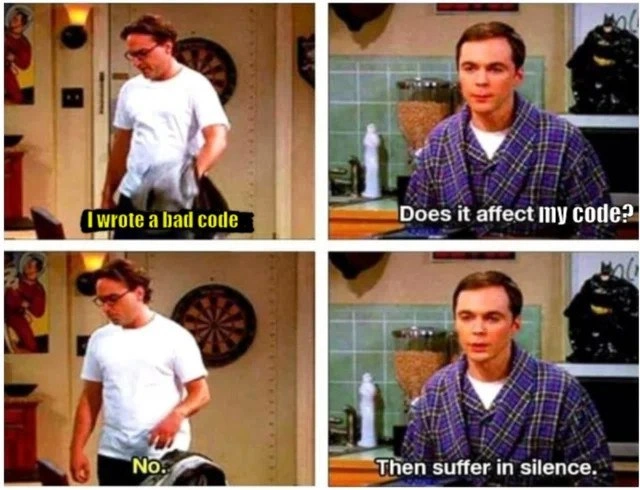
Let’s break down what’s happening in this scenario. A developer says, “I wrote a bad code.” In plain terms, they made a commit (a set of changes recorded in version control like Git) that introduced a bug. A bug is an error or flaw in the program that causes it to behave in unexpected or wrong ways. Now, this bug is confined to that developer’s module – a module is basically one section or component of the software, sort of like a self-contained unit of functionality. Think of modules as different parts of a big machine: each part has its own job. Here, the buggy commit didn't mess with any other parts of the machine, just the developer’s own part.
The colleague asks, “Does it affect my code?” In other words, “Is your bug going to break anything in my module or the parts I’m responsible for?” When the answer is “No,” it means the issue is isolated – the bad code isn’t causing failures or bugs in anyone else’s work. It’s like a spill that’s contained to one room; no other rooms are getting dirty. Because of that, the colleague responds with, “Then suffer in silence.” This sounds harsh, but it’s the meme’s way of showing the colleague basically saying, “If it’s not my problem, I’m not getting involved.” The humor here is a bit dry: the second developer isn’t showing any sympathy at all. They only cared if the bug would create extra work for them. Since it doesn’t, they’re completely indifferent.
In real developer life, teams ideally share responsibility for the overall project’s code quality, but often each person focuses on their own tasks. Code reviews are a process where team members check each other’s code changes before they are merged, aiming to catch bugs or design issues. However, if a code change (commit) only touches one developer’s own module, other teammates might glance over it quickly or not fully grasp its implications. They might think, “Alright, if it doesn’t break anything I rely on, it must be fine.” This meme shines a light on that apathetic attitude. It’s highlighting developer frustration: the first developer is essentially confessing, “I messed up,” possibly hoping for some help or at least a bit of “we’ve all been there” consolation. Instead, he gets a stone-cold reply. That reflects a reality where some teams have a strict “you build it, you fix it” policy. If a bug is truly self-contained (only in your code and not blocking anyone else’s work), you might find yourself debugging solo while your teammates carry on with their day. The dartboard and kitchen setting in the meme image drive home that casual, almost apathetic vibe – the colleague is literally not getting out of his chair because it’s “not his problem.” The joke is ultimately about how teamwork can sometimes fail: if your mistake doesn’t inconvenience others, you might be left alone to clean it up. The phrase “Teamwork 100” in the post caption is sarcastic – it implies the team is supposedly perfect at teamwork, while in reality this situation shows exactly the opposite.
Level 3: Sympathy 404
For seasoned engineers, this meme cuts deep because it highlights a harsh truth of code ownership culture. A developer sheepishly admits “I wrote bad code” (a buggy commit), and the colleague’s first question is a cold, “Does it affect my code?” When the answer is No, all concern evaporates. The sympathy meter instantly drops to 0% – essentially a 404: empathy not found. This scenario pokes fun at how some teams operate under an unwritten rule: not my module, not my problem. The humor works because it’s painfully relatable; many of us have seen a critical bug met with shrugs when it’s isolated to one person’s area. It’s a snapshot of team indifference born from rigid boundaries in the code base.
In a large project with well-defined modules or microservices, each engineer often “owns” their slice of the system. That division of responsibility can devolve into siloed thinking. Here, the offending commit didn’t break any integration tests, didn’t bring down anyone else’s service, and didn’t trigger a company-wide outage. So the rest of the team breathes easy – it’s your mess, not theirs. The colleague in the plaid robe (eerily reminiscent of a certain unsympathetic TV roommate) basically says: “Then suffer in silence.” It’s a cynical acknowledgement that as long as their service or module is unaffected, they have zero incentive to help. They’re essentially thinking: “Better you debugging at 2 AM than me.” Teamwork 100, indeed.
This meme perfectly satirizes a common code review anti-pattern. Ideally, peer review is meant to uphold code quality across the entire project: everyone should care if there’s a bug, because any bug in the codebase is a bad thing. In reality, reviewers might skim over sections that don’t touch their code, or they mentally check out if it’s “someone else’s area.” If your buggy commit doesn’t cross into their module, you might get a quick LGTM with minimal scrutiny. Later, when the defect surfaces, nobody feels accountable except you. The pain point being mocked is that on many teams, responsibility stops at the module boundary. The moment it’s confirmed a bug is self-inflicted and isolated, the collective response is “deal with it yourself.” It’s a darkly comic exaggeration of real office dynamics — you fess up to a mistake and instead of rallying to help, your teammates offer a polite version of “sucks to be you.” Developers who’ve been around the block recognize this as both a blessing and a curse of decoupled architecture. Sure, one buggy module won’t topple the whole system (good software design, right?), but it also means your colleagues might just sip their coffee while your part is on fire. The meme’s punchline lands because it subverts the expectation of team support; instead of a helpful rubber duck debugging session or at least a “you got this” pat on the back, the poor coder is left to suffer in silence. It’s a humorously cruel reminder that in the trenches of software development, responsibility boundaries can sometimes mean you’re on your own when things break.
Description
A four-panel meme featuring characters from the TV show 'The Big Bang Theory'. In the first panel, Leonard Hofstadter looks dejected and confesses, 'I wrote a bad code'. The second panel cuts to Sheldon Cooper in his signature plaid robe, asking with a deadpan expression, 'Does it affect my code?'. In the third panel, Leonard sadly replies, 'No.'. The final panel shows Sheldon delivering the punchline with cold finality: 'Then suffer in silence.'. The meme humorously captures the concept of developer silos and strict code ownership. For experienced engineers, it's a relatable take on working in large, modular codebases where one developer's crisis is contained within their own module and doesn't affect others' work. It satirizes the 'not my problem' attitude that can arise when teams prioritize clean interfaces and encapsulation over collaborative problem-solving and mutual support
Comments
7Comment deleted
That's just API-driven development. As long as your breaking changes don't breach the contract with my service, your internal suffering is an implementation detail I don't need to know about
Conway’s Law applies to feelings too: once your bug is safely inside its bounded context, the team’s empathy interface resolves to /dev/null
This is every code review where someone's "temporary workaround" from 2019 is still in production, but since it's isolated to their service and doesn't break the CI pipeline, we all just pretend it doesn't exist while secretly documenting it as technical debt that will never get prioritized
The classic 'works on my machine, not my problem' philosophy distilled to its purest form. This perfectly captures the unspoken social contract in large codebases: if your technical debt doesn't leak across module boundaries or trigger my pager at 3 AM, I'll pretend I didn't see that nested ternary operator nightmare or the 500-line function with no tests. It's the engineering equivalent of mutually assured destruction - we all have skeletons in our repos, so we maintain a fragile peace through strategic blindness. Of course, this détente lasts exactly until the next major refactor or the day that 'bad code' becomes load-bearing infrastructure that nobody dares touch
Sheldon's ISP corollary: segregate interfaces so your spaghetti never touches my ports
In microservices, empathy is eventually consistent - if your bug can’t breach my API boundary or SLO, it’s externalized as your tech debt
Microservice empathy: if it doesn’t trip my PagerDuty or breach my SLO, your bug is just a non-blocking suffering in your bounded context