Skip to content
DevMeme
1546 of 7435
It's Not a Bug, It's a Feature for a Niche Market
SDLC Post #1727, on Jun 20, 2020 in TG

It's Not a Bug, It's a Feature for a Niche Market

Why is this SDLC meme funny?

Level 1: Plan vs Wing It

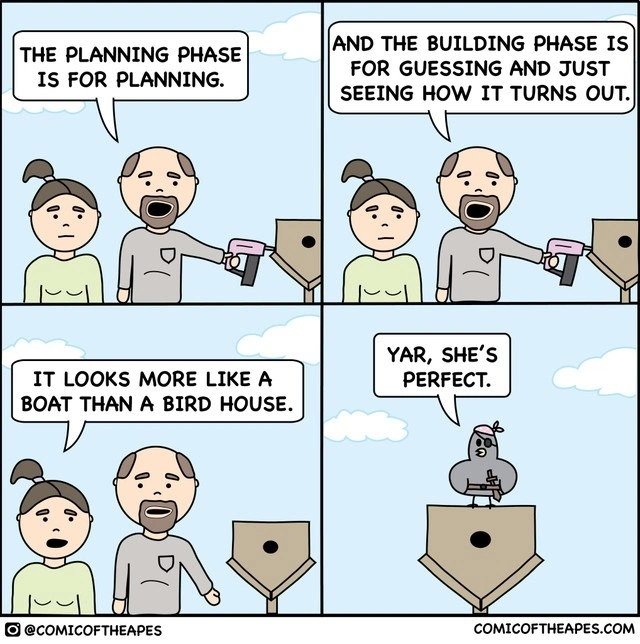
Imagine your teacher asks you to build a little wooden birdhouse, but you don’t follow any instructions or plan. You just start nailing pieces together randomly to “see what happens.” Instead of a birdhouse, suddenly you’ve built something that looks like a tiny boat by accident! Now picture a pigeon putting on a tiny pirate hat, sitting on that mini boat, and happily saying, “Yar, this is perfect for me.” It’s funny because you were supposed to make a house for the bird, not a pirate ship. The joke shows that if you don’t plan at all and just wing it, you might end up with a silly surprise result that wasn’t what anyone wanted (except maybe that pirate pigeon!).

Level 2: Scope Creep Ahoy!

Think of the planning phase as the step where you decide what you’re building and how it should basically look or work. The building phase (coding/development) is when you actually create it according to that plan. In this comic, the builder treats the building phase as an open-ended experiment. He literally says he’s “guessing and just seeing how it turns out” – which is not how things are usually done in software engineering! Normally, some planning happens upfront (even in Agile projects, we do sprint planning or write user stories) so that everyone knows we’re supposed to be making, say, a simple birdhouse for pigeons. Here, they skipped straight to hammering pieces together without a clear design.

In a typical SDLC (Software Development Life Cycle), skipping the planning usually spells trouble. A developer might start coding with their own assumptions, and the result might miss the mark completely. That’s why we gather requirements first – these are the details of what the software should do or look like. For example, a requirement for a birdhouse could be “must have a small round door for birds to enter.” If no one clarifies requirements like that, one developer might build a square door, another might make it a huge opening, and someone else might not add a door at all! In the meme, the lack of clear requirements (and lack of sticking to a plan) caused the project to drift: the birdhouse project unintentionally turned into a “boat” project.

This drifting outcome is a classic example of scope creep. Scope means the defined goals and features of the project (in simple terms, what you’re supposed to build). Scope creep is when that scope keeps changing or expanding uncontrolled. It’s like starting to build a small birdhouse, then someone says “let’s also add a sail!” and later “how about we make it big enough for two birds?” – and before you know it, the birdhouse has evolved into a mini pirate ship. The meme uses the birdhouse-to-boat transformation as an analogy for how a project can wildly change when there’s no stable plan. Each “little change” or guess in the building phase piled up until it no longer resembled the original goal.

Let’s compare what should happen versus what happens in the comic:

Proper Planning & Execution Guessing & Winging It
Team defines what to build before coding. For example: “We need a birdhouse. It should be about one foot tall, have these specific features, and serve this purpose.” Everyone agrees on the plan. Team dives into building with no clear plan. They start hammering wood together immediately, figuring they’ll make it up as they go.
If changes are needed, they discuss and adjust the plan. The end goal stays the same (it’s still meant to be a birdhouse for birds). Any new idea (“maybe add a perch?”) is considered carefully against the original goal before adding. Changes happen on a whim. One moment it’s a birdhouse, next someone nails on something random like a sail or a hull piece. The project direction shifts without anyone evaluating if that fits the goal.
Final result matches the intended design: a birdhouse that birds can actually use. It might not be exactly like the initial sketch (minor adjustments happen), but it fulfills what was asked for. ✅ Final result is off-target: a strange boat-shaped structure. It wasn’t planned; it just “evolved.” A pigeon might still perch on it, but it’s not what was originally requested. The stakeholders (the people who wanted the birdhouse) would likely be confused or unhappy. 😕

In the comic’s final panel, ironically, one pigeon is happy – but he’s a goofy pirate pigeon, which is the joke. In real software projects, you usually won’t get such a lucky (or bizarre) user. Instead, the client or end-user might say, “This isn’t what we needed at all,” and you’ll have to redo the work. That’s why planning isn’t just bureaucratic fluff; it’s there to ensure everyone has a shared vision of the project from the start.

For a junior developer, the lesson here is: don’t treat implementation like a guessing game. Even in Agile environments (where projects are done in short iterative cycles with frequent re-planning), you still begin each sprint by clarifying what you’re about to build. Agile methodology encourages flexibility during development (for instance, if requirements change, you adapt in the next iteration), but it doesn’t mean “just start coding with zero direction.” In fact, Agile teams do things like backlog grooming and sprint planning precisely to avoid aimless development. When someone skips those steps, it becomes what some jokingly call cowboy coding – basically, coding with no plan, oversight, or coordination. That might sound adventurous, but on a team project it usually leads to confusion and wasted effort.

Have you ever started a school coding assignment at the last minute without reading the instructions carefully? You might end up with a program that runs, but doesn’t do exactly what the assignment asked for, causing you to lose points. This meme is illustrating that same idea, but in a workplace context. The team “guessed” their way through building something, and sure enough, they built the wrong thing. It’s a funny exaggeration with a pirate twist, but it highlights a real truth: a bit of planning at the start can save a ton of headaches later on.

Level 3: Guess-Driven Development

This meme hits Agile pain points square on the head by showing what happens when the planning phase of a project is treated as a mere formality. The bald builder’s proclamation:

“THE PLANNING PHASE IS FOR PLANNING.”

followed immediately by “AND THE BUILDING PHASE IS FOR GUESSING AND JUST SEEING HOW IT TURNS OUT.” is dripping with irony. In a proper SDLC (Software Development Life Cycle), the building/coding phase is supposed to implement what was decided during planning. But here our intrepid carpenter treats implementation like a wild experiment. This is essentially guess-driven development – a tongue-in-cheek way to describe coding by pure trial-and-error with no clear design or requirements.

Experienced developers will recognize this scenario as a nightmare of project management dysfunction:

  • Lack of clear requirements: The team either didn’t gather requirements or ignored them. (They set out to build a birdhouse with no blueprint, so of course it’s morphing into a boat!)
  • Scope creep galore: Features or ideas are being added on the fly. The simple birdhouse design wasn’t nailed down, so now it’s sprouting a hull and looking like a miniature pirate ship. In real projects, this is when a small app quietly balloons into a monster because “hey, wouldn’t it be cool if...?” kept happening during development.
  • Misinterpreting Agile: The comic satirizes how some teams misconstrue Agile principles. Agile values “responding to change over following a plan,” but it doesn’t mean “no plan at all.” Here the team skipped straight to coding chaos, maybe thinking “we’re being Agile, we’ll just adapt as we go!” But without initial direction, adaptation becomes aimless wandering.

This kind of breakdown between planning and execution is all too familiar. When the woman exclaims “IT LOOKS MORE LIKE A BOAT THAN A BIRD HOUSE,” it mirrors a tech lead or product manager discovering halfway through the sprint that the feature in development is completely off-target. It’s the horrified realization that what’s being built isn’t what was agreed upon. By the final panel, a pirate pigeon perched on the boat-shaped “birdhouse” saying “YAR, SHE’S PERFECT,” adds a punchline: the only one pleased is this absurdly niche “user.” It’s a comical way of saying, “Well, we built the wrong thing... but uh, I guess someone out there likes it?” In real life, delivering the wrong product usually ends with an unhappy client, not a happy pirate pigeon. The meme gives a humorous silver lining to an engineering misadventure.

Under the hood, the joke underscores a serious engineering truth: skipping or skimping on planning can derail an entire project. You might end up shipping (pun intended) a product that not only fails to meet the original needs (no normal bird is moving into that wonky birdhouse), but also accumulates massive technical debt. When developers “guess and just see how it turns out,” they often jury-rig solutions on the fly. The architecture becomes as ad hoc as that lopsided boat-house – full of ill-fitting parts. Sure, it floats enough for a pirate bird, but scaling that design or maintaining it? Good luck. Seasoned engineers have seen how these quirky one-off decisions in code lead to brittle systems that are hard to extend or fix. It’s the software equivalent of having poor requirements combined with cowboy coding: you eventually get something, but probably not what you set out to make, and definitely with a few nails sticking out in the wrong places.

Why do teams end up in this situation? Often it’s a mix of over-optimism and pressure. Stakeholders might say, “We don’t have time to plan every detail, just build it!” or a team might lack a strong process, thinking a vague idea is “good enough” to start coding. There’s also the allure of immediate action – writing code feels productive, while planning meetings and documentation feel like slow overhead. Ironically, racing ahead without a map can lead to going in circles or off a cliff, requiring even more time to correct course later. The comic exaggerates to make the point: deliberately not deciding on a clear design (birdhouse) because “we’ll figure it out as we go” can land you with a completely off-course result (pirate ship) and a bewildered team.

For veterans, the humor has a bit of pain behind it. We chuckle because we’ve been on that project – the one that started as a straightforward SDLC task (“build a simple house for birds”) and, after a few chaotic sprints, we’re demoing something unintentionally bizarre (“so… it’s a nautical-themed bird mansion now?”). The YAR, SHE’S PERFECT is the cherry on top, implying maybe management or a random stakeholder bizarrely thinks this deliverable is fine, echoing those projects where despite obvious mismatches, someone declares success and moves the goalposts. It's a reminder that Agile doesn’t mean absence of discipline. A good Agile team still has a planning phase each iteration (e.g. sprint planning, backlog grooming) to prevent this exact situation. Skip that, and you’re essentially sailing without a compass, hoping to accidentally land at the right destination. As every grizzled engineer knows, hope is not a strategy – unless, of course, your end-user is a pirate pigeon with very low expectations.

Description

A four-panel comic strip from 'comicoftheapes'. In the first panel, a man holding a nail gun stands next to a woman and a half-built birdhouse, declaring, 'THE PLANNING PHASE IS FOR PLANNING.' In the second panel, he continues, 'AND THE BUILDING PHASE IS FOR GUESSING AND JUST SEEING HOW IT TURNS OUT.' The woman looks unimpressed. In the third panel, they look at the finished product, which is shaped like the hull of a boat, and the woman remarks, 'IT LOOKS MORE LIKE A BOAT THAN A BIRD HOUSE.' In the final panel, a pigeon wearing a pirate bandana and holding a small sword stands atop the structure and exclaims, 'YAR, SHE'S PERFECT.' This comic is a sharp allegory for software development projects where the final product deviates significantly from the initial plan but unexpectedly satisfies a specific user or niche market - the 'pirate pigeon.' It humorously critiques the 'move fast and break things' mentality that forgoes careful planning, leading to unintended but sometimes surprisingly successful features
Comments

7
Anonymous ★ Top Pick That's not a deviation from the spec; that's just discovering your product-market fit with the previously unidentified 'avian buccaneer' user persona
  1. Anonymous ★ Top Pick

    That's not a deviation from the spec; that's just discovering your product-market fit with the previously unidentified 'avian buccaneer' user persona

  2. Anonymous

    Estimated a 1-point birdhouse; two sprints later we’re deploying a Kubernetes “pirate ship” because someone misheard “just add Helm” - the pigeons have promoted me to Captain

  3. Anonymous

    After 20 years in the industry, I've learned that the difference between a senior architect and a junior developer is that the senior knows the boat was always the intended design - we just called it a birdhouse in the requirements doc to get stakeholder buy-in

  4. Anonymous

    This perfectly captures the eternal truth that no amount of upfront architecture diagrams and planning documents can prevent your microservices from somehow evolving into a distributed monolith - but hey, if it ships and the users are happy, you just call it 'emergent architecture' and move on to the next sprint

  5. Anonymous

    Architecture review: birdhouse. Implementation review: boat. Retrospective takeaway: if a pirate pigeon signs UAT, it's a pivot, not a bug

  6. Anonymous

    Architects blueprint birdhouses; engineers ship unsinkable monoliths - 'Yar, she scales across clusters.'

  7. Anonymous

    If your SDLC is 'plan, then guess,' that's not Agile - it's WaterScrumFall; occasionally you still hit PMF when the only stakeholder is a pirate pigeon

Use J and K for navigation