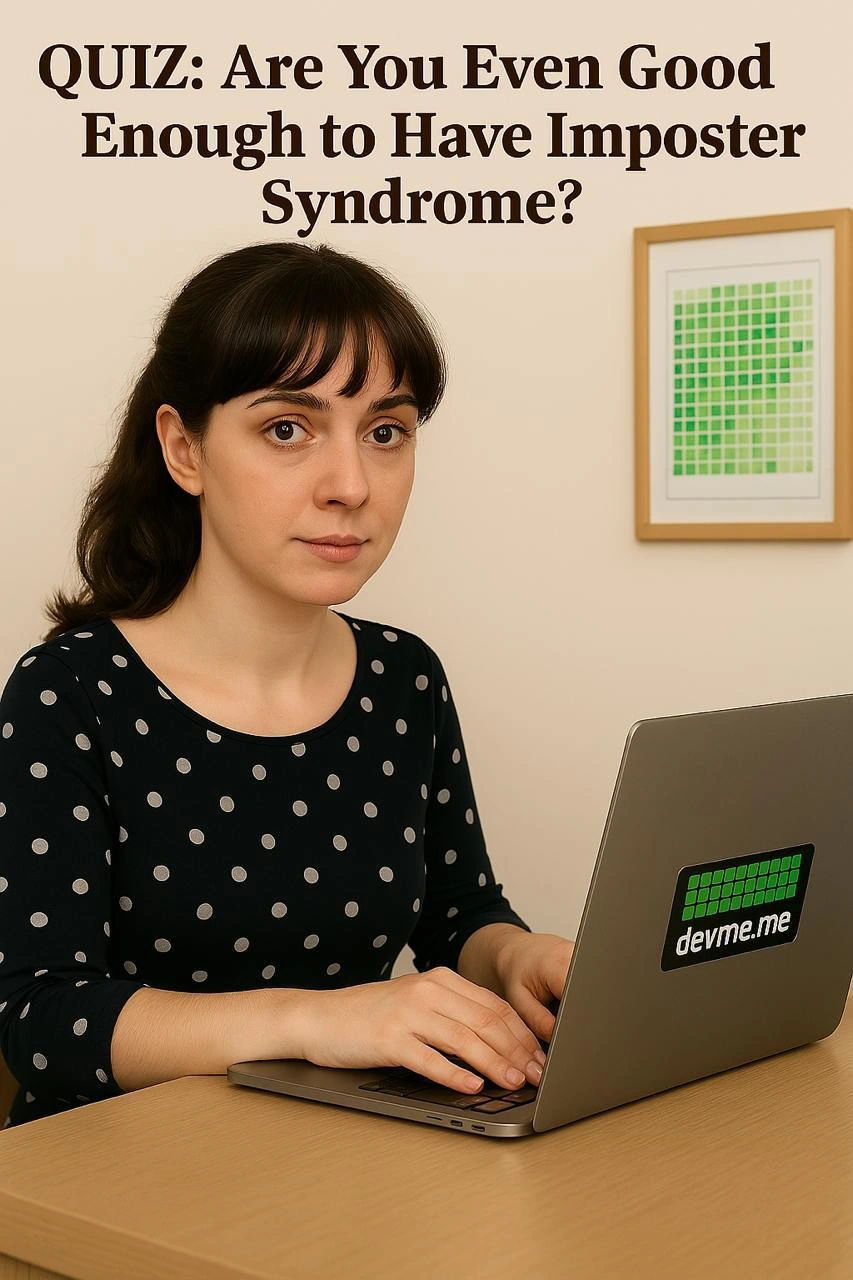
Quiz asks if you are qualified enough to experience imposter syndrome
Why is this Juniors meme funny?
Level 1: Doubting the Doubt
Imagine you just joined a new soccer team. You feel like all the other kids play better than you, and you start thinking, “I’m not a good player.” That’s a normal nervous feeling. Now picture taking a quiz that asks, “Are you even good enough to worry about being a bad player?” Silly, right? It’s like doubting whether you should even doubt yourself. This meme is joking about that exact loopy feeling. The girl in the picture is basically thinking, “Am I allowed to feel unsure, or am I so bad that I can’t even have that worry?” It’s a funny way to show how people sometimes get so insecure that they even question their own self-doubt. In real life, it reminds us that everyone feels unsure sometimes — and honestly, if you’re worried about doing a good job, it probably means you care and you’re doing just fine.
Level 2: Junior Jitters
At its core, this meme plays on the concept of impostor syndrome in a developer setting. Impostor syndrome means feeling like a fraud — as if you don’t actually know what you’re doing and will be “found out” at any moment, even when you are actually competent. It’s a familiar MentalHealthInTech topic: many programmers, especially junior developers, experience this as they start their careers. They might think, “Everyone here is so skilled; I don’t belong.” That nagging worry and self-doubt is exactly what imposter syndrome is. It’s a form of developer anxiety where you constantly question your own abilities.
Now, the meme delivers this serious feeling in a jokey format: a quiz title. The text “QUIZ: Are You Even Good Enough to Have Imposter Syndrome?” is written like a magazine or BuzzFeed-style quiz headline. Quizzes are usually meant for fun ("Are you a true Marvel fan?" etc.), but here it’s humorously asking about your self-worth as a developer. The absurdity is immediate: being “good enough” to feel “not good enough” is a comical contradiction. It’s poking fun at how inexperienced devs sometimes even doubt whether their insecurities are valid. In other words, a junior might think, “I’m so new that maybe it’s not even imposter syndrome — maybe I really just don’t know anything!” The meme exaggerates this thought by framing it as a qualifying test, which is both silly and sarcastic.
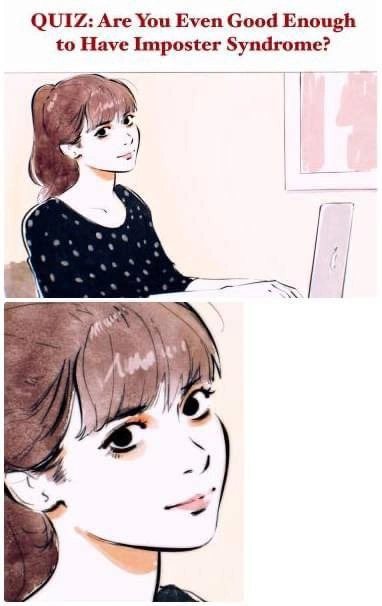
In the first panel, we see a young developer sitting at her laptop, looking neutral. The big quiz title above her is in fancy bold lettering, which makes it look official and serious (adding to the comedic effect, because the content is ironically ridiculous). In the second panel, the picture zooms in on her face, and we can see she looks a bit worried or uncertain. That facial expression represents the anxious confusion a lot of devs feel inside. She’s basically thinking, “Wait… am I not even worthy of my own imposter feelings?” The meme uses this character’s expression to mirror the reader’s own likely reaction: a kind of “uh oh” moment of recognition.
Let’s clarify some terms that come up with this meme. Developer Self-Deprecation is the habit programmers have of making fun of themselves. For example, a coder might joke “I’m a terrible programmer” even if they solved a tough problem — it’s a way to stay humble or cope with stress. This meme is a textbook case of that humor: it’s literally self-deprecating about self-deprecation! It also touches on DeveloperRelatability. That means it’s written in a way that other developers read it and go, “Haha, that’s so me.” The reason this joke lands is because it’s relatable humor about a real emotional experience in tech. When you’re new (and even when you’re not), seeing others joke about feeling inadequate makes you realize you’re not alone. It’s common enough that it’s become part of developer culture to openly talk about imposter syndrome and even laugh about it to take away some of its sting.
In summary, the meme takes a feeling almost every programmer knows (imposter syndrome) and turns it upside down: imagine needing to pass a quiz to prove you’re insecure! It’s funny in a gentle, ironic way. For a junior developer, it’s basically saying: “You feel unsure of yourself? Don’t worry, even that feeling is so common we joke about it!”
Level 3: Gatekeeping Self-Doubt
In tech circles, feeling like a fraud — Imposter Syndrome — has become almost a rite of passage. This meme wryly asks if you've even unlocked the "achievement" of doubting yourself. It’s a paradoxical gatekeeping of insecurity, as if you need a qualification just to feel unqualified. Seasoned engineers chuckle (and wince) because they've seen this irony up close: junior devs sometimes worry they’re not even good enough to have imposter syndrome. The joke hits home precisely because it takes a common developer anxiety and gives it a sarcastic twist — a quiz that essentially asks, “Are you worthy of feeling unworthy?”.
At a deeper level, the humor pokes at tech’s self-deprecating culture. Developers often cope with stress by joking about their own shortcomings. Here, that coping mechanism is cranked up to meta-level absurdity. The first panel’s bold quiz title mimics clickbait personality tests, but instead of “Are you a true JavaScript Ninja?” it’s “Are You Even Good Enough to Have Imposter Syndrome?”. It’s a satirical slap: even your self-doubt has a performance review! The second panel zooms in on the woman's blank, worried face — the thousand-yard stare of “Oh no… maybe I really don’t qualify”. Every experienced dev recognizes that look. It’s the same expression you get after your code breaks in production and you wonder if hiring you was a mistake. The meme resonates because it captures that private panic so accurately. We’ve all had moments of silently asking ourselves, “Do I actually know what I’m doing?” and then immediately doubting if we have the right to even ask that.
This tongue-in-cheek Developer Humor carries a grain of truth about tech's imposter phenomenon. Ironically, people who are truly inept rarely suffer from imposter syndrome — a quirk known as the Dunning–Kruger effect, where beginners are too ignorant of their ignorance to doubt themselves. Meanwhile, competent folks are keenly aware of everything they don’t know, so they perpetually feel behind. The meme’s joke is a nod to this irony: if you’re worrying that you’re not “qualified” to doubt yourself, you’re probably exactly the kind of conscientious developer who would have imposter syndrome. It’s practically saying, “Congrats, the fact that you question your ability means you have the ability to question!”.
Technically, it’s a no-win catch-22 that engineers bond over. If you “fail” this quiz (i.e. you're not good enough to merit imposter syndrome), it validates your deepest fear of inadequacy. If you “pass” and get imposter syndrome, you’ll just assume the quiz overestimated you. The meme gets its dark laugh from that loop of logic. To illustrate in code form, it’s like:
def qualifies_for_impostor_syndrome(dev):
# must be "good enough" to feel not good enough (absurd, right?)
return dev.years_experience >= 5 and dev.has_major_achievements
Here the joke is clear: requiring serious accomplishments to trigger self-doubt is absurd, yet it feels that way to those afflicted. The humor is painfully relatable (RelatableHumor) to developers who’ve sat in meetings convinced their knowledge is “meh” while everyone else seems brilliant. It’s a gentle jab at how we gatekeep ourselves. And it subtly highlights a serious topic in MentalHealthInTech: even highly capable devs can feel undeserving. By dressing that truth up as a sarcastic quiz, the meme invites us to laugh collectively at our own DeveloperAnxiety. After all, when everyone secretly feels like the imposter, realizing it’s universal is oddly comforting. We’re laughing, but we’re also nodding in solidarity.
Description
Two-panel watercolor-style comic. Panel 1 shows a young woman with auburn ponytail, polka-dot blouse, and neutral expression sitting at a laptop in a pastel office. Centered above her in bold, serif, dark-red text reads: "QUIZ: Are You Even Good Enough to Have Imposter Syndrome?" Panel 2 zooms in on her blank, slightly worried face, emphasizing the self-doubt. The joke turns the common developer affliction - imposter syndrome - into a paradoxical gate-kept achievement, poking fun at how junior engineers question whether they are even competent enough to feel incompetent. The meme resonates with tech mental-health discussions and self-deprecating humor prevalent in dev culture
Comments
10Comment deleted
Quiz result: Eligible - turns out you unlock imposter syndrome only after writing an ADR that begins “We know this is wrong, but…” and then watching it run in prod for five years
The only thing more recursive than your imposter syndrome is the callback function you wrote to check if you have imposter syndrome, which is now questioning if it's qualified enough to evaluate your qualifications
The ultimate recursive paradox: questioning whether you're experienced enough to doubt your experience. It's like a stack overflow of self-doubt - each layer of questioning spawns another layer, until you realize that worrying about whether you're qualified to have imposter syndrome is itself proof that you have it. Senior engineers know this truth: the more you learn, the more you realize how much you don't know, and the more qualified you become to question your qualifications. It's not a bug, it's a feature of expertise
Quiz: Are you even good enough for impostor syndrome? If you’ve written a runbook and a rollback plan for it, you’ve passed
Eligibility check: you run a blameless postmortem on your confidence after a green build, then draft an RFC titled “confidence v2” - congrats, you qualify
Imposter syndrome: the only distributed fault your career tolerates without failover
looks like we have an imposter among us Comment deleted
Don't say it 😤 Comment deleted
No. Comment deleted
There goes years of therapy Comment deleted