The Frontend Roadmap Trap
Why is this Frontend meme funny?
Level 1: Moving Finish Line
This is funny because it is like seeing an article called "How to Learn Every School Subject This Year" with a picture of someone holding three textbooks at once. The promise sounds simple, but everyone who has tried it knows the list keeps getting longer while you are still learning the first part.
Level 2: The Tutorial Promise
Frontend development is the part of web development that users directly see and interact with: pages, buttons, forms, navigation, layouts, animations, and browser behavior. A front-end developer usually works with HTML, CSS, JavaScript, and often frameworks such as React, Vue, Angular, or newer tools built around them.
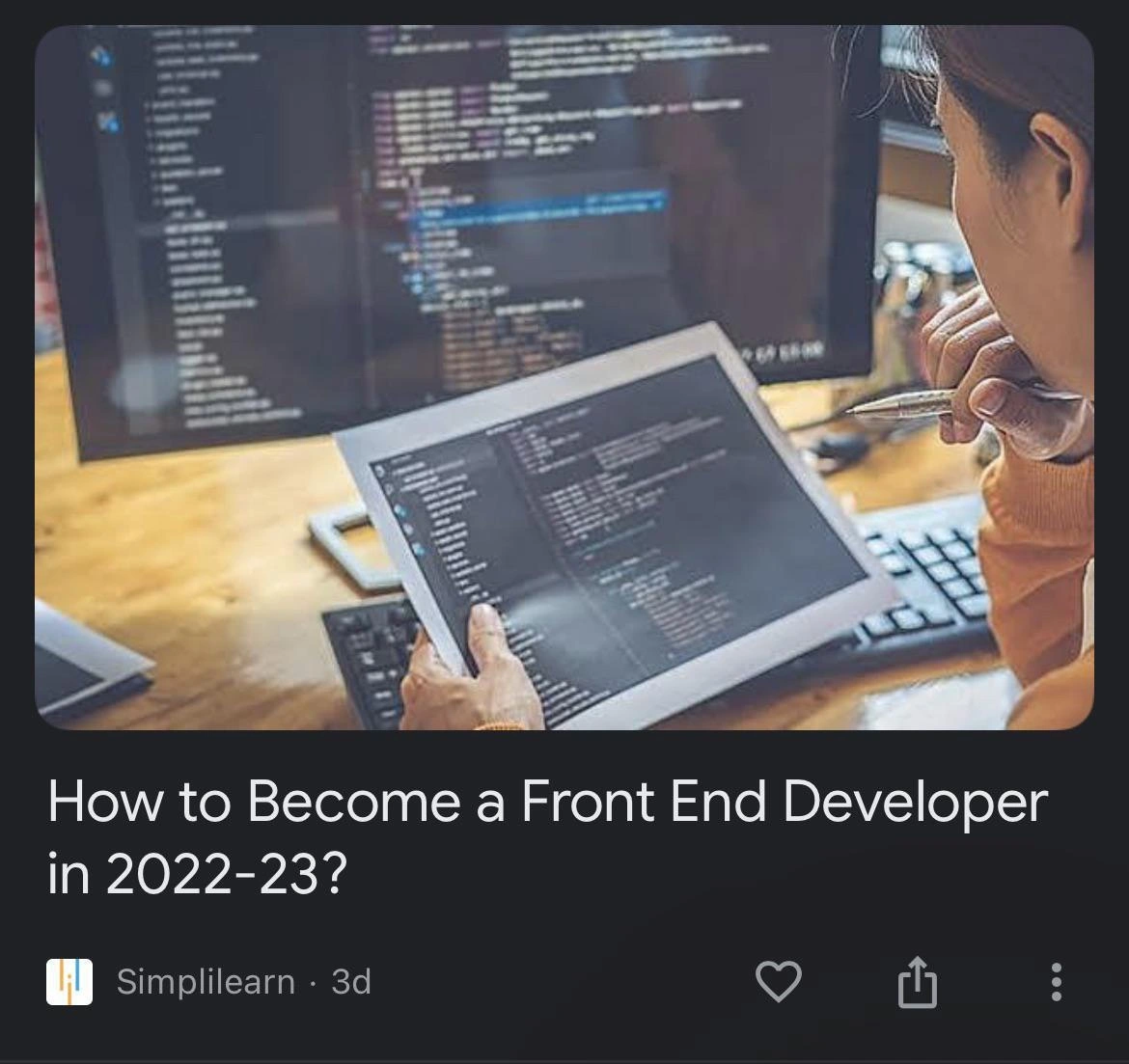
The image is a dark article card with a stock-style photo of a person looking at code on a monitor while holding another screen with code. The headline says How to Become a Front End Developer in 2022-23?, so the meme is about learning and career advice. It looks like a guide that will explain the path neatly.
The joke is that the path rarely feels neat when you are new. You might start by learning basic web pages, then discover responsive design, then JavaScript, then package managers, then a framework, then build errors, then browser compatibility, then accessibility, then deployment. Each topic is reasonable on its own, but together they can make a beginner feel like the roadmap keeps growing while they are walking on it.
This is why MarketingVsReality is an important part of the meme. Course platforms need simple headlines because simple headlines sell. Developers know that the real learning process is messier: building small projects, breaking them, reading errors, fixing them, asking better questions, and slowly recognizing patterns.
Level 3: Roadmap Collapse
The visible headline promises a clean path through chaos:
How to Become a Front End Developer in 2022-23?
That is the whole joke: front-end development is presented as a tidy current-year article card, while the actual field is a moving sidewalk installed on top of another moving sidewalk. The image shows someone holding a tablet full of code while facing a larger monitor also full of code, which makes the stock photo feel like it is trying to compress "modern web development" into one polished visual: more screens, more code, more seriousness, possibly more subscription popups.
For experienced developers, the humor is not that learning frontend is impossible. It is that LearningToCodeJourney marketing often treats the path as a checklist: learn HTML, CSS, JavaScript, React, Git, APIs, responsive design, accessibility, testing, TypeScript, bundlers, package managers, state management, browser devtools, performance, deployment, and whatever the ecosystem declared obvious last Tuesday. Then the headline asks "in 2022-23?" as if the answer has a stable shelf life.
The front-end ecosystem has a real churn problem because it sits at the intersection of browser behavior, user experience, design systems, accessibility requirements, JavaScript tooling, build performance, and product pressure. Every abstraction promises to make the complexity manageable: a framework, a meta-framework, a design system, a component library, a CSS strategy, a compiler, a linter, a package manager, a test runner. Some of those tools genuinely help. Some merely move the confusion into node_modules and ask you to call it architecture.
The article-card format is also part of the satire. The source line shows Simplilearn · 3d, with heart and share icons nearby, which gives it that EdTech feed energy: a career transformation packaged as a scrollable unit. There is nothing wrong with online courses, bootcamps, MOOCs, or structured learning. The trap is the implication that a marketable developer identity can be downloaded from a yearly roadmap. Real competence grows from repeated contact with weird bugs, browser inconsistencies, product compromises, accessibility details, performance regressions, and the humbling discovery that centering a div was only the tutorial boss.
The post message adds the Musk "print the code" jab, which fits the image because the stock photo appears to show code displayed on a tablet like a brochure. That is funny because code does not become more reviewable merely by being displayed in a more executive-friendly format. Serious code review needs context: diffs, tests, ownership history, production behavior, failure modes, and knowledge of why the ugly part is still there. A photo of code on every screen says "software work," but actual software work is the unglamorous chain of trade-offs hidden behind those glowing rectangles.
Description
The image is a dark-themed mobile article card showing a stock-like photo of a person holding a tablet with code while looking at a larger monitor that also displays code. The headline reads `How to Become a Front End Developer in 2022-23?`, and the source line reads `Simplilearn · 3d`, with heart, share, and menu icons on the right. The technical joke is implicit in the tutorial-card format: becoming a front-end developer is presented as a neat current-year guide, while the actual ecosystem changes constantly across JavaScript, frameworks, tooling, CSS, build systems, and browser behavior. For experienced developers, the funny part is how every roadmap compresses years of churn into a clean headline.
Comments
14Comment deleted
Step one: open the frontend roadmap; step two: watch three dependencies deprecate before the hero image finishes loading.
print the code... but not the IDE screenshot, why would it even be needed? Comment deleted
lol😂😂😂😂 Comment deleted
why print ide, when you can draw it by hand Comment deleted
They’re probably testing page layout for printing of their web IDE Comment deleted
And of course we won't bother changing IDE theme to white so we waste black toner on the useless background Comment deleted
because it looks sick! The shit! Dark theme. Yo Comment deleted
Tons of paper are wasted, but you are bothered just by toner? Comment deleted
Bruh that's a joke, sorry for ya if you didn't get it. Comment deleted
Im not taking everything seriously, just constanting the fact Comment deleted
Toner is probably more toxic [when disposed] than a whitened paper. And so is its plastic cartridge, especially when compared to carton package of office paper. Comment deleted
But, how toner can be disposed without being used? Comment deleted
The question is not whether toner is disposed or not — of course it is: almost 100 % of [laser] prints go to trashcan in less than 5 years, I assume. The volume of toner being spent (and thus disposed) is of concern, however: the more unnecessary dark prints are produced, the more waste (which is harmful) is generated in the end. Comment deleted
just pour it back into the container Comment deleted