Skip to content
DevMeme
4600 of 7435
Apple's App Store Power Play Over Twitter
Apple Post #5050, on Nov 29, 2022 in TG

Apple's App Store Power Play Over Twitter

Why is this Apple meme funny?

Level 1: Not Friends Anymore

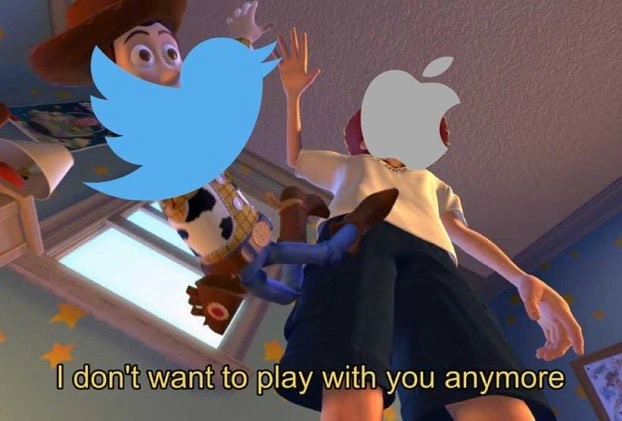
Imagine a kid who owns the only big playground in town. All the other kids have to play by this kid’s rules if they want to use the playground. Now picture one day the playground owner points at another kid and says, “I don’t want to play with you anymore.” Suddenly, that other kid isn’t allowed in the playground at all. It feels mean and shocking, right? In this meme, Apple is like that kid who controls the playground, and Twitter is the friend being kicked out. The picture is from Toy Story – the boy (Apple) is holding his toy (Twitter) and getting ready to drop it, just like saying “you’re not my friend now.” It’s funny because we see giant companies acting like children having a fallout on the playground. The emotion is a mix of “Ouch, that’s harsh!” and “Haha, they’re behaving like kids.” We can all understand what it’s like when a friend says they won’t play with you anymore – it’s petty and hurtful on a personal level. This meme makes us laugh by showing that even really powerful tech companies kind of do the same thing when they have an argument: one just walks away and leaves the other behind, like a kid dropping a toy he’s tired of.

Level 2: Platform Gatekeeping 101

For a junior developer or anyone new to these tech power dynamics, let’s break down what’s happening. Apple runs the App Store, which is the only official way to get apps on an iPhone or iPad. That makes Apple a gatekeeper – it decides which apps are allowed in and under what conditions. This tightly controlled approach is often called Apple’s walled garden. Inside this garden, Apple sets all the rules: apps must follow strict content guidelines, use Apple’s payment system for any purchases, and generally keep Apple’s ecosystem lookin’ spotless. If an app breaks the rules or even just upsets Apple’s leadership, it can be kicked out of the App Store. Getting kicked out is a huge deal, because it means normal iPhone users suddenly can’t easily download or update that app anymore.

Now Twitter is a massive social media app – the one represented by the little blue bird logo. In late 2022, Twitter was making some controversial changes (like different content moderation and new paid features) under new management. Meanwhile, Apple was watching closely because anything that happens inside apps on its platform can reflect on Apple too. The meme shows Apple (the gray logo over Andy’s face) holding Twitter (the blue bird over Woody’s face) and essentially saying, “I’m going to drop you.” The yellow caption “I don’t want to play with you anymore” is exactly what Andy says in Toy Story when he’s bored of his toy. Here it implies Apple is tired of dealing with Twitter or doesn’t approve of it anymore.

Why would Apple “not want to play” with Twitter? There are a few likely reasons that were buzzing in the tech news:

  • App Store Policies: Apple has rules to keep apps safe and civil. If Twitter was allowing nasty content (like bullying, hate speech, or other stuff Apple doesn’t like), Apple might threaten to remove it to protect users. Apple did this before with an app called Parler that wasn’t moderating bad content – they booted it from the store until it agreed to clean up. So, Twitter needed to be careful to not violate Apple’s content rules.
  • Money (30% Cut): Apple takes a 30% commission from many transactions in iOS apps (this is sometimes called the “Apple tax”). Twitter started offering a paid subscription (Twitter Blue for $8) and other services. Apple would insist on getting a share of those iOS sales. If Twitter tried to avoid paying that by directing users to pay on a website or something, Apple would be very upset. This scenario actually happened with the game Fortnite – Fortnite tried to bypass Apple’s payment system, and Apple dropped the ban hammer by removing Fortnite from the App Store entirely. So, the meme also hints that Apple could do the same to Twitter if pushed.
  • Corporate Spats: Sometimes big companies just clash over business or philosophy. Elon Musk (the CEO of Twitter then) was publicly complaining that Apple had paused advertising on Twitter and that Apple’s App Store fees were too high. It was a very public war of words. Apple might not have actually removed Twitter, but the tension was real. Think of it like two big players in the industry having a dramatic argument – and everyone else (users, developers) was anxiously watching to see if Apple would really pull the trigger.

In the image, the logos make it crystal clear who’s who: the Apple logo on Andy symbolizes Apple Inc., and the Twitter bird on Woody symbolizes Twitter. This is a common meme technique in tech circles — using company logos to label characters so you instantly know the “story.” The setting is Andy’s bedroom from Toy Story, scattered with other toys, which stands in here for Apple’s ecosystem or “playroom.” Apple/Andy declaring “I don’t want to play with you anymore” is dramatizing a potential reality: Apple could remove Twitter from the App Store, effectively severing ties. For developers, this scene hits home because it shows how a product we work on (or rely on) can be at the mercy of a bigger platform owner. It’s like building an awesome app or service, but knowing that if you break one rule or get caught in a corporate crossfire, a company like Apple can decide to cut you off — poof, your app vanishes from every iPhone. That’s the fragile dependency the description mentions: Twitter (and many apps) depend on platforms like the App Store to reach their users, so they’re somewhat fragile under the whims of those platform owners.

This meme also reflects CorporateCulture and power moves in Big Tech. Apple’s very image-conscious and rules-driven; Twitter was being more chaotic and “move fast, break things” under Musk. So it’s almost like a strict parent (Apple) dealing with a rebellious teenager (Twitter). And just like a parent might revoke privileges (“Give me your keys, you’re grounded from the car!”), Apple can revoke Twitter’s access to the “keys” of the App Store. The humor for tech folks comes from seeing this serious situation boiled down to a kid-and-toy scenario. It’s absurd yet accurate. Even if you’re a junior dev who hasn’t dealt with App Store drama yet, you probably know the feeling of relying on something you don’t fully control — like a third-party API or a library that suddenly changes. When that thing is a giant company’s platform, the stakes are much higher. Apple dropping Twitter would be like the ground disappearing under your feet if you’re standing on it. Scary for Twitter, and a bit nerve-wracking for any developer watching.

Level 3: The Walled Garden Ultimatum

In this meme, a beloved Toy Story scene is repurposed to dramatize a very real tech-world conflict. Apple (portrayed by Andy, the child) is shown holding Twitter (Woody, the toy cowboy) at arm’s length. The subtitle “I don’t want to play with you anymore” is Andy’s famous line as he prepares to drop Woody. Translating the imagery: Apple is bluntly telling Twitter it’s about to be dropped from the App Store – a corporate breakup delivered with a child’s decisiveness. It’s funny on the surface, but every senior developer in the room is nodding at the subtext. This is a classic walled garden ultimatum: follow my rules or get out of my playground.

To understand the humor, recall the real-world drama of late 2022. Twitter’s new owner had been openly sparring with Apple over platform fees and content policies. In fact, Elon Musk loudly tweeted about Apple’s supposed threat to boot Twitter off the App Store. It set the stage for a high-stakes standoff between Big Tech titans, now condensed into this Toy Story parody. Musk’s tweet captures the tension:

“Apple threatened to withhold Twitter from its App Store, but won’t tell us why.”
— Elon Musk (November 2022)

Beneath this playful meme lie serious reasons for Apple’s cold shoulder, well-known to industry insiders:

  • Content moderation clash – Apple has strict App Store rules about offensive or harmful content. With Twitter’s laxer moderation under Musk, Apple worried about unchecked hate speech or misinformation in the Twitter app. In Toy Story terms, Apple felt its “toy” was misbehaving and endangering the playroom atmosphere.
  • Revenue dispute – Twitter was rolling out new paid features (like the revamped Twitter Blue subscription) and chafing at Apple’s mandatory 30% cut of in-app purchases. This echoes the Epic Games vs. Apple showdown: if Twitter tried to dodge Apple’s “toy rental fee,” it risked getting kicked out of the toy box entirely.
  • Brand alignment – Apple is extremely protective of its brand image. Loud controversies and chaos on Twitter made the blue bird look like a risk to Apple’s pristine ecosystem. Just as Andy worries Woody might not be the coolest toy anymore, Apple didn’t want association with a platform stirring up too much drama.

For seasoned developers, this meme triggers a knowing sigh – we’ve seen this story before. Apple’s ecosystem is a prime example of a platform gatekeeper exercising power. The App Store is Apple’s playground, a curated marketplace often called a walled garden because Apple walls it off and controls what’s inside. If an app violates the garden rules, Apple can yank its access. This isn’t just theoretical: in 2020, Apple famously dropped Fortnite (Epic Games’ star app) from iPhones after Epic tried sneaking in its own payments. Millions of players suddenly found their favorite game gone – the result of a single decree from the gatekeeper. And in 2021, Apple (and Google) banned the social app Parler over content policy violations, essentially exiling that “toy” until it cleaned up its act. Platform dependency is fragile – no matter how popular your product, if it lives under another company’s rules, one policy twist can erase it from half the world’s devices.

That precarious balance of power is exactly what the meme lampoons. Twitter, the iconic blue bird, might be a giant of social media, but next to Apple it’s as helpless as Woody in Andy’s hand. Apple holds the keys to millions of iPhone users; if it says “no more playtime,” Twitter’s mobile reach plummets. The humor here is laced with anxiety: we’re laughing at the absurdity of a trillion-dollar company (Apple) acting like a picky kid tossing aside a toy, but we’re also painfully aware it’s true. The CorporateCulture of big tech can be as fickle and self-interested as any child in a bedroom drama. Today’s trusted playmate can become tomorrow’s cast-off.

By portraying Apple as Andy, the meme cleverly highlights that power imbalance. Apple appears almost petulant – a giant corporation reduced to a kid declaring, “I’m done with you.” And Twitter, despite all its influence, is reduced to a discarded cowboy doll, shocked and powerless. It’s an image that resonates with developers who’ve felt the sting of platform politics. We chuckle because the scenario is framed as child’s play, yet it underscores a serious truth in the tech industry: in a world of Big Tech breakups, the platform owner always has the upper hand. The meme lands as both comedy and cautionary tale – a reminder that in Apple’s walled garden, you’re always one whim away from “You’re not in the club anymore.”

Description

This meme uses the 'I Don't Want to Play With You Anymore' format from the movie Toy Story. The image depicts the character Andy, whose face is replaced by the grey Apple logo, dropping the character Woody, whose face is covered by the blue Twitter bird logo. The scene is captioned with the subtitle, 'I don't want to play with you anymore.' This image directly references the public tensions between Apple and Twitter in late November 2022, following Elon Musk's acquisition of the social media platform. Amidst controversies over content moderation changes at Twitter, there were reports and speculation that Apple was considering removing the Twitter app from its iOS App Store. The meme humorously captures this power dynamic, portraying the platform owner (Apple) as having the ultimate authority to discard a major application (Twitter), highlighting the significant platform risk that even large tech companies face within a 'walled garden' ecosystem
Comments

7
Anonymous ★ Top Pick Our biggest dependency risk used to be a left-pad incident. Now it's whether our entire mobile user base gets nuked because two billionaires are in a custody battle over the bird app
  1. Anonymous ★ Top Pick

    Our biggest dependency risk used to be a left-pad incident. Now it's whether our entire mobile user base gets nuked because two billionaires are in a custody battle over the bird app

  2. Anonymous

    Enterprise risk metric: if your entire business maps to a single bundle ID in Cupertino, congratulations - you’re Woody, and your quarterly roadmap depends on Andy’s next mood swing

  3. Anonymous

    When you've spent years building native iOS features only to watch your platform owner threaten to pull you from the App Store over a blue checkmark pricing model that competes with their 30% cut

  4. Anonymous

    When Apple decides your Twitter integration is 'legacy code' and it's time to sunset the relationship - no deprecation notice, no migration path, just straight down the stairs. At least they didn't call it 'sunsetting' in the release notes; they just changed the App Store guidelines at 2 AM on a Friday

  5. Anonymous

    Apple dropping Twitter is the App Store kill switch in action - turns out your “external dependency” is a chaos monkey with a legal department

  6. Anonymous

    If your architecture diagram has another company’s logo on the critical path, you didn’t design a system - you scheduled a breakup

  7. Anonymous

    Vendor lock-in finally backfiring: even Twitter's bailing faster than a deprecated iOS SDK

Use J and K for navigation