Skip to content
DevMeme
7476 of 7506
The Five-Year Engineer’s Pastoral Exit Strategy

The Five-Year Engineer’s Pastoral Exit Strategy

Why is this Career HR meme funny?

Level 1: The Peaceful Second Job

It is like a tired restaurant cook saying, “I’ll retire by opening my own bakery.” The bakery may smell nicer and feel more personal, but it still needs early mornings, money, customers, cleaning, and a great deal of work. The engineer sees a pretty butterfly-shaped escape and forgets that the escape comes with chores—making the hopeful question both understandable and wonderfully mistaken.

Level 2: Why Engineers Dream Green

A software engineer designs, builds, tests, and maintains software. After five years, a developer may be trusted with larger systems and harder decisions. That can bring satisfying responsibility, but also more code review, planning, support, and production incidents.

Burnout describes longer-term work exhaustion and disconnection, often caused by a mismatch between demands and available control, support, recognition, or recovery time. The image exaggerates that feeling: this engineer is already looking for retirement after only five years.

A small-scale farm is not simply a quiet plot of land. It is an operating business. The owner may need to manage soil, planting, animals, machinery, suppliers, customers, bookkeeping, safety rules, and unpredictable weather. Some technical skills can transfer—automation, sensors, data tracking, online sales, and systematic troubleshooting—but domain knowledge and physical work remain essential.

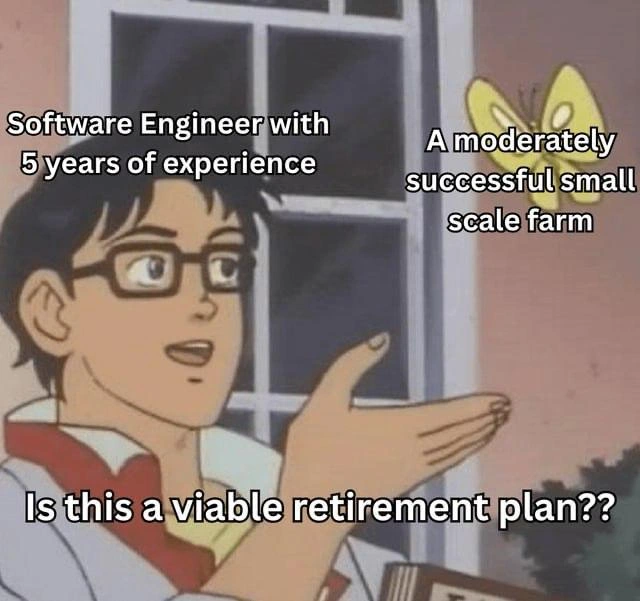
The famous reaction image normally labels the person, the butterfly, and the mistaken question. Here the mapping is:

  • The person is an experienced but tired developer.
  • The attractive butterfly is a modest farm.
  • The mistaken question calls active farm ownership a retirement plan.

That makes the humor affectionate rather than purely dismissive. The escape sounds peaceful because farm work is concrete and self-directed, yet the viewer knows the imagined refuge has its own deadlines and emergencies. It is less “stop working” than “please let me work on problems that photosynthesize.”

Level 3: Production, But With Crops

“Software Engineer with 5 years of experience”

“A moderately successful small scale farm”

“Is this a viable retirement plan??”

The “Is this a pigeon?” template is built around confident misclassification. In its original anime scene, an android mistakes a butterfly for a pigeon; here, the five-year engineer mistakes running a farm for retirement. The substitution is brutally efficient. A small farm may offer independence, visible results, and distance from corporate software, but “moderately successful” is doing the work of an entire business plan while the butterfly remains conveniently silent about debt, weather, equipment, distribution, and dawn.

Five years is funny because it is far too early for conventional retirement yet entirely plausible as the point when a developer starts designing an exit. The first years of a software career can provide rapid learning and satisfying feedback. Later, the job often expands beyond writing code into maintaining inherited systems, reviewing generated patches, answering incidents, negotiating priorities, documenting decisions, and attending the meeting that schedules the meeting where ownership will be clarified. Experience increases the ability to solve problems and the number of problems that know your name.

The farm fantasy is not random. It inverts several properties of software work:

Software frustration Pastoral promise
Abstract output behind a screen Food and plants that can be touched
Priorities changed by distant stakeholders Local decisions with visible consequences
Endless digital systems Seasonal cycles with apparent completion
Ambiguous impact A crop either grows or does not
Corporate dependencies Personal ownership and autonomy

That last column is idealized, of course. Agriculture replaces software dependencies with biological, mechanical, climatic, regulatory, and market dependencies. A farm is a stateful production system where replicas take months to grow, disaster recovery depends on next season, and the primary database occasionally eats the fence. Livestock and crops do not respect weekends, weather does not honor a maintenance window, and a failed deployment cannot always be rolled back from hay.

This is why the phrase “viable retirement plan” is the second half of the joke. Retirement usually means accumulated resources can support a person without full-time paid work. Buying or operating a farm is closer to a career change and small-business launch: it needs land or leases, equipment, working capital, specialized knowledge, routes to market, insurance, maintenance, and tolerance for uncertain income. Even moderate success can require intense labor. The dream removes Jira but retains incident response.

The meme nevertheless expresses something real about developer burnout. Burnout is not merely being tired after a difficult week; it can involve persistent exhaustion, cynicism, detachment, and a reduced sense that one’s work matters. Software creates fertile conditions when teams combine urgent deadlines, low control, unstable priorities, on-call disruption, and little time to improve the systems causing those disruptions. The imagined farm offers the opposite emotional package: agency, physical movement, a direct relationship between effort and outcome, and an identity not measured in pull requests.

The “moderately successful” qualifier is especially revealing. The engineer is not fantasizing about becoming an agricultural billionaire. They want enough: a sustainable operation, a comprehensible scale, and freedom from an industry where “growth” can mean tripling complexity so a dashboard line continues upward. Modest success becomes aspirational when the current career feels optimized for endless expansion.

There is also a classic career-reflection trap here: comparing the worst, fully known parts of one’s current profession with the prettiest, least known parts of another. The developer sees production outages and architecture politics in high resolution; the farm appears as a yellow butterfly, delicate and detail-free. A farmer looking at software from the other direction might see indoor work, predictable tools, remote flexibility, and no hailstorm capable of deleting a quarter’s output in fifteen minutes.

The fantasy can still be useful without being literal. It identifies missing requirements in the current career: more autonomy, tangible work, a smaller scope, fewer emergencies, physical activity, or clearer boundaries. Those needs might lead to a different engineering team, reduced on-call duty, a sabbatical, part-time work, a garden, or a genuine agricultural business pursued with training and realistic finances. The meme’s error is not wanting those qualities. It is calling a second operations career “retirement” because the incidents arrive wearing overalls.

Description

The image uses the anime “Is this a pigeon?” reaction-meme format, showing a bespectacled young man gesturing toward a yellow butterfly in front of a window. Text over the man reads “Software Engineer with 5 years of experience,” while the butterfly is labeled “A moderately successful small scale farm.” Across the bottom, the character asks, “Is this a viable retirement plan??” The meme turns mid-career developer fatigue into a fantasy of escaping abstract software work for a tangible rural business, while quietly ignoring how operationally demanding farming is.

Comments

1
Anonymous ★ Top Pick Retirement plan accepted—pending the discovery that livestock also has an on-call rotation.
  1. Anonymous ★ Top Pick

    Retirement plan accepted—pending the discovery that livestock also has an on-call rotation.

Use J and K for navigation