Skip to content
DevMeme
7475 of 7506
Small Talk, Now With Verbose Logging
CLI

Small Talk, Now With Verbose Logging

Why is this CLI meme funny?

Level 1: The Details Button

It is like asking a friend how their day was and hearing “fine,” then pressing an imaginary tell me everything button. Suddenly the tiny answer becomes a giant story. The picture is funny because the sender uses a computer-style switch instead of asking a more caring question—and, unlike most social tricks, it appears to work immediately.

Level 2: Flags Mean More

A terminal lets a user run programs by typing commands. The program name may be followed by arguments that supply values or change behavior. An argument used as an on/off setting is often called an option or flag.

For example:

tool report.txt           # Normal, brief output
tool report.txt --verbose # Extra details about the work

The double dash usually introduces a readable long option. --verbose conventionally asks for more information, especially useful while debugging. A tool might print which files it opened, which settings it chose, or why it retried an operation. The exact behavior depends on the tool; --verbose is a convention, not a universal command understood automatically.

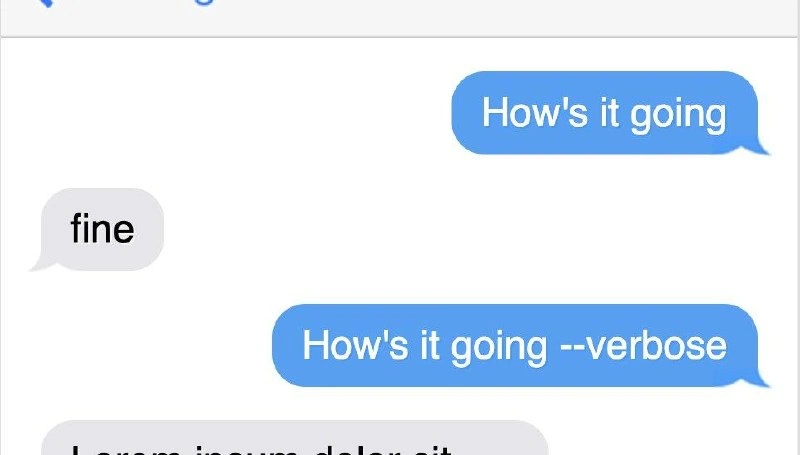
In the image, the first message gets the default response: fine. The sender then attaches --verbose to the same question as if talking to a shell program. The next response becomes visibly much longer. The joke works because developers instantly recognize that change in output mode, while the chat interface makes the computer syntax look absurdly formal in ordinary conversation.

Good CLI design follows the same courtesy as good communication: be brief by default, provide detail when asked, and make the extra information useful rather than merely abundant. A useful verbose message explains what happened and why; a bad one produces ten screens of noise and leaves the actual problem hiding on line 742.

Level 3: Social Debug Mode

“How’s it going”

“fine”

“How’s it going --verbose”

The second question changes no English words; it appends a command-line option. That is the whole elegant mechanism of the joke. The other person is treated like a program whose default output is the socially conventional one-word status, fine, but whose hidden diagnostic stream can be enabled with --verbose. The much larger gray reply beginning below the crop visually confirms that the flag worked. Human vulnerability is apparently available; it was merely disabled in the default configuration.

In a command-line interface, or CLI, a program receives an array of arguments. A parser commonly interprets tokens beginning with -- as named options:

how-is-it-going --verbose
│               └── option: request additional detail
└── command

The convention is widespread, but it is not magic built into every operating system. Each program decides which options it accepts and what they mean. Long options such as --verbose favor readability; many tools also offer a short form such as -v. Some let users repeat it—-vv or -vvv—to reveal progressively more detail, the terminal equivalent of asking “No, how are you really doing?” until a stack trace appears.

Verbosity exists because CLI output serves competing audiences. A routine successful command should be concise enough for humans to scan and scripts to compose. When something fails, an operator may need filenames, request IDs, timing, configuration sources, retry decisions, and internal state. Printing all of that constantly creates noise; hiding it permanently makes diagnosis painful. --verbose is a small observability contract: normal mode reports the outcome, while diagnostic mode explains the path taken.

A carefully designed tool often separates several concerns:

  • Standard output (stdout) carries the result another command may consume.
  • Standard error (stderr) carries diagnostics and warnings.
  • Exit status communicates success or a category of failure numerically.
  • Log levels such as debug, info, warning, and error control detail.
  • Options such as --verbose, --quiet, or --json adapt output for a person or another program.

That separation matters because more output is not always better. Verbose logs can bury the useful line, slow high-volume operations, expose filesystem paths or request data, and accidentally leak credentials if developers log entire configuration objects. A mature CLI makes extra detail intentional, sends it to the appropriate stream, and redacts sensitive values. The meme’s long gray response is emotionally charming; the production equivalent should still avoid dumping the authentication token along with the childhood backstory.

The social behavior maps surprisingly well. “How’s it going?” is often a phatic question: it maintains a relationship more than it requests a complete health report. “Fine” is the stable default interface because it is quick, polite, and safe. A detailed answer requires stronger evidence that the listener genuinely wants it. The syntactically precise --verbose acts as that explicit consent signal.

The visual crop makes the response feel potentially unbounded. Only the top of the new gray bubble is visible, so the viewer imagines an enormous state dump triggered by a tiny flag. This is classic developer humor: formal syntax is applied literally to an informal human exchange, and it succeeds more reliably than ordinary conversation. Years of interface design have apparently produced a protocol for emotional honesty; unfortunately, deployment remains blocked on humans implementing an argument parser.

Description

A tightly cropped iMessage-style conversation appears on a white background with blue outgoing bubbles and gray incoming bubbles. The first blue message says “How’s it going,” and the gray reply says “fine”; the sender then repeats the question as “How’s it going --verbose.” At the lower edge, a much longer gray response begins but is mostly cut off, with the visible letter tops resembling the start of “Lorem ipsum dolor sit…”. The joke treats a person like a command-line program, where appending the conventional long option `--verbose` switches terse output into an excessively detailed response.

Comments

1
Anonymous ★ Top Pick Next try `--json`; at least the emotional payload will be machine-readable.
  1. Anonymous ★ Top Pick

    Next try `--json`; at least the emotional payload will be machine-readable.

Use J and K for navigation