Asking Matrix Multiplication Why It Took Your Job
Why is this Mathematics meme funny?
Level 1: The Tiny Machine Behind the Curtain
It is like discovering that the impressive talking robot is powered by millions of very fast workers who only know how to multiply and add numbers. Someone says those workers may take his job, and another person immediately asks the robot to explain why. The joke is that they prove how useful the robot is at the exact moment they are worrying about becoming too dependent on it.
Level 2: Rows Become Replies
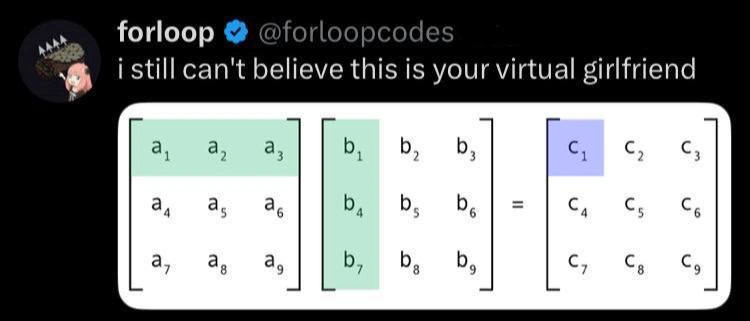
A matrix is a rectangular grid of numbers. Matrix multiplication combines two grids by taking one row from the first matrix and one column from the second. Multiply corresponding numbers, add those products, and place the result in one cell of the output matrix. The image uses green shading to select the first row of $A$ and first column of $B$, then blue shading to mark the resulting first cell of $C$.
For the labels visible in the diagram:
c₁ = (a₁ × b₁) + (a₂ × b₄) + (a₃ × b₇)
A neural network stores many learned numerical values called weights. Input values are repeatedly combined with those weights, often through large matrix multiplications, to create new representations. In a language model, those representations help calculate which token is likely to come next. Repeating that process produces a sentence.
Matrix multiplication alone is not intelligent. The useful behavior comes from the learned values, the arrangement of layers, nonlinear steps between them, training examples, and the program around the model. Still, matrices are central enough that the diagram is a fair visual shorthand for machine learning, just as a gear can represent a whole factory.
The reply is funny because Grok must run its own model to answer. If it explains that matrix multiplication helps power AI, it uses matrix multiplication to assemble the explanation. The user has effectively asked the engine to describe the engine while it is running—and has outsourced a tiny piece of understanding in a thread about jobs being outsourced.
Level 3: Ask the Culprit
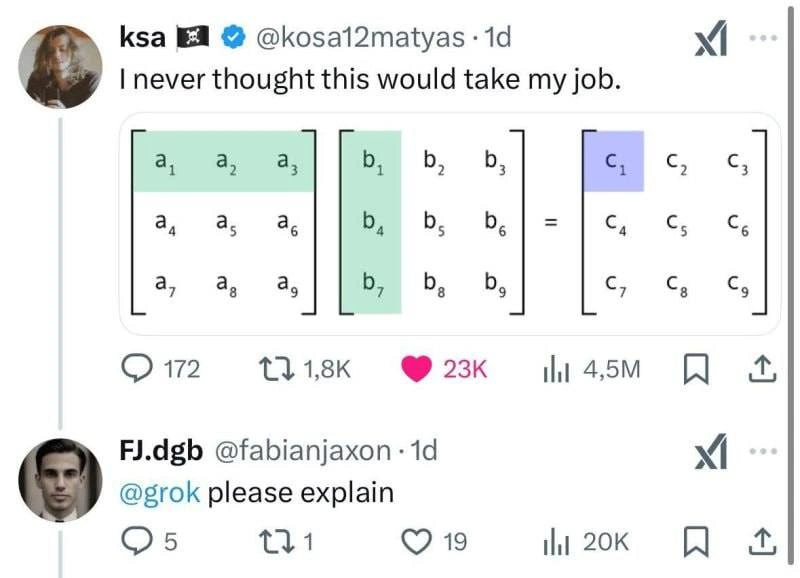
The top post states:
I never thought this would take my job.
It points not to a humanoid robot or a menacing supercomputer, but to a clean diagram of matrix multiplication. That visual downgrade is the first punchline. Public discussion gives AI agency—AI thinks, creates, decides, and replaces—while the meme reveals an elementary mathematical operation beneath the dramatic language. The supposed career thief is a row of symbols bumping into a column of symbols.
The connected reply delivers the recursive punchline:
@grok please explain
Grok is the AI assistant integrated into X, so asking it to explain is a live demonstration of the behavior being mocked. A person encounters an idea, delegates interpretation to an LLM, and thereby supplies evidence that some explanatory labor can be automated. The reply does not merely discuss dependence on AI; it performs that dependence underneath a post about dependence on AI. Four and a half million displayed views on the original post amplify the sense that this tiny recursion has become a mass spectator sport.
The meme balances two opposed simplifications. AI hype describes models as independent synthetic minds, obscuring their mathematical and human-built machinery. Skeptical reductionism says they are “only matrices,” obscuring the fact that simple operations composed at scale can implement surprisingly rich functions. A web server is “only transistors” in the same unhelpful sense. The lower layer explains how computation happens, not all the reasons the resulting system behaves as it does.
The employment claim needs the same separation of layers. Matrix multiplication does not walk into a company and eliminate a position. Organizations decide to automate tasks because software changes cost, speed, quality, or managerial control. A model may draft support replies, summarize documents, generate code, or answer routine questions; humans still define workflows, review failures, handle ambiguous cases, maintain infrastructure, and absorb the consequences when a fluent error reaches a customer. Jobs are bundles of tasks, so automation can remove some tasks, intensify others, create new review work, or give management a reason to redesign the role entirely.
That is why the anxiety feels real even when the caption is absurd. Knowledge workers were often told automation threatened repetitive physical labor while judgment-heavy work was protected. Generative systems made plausible language, images, and code—the visible artifacts of many professional roles—their primary interface. The underlying computation may be old linear algebra, but its packaging changes who can request it and how cheaply output can be produced. The surprising part is not that matrices exist; it is that scale, training, and interfaces turned them into a coworker with a mention handle.
There is also hidden labor behind the neat equation: researchers choosing architectures, engineers building training systems, people producing and curating data, evaluators testing behavior, operators running accelerators, and users correcting outputs. Reducing that sociotechnical system to one diagram is part of the joke. It lets the poster accuse an innocent mathematical abstraction while the actual decisions about deployment, staffing, and acceptable error remain conveniently offscreen. git blame, but for civilization.
Level 4: Silicon Does the Dot Product
The highlighted row, column, and output cell show the atomic operation behind dense linear algebra. For matrices $A \in \mathbb{R}^{m \times k}$ and $B \in \mathbb{R}^{k \times n}$, their product $C = AB$ is defined by
$$ c_{ij} = \sum_{r=1}^{k} a_{ir}b_{rj}. $$
Using the image’s flattened labels, the blue top-left result is therefore
$$ c_1 = a_1b_1 + a_2b_4 + a_3b_7. $$
That multiply-and-sum pattern scales from the pictured $3 \times 3$ classroom example to the enormous tensor operations used by deep learning. A neural-network layer commonly applies something resembling $Y = \phi(XW + b)$: activations in $X$ are multiplied by learned weights in $W$, a bias is added, and a nonlinear function $\phi$ transforms the result. During training, matrix calculus propagates loss gradients backward so an optimizer can adjust those weights. During inference, the trained matrices repeatedly transform a sequence of token representations until the model produces scores for the next token.
Transformers make the connection especially explicit. They project an input $X$ into query, key, and value arrays and compute scaled dot-product attention:
$$ \operatorname{Attention}(Q,K,V) = \operatorname{softmax}!\left(\frac{QK^\mathsf{T}}{\sqrt{d_k}}\right)V. $$
Both $QK^\mathsf{T}$ and the subsequent multiplication by $V$ are matrix products. The projection layers and the large feed-forward blocks surrounding attention are also dominated by matrix multiplication. Thus the reply @grok please explain asks a chatbot to interpret the primitive that its own forward pass is executing many times while generating the interpretation. The explanation is, in a computationally literal sense, matrix multiplication explaining matrix multiplication through additional matrix multiplication.
Calling an LLM “just matrix multiplication” is witty reductionism, not a full architecture diagram. Tokenization, positional information, normalization, residual connections, nonlinear activations, attention masking, softmax, sampling, trained parameters, and the surrounding software system all matter. Without nonlinear operations, merely stacking linear transformations would collapse into another linear transformation and could not express the same behavior. The meme works because matrix products remain the dominant computational workhorse even though they are not the entire algorithm.
Hardware turns that workhorse into an industrial machine. High-performance GEMM kernels tile large matrices into blocks that fit fast levels of the memory hierarchy, reuse loaded values, and schedule many fused multiply-accumulate operations in parallel. GPU Tensor Cores and similar accelerators are designed around small matrix multiply-accumulate primitives, often using lower-precision inputs with wider accumulation. Performance depends not only on arithmetic throughput but also on shapes, batching, memory bandwidth, data movement, and how effectively kernels keep the hardware occupied. The humble blue square in the diagram has a global supply chain.
This creates the deepest layer of the job joke. No individual scalar product “understands” language or chooses to automate a task. Capability emerges from architecture, vast learned parameter arrays, optimization, data, tools, and repeated computation at scale. Yet after all that abstraction is peeled away, the expensive center of the system still resembles the green row meeting the green column. Humanity did not lose a knowledge-work task to one $3 \times 3$ worksheet; it built warehouses that can evaluate its descendants at extraordinary speed, then attached them to the reply button.
Description
A light-mode X thread shows user "ksa" with a skull-and-crossbones flag emoji, blue verification badge, handle "@kosa12matyas", and "1d", posting "I never thought this would take my job." Above the engagement row is a diagram of two 3×3 matrices multiplied into a third: the first row of matrix A and first column of matrix B are shaded green, and the resulting top-left C element is shaded blue; the post shows 172 replies, "1,8K" reposts, 23K likes, and "4,5M" views, plus bookmark and share icons. A connected reply from "FJ.dgb @fabianjaxon · 1d" says "@grok please explain" and shows 5 replies, 1 repost, 19 likes, and 20K views, with X logos and three-dot menus visible on both posts. Since neural networks and transformer models depend heavily on large-scale matrix multiplication, asking Grok to explain the image makes a system built from that operation explain how the operation displaced human work, adding a recursive layer to the job-automation joke.
Comments
1Comment deleted
We asked a pile of matrix multiplications to explain why matrix multiplication replaced us.