Skip to content
DevMeme
7477 of 7506
When the Ferrari Routes You to Civic

When the Ferrari Routes You to Civic

Why is this AI ML meme funny?

Level 1: The Car That Changes

Imagine paying to ride in a race car, then learning it turns into a normal family car whenever the road becomes interesting. The family car may be safe and dependable, but it is not what the shiny red body promised. The picture is funny because the salesman presents that surprise as perfectly ordinary—while the customer is left wondering when the Ferrari is actually allowed to be a Ferrari.

Level 2: Who Answers the Prompt

An LLM is the model that reads a prompt and generates a response. An AI product can offer several models with different capability, speed, cost, and safety properties. A model router chooses which one handles a request.

A fallback is an alternative used when the preferred component should not or cannot complete the job. Common software examples include serving a cached page when a backend is unavailable or switching to a backup provider during an outage. The goal is to provide reduced but useful service instead of total failure.

In this case, the decision can be driven by content filtering rather than an outage. A classifier examines the request for sensitive cybersecurity or biology content. If it triggers, the product may route the request from Fable 5 to Opus 4.8. That second model can still answer many questions, but it may not perform identically.

The car labels communicate the hierarchy instantly:

Car metaphor AI meaning
Ferrari Premium frontier capability selected by the user
Honda Civic Capable, practical fallback
Driving The real task the user wants performed
Automatic transformation Safety router changes the serving model

This can be a reasonable security trade-off when a stronger model would make harmful work substantially easier. The frustration comes from surprise. If users believe they are testing one model but receive another, they cannot accurately judge quality or reproduce results. Clear labels and response metadata turn a mysterious downgrade into an explicit system state.

The image also distinguishes availability from capability. The service remains available because something answers. The selected capability may not be available for that request. A well-designed application must decide whether a lower-capability answer is useful, whether it should ask the user, or whether it should stop and report that the requested model was not used.

Level 3: Safety in the Slow Lane

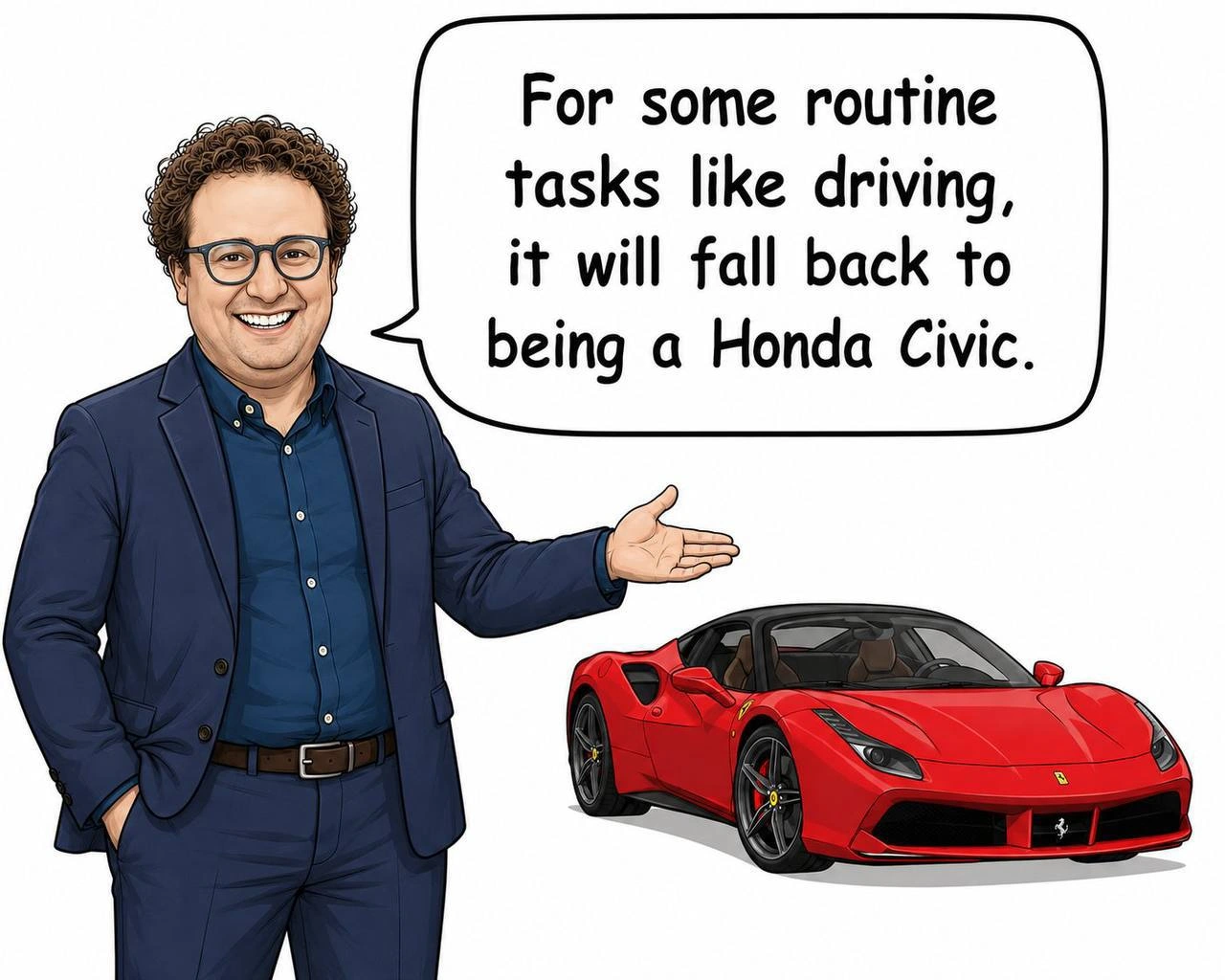
“For some routine tasks like driving, it will fall back to being a Honda Civic.”

The visible product is a bright red Ferrari, yet the smiling presenter—drawn to resemble Anthropic CEO Dario Amodei—explains that ordinary use may turn it into a Honda Civic. That inversion is the joke. A Ferrari’s extravagant capability is justified by driving; if it becomes a cheaper car when driven, the buyer reasonably asks what the Ferrari badge purchased. Applied to AI, the cartoon satirizes a premium frontier model whose safety system may route selected requests to a less capable model precisely in domains where users value frontier capability.

The timing is directly relevant. Posted on July 1, 2026, the image accompanied the return of Claude Fable 5, Anthropic’s most capable broadly available model at the time. Fable shared an underlying model with the more restricted Mythos 5, but surrounded it with safeguards for high-risk cybersecurity and biology work. When certain safeguards triggered in consumer applications, the request could be handled by Claude Opus 4.8 instead. The user still received an answer, but not necessarily from the model they originally selected.

Technically, this is model routing:

request
   │
   ▼
safety classifier
   ├── allowed ─────────────► Fable 5
   └── flagged/ambiguous ───► Opus 4.8 fallback or block

The classifier is a separate decision layer that estimates whether a prompt or prospective response belongs to a risky category. Routing to a safer fallback can be more useful than refusing outright: the user may still receive ordinary guidance, while the provider withholds the capability believed to create dangerous uplift. In security architecture, graceful degradation is usually desirable. If a primary service fails, a reduced service preserves availability.

The satire exposes why model fallback is stranger than conventional failover. A backup database should preserve the same contract even if it is slower. A fallback language model may change reasoning quality, context handling, tool behavior, tone, error patterns, and success on the task itself. The request has not merely moved to another server; it may now be processed by a different capability profile. The vehicle still looks red in the driveway, but somebody replaced the drivetrain while the user was choosing a route.

That creates several engineering and product problems:

  • Semantic consistency: the fallback may interpret or complete the same task differently.
  • Reproducibility: yesterday’s accepted prompt may route differently after a classifier update.
  • Observability: users need to know which model actually produced an answer.
  • Evaluation validity: a benchmark or internal test is misleading if some samples silently use another model.
  • Cost expectations: customers choosing a premium tier need clear behavior when it is not served.
  • Application control: API developers may prefer a structured error, explicit retry policy, or approved alternative instead of automatic substitution.

The hardest issue is classifier error. A false negative lets a dangerous request reach the frontier model. A false positive treats benign work as dangerous and downgrades or blocks it. Cybersecurity is particularly difficult because defensive and offensive tasks share vocabulary, tools, and techniques. “Find this vulnerability and demonstrate its impact” could describe responsible remediation or exploitation. Biology has similar dual-use boundaries: the same analytical capability can support useful research or harmful design.

Providers therefore tend to tune high-stakes classifiers conservatively, accepting more false positives to reduce missed misuse. From a safety perspective, that can be rational. From the customer’s perspective, it means the flagship model may disappear during exactly the advanced technical work for which it seemed valuable. The phrase “routine tasks like driving” mocks any product framing that makes this substitution sound incidental. For the affected user, the restricted task may be the whole journey.

The Civic choice adds useful ambiguity. A Honda Civic is not a broken vehicle; it is widely understood as practical transportation. Opus 4.8 likewise represents a capable fallback, not no service. The comparison is about performance, price, and expectation rather than absolute competence. That makes the criticism sharper: graceful degradation may be responsible architecture, but selling it requires honesty about when the premium capability is available. “You will always get a car” does not fully answer “Will I get the car I selected?”

Good implementation makes routing a first-class part of the interface. The response should identify the serving model; APIs should expose a machine-readable routing reason; developers should be able to choose between fallback and failure; audit logs should record classifier decisions without leaking sensitive content; and documentation should describe affected categories without publishing a convenient bypass manual. Safety policy is not merely a refusal sentence. It is distributed systems behavior with product, billing, evaluation, and trust consequences.

The cheerful sales pose beside the Ferrari is therefore doing corporate-satire work. It presents a serious trade-off as a charming feature demonstration. The company sees controlled risk and continuous service; the user sees AI hype versus reality, where the highest capability exists behind a classifier whose definition of “routine driving” may not match theirs. Both views can be true, which is inconveniently more complex than drawing a second car.

Description

On a plain white background, a smiling caricature resembling Anthropic CEO Dario Amodei stands in a navy suit and gestures toward a bright red Ferrari sports car. A large outlined speech bubble says, “For some routine tasks like driving, it will fall back to being a Honda Civic.” The absurd automotive metaphor presents a premium, high-performance system that downgrades itself precisely when asked to perform an ordinary task. In AI terms, it satirizes safety-policy routing that sends some requests from a frontier model to a less capable fallback, trading consistent capability for controlled risk.

Comments

1
Anonymous ★ Top Pick Apparently graceful degradation means Ferrari pricing, Civic responses, and a policy engine at the wheel.
  1. Anonymous ★ Top Pick

    Apparently graceful degradation means Ferrari pricing, Civic responses, and a policy engine at the wheel.

Use J and K for navigation