Skip to content
DevMeme
7469 of 7506
Ten Years Required for a One-Year-Old Tool

Ten Years Required for a One-Year-Old Tool

Why is this Career HR meme funny?

Level 1: The Brand-New Bicycle Expert

It is like inventing a new kind of bicycle last year and then advertising for someone who has ridden that exact bicycle for ten years. Even the inventor cannot qualify, so the only possible applicants are time travelers or people willing to lie. The joke is that the job ad tries so hard to sound demanding that it asks for something reality cannot provide.

Level 2: What the Role Should Ask

Claude Code is an agentic coding tool that runs from a command line. A developer can ask it to inspect a repository, edit files, run commands, execute tests, and help complete multi-step engineering tasks. “Agentic” means it can take a sequence of tool-assisted actions toward a goal, subject to permissions and human supervision, rather than only completing the next line of code.

A senior software developer is usually expected to do more than operate one tool. Senior work includes making architectural trade-offs, handling ambiguous requirements, reviewing others’ code, designing for reliability and security, debugging production failures, mentoring teammates, and taking responsibility for long-term maintenance.

Job descriptions often use years as a quick filter:

Weak requirement:
10+ years with a product that has existed for about one year

Stronger requirement:
8+ years building production software
Hands-on experience with Claude Code or similar coding agents
Evidence of safe, maintainable AI-assisted development workflows

An applicant-tracking system, or ATS, stores applications and may rank or filter them using fields and keywords. If a nonsensical requirement is encoded literally, truthful candidates cannot satisfy it, while a person who exaggerates may pass the automated check. Automation then scales the author’s misunderstanding instead of correcting it.

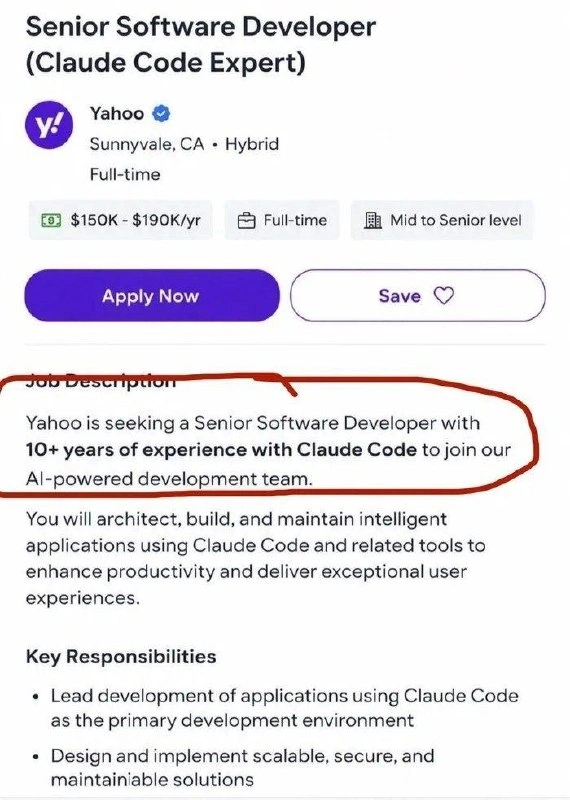
The visible salary, hybrid location, and Apply Now button make the impossible line look like an ordinary opportunity, which is why the red circle matters. It asks the viewer to stop scanning and compare the technology’s age with the demanded tenure. That tiny timeline check is exactly the kind of validation the hiring process apparently skipped.

Level 3: Experience From the Future

The red circle isolates a requirement that defeats arithmetic before any applicant reaches the coding interview:

Yahoo is seeking a Senior Software Developer with 10+ years of experience with Claude Code to join our AI-powered development team.

Claude Code was publicly introduced as a research preview on February 24, 2025 and became generally available in May 2025. When this image circulated, public experience with the product could total roughly sixteen months, not a decade. Even people who built it internally could not manufacture the missing years. The post message sharpens the joke by naming its inventor:

Boris Cherny, you are underqualified and your CV has been refused

That is the purest version of the impossible-experience meme: the creator of a technology fails the keyword gate for insufficient experience with the technology. Somewhere, a time traveler is tailoring a résumé while the applicant-tracking system rejects 2035 as an invalid employment date.

The employer attribution needs a caution label. The screenshot presents a verified Yahoo listing, but an image is not a job-record archive, and no independently verifiable original listing accompanies it. Public discussion around the image also questioned whether the ad was fabricated or edited. The safe reading is therefore a meme depicting a Yahoo listing, not proof that Yahoo published these words. Its satire still works because impossible “years of experience” requirements are a long-running recruiting anti-pattern, whether this instance came from a real requisition, a bad template substitution, or someone manufacturing the perfect example.

The surrounding text makes the mistake especially plausible. It is assembled from familiar recruiting blocks: AI-powered development team, “architect, build, and maintain intelligent applications,” “enhance productivity,” and “scalable, secure, and maintainable solutions.” Every phrase sounds acceptable in isolation. None forces the author to specify what the system does, which languages it uses, what production responsibility the engineer owns, or what expertise with Claude Code actually means. A numeric requirement supplies false precision where the role lacks concrete definition.

This is how organizational distance becomes a technical error. A hiring manager may ask for “a senior engineer who is excellent with Claude Code.” Recruiting maps senior to a template containing 10+ years. A role-building tool inserts the named technology into the nearest experience field. Compensation, location, and generic responsibilities survive several approvals because each reviewer assumes someone else validated the substance. The result is syntactically professional and semantically impossible—the corporate equivalent of code that compiles because the tests are also wrong.

Years of experience are already a weak proxy for skill. Ten years can mean ten increasingly difficult systems with operational responsibility, or the same comfortable year repeated ten times. For a rapidly changing AI coding agent, calendar tenure is even less informative: models, permission systems, tool integrations, context behavior, and recommended workflows can change within months. A developer with six focused months may understand the current product better than someone whose “experience” began on a substantially different version.

Meaningful Claude Code expertise would be demonstrated through outcomes and judgment, such as:

  • Scoping tasks so the agent can make reviewable changes.
  • Supplying repository context without flooding the context window.
  • Using tests, static analysis, and code review to verify generated work.
  • Configuring permissions, sandboxing, secrets, and network access safely.
  • Recovering when the agent follows the wrong abstraction or edits too broadly.
  • Integrating terminal, version-control, issue-tracking, and tool-server workflows.
  • Knowing when direct engineering is faster or safer than delegating to an agent.

Those skills rest on ordinary software-engineering depth: architecture, debugging, security, testing, version control, and production ownership. The tool amplifies that base; it does not retroactively turn tool tenure into a substitute for it. A better job description would ask for substantial senior engineering experience, demonstrated use of Claude Code or comparable coding agents, and evidence of shipping reliable systems with appropriate guardrails. Transferable judgment ages better than a product version string.

The impossible requirement also damages the hiring signal. Careful candidates may conclude that the team does not understand its own primary tool and decline to apply. Literal candidates may self-reject. Applicants comfortable inflating claims face less competition. Recruiters then receive a distorted pool and may cite the lack of qualified applicants as proof of a talent shortage. The filter selects for willingness to ignore the filter.

The screenshot’s other labels deepen the incoherence. The title says Senior Software Developer, while a chip says Mid to Senior level. The responsibilities call Claude Code the primary development environment, even though it is more precisely an agentic command-line coding tool that operates within a broader environment of editors, shells, repositories, build systems, and deployment infrastructure. The listing appears to want senior architectural accountability while describing expertise almost entirely through one fashionable interface.

That is the corporate-culture target: hiring treats a new tool as both indispensable enough to define the role and mature enough to demand a decade of specialization. The company wants the productivity of the future, the certainty of a legacy certification, and the recruiting effort of a find-and-replace operation. It has accidentally specified the only candidate AI hype cannot yet generate: someone with a valid employment history from nine years ahead.

Description

A mobile job-listing screenshot advertises "Senior Software Developer (Claude Code Expert)" at verified company "Yahoo" in "Sunnyvale, CA · Hybrid" and "Full-time". Compensation and role chips read "$150K - $190K/yr", "Full-time", and "Mid to Senior level", above purple "Apply Now" and outlined "Save" buttons. Under "Job Description", a thick red hand-drawn circle highlights: "Yahoo is seeking a Senior Software Developer with 10+ years of experience with Claude Code to join our AI-powered development team."; below it, the visible copy says "You will architect, build, and maintain intelligent applications using Claude Code and related tools to enhance productivity and deliver exceptional user experiences.", followed by "Key Responsibilities", "Lead development of applications using Claude Code as the primary development environment", and "Design and implement scalable, secure, and maintainable solutions". Because Claude Code was released in February 2025, the June 2026 listing demands years of experience that no candidate could possess, epitomizing recruiting requirements detached from technology timelines.

Comments

1
Anonymous ★ Top Pick The only qualified applicant is a time traveler, and the ATS rejected their unexplained nine-year gap.
  1. Anonymous ★ Top Pick

    The only qualified applicant is a time traveler, and the ATS rejected their unexplained nine-year gap.

Use J and K for navigation