Skip to content
DevMeme
7504 of 7506
Engineering Memes Were the Orientation Manual

Engineering Memes Were the Orientation Manual

Why is this Learning meme funny?

Level 1: The Funny Road Sign

Imagine older hikers keep sharing jokes about a trail full of mud, steep hills, and missing signs. You laugh until you take the trail yourself and find the exact mud, hills, and missing signs. The turtle’s shocked face is funny because the new students suddenly understand that everyone was laughing to help one another through a genuinely difficult trip—not because the obstacles were imaginary.

Level 2: Welcome to the Lab

First-year engineering usually combines foundational subjects with an unfamiliar style of work. Mathematics and science provide tools; design exercises, labs, and programming teach students to apply those tools under constraints. The difficult part is often the interaction among them.

  • Prerequisites are cumulative. Missing one concept can make the next lecture feel like it started halfway through a sentence.
  • Labs include uncertainty. Measurements contain noise, equipment misbehaves, and results still need interpretation.
  • Programming requires debugging. A solution can be conceptually right while one index, type, or edge case makes the implementation fail.
  • Design has trade-offs. Cost, safety, performance, time, and manufacturability cannot all be maximized at once.
  • Team projects expose coordination. Dividing work is easy; integrating incompatible pieces the night before submission is the traditional sequel.

This explains why the meme says “warnings.” A joke such as “the answer is either zero or I have ruined civilization” points to unit checks and order-of-magnitude reasoning. A joke about four teammates editing the final report at 2 a.m. points to version control, ownership, and earlier integration. The funny sentence is memorable because it packages a practical lesson inside an emotional one.

For a junior student, the useful move is to treat confusion as information. Break a large task into smaller checks, compare assumptions with classmates, use teaching support early, and leave time for a first attempt to fail. Engineering is not the art of never being wrong; it is the discipline of finding wrongness while the cost of correction is still small.

Level 3: The Hidden Curriculum

The caption turns engineering meme culture into an unofficial telemetry system:

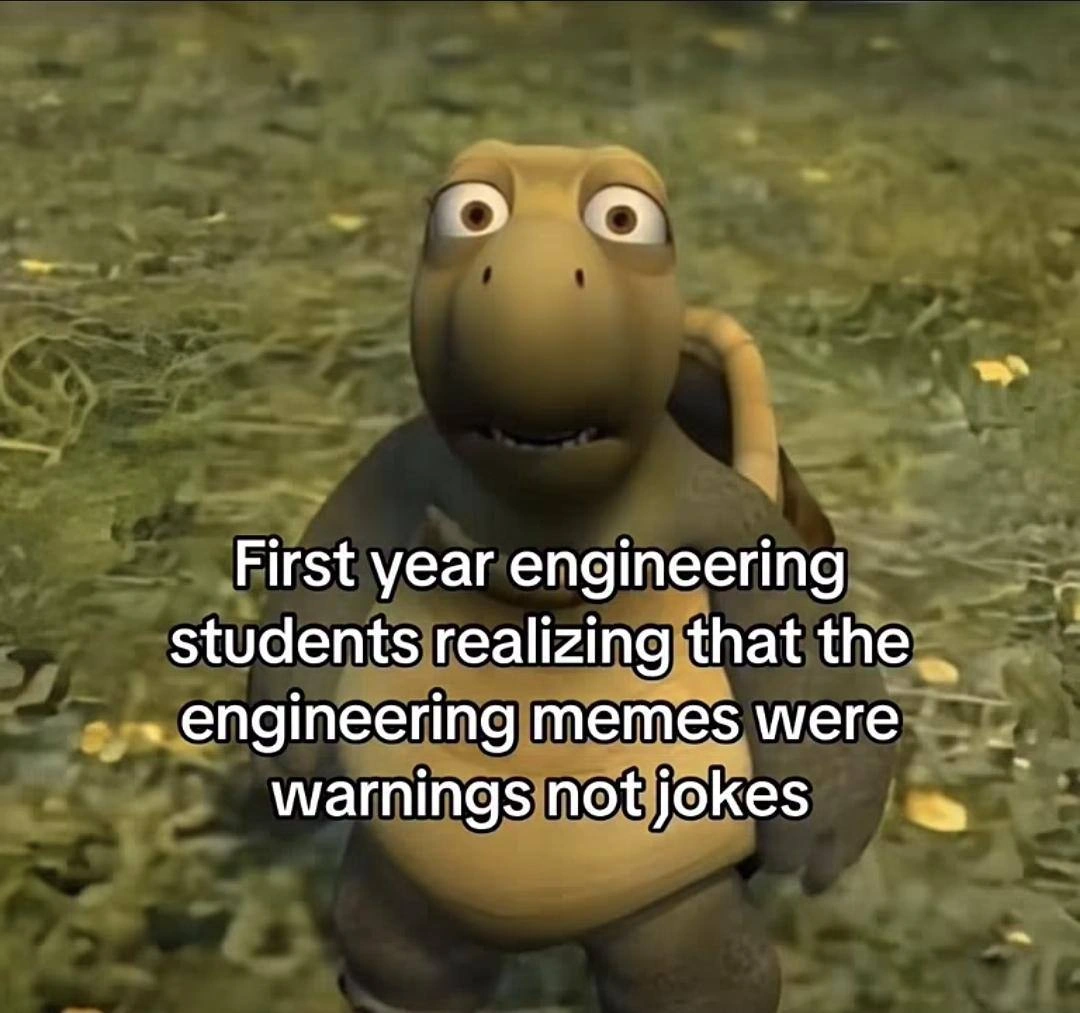
First year engineering students realizing that the engineering memes were warnings not jokes

Before enrollment, jokes about impossible problem sets, all-night projects, chaotic group work, and one tiny sign error destroying a page of calculations look like exaggeration. First year supplies the decoder. The same jokes now resemble compact incident reports from earlier cohorts—names removed, trauma deduplicated, impact marked “relatable.”

That is the meme’s sharpest insight: formal curricula list calculus, physics, programming, design, and laboratory work, but students also encounter a hidden curriculum of unstated expectations. They must learn how to estimate unfamiliar work, read a dense technical prompt, ask useful questions, find office hours and peer support, divide a team task, recover from a failed approach, and decide when “I’m stuck” means try another model rather than I do not belong here. Students who already know these institutional conventions receive an invisible head start.

Engineering workload also composes badly. Five instructors can each assign a reasonable task, yet the student experiences their deadlines as one coupled system. A lab report delayed by broken equipment steals time from a calculus set; that pushes a programming exercise into the night; fatigue then increases errors in both. The failure mode resembles resource contention more than simple laziness:

individually reasonable assignments
              +
shared student time and attention
              =
deadline deadlock

The intellectual transition can be equally jarring. Earlier courses often reward recognizing a familiar problem type and applying the demonstrated method. Engineering increasingly asks students to build a model from incomplete information, choose assumptions, track units, test edge cases, and explain why an answer is physically or computationally plausible. Getting the algebra right is not enough if the bridge has negative mass, the circuit violates conservation laws, or the program passes only the sample input. Reality remains a notoriously strict grader.

The wide-eyed turtle is Verne from a low-resolution Over the Hedge video-game cutscene, a reaction image commonly used for stunned confusion. Here his frozen stare captures an expectations-versus-reality update: the newcomer has not merely discovered that the work is hard; they have realized older students were describing a stable pattern. The dirty green scene behind him visually helps the joke—the orientation brochure has abruptly become the aftermath photo.

Memes serve several useful social functions. They let students recognize shared pain, signal membership in a community, and discuss failure without making a formal confession. A joke about a compiler error or a brutal exam can say, “This happened to me too,” which reduces isolation. In that sense, humor is a low-bandwidth peer-support protocol with excellent adoption and absolutely no service-level agreement.

But “warnings” has a darker edge. Repeated jokes about sleep deprivation, panic, or never seeking help can normalize preventable harm. If suffering becomes proof that someone is a “real engineer,” the culture turns a coping mechanism into a gatekeeping mechanism. The correct lesson is not that exhaustion is a prerequisite; it is that workload, belonging, and support need active management. Memes are valuable observability, but no competent engineer treats a recurring alarm as the desired operating state.

The same pattern continues into software careers. Jokes about git blame, production outages, vague tickets, and “temporary” fixes often sound absurd to students. Later they recognize compressed lessons about ownership, communication, technical debt, and incentives. The best response is not fatalism. A warning is useful precisely because it can change behavior: start earlier, reduce scope, make assumptions explicit, test incrementally, ask for review, and surface a blocked dependency before the deadline becomes an archaeological date.

Description

A low-resolution animated still centers Verne, the brown turtle from "Over the Hedge," standing wide-eyed and slack-jawed amid a murky green field of scattered debris. Large white text with a thick black outline fills the lower half: "First year engineering students realizing that the engineering memes were warnings not jokes." His stunned expression turns a familiar reaction image into the moment a novice discovers that jokes about engineering workload, failure, and dysfunction are compressed accounts of real shared experience. The meme treats community humor as unofficial onboarding documentation whose meaning only becomes clear after entering the discipline.

Comments

1
Anonymous ★ Top Pick Turns out the meme folder was the only onboarding documentation anyone kept current.
  1. Anonymous ★ Top Pick

    Turns out the meme folder was the only onboarding documentation anyone kept current.

Use J and K for navigation