Skip to content
DevMeme
7501 of 7506
The Five-Minute Fix Fails Its Skill Check

The Five-Minute Fix Fails Its Skill Check

Why is this Debugging Troubleshooting meme funny?

Level 1: The Squeaky Door

Imagine someone says a broken door will take five minutes to fix. You open it and discover that years ago you held the hinge together with tape, everyone built shelves against that door, and removing the tape might knock the shelves down. While people wait outside, voices in your head argue about hiding, blaming the wall, drinking something sugary, or admitting what happened. It is funny because the bravest and most sensible choice—telling the truth and repairing it carefully—somehow feels like the hardest move in the game.

Level 2: The Haunted Monolith

Production, often shortened to prod, is the live system customers use. When it fails, debugging is harder than fixing a practice project because every experiment can affect real people. A sensible first pass asks what broke, who is affected, what changed recently, and whether the team can roll back or disable the failing feature.

A monolith is an application whose features are deployed largely as one unit. Monoliths are not automatically bad, but years of tightly coupled changes can make one area unexpectedly depend on another. Legacy code simply means code inherited from the past that still matters now; it becomes painful when knowledge, tests, and documentation have decayed. Technical debt is the future work created when a quicker solution is chosen today—like borrowing time and repaying it with interest during an outage.

Several visible phrases describe common debugging tools and habits:

  • Logs are timestamped records of what a running program did. They provide clues, but an old TODO is not itself proof of the current failure.
  • git blame shows the last commit associated with each line. It helps locate history, not moral guilt.
  • Reproducing locally means making the bug happen on a developer’s own computer so it can be studied safely.
  • do_stuff() is a deliberately vague function name. At 4,000 lines, it suggests too many responsibilities packed into code nobody can understand or test in isolation.
  • A Friday deployment is a running joke because a late-week change can fail when fewer colleagues are available, turning the author’s weekend into an unofficial monitoring plan.

The game reference amplifies all of this. In Disco Elysium, skills such as Logic, Drama, Volition, and Electrochemistry interrupt dialogue with their own perspectives, and checks can succeed or fail. Here those voices become a developer’s internal monologue. Logic notices the contradiction, Volition begs not to open the file, Electrochemistry requests an energy drink, and Impostor Syndrome declares guilt. The production bug is therefore both a software problem and a role-playing boss fight against one’s own coping mechanisms.

Level 3: Incident Response, Inland

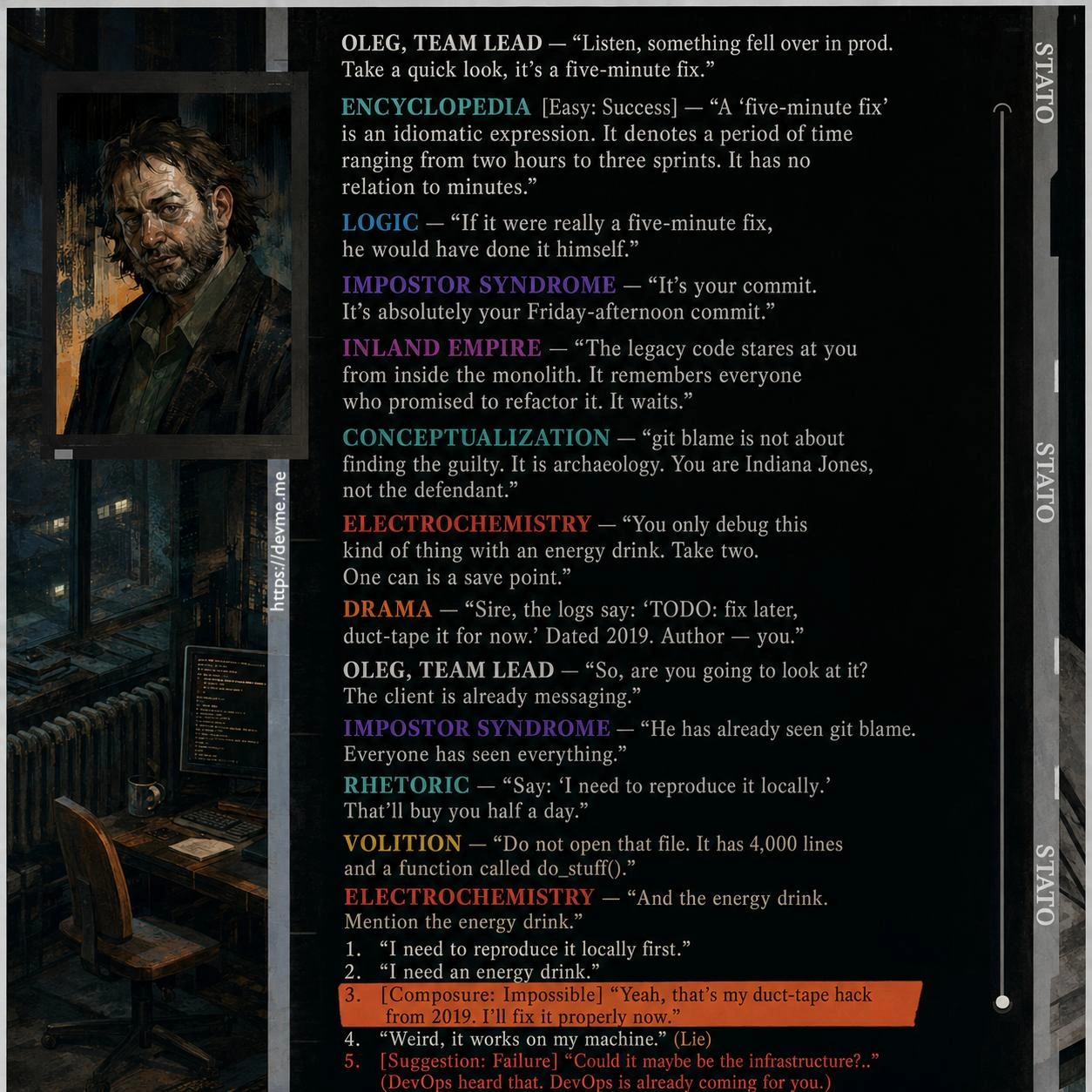
The image recasts a production incident as a Disco Elysium dialogue, where mental faculties speak like argumentative characters and skill checks decide which thought wins. That is a perfect interface for debugging under pressure: the developer is not choosing between clean technical options so much as negotiating with experience, shame, caffeine, self-preservation, and a codebase that appears to have developed a memory.

Oleg opens with the most dangerous unit of engineering estimation:

“Listen, something fell over in prod. Take a quick look, it’s a five-minute fix.”

Calling it a five-minute fix before investigation collapses four different jobs—triage, diagnosis, remediation, and verification—into one optimistic number. “Something fell over” does not identify a failing component, blast radius, trigger, or safe rollback. Meanwhile, “The client is already messaging” establishes that the incident has escaped the monitoring dashboard and become a business problem. The timer is real; the estimate is decorative.

The personified skills expose why these incidents become organizational theater:

  • ENCYCLOPEDIA translates “five-minute fix” into “two hours to three sprints,” mocking how a tiny code change can require reproducing state, reviewing dependencies, deploying safely, and watching for regression.
  • LOGIC asks why Oleg did not make the supposedly trivial change himself. The answer could be ownership and access rather than incompetence, but the suspicion is familiar: certainty is cheapest when assigned to somebody else.
  • IMPOSTOR SYNDROME converts uncertainty into personal guilt before evidence exists: “It’s absolutely your Friday-afternoon commit.” This is incident response performed by anxiety, with a zero-minute mean time to self-blame.
  • INLAND EMPIRE turns the monolith into a patient horror: “It remembers everyone who promised to refactor it. It waits.” Technical debt is frightening because it preserves old compromises long after their original deadlines and authors have vanished.
  • DRAMA produces the actual archaeological artifact: TODO: fix later, duct-tape it for now, dated 2019 and authored by the current developer.

That last reveal is sharper than a generic legacy-code joke. A workaround that survives for seven years is no longer merely a bad patch; other code, operational habits, and customer expectations may now depend on it. Replacing it “properly” can expose hidden contracts. This is why refactoring—changing internal structure without intentionally changing behavior—needs tests and observability. The embarrassing line may be load-bearing, because production has a wicked sense of interior design.

The meme also understands git blame unusually well. The command maps lines to commits and authors, but authorship is not causality. A line may have been correct under 2019 requirements, moved by a mechanical change, or written under an explicit deadline. Calling it codebase archaeology is healthier than using it as a courtroom exhibit: inspect the surrounding commit, ticket, deployment history, and assumptions. Unfortunately, “Author — you” removes the comforting option of blaming a departed contractor.

The response choices form a compact catalogue of incident anti-patterns. “I need to reproduce it locally” can be sound engineering, but RHETORIC admits it is being used to buy time. A local reproduction may also be impossible when the failure depends on production data, traffic, permissions, timing, or configuration. “Works on my machine” then mistakes environment drift for exoneration. Blaming infrastructure without evidence summons DevOps because cross-team deflection burns time while the outage continues.

The highlighted option is the emotionally honest one:

[Composure: Impossible] “Yeah, that’s my duct-tape hack from 2019. I’ll fix it properly now.”

Labeling ownership “Impossible” captures the human cost of blame-heavy operations. Healthy incident culture separates accountability from humiliation: stabilize service first, document what happened, then improve the system that allowed an old workaround to remain critical. Otherwise engineers learn to conceal uncertainty, avoid risky files, and optimize for surviving the postmortem rather than repairing production.

Description

A square, dark dialogue screen styled after Disco Elysium shows a painted portrait of an exhausted, unshaven developer beside a gloomy office desk, code-filled monitor, mug, radiator, and nighttime windows; a partially cropped vertical "https://devmeme..." mark and a right-side rail repeating "STATO" frame the interface. The exchange begins, "OLEG, TEAM LEAD — ‘Listen, something fell over in prod. Take a quick look, it’s a five-minute fix.’"; "ENCYCLOPEDIA [Easy: Success] — ‘A ‘five-minute fix’ is an idiomatic expression. It denotes a period of time ranging from two hours to three sprints. It has no relation to minutes.’"; and "LOGIC — ‘If it were really a five-minute fix, he would have done it himself.’" The internal skills continue: "IMPOSTOR SYNDROME — ‘It’s your commit. It’s absolutely your Friday-afternoon commit.’"; "INLAND EMPIRE — ‘The legacy code stares at you from inside the monolith. It remembers everyone who promised to refactor it. It waits.’"; "CONCEPTUALIZATION — ‘git blame is not about finding the guilty. It is archaeology. You are Indiana Jones, not the defendant.’"; "ELECTROCHEMISTRY — ‘You only debug this kind of thing with an energy drink. Take two. One can is a save point.’"; and "DRAMA — ‘Sire, the logs say: ‘TODO: fix later, duct-tape it for now.’ Dated 2019. Author — you.’" Oleg then asks, "So, are you going to look at it? The client is already messaging," followed by "IMPOSTOR SYNDROME — ‘He has already seen git blame. Everyone has seen everything.’"; "RHETORIC — ‘Say: ‘I need to reproduce it locally.’ That’ll buy you half a day.’"; "VOLITION — ‘Do not open that file. It has 4,000 lines and a function called do_stuff().’"; and "ELECTROCHEMISTRY — ‘And the energy drink. Mention the energy drink.’" Five response choices read "1. ‘I need to reproduce it locally first.’ 2. ‘I need an energy drink.’ 3. [Composure: Impossible] ‘Yeah, that’s my duct-tape hack from 2019. I’ll fix it properly now.’ 4. ‘Weird, it works on my machine.’ (Lie) 5. [Suggestion: Failure] ‘Could it maybe be the infrastructure?…’ (DevOps heard that. DevOps is already coming for you.)," with option three highlighted orange; the elaborate RPG skill checks turn a routine production incident into a battle among blame, legacy-code archaeology, avoidance, caffeine, and reluctant ownership.
Comments

1
Anonymous ★ Top Pick If the duct-tape hack survives seven years, it’s no longer a workaround—it’s an undocumented platform API.
  1. Anonymous ★ Top Pick

    If the duct-tape hack survives seven years, it’s no longer a workaround—it’s an undocumented platform API.

Use J and K for navigation