Skip to content
DevMeme
The Existential Dread of an HTML Email Developer
Frontend Post #98, on Feb 12, 2019 in TG

The Existential Dread of an HTML Email Developer

Why is this Frontend meme funny?

Level 1: Oh My God

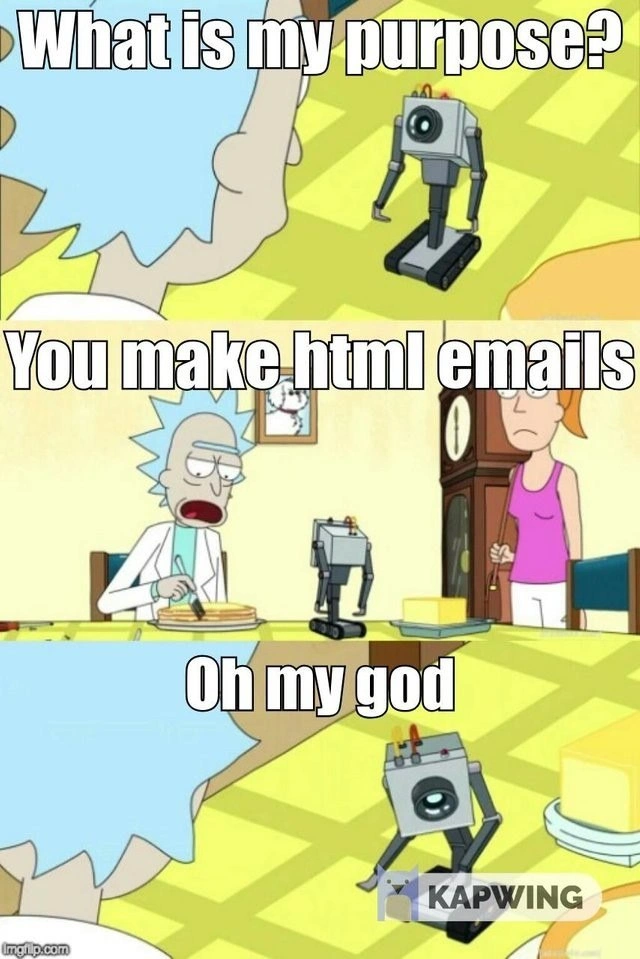
A brilliant inventor builds a clever little robot. The robot, full of hope, asks the big question every new being asks: "What is my purpose?" And the answer is... a chore. Not even a fun chore — the family's single most tedious, thankless, nobody-wants-it chore, the equivalent of being told your life's mission is untangling the Christmas lights, forever. The robot looks down at its little claws and says "Oh my god," and that tiny crisis is the whole joke: the gap between hoping you were made for something grand and finding out you were made to do the one task everyone else has been avoiding. Programmers laugh because in every office there's one such task — and someone, right now, is the butter robot.

Level 2: Why Emails Aren't Just Web Pages

  • HTML email: a marketing newsletter, receipt, or password-reset email with formatting — colors, columns, buttons — built from the same HTML as web pages, but displayed by email clients instead of browsers.
  • Email client: the program that shows your mail (Gmail, Outlook, Apple Mail). Unlike browsers, which converged on shared standards, each client renders HTML its own way, and some are frozen decades in the past.
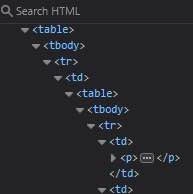
  • Table-based layout: positioning content using HTML tables — the web's pre-2003 technique. Modern web devs never learn it; email devs can't escape it. Taking a frontend job and being handed email templates is like joining an orchestra and being handed a washboard.
  • Inline CSS: writing styling directly on every single element instead of in one shared stylesheet. Imagine labeling every sock in your drawer individually because the drawer eats labels.

The junior-dev experience encoded here: you learn modern CSS, you feel powerful, and then a ticket arrives — "fix the newsletter in Outlook." You open the template and find four levels of nested tables and a comment that says <!-- DO NOT REMOVE, OUTLOOK NEEDS THIS --> on an empty cell. Three days later you understand the robot's face perfectly. It's a rite of passage with no graduation ceremony.

Level 3: A Purpose Worse Than Butter

"What is my purpose?" "You make html emails" "Oh my god"

In the original scene, Rick builds a fully sentient robot and assigns it the most trivially demeaning task imaginable: passing butter. The meme's swap works because HTML email development is the inverted version of that tragedy — a task that sounds trivial ("it's just an email") but is actually one of the most quietly brutal disciplines in web development. The robot isn't despairing because the job is beneath its abilities. It's despairing because it now knows what's coming.

Here's the archaeology that earns the third panel. Email clients never agreed on a rendering standard, so HTML email is frontend development with the last twenty-five years of progress revoked:

  • Layout is tables. Not CSS grid, not flexbox — nested <table> elements, the technique the rest of the web abandoned around 2003. In email, it's not legacy; it's best practice, because it's the only thing that renders consistently.
  • Styles are inline. Many clients strip <style> blocks, so every cell carries its own style="..." attribute like a refugee carrying its own luggage. External stylesheets? A myth told to children.
  • Outlook renders HTML with Microsoft Word. This is the load-bearing horror of the entire field: desktop Outlook switched its rendering engine to Word's, which understands roughly the HTML of 1999. Hence conditional comments like <!--[if mso]> — code written specifically to negotiate with a word processor.
  • No JavaScript, unreliable media queries, background images that vanish, padding that means different things in different clients. Testing one email across the client matrix (Gmail web, Gmail app, Apple Mail, three vintages of Outlook, that one executive still on Lotus Notes spiritually) is a combinatorial punishment that spawned an entire SaaS industry of email-preview tools.

The deeper satire is organizational: HTML email work is essential — it drives revenue, marketing lives on it — yet it carries zero prestige. No conference talks, no GitHub stars, no "email-driven development" thought leadership. It gets assigned, like butter-passing, to whoever can't say no: the newest hire, the agency contractor, the robot. The meme is the moment of assignment, and every frontend developer who's been voluntold into "just a quick newsletter template" has lived all three panels, including the stare at their own hands.

Description

A three-panel meme from the animated show 'Rick and Morty,' featuring the small, sentient 'butter robot.' In the first panel, the robot looks up at its creator, Rick, and asks, 'What is my purpose?'. In the second panel, Rick, seated at a breakfast table, replies with a deadpan expression, 'You make html emails'. The final panel shows the robot looking down in despair, uttering, 'Oh my god'. A 'KAPWING' watermark is visible in the bottom panel. The joke lands hard with developers who have experienced the uniquely frustrating task of coding HTML emails. Unlike modern web development, creating emails requires using outdated, non-standard practices like table-based layouts and inline styles to ensure compatibility across a nightmare landscape of inconsistent email clients (especially different versions of Outlook). This soul-crushing, uncreative work is perfectly captured by the robot's existential crisis
Comments

8
Anonymous ★ Top Pick I once had to debug an HTML email in Outlook. It was then I truly understood that the void stares back
  1. Anonymous ★ Top Pick

    I once had to debug an HTML email in Outlook. It was then I truly understood that the void stares back

  2. Anonymous

    Some robots dream of escaping the singularity; ours just wants a CSS selector that Outlook 2013 will respect

  3. Anonymous

    Twenty years of experience, three exits, and somehow I'm still explaining to stakeholders why we can't use flexbox in their marketing emails because Outlook 2007 refuses to die

  4. Anonymous

    HTML email is the only domain where 'modern stack' means tables, inline styles, and praying to the Outlook 2007 Word rendering engine. The robot's despair is just acceptance-stage email QA

  5. Anonymous

    The robot's existential crisis perfectly captures the moment a senior engineer realizes they're spending their Friday debugging why a 2-pixel padding renders differently in Outlook 2013 versus Gmail's mobile app - all while using nested tables and inline styles like it's 1999, because that's the only way HTML emails work across clients. At least the robot has a clear purpose; most email developers are still trying to figure out why `margin: auto` doesn't center elements in Yahoo Mail

  6. Anonymous

    Nothing humbles a staff engineer like shipping a ‘bulletproof’ button made of VML and nested tables because Outlook still thinks CSS is a feature request

  7. Anonymous

    Achieved self-awareness, just to master mso-conditionals and pray Gmail doesn't nuke your floats

  8. Anonymous

    Distributed systems are easy - try achieving eventual consistency across Gmail, Outlook (Word), and Apple Mail using only nested tables, inline CSS, and VML

Use J and K for navigation