Skip to content
DevMeme
Coffee Logic Fails the Review
Languages Post #99, on Feb 12, 2019 in TG

Coffee Logic Fails the Review

Why is this Languages meme funny?

Level 1: The Backward Coffee Rule

This is like making a rule that says, “If my cup is empty, keep working; if my cup has coffee, go get more coffee.” It sounds official because it is written like code, but the rule is backwards. That is why developers laugh: it looks smart for one second, then immediately looks like something they would have to fix before breakfast.

Level 2: If Means Choose

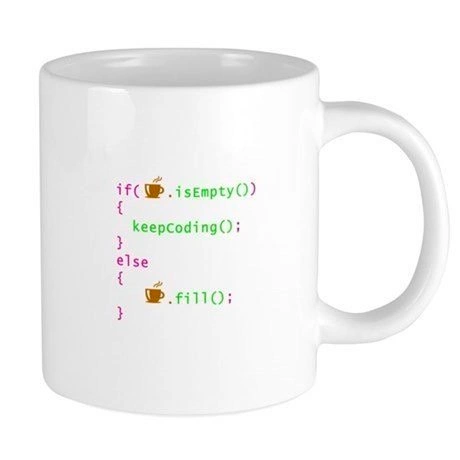
An if statement tells a program which action to take depending on whether a condition is true. In plain English, this mug says:

if (cup.isEmpty()) {
  keepCoding();
} else {
  cup.fill();
}

The condition cup.isEmpty() asks whether the cup has no coffee. Most people would expect the empty case to refill the cup:

if (cup.isEmpty()) {
  cup.fill();
} else {
  keepCoding();
}

That reversal is the technical joke. The code is not complicated, but it violates the expected relationship between the condition and the action. This is the same kind of bug beginners hit when learning control flow: the syntax is correct, the braces match, the function names look sensible, but the branches do the opposite of what the user expects.

It also reflects a real CodeReview habit. Reviewers often look beyond whether code “runs” and ask whether the logic matches the intent. A program can be valid JavaScript-like code and still be wrong. The mug is funny because it turns that very ordinary review comment into a lifestyle object.

Level 3: Caffeine Branch Misprediction

The mug prints a tiny program as if coffee were an object with methods:

if(☕.isEmpty())

keepCoding();

else

☕.fill();

The joke is that the control flow appears backwards. If the coffee cup is empty, the code calls keepCoding();. If it is not empty, it calls fill();. That is exactly the kind of logic a reviewer would circle with the tired politeness of someone trying not to write “have you run this even once?”

This lands because it combines two familiar developer rituals: ConditionalLogic and caffeine dependency. The mug wants to be cute coding culture merch, but the snippet has the same smell as a production bug hiding in a happy-path demo. The syntax is recognizable enough to parse immediately, and that makes the wrongness more satisfying. The audience does not need a compiler; the human brain executes the branch and trips over the empty cup.

There is also a small BugVsFeature ambiguity. Maybe the developer really does keep coding when the cup is empty because deadlines have converted the body into a deprecated runtime. Maybe fill() means “fill the already non-empty cup to the top.” Maybe the methods have side effects with names chosen by someone who likes chaos. But the straightforward reading is the funniest one: the code refills coffee only when coffee already exists.

The post message asks, Maybe you wanna to order some morning debugging also?, which fits perfectly. This is morning debugging as merchandise: a tiny condition that would fail the first unit test, printed permanently on ceramic. Somewhere, a lint rule just sighed.

Description

A plain white coffee mug is printed with a small colorful code snippet using a coffee cup icon as the object. The visible text reads `if(☕.isEmpty()) { keepCoding(); } else { ☕.fill(); }`, with braces in purple and method calls in green. The joke combines developer coffee culture with control-flow humor, especially because the logic appears backwards: an empty cup should probably trigger refill before continued coding. For experienced engineers, it reads like a wearable code review finding disguised as a novelty mug.

Comments

1
Anonymous ★ Top Pick The real production incident is that the caffeine dependency has no failing test for the empty branch.
  1. Anonymous ★ Top Pick

    The real production incident is that the caffeine dependency has no failing test for the empty branch.

Use J and K for navigation