When Code Review Needs Typography
Why is this CodeReviews meme funny?
Level 1: The Tiny Label Problem
This is like labeling two boxes with almost identical tiny handwriting, then asking someone else to sort important papers into them. Maybe you know which box is which, but everyone else has to squint and argue. The joke is that the computer can read the code, but the humans reviewing it are stuck asking, “Is that an i or a j?”
Level 2: Names Are Interfaces
In JavaScript and many other languages, a for loop often uses a variable to count positions in an array:
for (let j = 0; j < pointsToFilter.length; j++) {
// use j as the current index
}
That can be fine when the loop is very small. But if nearby code also uses i, or if the condition is hard to read, names like pointIndex, filterIndex, or candidateIndex may make the code much easier to review.
A pull request is where other developers inspect a change before it gets merged. They look for bugs, unclear logic, missing tests, and maintainability problems. In this image, the review is stuck on VariableNaming and MonospaceFonts before it can even get to the actual algorithm. That is funny because code review is supposed to be about correctness, but here it becomes an eye exam.
For newer developers, the lesson is practical: short names are not automatically clever. If a name makes the next person stop and ask “what character is that?”, the code is spending team time to save one keystroke.
Level 3: Typography as Triage
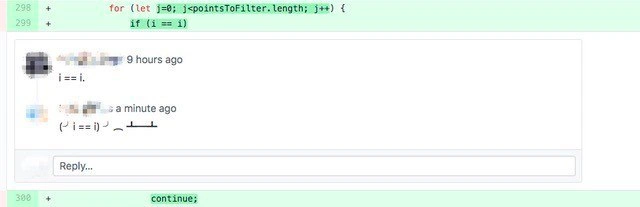
The screenshot shows a pull-request diff where the added code uses a loop like:
for (let j=0; j<pointsToFilter.length; j++) {
and the review conversation immediately collapses into identifying whether a tiny glyph is an i or a j. One reviewer writes:
i == i.
and the reply appears to correct it with:
(j == j)
complete with an arrow pointing at the character shape. This is the kind of code review pain that looks petty until it costs ten minutes, three comments, and somebody’s remaining will to approve the PR.
The joke is not that single-letter variables are always evil. In a tight loop, i, j, and k are traditional, especially for indexes. The problem is context. Here the diff is cropped, the font is small, the code is inside a web review UI, and the condition visually resembles a self-comparison. If reviewers have to debate typography before they can reason about behavior, the code has already created maintenance drag.
This is where CodeReadability becomes more than aesthetic preference. A pull request is not just code; it is a communication artifact. It has to survive small screens, syntax highlighting, tired reviewers, font rendering, and the awkward fact that humans do not parse source code like compilers. The compiler knows whether the character is i or j. The reviewer knows only that lunch was an hour ago and this line looks cursed.
The visible continue; below the thread adds to the flavor. Control-flow statements inside loops already require careful reading because they change which branches execute. Pair that with ambiguous names, and the reviewer has to hold both the algorithm and the alphabet in working memory. That is how a tiny naming choice compounds into review latency.
Description
The image shows a cropped pull-request diff with green added lines and an inline review thread over the code. The visible code includes a loop like `for (let j=0; j<pointsToFilter.length; j++) {`, a following condition that appears to use a visually ambiguous `i` or `j`, and a later added `continue;`; the review box shows blurred usernames, "9 hours ago", "a minute ago", a comment reading roughly "i == i.", a reply resembling "(j == j)" with an arrow, and a "Reply..." field. The joke is about code review degenerating into a glyph-identification exercise when short variable names, small screenshots, and similar characters collide. It is less about algorithmic correctness than the maintainability cost of making reviewers reverse-engineer typography.
Comments
1Comment deleted
A one-letter variable saves two keystrokes and spends them later with compound interest in review latency.