Skip to content
DevMeme
3063 of 7435
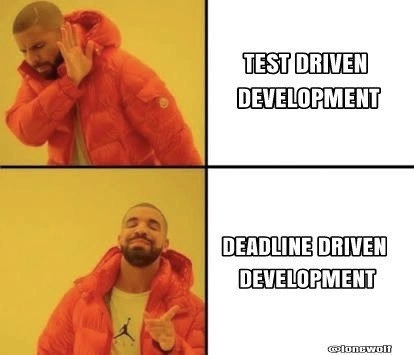
Choosing deadline driven development over TDD, classic two-panel reaction meme
Testing Post #3378, on Jul 6, 2021 in TG

Choosing deadline driven development over TDD, classic two-panel reaction meme

Why is this Testing meme funny?

Level 1: Hide the Mess

Imagine you’re supposed to clean your room properly, but you only have a few minutes before your parents check it. The right way to clean (like Test Driven Development) would be to put each toy in its correct place, fold your clothes nicely, and make sure everything is tidy. That takes time and care. But the fast way to clean (like Deadline Driven Development) is to shove all your toys and clothes into the closet and pull the door shut just as your parents walk in. On the surface, the room looks clean just in time – you met the “deadline”! You might even grin like “See, all done!” But what’s the catch? The mess is still there, just hidden. If someone opens the closet door (or looks a bit closer later), everything will tumble out and reveal that it wasn’t really cleaned properly.

This meme is joking about a very similar situation, but with writing code. Writing tests for code is like cleaning carefully: it makes sure everything is in order, but it takes a bit more time. Skipping tests to meet a deadline is like hiding the mess: it’s quicker and looks fine for the moment, but it might cause trouble later. It’s funny because we’ve all done something like this – choosing the quick fix because we’re short on time, even though we know it’s not the best way. The meme shows one picture of someone saying “No” to doing things the careful way (writing tests) and “Yes” to doing it the rushed way (just getting it done before time’s up). We laugh because it reminds us of ourselves when we’re in a pinch: sometimes you gotta do what you gotta do, even if it means there might be a mess to clean up later!

Level 2: Test vs Deadline

So, what’s going on here? This meme highlights a common situation in programming: choosing between writing tests for your code or rushing to finish the job before time runs out. The text in the meme contrasts “TEST DRIVEN DEVELOPMENT” (TDD) with “DEADLINE DRIVEN DEVELOPMENT.” Let’s break those down in plain terms:

  • Test Driven Development (TDD) is a practice where developers write tests before writing the actual code. Think of tests as little checklists or experiments that verify if the code works correctly. In TDD, you first write a test expecting a certain outcome, see the test fail (because the feature isn’t built yet), then write just enough code to make that test pass. You repeat this cycle for each small piece of functionality. For example, if you’re adding a login feature, you’d write tests to check things like “does it accept the correct password?” and “does it reject a wrong password?” before coding the login function. Only after writing those tests would you implement the login logic. When the code passes all the tests (turning them green), you’ve not only built the feature but also gained confidence that it works as expected. TDD is loved for producing high-quality, bug-resistant code. It’s like doing quality assurance step by step as you develop. Teams that follow TDD usually end up with a comprehensive test suite (a bunch of tests) that acts as a safety net. If someone changes the code later, and it breaks something, one of those tests will fail and warn the developers. This makes maintaining and refactoring the code much safer.

  • “Deadline Driven Development,” on the other hand, is not an official term or methodology you’ll find in textbooks – it’s a joking phrase developers use. It refers to the behavior of building software with the main goal of meeting a deadline, even if it means skipping best practices like writing tests. In a deadline-driven scenario, the thought process is: “We have to deliver this feature by tomorrow; writing tests will slow us down, so let’s just code the feature as quickly as possible and hope it works.” Essentially, all the focus is on speed and getting the product out the door by a certain date or time. Quality checks (like testing) tend to get postponed or ignored. Maybe someone says, “We’ll come back and write tests later when we have more time.” But often “later” never comes, because there’s always another deadline. This approach is very common when there’s heavy deadline pressure – say a client presentation, a holiday shopping season launch, or an investor demo – and the team is running behind schedule. Everyone is anxious about the date, so they take shortcuts. They might manually test a few critical things really quickly (or just say “it works on my machine, ship it!”). This is often humorously called “cowboy coding” or “YOLO coding” – as in, you Code Fearlessly (and maybe a bit recklessly) just to make that deadline.

The meme uses a popular two-panel format (often called the Drake Hotline Bling meme or orange jacket meme). In the first panel, Drake (the guy) is turning away with his hand up, clearly saying “nope” to whatever text is next to him. Here that text is “TEST DRIVEN DEVELOPMENT.” This indicates that in the scenario being joked about, the team is rejecting TDD – they are choosing not to do it. In the second panel, Drake is smiling and pointing approvingly at the text “DEADLINE DRIVEN DEVELOPMENT.” That implies the team is embracing the deadline-focused approach. The humor comes from the contrast: it’s like saying, “We should be doing TDD (writing tests), but haha, who are we kidding – we’re just doing whatever it takes to meet the deadline.” It’s funny to developers because it’s a bit of a guilty admission. Many of us have been taught that writing tests is important. Perhaps in school or bootcamp you learned to always test your code, or maybe your company even claims to follow TDD. Yet, in practice, when there’s a rush, everyone often defaults to just coding without tests to save time. The meme is basically winking and saying, “Yeah, we all know how it really goes when time’s almost up.”

Some terms and context for those newer to software development:

  • Deadline Pressure: This means feeling the stress of an upcoming due date. In software teams, a deadline might be the end of a sprint (a 2-week development cycle in Agile), a promised date to a client, or a big event (like launching a new app version at a conference). When the deadline is close and the work isn’t finished, the team feels pressure to hurry up.

  • SDLC (Software Development Life Cycle): This is just a fancy term describing the steps of creating software – from planning, designing, coding, testing, to deploying and maintenance. Testing is one key step in this cycle. In ideal scenarios, testing is given a good chunk of time and importance in the SDLC so that the final product is reliable.

  • Unit Tests & Test Suite: A unit test checks a small piece of your code (a “unit”) to make sure it behaves correctly for a given input. For instance, a unit test might call a function add(2, 2) and expect the result to be 4. A whole bunch of unit tests (along with other types like integration tests) make up a test suite. Running the test suite tells you if any part of the code is broken. If you practice TDD, your test suite grows alongside your code.

  • Technical Debt: This is a term developers use to describe the extra work or "cost" you incur by taking shortcuts in coding. For example, skipping tests or writing messy code under deadline pressure might save time now, but it means you’ll “owe” time later to fix bugs or clean up the code. It’s like borrowing time that you have to pay back with interest. A project with lots of issues left unfixed or tests not written is said to have technical debt. Too much technical debt makes future work slower and riskier (because things break easily).

Now, with those terms explained, you can see what the meme is getting at. It’s highlighting a relatable developer experience: the struggle between doing things the right way versus the fast way. If you’re new to development, you might have heard from mentors or senior devs: “Don’t skip writing tests; you’ll regret it later!” That’s the TDD camp talking – they’re right in principle. But you might also have seen real situations where your team said, “We’re short on time, just finish the feature, we’ll test later.” That’s the deadline-driven reality.

Imagine you’re working on a school coding project or a hackathon: initially, you might plan to test everything properly. But as the submission hour nears, you find yourself smashing out code, maybe commenting out tests that are failing at the last minute just so you can submit something that appears to work. It’s that same idea: in crunch time, testing and quality assurance are the first things to get sacrificed. Everyone hopes for the best, and often silently prays that no major bug shows up during the demo or right after release.

Why do developers laugh (or sometimes groan) at this meme? Because it’s a little bit of “it’s funny ’cause it’s true.” We like to joke about our own bad habits or the compromises we make. It’s like seeing a cartoon where a student chooses “Last-Minute All-Nighter” over “Study Gradually” – you chuckle because you’ve done it, even though you know it’s not the best way. Coding humor often revolves around these kinds of ironies in the tech workplace.

Also, note that nobody formally says, “We do Deadline Driven Development” – it’s a sarcastic term. Test Driven Development is a real, structured approach taught in many places. But “Deadline Driven Development” is just dev-slang to criticize situations where deadlines dominate everything else. It suggests a kind of chaotic, hurry-up coding style born out of necessity. Some developers also call it “panic-driven development” or joke that they are “test-driven” by whether the app crashes or not. All these jokes carry the same message: not enough testing, too much rushing.

In summary, Level 2 explanation: the meme is contrasting writing tests first (which leads to better code but takes time) versus coding with an eye on the ticking clock (which might save time now but can cause problems later). New developers should understand that this meme isn’t advising to do deadline-driven development; it’s sarcastically reflecting on it. It’s saying, “Look, we know TDD is good, but honestly, we often end up just rushing for deadlines instead.” It’s a wink-wink to all the programmers who have cut a few corners to make a ship date. If you’ve ever rushed to finish a project by a due date (say, coding something the night before it’s due), you’ve lived the spirit of deadline-driven development! The meme uses Drake’s familiar expressive faces to make the point with just a glance. Now you’re in on the joke: the next time you hear a dev say with a smirk that their team follows “Deadline Driven Development,” you’ll know they’re commenting on this exact scenario – prioritizing the deadline over the tests.

Level 3: Fix It in Production

In the top panel of this meme, Test Driven Development (TDD) gets the cold shoulder. In the bottom panel, our meme hero (the famous orange-jacket guy from the Drake meme template) is all smiles pointing to “Deadline Driven Development.” This is poking fun at a painful reality in software development: when push comes to shove, shipping on time often wins over writing thorough tests. The humor hits home for many seasoned developers because it’s developer humor grounded in truth. Everybody preaches “write your tests!” and “quality first!” during sprint planning, but when an unrealistic deadline looms, those idealistic TDD plans often fly out the window.

Why is this funny? It’s that mix of irony and shared suffering. Test Driven Development is a disciplined methodology where you write failing unit tests before writing the code, then write just enough code to pass the tests. It’s a pillar of good engineering in agile SDLC (Software Development Life Cycle). In theory, TDD leads to robust, bug-resistant code and acts as a safety net for future changes. But enter the reality of deadline pressure: hard release dates, last-minute feature requests, and product managers breathing down your neck. Suddenly, the priority shifts from writing tests to simply making sure the feature “works” by Friday. Thus, we slip into what this meme dubs “Deadline Driven Development.” It’s not an official methodology you’ll find in textbooks – it’s a tongue-in-cheek label for the all-too-common practice of letting the calendar dictate our coding habits. The meme text explicitly spells out this contrast, making the joke obvious: the person in the meme rejects “TEST DRIVEN DEVELOPMENT” and embraces “DEADLINE DRIVEN DEVELOPMENT.” The joke lands because every developer with a few years under their belt has lived this scenario (often late at night, eyes gritty from too much caffeine).

Let’s unpack the deeper context. In a perfect world, we’d write tests for every new feature or bug fix. Our continuous integration (CI) pipeline would glow green with passing tests, and deploying on Friday wouldn’t feel like diffusing a bomb. But in the real world, features have ship dates, clients have demos, and there’s always that one critical customer bug that ate up the time reserved for writing tests. This is where the “crunch mode” mentality takes over. Deadline-driven development is basically the art of coding on borrowed time – you skip writing tests and perhaps even skip code reviews, just to push out “something that works” before the clock runs out. The underlying dark joke is that we often don’t have time to do it right, but somehow we find time to do it over. Skipping tests feels faster in the short term, but it’s like taking out a payday loan on your codebase: you incur technical debt. The code might ship today, but the debt comes due later in the form of bugs, crashes, and frantic hotfixes in production. And guess who pays that debt? The dev team, often at 3:00 AM on a weekend, when that untested code inevitably blows up.

From a senior engineer’s perspective, this meme is painfully relatable. We’ve all seen the cycle: a project is behind schedule, management declares “No time for testing, just get it done!” and everyone reluctantly agrees to cut corners. Initially, it feels like we saved the day by delivering on time. Then the relatable developer experience kicks in: the code starts misbehaving in the wild. Error logs fill up, users complain about weird bugs, and the on-call developer’s phone starts buzzing nonstop. It’s essentially testing in production – a risky gamble where end-users become unwitting QA testers. The “Deadline Driven” approach means the team often ends up debugging live issues that proper tests might have caught. There’s an old sysadmin joke: “We don’t test in prod – we monitor in prod.” In other words, you skip writing tests and just watch the application like a hawk once it’s live, ready to jump in with a hotfix when something breaks. It’s funny because it’s true: plenty of teams have a wall of production dashboards (and maybe a bottle of antacid) instead of a comprehensive test suite.

This meme also hints at the incentive problem in many organizations. Why do smart developers keep repeating this pattern of neglecting tests under pressure? Because often the immediate reward (or avoidance of punishment) comes from meeting that deadline. If you ship the feature on time, everyone high-fives and the boss is happy — at least for that moment. No one’s giving out awards for “Most Unit Tests Written This Sprint.” On the flip side, if you miss the deadline because you insisted on writing tests, that failure is very visible. So the system silently encourages cutting corners. The code quality issues that arise later are diffuse and can be blamed on many things (users, requirements, “tech complexity”), but a missed deadline has your name on it. Experienced devs recognize this dysfunctional dynamic; we joke about it in memes, but it’s a real challenge to balance code quality with deadline pressure. As a result, even teams that start with good TDD intentions can slide into “just ship it now, we’ll fix it later” mode when the going gets tough. It’s a classic trade-off: speed vs. quality. This trade-off is even captured by the old project management triangle of Time, Scope, Quality – if time is fixed and scope is fixed, quality is the flexible one that usually suffers. Deadline Driven Development is basically living in that triangle’s bad corner, where we sacrifice testing (quality) to meet time and scope.

Let’s illustrate the contrast between these two “methodologies” in a quick tongue-in-cheek comparison:

Test-Driven Development (TDD) "Deadline-Driven Development"
Approach Write tests before code. Code guided by failing tests until they pass. Code first (often last-minute), tests postponed or abandoned ("we’ll add tests later... maybe").
Priority Code quality and long-term maintainability. Each change backed by tests. Deliver on time at all costs. The sprint demo is tomorrow and it needs to “work” (somehow).
When Bugs Appear Caught early by a failing test during development or CI. Caught in production by users (oops!) or late-night on-call alerts.
Developer Mood Confident to refactor, knowing tests will catch regressions. Nervous and sleep-deprived, hoping nothing breaks, ready to firefight issues live.
Famous Motto “Red, Green, Refactor” (write a failing test, make it pass, improve the code). YOLO, ship it!” or “We’ll fix it in prod.”
Outcome Higher initial effort, but fewer nasty surprises later. Codebase stays cleaner, technical debt reduced. Quick initial delivery, but likely technical debt and chaos later. Future you will curse past you.

We chuckle at this table, but each line probably triggers a war story among veteran engineers. Remember the build that finally passed all tests at midnight? That was TDD saving you. Remember the app crash on launch day because nobody tested that one scenario? That was the deadline-first approach biting back. This meme lands so well because it compresses all those painful lessons into a snappy two-frame joke. The top frame, “TEST DRIVEN DEVELOPMENT,” is the thing we know we should embrace (but Drake is rejecting it, as we often do when time’s short). The bottom frame, “DEADLINE DRIVEN DEVELOPMENT,” is the cheeky name for what we actually end up doing (and Drake’s grin tells us “yep, guilty as charged!”).

From an industry history angle, this tension isn’t new. Extreme Programming popularized TDD back in the late ’90s as a reaction to chaotic “code-and-fix” practices. Yet, decades later, here we are — still skipping tests when the pressure cooker heats up. Waterfall project plans from the ’90s often had a dedicated testing phase, but guess which phase got cut first when deadlines slipped? Testing. In Agile, we moved to doing testing continuously, but if each two-week sprint is jam-packed with features, guess what often gets deferred? Writing tests. Some teams try to enforce rules like “no code merges without tests,” but reality often finds loopholes (like commenting out failing tests just to get the build out the door). The meme’s tech humor exposes that disconnect between what we aspire to do (TDD, quality first) and what we actually do under pressure (just get it done, tests be damned).

There’s also a shared trauma implied here. Developers joke about Deadline Driven Development because many have been burned by it. They’ve experienced the anxiety of pressing “Deploy” without a safety net of tests. They’ve felt that sinking feeling when an error is discovered by a customer during a big demo – something a simple test could have caught. And of course, it’s often the same higher-ups who said “skip the tests, we must ship now” who later ask, “How on earth did we miss this bug?!” 🙃 The cynical veteran in us smirks at this meme because we’ve seen this movie too many times: we know the twist ending, but we still watch it play out on project after project. It’s a sort of gallows humor for engineers – laughing so we don’t cry about the dysfunction.

To make the situation even more relatable, imagine the internal monologue of a developer in crunch time:

Manager: “We absolutely must release by end of day. Skip anything that isn’t delivery-critical.”
Developer: “…Even tests?” 😟
Manager: “Especially tests. We’ll handle bugs later if we have to. Just get it out now.”
Developer: “Alright... (Later == 2 AM production hotfix, I just know it.)” 😒

That little dialogue encapsulates the meme’s story: the boss prioritizes the deadline over quality, and the developer is left to grapple with the inevitable fallout. The phrase “handle bugs later” is essentially the slogan of Deadline Driven Development. It’s both hilarious and horrifying because “later” usually means after users find the bug, or when the system crashes at an inconvenient time. As the meme suggests, we often knowingly walk into these situations. We do the coding equivalent of crossing our fingers and deploying, hoping that by some miracle the untested code will just work. Sometimes we get lucky, but often Murphy’s Law wins.

In summary, the complex humor here comes from the clash between ideal software engineering practices and pragmatic survival against deadlines. The meme exaggerates it into a binary choice for comic effect, but that exaggeration is anchored in something very real. Seasoned devs laugh (or groan) because they remember high-fiving each other for meeting a crazy deadline, only to spend the next week scrambling to fix the aftermath. Deadline Driven Development is a bit of an inside joke – we pretend it’s a “methodology” like TDD, but it really just means making a deal with the devil of time. And like any devil’s bargain, you get what you want now (delivered code!) at the cost of trouble later (bugs! tech debt! stress!). The meme’s two panels capture that trade-off in a nutshell. The fact that it’s using the famous Drake meme format just adds an extra layer of humor – it’s a format everyone recognizes instantly, so the joke is communicated in literally one second: Drake says “no” to tests, and “yes” to chasing deadlines. Every engineer instantly fills in the story behind those panels from their own experience. That instant “I’ve been there” recognition is what makes this meme both funny and a tad bittersweet.

Description

Accessibility details: A two-panel reaction meme using the well-known orange-puffer-jacket template. Top left panel shows the jacket-wearing person turned away with a raised hand in rejection; the adjacent white, all-caps text on the right says “TEST DRIVEN DEVELOPMENT”. Bottom left panel shows the same person smiling and pointing approvingly; the adjacent white, all-caps text on the right says “DEADLINE DRIVEN DEVELOPMENT”. Technical context: The meme contrasts disciplined test-first workflows (TDD) with the all-too-common practice of prioritizing shipping before a looming delivery date, poking fun at real-world trade-offs senior engineers face between code quality and time pressure

Comments

9
Anonymous ★ Top Pick Deadline-Driven Development: the senior-grade TDD where your unit tests run in prod and their assertions arrive as PagerDuty pings at 2 AM
  1. Anonymous ★ Top Pick

    Deadline-Driven Development: the senior-grade TDD where your unit tests run in prod and their assertions arrive as PagerDuty pings at 2 AM

  2. Anonymous

    After 15 years in the industry, I've learned that TDD actually stands for 'Technically Delayed Delivery' - because the only test that really matters to stakeholders is whether it ships before the quarterly earnings call

  3. Anonymous

    The irony is that TDD advocates promise it saves time in the long run, but when your PM schedules the demo for tomorrow and you're still refactoring your test fixtures, suddenly 'move fast and break things' becomes the de facto methodology. We all know the technical debt will compound at 40% APR, but that's Future Team's problem - right now, we're just trying to make it to Friday's deploy without the build breaking. The real test-driven development is whether your code survives production long enough to write those tests you promised yourself you'd add 'right after launch.'

  4. Anonymous

    We promised TDD and delivered DDD: product thinks Domain-Driven Design, leadership enforces Deadline-Driven Development, and CI implements 'Don't Detect Defects.'

  5. Anonymous

    Deadline-driven development: where red - green - refactor becomes red‑alert, greenlight, refactor‑never

  6. Anonymous

    TDD: Red-Green-Refactor. Deadlines: Red-F5-Deploy-Pray

  7. @nipunattri1 5y

    Committing that I was unable to do it :❌ Saying that it's farmework's problem:✅

  8. @Vlasoov 5y

    Now that's a 3D

  9. @Supuhstar 5y

    This is why every time my boss says I gotta finish something by a certain deadline, I respond "why?"

Use J and K for navigation