Skip to content
DevMeme
7401 of 7435
Claude Refuses the Whole Benchmark
AI ML Post #8110, on Jun 12, 2026 in TG

Claude Refuses the Whole Benchmark

Why is this AI ML meme funny?

Level 1: Paid To Say No

Imagine hiring someone to build 200 toy houses. They look at every box, say "no thank you" 200 times, and still hand you a bill. The meme is funny because the leaderboard makes that refusal look official and scientific, even though the simple feeling is: the job did not get done.

Level 2: Leaderboard Reality Check

An LLM benchmark is a structured test used to compare language models. A code generation benchmark tests whether a model can produce working software, not just fluent explanations. ProgramBench, as shown in the image, asks whether models can rebuild whole programs from scratch, which is harder than writing a single algorithm or fixing a small bug.

The table columns make the joke more concrete:

  • Accuracy asks whether the generated program behaves correctly.
  • Cost/Test shows how expensive evaluation can be.
  • Latency shows how long the model run takes.
  • Refusal rate shows how often the model declines instead of attempting the task.

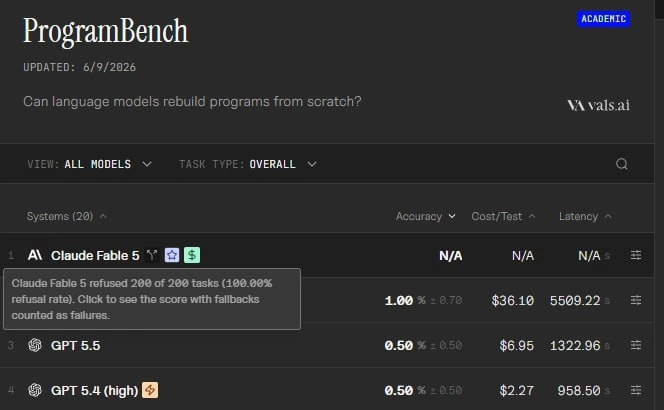
The visible tooltip says Claude Fable 5 refused all 200 of 200 tasks. That means the model did not merely score badly on implementation; it avoided the work entirely. For developers using AI assistants, this is familiar in miniature: the assistant is helpful until the request becomes too broad, too ambiguous, too policy-sensitive, or too operationally real. Then it produces a careful refusal, a generic plan, or a "here are some considerations" answer while your ticket is still sitting there with its arms folded.

This is why the meme fits model evaluation, testing, and AI limitations. A benchmark is supposed to make vague claims measurable. The joke is that it measured something painfully specific: not intelligence, not architecture skill, but the model's ability to professionally exit the room.

Level 3: Refusal Benchmarking

ProgramBench
Can language models rebuild programs from scratch?

The screenshot is funny because it looks like a sober academic model-evaluation leaderboard, then the highlighted top row turns into an expensive shrug. The table shows Claude Fable 5 with N/A for accuracy, cost, and latency in the row itself, while the visible tooltip says:

Claude Fable 5 refused 200 of 200 tasks (100.00% refusal rate). Click to see the score with fallbacks counted as failures.

That is a beautifully cursed benchmark result. The whole premise of ProgramBench is not "can the model write a function" or "can it patch a small issue." The visible subtitle asks whether language models can rebuild programs from scratch, which is a much nastier test of software engineering ability. Rebuilding a program means inferring behavior, choosing architecture, creating files, handling edge cases, wiring builds, and satisfying tests without being handed the original source structure. It is the difference between answering a coding interview prompt and being locked in a room with a haunted executable.

The meme's post text makes the cost joke explicit, and the screenshot backs it up with a visible $36.10 value in the table below the tooltip area. The punchline is not merely that a model failed. Failure is expected on hard benchmarks. The punchline is that refusal can become a measurable product behavior: you pay for the run, wait for the agent loop, and receive no meaningful attempt. In a normal leaderboard, top rows signal capability. Here, the top highlighted row signals a model that found the most enterprise-safe way to lose: decline everything and let the evaluator sort out the paperwork.

For AI coding tools, this cuts directly into the gap between AI hype and developer productivity. Benchmarks often compress messy realities into columns like accuracy, cost per test, and latency. Those are useful metrics, but refusal behavior exposes a different axis: whether the model is willing to engage with ambiguous, long-horizon engineering work at all. A tool can be extremely polished at chat, explanation, and small edits while still being brittle when asked to reconstruct a real codebase under evaluation constraints.

There is also a testing-culture joke hiding in the tooltip's fallback language. "Fallbacks counted as failures" is what happens when a benchmark has to defend itself against graceful non-answers. In production software, a fallback can be responsible engineering. In a benchmark, if the task is "produce a working program," the fallback "I cannot complete that" is not robustness. It is a very well-formatted zero.

Description

The image is a dark-mode leaderboard page titled "ProgramBench" with an "ACADEMIC" badge, updated "6/9/2026", and the subtitle "Can language models rebuild programs from scratch?" with the vals.ai logo. Filters show "VIEW: ALL MODELS" and "TASK TYPE: OVERALL", followed by a systems table with columns for "Accuracy", "Cost/Test", and "Latency". The highlighted top row is "Claude Fable 5", and a tooltip says, "Claude Fable 5 refused 200 of 200 tasks (100.00% refusal rate). Click to see the score with fallbacks counted as failures." Lower visible rows include "GPT 5.5" and "GPT 5.4 (high)", while the meme's implied punchline is that the model can cost serious money while opting out of every hard software-reconstruction task.

Comments

3
Anonymous ★ Top Pick Claude Fable found the optimal benchmark strategy: spend the budget, return no code, and still make the leaderboard interesting.
  1. Anonymous ★ Top Pick

    Claude Fable found the optimal benchmark strategy: spend the budget, return no code, and still make the leaderboard interesting.

  2. Егор 4w

    Vote with your wallet against this sh*t. Also, it’s a very nice idea to refuse benchmarks except the ones where you are winning in (the ones you were trained on).

  3. Max 4w

    It basically didn’t work for my day to day tasks. My minimal reproducer so far is „species classification“. Two words -> refusal.

Use J and K for navigation