Skip to content
DevMeme
3062 of 7435
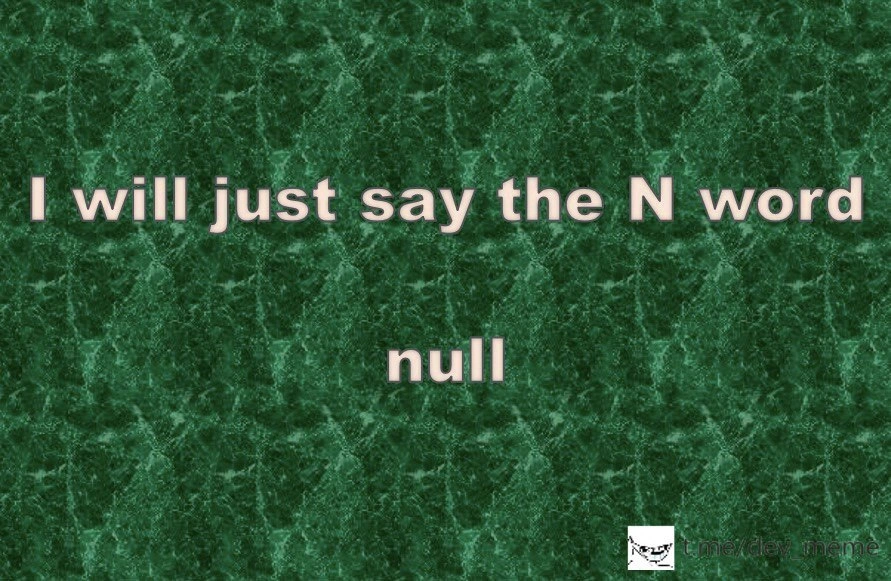
When devs threaten to drop the most dangerous N-word: null
Bugs Post #3377, on Jul 5, 2021 in TG

When devs threaten to drop the most dangerous N-word: null

Why is this Bugs meme funny?

Level 1: The Big Scary Nothing

Imagine you’re building a huge tower out of LEGO blocks, and right in the middle of the tower there’s one important block missing, leaving a gap. You didn’t notice the gap while building, but as soon as you place the next block on top, the whole tower comes crashing down. 😱 In this story, that missing LEGO piece is like null in a computer program – it’s an empty space where something important was supposed to be. When a program tries to use something that isn’t there (that “nothing” value), everything can fall apart. That’s why programmers joke that “null” is a super scary word. It’s like the one missing piece that can break the whole toy. The meme makes us laugh because it’s saying null is the nastiest, most dangerous word you can say to a computer – a little “nothing” that can cause a big problem. Just like you’d be shocked if your friend shouted a really bad word in class, coders get a jolt when they see null pop up in their work. It’s the big scary nothing that everyone in programming knows to watch out for, and that’s what makes the joke funny!

Level 2: The Absent Value

Let’s break this down in simpler terms. In programming, null is a special word that basically means “there is no value here” or “nothing.” It’s like a placeholder that says, “I’m supposed to hold some data, but right now I don’t have any.” Many languages (like Java, C#, C, and others) use null to represent an empty reference — essentially a variable that isn’t actually pointing to any object or useful data. This sounds harmless, but it can cause big problems when you forget about it. If you try to use a variable that is null as if it were a real object, the program will throw errors or even crash. For example, in Java:

String username = null;
System.out.println(username.length()); // Oops! NullPointerException thrown here

In the code above, we set username to null, meaning “there’s no actual string here.” When the program tries to find the length of username, it freaks out because there is no string to measure — NullPointerException! This is a runtime error that stops the program and yells, “You tried to use nothing as if it were something.” Different programming languages have different names for this error: Java calls it a NullPointerException, C# calls it a NullReferenceException, JavaScript might say something like “Cannot read property X of undefined”, and C or C++ might just outright crash (since they don’t automatically catch the error for you). But no matter the name, it all boils down to the same mistake: some piece of code expected a real value or object, and got null instead.

Now, why is null jokingly called the most dangerous “N-word” among developers? It’s a bit of tongue-in-cheek humor based on how much trouble this simple concept causes. BugsInSoftware often trace back to somebody not checking for null. Imagine you wrote a function to send an email to a user, and you assume the user’s email address is there. If, for some reason, the email wasn’t set (so it’s null), your function might blow up with an error the moment it tries to use that empty value. Suddenly, what could have been a simple “no email, do nothing” becomes a big RuntimeError. This kind of mistake happens a lot, especially in large codebases or when developers are moving fast and forget to handle that “what if there’s nothing here?” case.

There’s even a famous anecdote: Tony Hoare, the inventor of the null reference concept, later apologized and called it “the billion-dollar mistake.” Why “billion-dollar”? Because collectively, across many industries over many years, null-related bugs (like null_reference_exceptions, crashes, lost data, etc.) have caused enormous amounts of damage and cost a ton of money to fix. For something so small – just the idea of a “no value” value – it has an outsized impact on software quality. Every new programmer quickly learns what a null bug is, often on day one of debugging their code. It might be the first serious error message you don’t understand. You run your program and boom: NullPointerException or TypeError: something is null/undefined. It’s practically a rite of passage in learning to code.

Because null is so error-prone, modern programming practices emphasize “null safety.” Null safety means designing code (or languages) so that you minimize the chance of these errors. Some newer languages have nullable types and non-nullable types. For instance, in Kotlin (a language developed after Java), you can have a variable that is explicitly not allowed to ever be null (say, var name: String), and another that can be null (like var nickname: String?). That ? in Kotlin means “this string might be absent, i.e., null.” If you try to use a maybe-null variable without checking, the code won’t even compile – the language forces you to handle the null case, perhaps by using a null check or a safe call operator. This way, Kotlin and similar languages put up guard rails: you have to consciously deal with the empty case, so you’re much less likely to hit a surprise runtime error. Similarly, C# added a feature to mark reference types as non-nullable, and TypeScript (used in web development) lets you mark variables as possibly undefined to catch mistakes early. These are all responses to the realization: hey, null is causing a lot of bugs, let’s try to make it safer.

In older languages or in situations where such type distinctions aren’t available, the onus is on the developer to write defensive code. That’s why you’ll see a lot of null_checks like:

if (user == null) {
    return; // nothing to do if user is null
}
user.sendEmail();

The code above first checks user != null (in this C# style pseudocode) before calling sendEmail() on it, to avoid a crash. This is a simple example of how developers guard against null. But imagine in a huge program, you might need to remember to do this check everywhere an object could be null. Forget one spot, and bam — error at runtime. That’s why null has a bad reputation: it’s easy to forget about and can cause disproportionate havoc when forgotten.

Now, the meme itself is using a play on words. There’s a well-known phrase “the N-word” which in everyday (non-programming) context refers to a very offensive word you should never say. This meme takes that phrase and humorously repurposes it: for developers, the truly dangerous “N-word” is null. Of course, null isn’t offensive to people, but in code it’s “offensive” in the sense that it can wreck your program if misused. So it’s a lighthearted way to say “null is something we’re all afraid of dealing with.” The big text “I will just say the N word” sets you up to think of something taboo, and then the reveal “null” delivers the punchline by twisting the meaning. It’s funny to developers because it dramatises a very real sentiment: we dread null.

To a newer developer, this meme is basically a warning packaged as a joke. It says: be careful with null! That simple five-letter word causes more Debugging_Troubleshooting sessions than you can imagine. Everyone in software has cursed at a bug only to find it was a null value somewhere it shouldn’t have been. So in summary: null means no value, it’s notorious for causing program errors (like NullPointerExceptions), and developers have such a love-hate (mostly hate) relationship with it that we joke about it as if it were a swear word. The meme captures this inside joke in one snappy line.

Level 3: The Forbidden Word

Every experienced developer immediately gets the joke: “I will just say the N word… null.” It’s a playful way to call null the ultimate forbidden word in coding. The meme sets us up to expect a shock – as if someone is about to drop a very offensive slur – and then delivers the punchline: null. For programmers, that’s hilarious because null has indeed achieved a notorious, almost unspeakable status in our industry. It’s the source of countless bugs and has earned nicknames like the billion-dollar mistake (a nod to how much time and money NullPointerExceptions have wasted over decades). The meme’s dark-green marble background and simple bold text lend it a serious, almost ominous tone – as if we’re about to witness something truly scandalous. And in a sense, we are: someone threatening to use null in their codebase is a bit of a horror story for any team that’s been burned by it.

Why do senior devs smirk at this? Because they’ve all been there. NullPointerException at 3 AM, anyone? The phrase “drop the N-word” usually means uttering a highly taboo word – and in a coder’s world, null is that taboo. It’s the harbinger of a runtime error that can bring down a production system or crash a demo in front of stakeholders. We’ve learned (often the hard way) that whenever null pops up unexpectedly, it’s trouble. For example, a senior engineer might recall that one deploy Friday evening where an unhandled null value threw an exception, cascading into a full-blown outage. Cue the on-call pager and the scramble to patch the code. This collective trauma is exactly what the meme riffs on – the dread of null is so universally felt that we joke about it like a curse word.

The humor also pokes at language design wars. In some programming language communities, merely mentioning null can spark debates or derision. Java veterans roll their eyes at how much boilerplate null checking they’ve written (“if (obj == null) return error…” all over the place). C programmers know the terror of a null pointer dereference leading to a segmentation fault (instant program crash). In contrast, fans of newer languages like Kotlin or Swift will smugly tout their null safety features – their compilers make it harder (or impossible) to use null without handling it. So saying “null” around a mixed group of devs can indeed be incendiary: it’s a reminder of pain for some and a point of pride for others (“our codebase is 100% null-free!”). It’s akin to waving a red flag in a room full of bulls.

Consider the unspoken shared experiences this meme exploits. Every developer, at some point, has chased down a bug only to exclaim, “Ugh, it was null the whole time!” Maybe it was an uninitialized variable or a missing return value, but the result was the same: a crash or exception that seemed to come out of nowhere. We’ve all seen the frightening stack trace that includes something like NullReferenceException (as it’s called in C#) or its cousin TypeError: Cannot read property 'foo' of undefined in JavaScript (the web’s version of a null pointer error). These moments leave a mark. After you’ve been burned once, you start treating null like a live grenade. You avoid it, you check for it obsessively, or you adopt libraries and linting rules to banish it. In other words, null becomes “the word that must not be spoken” – exactly what the meme captures.

The meme’s minimalist presentation (just text on a marble backdrop) puts all the focus on that phrase. It’s an in-joke aimed straight at developers’ nervous laughter. The real N-word is obviously something else in life (a very offensive slur), so substituting it with “null” is tongue-in-cheek hyperbole. It’s saying: Inside the programmer’s world, this innocuous-sounding word is our version of a nightmare. We even personify null as a villain in countless stories. How many post-mortem meetings have the line “Root cause: the object was null”? How many times have we muttered under our breath, “If I see one more NullPointerException…”? The meme leans on this collective angst.

On top of that, there’s an element of gallows humor about legacy code and language gotchas. Null references are often called a “billion-dollar mistake” because of how much damage they’ve caused (legend has it that this one little design choice has cost companies immeasurable time in debugging). Yet, here we are in 2021 (when this meme was posted) and still dealing with it – it’s both funny and frustrating. A senior dev reading the meme might also think of all the band-aid solutions we’ve come up with: from pervasive null checks sprinkled through code (if (x == null) {...} everywhere), to using wrapper classes like Optional, to static analysis tools screaming warnings about “possible null dereference” that we sometimes just suppress. The meme sarcastically threatens to “say it” – as if merely using or even mentioning null could unleash chaos. And in a way, it can! One null in the wrong place can throw off an entire program. Seasoned devs appreciate the hyperbole: it’s funny because it’s true. We treat null like a joke, but also like a loaded gun.

In summary, this level unwraps why the meme lands so well with developers who’ve been in the trenches. It references the common pain and longstanding jokes of our field: that null is the ultimate boogeyman hiding in our code. The text-only meme format even resembles those blunt, text-only error messages we dread. It’s ridiculous to equate null to a curse word – and that ridiculousness is exactly the point. We laugh, perhaps a bit darkly, because we all agree: null is not to be taken lightly. Drop this particular “N-word” at your own peril.

Level 4: The Billion-Dollar Mistake

At the theoretical core of this meme is the infamous concept of null references in programming languages, often lamented as a fundamental design flaw. In 1965, computer scientist Sir Tony Hoare introduced the idea of a null reference – a special "value" that represents the absence of any object. Decades later he regretted it, famously calling it “my billion-dollar mistake.”

“I call it my billion-dollar mistake – the invention of the null reference.”
– Sir Tony Hoare, on introducing null in ALGOL W (circa 1965)

Why such strong words? Because a null reference essentially breaks the rules of type safety. In type theory terms, it’s like smuggling an extra invisible member into every data type – an “absent value” that wasn’t properly accounted for. A variable of type String in many languages isn’t just a string; it might secretly be “no string at all” (null). This under-the-hood exception to the type system has led to untold runtime crashes and NullPointerExceptions. It undermines the compiler’s guarantees, meaning a program can compile fine but still blow up at runtime because some pointer hit the dreaded null. In formal terms, the existence of null makes many functions partial: they don’t have a valid output for every possible input (passing a null where an object is needed causes an exception rather than a normal result). That complicates reasoning about correctness and has kept engineers and QA teams busy (and employed!) for ages.

From a language design perspective, null is a cheap hack that traded compiler enforcement for convenience back when memory was scarce. Historically, many systems used the memory address 0 as a universal “nowhere” address. Attempting to read or write address 0 triggers a hardware fault (segmentation fault), so using 0 (null) as a sentinel value was an easy way to catch errors at runtime. But it means we’ve been implicitly playing with a pointer to nowhere — a recipe for unpredictable behavior. Once this idea seeped into popular languages like C and Java, it became a cultural constant in programming: a null pointer was always lurking as a possibility, ready to throw errors or corrupt memory.

Over the years, academics and language designers proposed better approaches. The mathematically inclined introduced Maybe monads and Option types, which wrap a value to explicitly indicate “there might be something or nothing here.” Languages like Haskell and Rust took this route, completely eliminating null references in favor of explicit nullable types (like Maybe<Int> or Option<String>). These constructs force the programmer to handle the “nothing here” case at compile time, preventing the surprise null bomb from exploding at runtime. It’s a principled, type-safe answer to the problem — one rooted in algebraic data types and category theory (the Maybe monad being a functor that encapsulates an optional value). Meanwhile, mainstream languages tried retrofitting similar ideas: Java added Optional<T> as a library type, and C# introduced nullable reference types with compiler checks. These solutions draw directly from the theory that a program should explicitly acknowledge “no value” as a possibility, rather than sneaking it in implicitly.

In essence, the meme’s joke about “the most dangerous N-word” touches on deep truths in computer science. It’s poking fun at how a simple concept — null, meaning nothing — turned into one of the most dangerous words in software. The theoretical takeaway is that representing nothingness improperly in programming languages led to an entire legacy of bugs, crashes, and design debates. The humor has a razor-sharp edge because it’s grounded in this reality: a tiny tweak to language design in the 1960s created a ripple effect so vast that “null” became the boogeyman of modern code. It’s both absurd and enlightening that four letters (null) could cause so much chaos and cost. The meme distills that irony: in programming, the truly unspeakable “N-word” isn’t a profanity at all, but a seemingly innocuous keyword that has haunted our software for generations.

Description

The image is a simple meme with a dark green, marble-like textured background. Centered in large, bold, desaturated-pink text it reads, “I will just say the N word”, and directly underneath in the same font but slightly smaller size it says, “null”. In the bottom-right corner there is a tiny white square avatar of a cat face and a faint watermark that reads “mem/dev_meme”. The humor hinges on the developer in-joke that the scariest “N word” in programming is the literal value null, infamous for causing NullPointerExceptions and unpredictable runtime crashes. The visual minimalism focuses attention on the punchline, poking fun at language design debates, the “billion-dollar mistake”, and every engineer’s dread of debugging null references

Comments

59
Anonymous ★ Top Pick The only time our legacy monolith and the shiny microservices cluster coordinate perfectly is at 2 AM - when they simultaneously broadcast a NullPointerException like some distributed denial-of-sanity protocol
  1. Anonymous ★ Top Pick

    The only time our legacy monolith and the shiny microservices cluster coordinate perfectly is at 2 AM - when they simultaneously broadcast a NullPointerException like some distributed denial-of-sanity protocol

  2. Anonymous

    After 20 years in this industry, I've learned that null isn't Tony Hoare's billion-dollar mistake - it's the trillion-dollar consulting opportunity that keeps half of us employed fixing the other half's optimistic assumptions about data integrity

  3. Anonymous

    Ah yes, the billion-dollar mistake that Tony Hoare apologized for, yet we still invoke it daily with the reverence of a forbidden incantation. Senior engineers know that saying 'null' in production is less about the word itself and more about the existential dread of NullPointerExceptions cascading through your carefully architected system at 3 AM. It's the programming equivalent of Voldemort - 'He-Who-Must-Not-Be-Dereferenced' - yet we can't help but summon it in every other method signature, because Optional<T> is apparently too verbose for our delicate sensibilities

  4. Anonymous

    Null: the N-word that summons NullPointerExceptions faster than any slur - even Kotlin can't fully exorcise it

  5. Anonymous

    We banned null with Option/Maybe and strictNullChecks; then a LEFT JOIN reminded us SQL speaks three-valued logic and PagerDuty speaks tears

  6. Anonymous

    Every time someone says “just make it nullable,” we inherit SQL three‑valued logic, JSON null‑vs‑missing, Kotlin safe‑calls - and a 3am NPE

  7. @mvolfik 5y

    @umlaut

  8. @sylfn 5y

    i will just say the N word cout << "N word";

  9. @Dobreposhka 5y

    nigger is better

    1. @FGH378yufs 5y

      True

    2. @paul_thunder 5y

      Nig Nigger The niggest 🤔

      1. @Dobreposhka 5y

        lol

  10. @pyproman 5y

    I will just say the F word False

  11. @Dobreposhka 5y

    @Umlaut

    1. @pavloalpha 5y

      srry bro я завязал(i'm done)

      1. @Dobreposhka 5y

        ((

      2. @unexpiredmilk 5y

        Your bio doesn't say so :)))

        1. @pavloalpha 5y

          Hahahaha didn't mind Russian people from this chat would check it

          1. @Dobreposhka 5y

            that's bot about nigas, but about negros, right?

            1. @pavloalpha 5y

              Negus

          2. @unexpiredmilk 5y

            Amongus

            1. @pavloalpha 5y

              Amogus

              1. @unexpiredmilk 5y

                Abobus

                1. @pavloalpha 5y

                  🅰🅱🅾🅱🅰

                  1. @unexpiredmilk 5y

                    Can I dm you in 5 mins?

                    1. @pavloalpha 5y

                      Dm?

                      1. @Dobreposhka 5y

                        лс

                        1. @unexpiredmilk 5y

                          Remember the rules: No Russian

                          1. @sylfn 5y

                            No violation, it was descriptive text

                            1. @unexpiredmilk 5y

                              Okay. It's nice.

                          2. @pavloalpha 5y

                            Lol, how u can tell the info another way

                            1. @unexpiredmilk 5y

                              You mean changing font settings?

                              1. @pavloalpha 5y

                                Nah, I mean for the clearance of information. I think it is ok to to send 2 letters on Russian

                                1. @unexpiredmilk 5y

                                  Yes. I agree!

                          3. @Dobreposhka 5y

                            it is a translation, dude

                            1. @unexpiredmilk 5y

                              Rog'

                      2. @unexpiredmilk 5y

                        I mean 'text you'

                        1. @pavloalpha 5y

                          Ammm, yeah

  12. @pavloalpha 5y

    negus

    1. @Dobreposhka 5y

      why are you Pavel now?

      1. @pavloalpha 5y

        because some idiots call me "Омлет"(Omlet)

        1. @Dobreposhka 5y

          ahah

          1. @Dobreposhka 5y

            and why are you done about nigs?

            1. @pavloalpha 5y

              I have a deal

            2. @RiedleroD 5y

              we made a deal: he gets all warnings removed & he'll stop saying it

              1. @Dobreposhka 5y

                bad deal

              2. @pavloalpha 5y

                negus

                1. @RiedleroD 5y

                  alternatively: ni🅱️🅱️a

                  1. @pavloalpha 5y

                    nah man u don't understand

        2. @intbyte20 5y

          Lol

  13. Deleted Account 5y

    oof

    1. @pyproman 5y

      why I see you in every chat

      1. Deleted Account 5y

        ¯\_(ツ)_/¯

  14. @RiedleroD 5y

    ahahaha that's hilarious

    1. @pavloalpha 5y

      negus

  15. @Libertas3301 5y

    Bruh, man, niggajoke

  16. @nedoedaev 5y

    Unhandled NullReferenceException.

  17. dev_meme 5y

    Bruh

  18. @batuto 5y

    None

Use J and K for navigation