Skip to content
DevMeme
3064 of 7435
Manager’s ‘no problems’ motto meets the harsh reality of a DDoS
OnCall ProductionIssues Post #3379, on Jul 6, 2021 in TG

Manager’s ‘no problems’ motto meets the harsh reality of a DDoS

Why is this OnCall ProductionIssues meme funny?

Level 1: Flood of Opportunities

Imagine you’re at home and suddenly the kitchen sink breaks, and water starts flooding all over the floor. It’s a huge mess – puddles everywhere, your shoes are wet, the dog is swimming by 🤨. You run to your parent or a friend and shout, “Uh oh, we have a big problem – the kitchen is flooding!” Now, picture that the person in charge – instead of saying “Oh no!” – smiles calmly and says, “Remember, we don’t have problems, only opportunities!” That’s their motto, like a family saying that tries to keep everyone positive. You might blink in disbelief because, well, a flood sure feels like a problem, doesn’t it? But this optimistic person insists it’s an “opportunity” – maybe an opportunity to take a free shower or to clean the floor? 😅

So, being cheeky, you play along and yell back excitedly, “Great news, everyone! We have a wonderful flood opportunity!” You start pretending this disaster is the best thing ever – maybe you say it’s an opportunity to test how good your new mop is, or a chance to go ice skating in the kitchen if it freezes. Of course, you don’t actually believe it’s good news; you’re just mirroring that silly positive spin. That contrast is exactly what makes it funny: one person refuses to call a bad thing bad, and the other person goes, “Okay, fine, I’ll call it good – see how ridiculous that sounds?” In the end, the flooded kitchen isn’t really an opportunity; it’s a mess to fix. And calling it an opportunity doesn’t magically dry the floor. But humor helps! Sometimes when things go very wrong, joking about it – like saying “what an opportunity!” – makes everyone chuckle and eases the stress a bit. It’s a way to cope with the fact that, yeah, we have a real problem, no matter what words we use.

Level 2: When Good News Goes Bad

Let’s break down the joke in simpler terms and explain the tech and lingo for those newer to the field. First, DDoS stands for Distributed Denial of Service. It’s a type of cyber-attack where an attacker uses many computers (sometimes an army of hijacked machines called a botnet) to send an overwhelming amount of traffic (requests, data, packets – basically internet messages) to a target system (like a website or online service). The goal is to overload that system so it can’t respond to real users – essentially knocking it offline. It’s called “distributed” because the attack comes from many sources at once, making it harder to block; and “denial of service” because legitimate users are denied the service (imagine too many people crowding a store so real customers can’t get in – it’s the same idea, but with network traffic). A DDoS attack is a big deal in the realm of SecurityIncidents: it can crash websites, disrupt online games, even temporarily take down big companies if their defenses aren’t robust. You’ll often hear of companies investing in DDoS protection – these are measures like traffic filters, extra bandwidth, and working with services like Cloudflare or AWS Shield that specialize in absorbing or deflecting these floods of data.

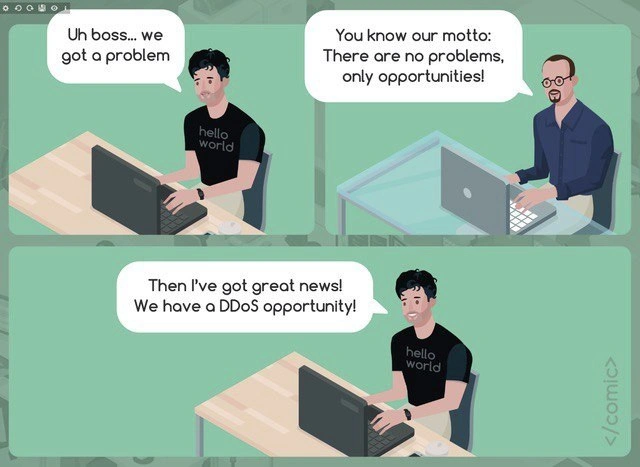
Now, the meme specifically shows a conversation between a developer and a manager during a crisis. The developer says, “Uh boss… we got a problem.” Pretty straightforward – he’s noticed the service is under attack (maybe the servers are slow or unresponsive because of the DDoS) and he’s alerting his manager. The manager replies, “You know our motto: There are no problems, only opportunities!” This is a bit of corporate-speak. Basically, some companies or managers encourage a mindset where you don’t label things as “problems” because that sounds negative. Instead, they want you to call them “opportunities” – as in, opportunities to improve, to learn, or to show your skills. It’s a communication strategy meant to keep everyone optimistic and solutions-focused. For example, if a project is behind schedule, a manager might say “It’s an opportunity to streamline our process” instead of “We’re failing our deadline.” It’s debatable if this actually helps, but it’s definitely something you’ll encounter in offices: reframing issues in a positive light. That phrase “no problems, only opportunities” is basically a motto to remind employees to stay positive and not dwell on the negative.

In the third panel, the developer turns the motto on its head. He says, “Then I’ve got great news! We have a DDoS opportunity!” Here’s why that’s funny: no one in their right mind thinks a DDoS attack is “great news.” It’s very much bad news. So the developer is being facetious (playfully sarcastic). He’s taking the manager’s forced optimism and applying it literally to an extreme situation. If the rule is to call problems “opportunities,” then hey, a DDoS isn’t a problem – it’s an opportunity! An opportunity presumably to test their emergency response, or an opportunity to improve security, etc. This joke highlights how sometimes management can use positive language to the point of silliness. By cheerfully announcing a cyber attack as “great news,” the developer is indirectly saying, “See how ridiculous it sounds when we can’t even call a disaster a problem?” It’s a gentle jab at the optimistic_management style.

Let’s touch on a few details and tags:

  • OnCall_ProductionIssues: “On call” means a developer (often a site reliability engineer or ops engineer) is designated to respond if something goes wrong with a live product, usually even outside normal hours. A DDoS definitely qualifies as a production issue – it affects the live site/app, potentially causing downtime. Being on call for a DDoS might mean you’re suddenly scrambling to mitigate the attack at odd hours. The meme doesn’t explicitly show a time, but the vibe of “we got a problem, boss” is classic on-call scenario. The humor is extra rich for folks who have been on call, because they know the feeling of panic when an alert pops up – and they can imagine a manager spouting a motto in the middle of that chaos.
  • Security: A DDoS is fundamentally a security issue. It’s an attack on the availability of a service. Security isn’t just about hackers stealing data; it’s also about keeping services reliable and up (the “Availability” in the CIA triad of security: Confidentiality, Integrity, Availability). This meme falls under security humor because dealing with a DDoS is part of a security engineer’s or network engineer’s world – and the mismatch between technical urgency and corporate phrasing is a known friction point.
  • Communication: This is a big part of the joke. The communication style of the manager vs the developer differs. The developer communicates plainly (“we got a problem”), the manager communicates in a crafted motto (“no problems, only opportunities”). The developer then mirrors that style in an exaggerated way to communicate a point. It’s about how we talk about incidents. In tech teams, clear communication is critical during an incident – usually you want to be candid and specific (“We’re seeing 10x traffic, the database CPU is maxed out”). Managers sometimes focus on communication in a broader sense, like how to frame the situation to stakeholders or the team to keep everyone calm. Here the manager’s motto is about framing, and the dev’s reply is showing that framing taken to an extreme.
  • Corporate_spin: That’s basically what the manager is doing – “spinning” a negative situation (a problem) into something that sounds positive or at least palatable (an opportunity). It’s common not just in corporate life but even in public relations. For example, instead of “We have a bug causing data loss,” one might spin it as “We have an opportunity to enhance our data integrity checks.” It means the same thing with a positive twist. The meme highlights this spin and pokes fun at it.

Also notice the developer’s t-shirt with “hello world” printed on it. This is a nod to programming culture. “Hello, World!” is traditionally the first thing you output when learning a new programming language (just a simple program that prints Hello World to the screen). It’s become an icon for coders – so having it on his shirt is a quick way to show, “This is the developer/engineer character.” It’s also a lighthearted detail: even as everything goes wrong, he’s wearing the phrase that represents the beginning of programming adventures. Kind of poetic – from “hello world” to “the world is attacking us” via DDoS 😅.

For a junior developer or someone new to these concepts, the key takeaway of the meme is: there’s a big gap between calling something nice words and dealing with the actual problem. The DDoS is the actual problem (lots of malicious traffic = site might go down), and the manager’s slogan is just words. The developer’s witty comeback basically says, “If you insist on using only positive words, I’ll do it – but it won’t change the fact that we’re under attack.” It’s a comedic example of engineer humor where literalism and sarcasm expose a truth. In real life, of course, during a DDoS your team would be taking it very seriously: pulling up dashboards, contacting your hosting provider, enabling mitigation strategies. Only after it’s handled (or maybe in a moment of stress-relief joking) would someone quip something like the line in the meme. It’s that shared laugh in a tense situation that helps the team bond – laughing at the absurd idea that this awful situation is somehow a “great opportunity.”

Level 3: Motto vs Botnet

For veteran engineers, this meme hits a nerve because it depicts a clash between technical reality and corporate spin. The developer is dealing with a production incident – specifically a DDoS attack, one of the nastier OnCall_ProductionIssues that can knock a service offline. Meanwhile, the manager chirps the classic cheery motto: “There are no problems, only opportunities!” This is a well-worn bit of corporate optimism, essentially a mandate to reframe any bad news as positive. Seasoned devs have seen this pattern: outages become “learning opportunities”, security incidents become “chances to improve our defenses”, and so on. It’s management communication 101 – keep morale and investor confidence high by never admitting outright failure. The dark humor here comes from the developer taking that motto and applying it literally to a crisis: “Then I’ve got great news! We have a DDoS opportunity!” The dev’s enthusiastic thumbs-up attitude in the face of chaos is pure sarcasm. He’s basically telling the boss: “Alright, if you insist everything is an opportunity, well congratulations – this major outage is the biggest ‘opportunity’ we’ve had in a while!”

Why do experienced engineers find this hilarious (and a bit painful)? Because it’s a scenario that rings true. When you’re on call at 3 AM and the site is on fire (or your servers are melting under a DDoS), the last thing you need is a motivational slogan. You need actionable solutions and maybe enough coffee to fill a swimming pool. But some managers – especially non-technical ones – default to toxic positivity. Instead of acknowledging “Yes, this is a serious problem and customers are impacted,” they’ll say something like, “This is a great opportunity to show our resilience and teamwork.” 🙄 In the meme, the manager’s motto is an attempt to reshape the narrative: in his world, admitting “problem” is taboo because it sounds negative or defeatist. It’s optimistic_management style – the idea that how we label something influences how we tackle it. However, to the engineer furiously typing commands to mitigate an attack, that attitude can feel delusional. The meme exaggerates it perfectly: a DDoS is the archetypal “bad day in production”. It’s an uptime-threatening, pager-triggering, all-hands-on-deck emergency. Calling it an “opportunity” is absurd – hence the comedic crux. It’s the extreme of corporate_spin: like calling a five-alarm fire an “unplanned barbecue opportunity.”

There’s also industry commentary here. “No problems, only opportunities” sounds like those sanitized post-incident reports where a catastrophic outage is described as "an opportunity to improve our system’s robustness." It’s basically PR mode language. Engineers often joke that in press releases, downtime is never “downtime”, it’s “performance event” or “service degradation” – anything to avoid saying “we messed up” or “we got hit hard.” Similarly, internally, a manager might try to keep the team’s spirits up by avoiding the word “failure.” The developer’s comeback in the meme is a playful way of saying, “Let’s cut the nonsense – if you want opportunities, we’ve got one: a chance to witness our infrastructure crumble under an attack!” The humor is sharpened by the contrast in attitudes: the manager is calm, almost in denial, typing on his laptop as if everything’s fine, while the dev initially looks concerned (“Uh boss… we got a problem”) then flips to grinning enthusiasm once he parrots the motto. That image of the developer smiling about a DDoS – something that usually causes panic – is inherently funny because it’s so ridiculously inappropriate. It’s the kind of forced positivity you’d only express with heavy sarcasm.

From a senior dev perspective, this meme also pokes at the reality of incident_response culture. In a real DDoS, the team would be scrambling: contacting the DDoS protection service, updating firewall rules, maybe temporarily blackholing traffic or scaling out servers. It’s a firefight. The manager’s contribution in such moments can sometimes feel lightweight – maybe coordinating meetings or sending emails while the techies do the heavy lifting. So when the manager just quotes a motto instead of acknowledging the gravity, the dev’s snappy reply doubles as a subtle protest: Please recognize this is serious. It resonates with any engineer who’s had to explain to higher-ups why “the site being down” is indeed a problem, not just a PR reframe exercise.

There’s a layer of shared trauma humor here too. DDoS attacks are notorious; many of us have war stories about the time some script kiddie or angry ex-user unleashed a botnet on our service. It’s stressful: alarms blaring, dashboards blood-red, CPU at 100%, legitimate users screaming on Twitter. Everyone is on a Zoom bridge mumbling status updates and frantically trying mitigation steps. In the aftermath, managers and execs often try to put a positive spin – “we learned our weaknesses; this gave us a chance to test our incident process” – which is true in hindsight but utterly exasperating to hear in the heat of the moment. The meme captures that frustration perfectly. The line “We have a DDoS opportunity!” is something an exhausted engineer might jokingly say in the war room to break the tension, eliciting chuckles from fellow devs who get the absurdity. It’s basically engineer-speak for “This is fine 😅” while everything burns.

Let’s not overlook the "hello world" shirt on the developer. It’s a cute detail underscoring he’s the techie. Hello world is traditionally the first program one writes when learning a new language – it screams “software developer”. This contrasts with the manager’s more formal attire. It’s a small visual cue about their roles: the developer is the hands-on keyboard guy, the manager is the business-y motto guy. The dev’s shirt might also hint that he’s relatively junior or at least still idealistic enough to poke fun at corporate culture. But regardless of experience, any dev under attack will relate to his initial worry and subsequent sarcastic glee in delivering that punchline to the boss.

In summary, at the Level 3 perspective this meme is a commentary on how communication in a crisis can diverge between engineers and management. It highlights the gallows humor tech teams use to cope (calling a disaster “great news”) and the often out-of-touch positivity from higher-ups. Seasoned professionals laugh (perhaps with a groan) because they recall being in similar situations – juggling real SecurityIncidents like a DDoS while someone upstairs insists on using positive language or refuses to acknowledge the severity. It’s funny because it’s true: you can technically label a catastrophe as an “opportunity” all you want, but it sure doesn’t feel that way when you’re the one rebooting servers at midnight. The meme is basically a polite eye-roll at optimistic_management culture colliding with the harsh realities of production incidents. As any grizzled on-call engineer will tell you, sometimes the biggest “opportunity” you get from a DDoS is the opportunity to update your resume once the dust settles.

Level 4: Volumetric Onslaught

At the most granular technical level, a DDoS (Distributed Denial-of-Service) attack is essentially a massively distributed flood of network requests designed to exhaust the target’s capacity. Think of it as billions of packets screaming at your server all at once, a brute-force saturation of bandwidth, CPU, memory, and any other finite resource in the system. No amount of positive thinking or corporate mottoes can bend the fundamental physics here: network links have fixed bandwidth, and servers can only handle so many concurrent connections or requests before queues overflow or memory is exhausted. The meme’s punchline plays off this immutable truth – a cheery slogan won’t raise your throughput limit or magically spawn extra CPU cores when a botnet onslaught hits.

In theory, handling a DDoS is about recognizing malicious traffic patterns and filtering or rate-limiting them without blocking legitimate users. But attackers have turned this into an arms race. They exploit protocol nuances and amplify their traffic. Classic examples include SYN flood attacks (filling up a server’s half-open connection table with forged requests) and DNS amplification (where a small query elicits a huge response from unwitting DNS servers, ballooning the attack volume). This is the adversarial flip side of scalability: while we design systems to scale up for real users, attackers leverage that same scalability against us. It’s almost like a perverse stress test of your infrastructure – except it’s unplanned, hostile, and many times heavier than normal load. Academic research and distributed systems theory acknowledge that any system with finite resources is vulnerable to denial-of-service if an attacker can muster enough resources. In practice, the best you can do is build massive overcapacity, deploy smart filters (like Web Application Firewalls and DDoS scrubbing networks), and have rapid incident response to cut off or absorb the avalanche of traffic. Even so, a sufficiently large botnet can still overwhelm the defenses, much like a dam eventually breaking under a once-in-a-millennium flood. The humor in calling a DDoS an “opportunity” hints at the absurdity of reframing a raw availability threat – governed by hard math and physics – with optimistic semantics, as if euphemism could absorb 100 million packets per second.

Yet, in a darkly funny way, one could argue a DDoS is an “opportunity” in the sense of a free load test provided by the internet’s most unfriendly QA team (a botnet 💀). Underneath the sarcasm, there’s an engineering truth: you learn a lot about your system’s weak points when it’s pushed beyond its limits. The TCP/IP stack, kernel network buffers, and database connection pools all reveal their breaking points. Distributed denial-of-service attacks essentially exploit the non-linear scaling issues – like how a slight increase in load can disproportionately degrade performance once past a tipping point (queues start dropping packets, context switching skyrockets, caches miss more often, etc.). The sheer volume can defeat even algorithmic optimizations because the battle is often decided by raw numbers. There’s a bit of game theory too: the attacker throws cheap traffic from many sources, while the defender must expend costly resources (CPU cycles for crypto handshakes, memory for tracking state, support staff time) to handle each bogus request. No witty motto changes the economics of that exchange. So in Level 4 terms, the meme slyly contrasts the manager’s denial of reality (treating a physical resource exhaustion as mindset issue) with the unforgiving denial-of-service reality: a demonstration of the internet’s brutal math where N attacking nodes can overwhelm 1 target if N is large enough. It’s a showdown between rose-colored management philosophy and the cold laws of computing.

Description

Three-panel comic style illustration with flat pastel colors. Panel 1: a developer wearing a black T-shirt that says “hello world” sits at a laptop and says, “Uh boss… we got a problem.” Panel 2: a manager at another desk, typing on a silver laptop, replies in a speech bubble, “You know our motto: There are no problems, only opportunities!” Panel 3: back to the developer who enthusiastically announces, “Then I’ve got great news! We have a DDoS opportunity!” The joke subverts the corporate spin of reframing issues as ‘opportunities’ by applying it to a security incident - specifically a distributed denial-of-service attack, a classic availability threat that typically triggers production firefighting and on-call escalation

Comments

11
Anonymous ★ Top Pick It’s not a DDoS, it’s an unscheduled, botnet-sponsored chaos test - just let Finance know our “opportunity” is a 10× spike in cloud spend
  1. Anonymous ★ Top Pick

    It’s not a DDoS, it’s an unscheduled, botnet-sponsored chaos test - just let Finance know our “opportunity” is a 10× spike in cloud spend

  2. Anonymous

    The best part about reframing incidents as opportunities is that our post-mortem can now be called a 'growth retrospective' while we explain how our autoscaling opportunity helped us discover our cloud budget's elastic limit

  3. Anonymous

    When your manager's 'growth mindset' framework collides with a 300Gbps volumetric attack, suddenly that blameless postmortem culture gets real quiet. Nothing says 'fail fast' quite like your entire infrastructure actually failing fast - though I'm sure the incident retrospective will call it an 'unplanned learning experience' while the SRE team updates their résumés

  4. Anonymous

    Enterprise alchemy: transmuting a L7 DDoS into a 'scalability opportunity' that greenlights your next K8s cluster spend

  5. Anonymous

    Perfect - if a DDoS is an opportunity, I'll file the scrubbing-center invoice under CAC and count the botnet as DAUs

  6. Anonymous

    Rebranding a DDoS as an “opportunity” is just converting SLO error budget into cloud budget - courtesy of the auto-scaler

  7. @ZgGPuo8dZef58K6hxxGVj3Z2 5y

    Lol

  8. Deleted Account 5y

    bayan pizdec

    1. @sylfn 5y

      pozhaluysta, ispol'zuyte normal'niy angliyskiy v etom chate плииз юуз инглиш ин зис чат (please use English in this chat)

      1. Deleted Account 5y

        accordion fucked up

        1. @xaea0 5y

          hah

Use J and K for navigation