Ah, Yes, 'Computer Sciance'
Why is this Juniors meme funny?
Level 1: Playing Dress-Up
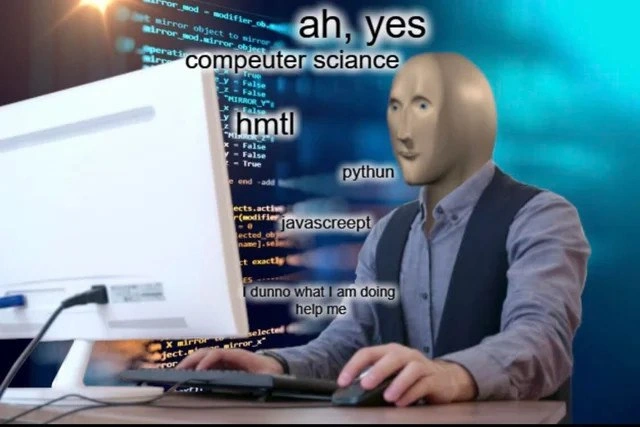
Imagine a little kid who puts on a big white lab coat and a stethoscope from a toy doctor set. He stands there in front of you very seriously and says, “Ah, yes, I am doing brain surjurry today.” He’s trying to act like a real doctor doing a complicated surgery, but he can’t even pronounce “brain surgery” correctly. It’s adorably funny, right? He looks the part with the coat and all, but you can tell he’s just pretending. That’s exactly what’s happening in this meme, but with programming. The funny bean-faced guy is like a kid playing dress-up as a computer expert. He’s sitting at a computer with real code glowing behind him (looking very important and techy), and he’s using big computer words – except he says them a little wrong, like “compeuter sciance” instead of computer science, and “javascreept” instead of JavaScript. He’s trying to seem like a pro coder, but those silly slip-ups give it away: he’s actually super confused and just learning. The line “dunno what I am doing help me” is like the kid whispering, “I actually have no idea how to do this!” to his parent. We find it funny and cute because we’ve all been that person learning something new, acting confident on the outside but honestly a bit lost. It’s like playing pretend – wearing the fancy outfit but not quite sure how it all works yet. And just as a parent would smile at the kid doctor’s made-up “surjurry”, experienced programmers smile at this meme because it reminds them of their own early days trying to code, messing up, and learning step by step.
Level 2: Spelling It Out
Let’s break down the tech terms and visual cues so it’s crystal clear. The meme scatters a bunch of intentionally misspelled programming terms around our befuddled character. Each of these corresponds to a real technology that beginners often learn about:
HTML – pronounced “H-T-M-L” – stands for HyperText Markup Language. It’s the standard language for creating web page structure. Think of HTML as the skeleton of a website, defining headers, paragraphs, links, etc. It’s usually the first thing you learn in web development. In the meme, it’s jokingly spelled “hmtl”. That typo is a wink to how beginners might fumble even with the acronym at first. Fun fact: if you actually wrote
<hmtl>instead of<html>in a file, the browser would be very confused! The misspelling here exaggerates the newbie’s lack of experience – they know HTML exists, but even the letters aren’t in the right order yet.JavaScript – a full-fledged programming language that runs primarily in web browsers to make websites interactive. For example, JavaScript is what makes buttons clickable and images slideshow on a webpage. It’s a step up in complexity from HTML, and many newbies dive into it right after learning HTML/CSS. The meme spells it as “javascreept”. This goofy spelling hints that the person might have heard of JavaScript but isn’t comfortable with it. (They might even be mixing up how it’s spelled or pronounced – sometimes newbies say “Java-scrap” or “Jaba script” by mistake.) JavaScript is infamous for tripping up learners with its syntax and quirks, so seeing it spelled wrong signals “I’m new to this language.” It’s like mispronouncing someone’s name because you just read it once online.
Python – a popular beginner-friendly programming language known for its clear syntax (it reads almost like English). Python is often recommended as a first language because you can do a lot with a few lines of code, from printing text to making simple games. In the image, we see the word “pythu” hovering near Meme Man’s head. Obviously, that’s “python” with a typo. This suggests our newbie tried out Python too (perhaps writing a quick
print("Hello World")script) and is proudly adding it to his mental list of skills – even though he can’t spell it right. It’s a humorous detail: he’s advertising “I know Python!” while literally misspelling Python. Imagine someone saying “I’m an expert at Pythom.” — it doesn’t inspire confidence, right? That’s exactly the joke.
Now, the phrase “computer science” (properly spelled) usually refers to the broad field of studying computers and computational theory – everything from algorithms and data structures to operating systems and beyond. It’s what you’d major in at college to learn how computers really work under the hood. In casual use, people say “computer science” just to mean “coding” or “programming” too. The meme deliberately writes it as “compeuter sciance”. Those spelling errors (“compeuter” with an extra e, “sciance” instead of science) immediately tell us the person using the term is naive. It’s like someone claiming to be an expert in a field but mispronouncing the field’s name – a dead giveaway that they’re not actually experienced. So when Meme Man proudly says “ah, yes, compeuter sciance”, it’s him acting like he’s got mastery over this big subject, while the misspelling lets us know he definitely does not.
The Meme Man character himself (that grey, smooth 3D face) is an internet-famous meme figure. He’s often used to represent a kind of clueless confidence or simplistic thinking. You might have seen him in other memes, like the famous “Stonks” meme about finance, where he personifies a goofy understanding of the stock market. Here, Meme Man is used perfectly to depict a novice programmer. His expression is neutral (almost deadpan) which adds to the comedy – he looks serious and composed even while spouting nonsense like “javascreept”. This contrast makes the scenario even funnier. It’s the digital equivalent of someone with a very straight face saying, “I am now an expert hacker man,” but they can’t even pronounce “hacking” right. The community loves using Meme Man for CodingHumor because he so perfectly delivers that “I have no idea what I’m doing, but I’ll act like I do” vibe.
In the background of the image, there’s a bluish wall of code. If you look closely, you’ll notice things like if statements and what appear to be function definitions or calls. For instance, you might see syntax resembling: if (x > 5) { ... } else { ... }. An if-else statement is a basic programming construct that executes different code depending on whether a condition is true or false (like “if I have coffee, then code energetically, else try to stay awake” 😅). A function call means some code is invoking a reusable block of code (the function) to do a specific task. This backdrop code gives the meme a “high-tech” atmosphere, kind of what a beginner imagines professional coding looks like – glowing text, complex logic everywhere (almost like the “Matrix” code waterfall vibe). To a newcomer, a screen full of unfamiliar code can feel overwhelming, almost magical. By placing Meme Man in front of it, the meme artist emphasizes how out-of-depth the character is. He’s literally surrounded by code he likely doesn’t understand. It’s as if on day one of learning, a person opened a massive source file from a real project and went “yep, I’m doing computer science!” while 99% of that code is inscrutable to them.
The text at the bottom, “dunno what I am doing help me”, is intentionally written in a panicky, lower-case style. That line is super relatable to anyone starting out in coding. Beginners often feel lost – they really “don’t know what they’re doing” and frequently search Google or ask more experienced friends for help. The meme combines this cry for help with the overconfident top text to highlight the contrast. It’s basically showing two sides of the beginner’s mind: the part that’s trying to appear on top of things (“I’m doing great, I totally get this computer stuff”) and the part that is internally screaming (“oh no, I have no clue, someone please show me what to do”). This duality is a hallmark of early learning experiences in tech. Imposter syndrome (feeling like “I’m fake and everyone will figure out I actually can’t code”) starts early and is captured perfectly by that small plea for help.
Let’s talk about beginner mistakes a bit. New developers often stumble on seemingly simple things – and that’s normal! For example, a tiny typo in code can break everything, and you end up scratching your head wondering why it’s not working. In the meme’s spirit of spelling errors, consider this little Python snippet a newbie might write:
# A beginner might try something like this:
message = "Hello, world!"
pritn(message) # Oops, typed 'pritn' instead of 'print'
# This will cause an error because 'pritn' is not a defined function.
# In programming, even one letter out of place (like swapping 't' and 'n') means the computer gets confused.
In Python (and most programming languages), you have to spell commands and keywords exactly right. Here, print is the correct command to display text. If you accidentally type pritn, the computer doesn’t intuitively know what you meant – it just throws an error like NameError: name 'pritn' is not defined. This is a classic beginner error and can be really frustrating the first few times. You quickly learn to double-check your spelling and syntax. Now relate this back to the meme: if our Meme Man can’t even spell “JavaScript” correctly, imagine what his code might look like! Probably full of red squiggly error lines and crash messages. But that’s how learning goes – through these mistakes.
The meme’s humor comes from exaggeration, but there’s truth in it. Everyone starts somewhere. The beginner’s journey in programming involves:
- Learning new terms (and often mispronouncing or misspelling them initially).
- Writing code and encountering bewildering errors (like the dreaded “SyntaxError” because you missed a semicolon or bracket).
- Feeling excited about small victories (getting a webpage to display “Hello!” in bold for the first time feels huge!).
- Feeling utterly confused when looking at more complex real-world code (a single page of someone else’s code can look like an alien language to a newbie).
All these feelings – pride, confusion, frustration, excitement – are mashed together in this meme. It’s a snapshot of a new coder’s reality. The terms “hmtl, javascreept, pythu” might seem silly, but they perfectly represent that messy first step where you have the enthusiasm of a budding developer, just not the accuracy or experience yet. And that’s okay! Ask any veteran programmer and they’ll have stories of the ridiculous misconceptions they had when they started (like thinking CSS was a programming language, or that you could learn C++ in a weekend).
In summary, the meme uses humor and misspellings to say: “Being new at coding is confusing and a bit comical – and we’ve ALL been there.” It’s part of the LearningToCode journey to go from writing gibberish to writing solid code. Over time, computer science terms that once seemed like magical incantations (“OOP”, “recursion”, “API”) become everyday vocabulary – but at the start, it absolutely feels like you’re just mashing the keyboard and hoping something works. This meme reassures us that feeling lost and shouting “I have no idea what I’m doing, help!” is a relatable dev experience. Hang in there – every expert was once a beginner who confused JavaScript with Java or thought HTML was spelled “HMTL”!
Level 3: Hello World Hubris
Every developer can recall that early-career phase of confident confusion. This meme nails it: a wide-eyed newcomer proudly declaring “ah, yes, compeuter sciance” while typo-riddled buzzwords float around. The grey-faced Meme Man in a business suit embodies the naive junior developer who’s learned just enough to sound techy, but not enough to avoid hilarious mistakes. The backdrop – a glowing wall of actual code (if-else logic and function calls) – contrasts sharply with the newcomer's muddled vocabulary (hmtl, javascreept, pythu). It’s a comedic collision between real programming and rookie posturing.
This image satirizes the learning curve at the start of a LearningToCode journey. The newbie knows a few terms like HTML, JavaScript, Python – but as the meme shows, just knowing the “words” isn’t the same as understanding. The misspellings (“hmtl” for HTML, “javascreept” for JavaScript, “pythu” for Python) scream I’ve heard of these, but I’m still figuring them out. For experienced devs, these errors are a relatable rite of passage. We chuckle because we’ve all been that person mixing up jargon, maybe bragging about making a “website” after one tutorial. It’s a form of Hello World hubris: after printing your first "Hello, World!", you momentarily feel like a coding genius… until reality hits.
That reality check is lurking in the meme too. The top text “ah, yes, compeuter sciance” oozes overconfidence, while the bottom plea “dunno what I am doing help me” exposes impostor syndrome and panic. This rollercoaster of bravado and self-doubt is too real. In one moment the junior dev is faking it (‘I totally got this’ energy), and the next they’re drowning in confusion. The humor here is how pronounced that gap is – literally spelled out in broken tech lingo. Seasoned devs recognize this as the Dunning-Kruger effect in action: a little knowledge can inflate confidence massively, right before the steep drop-off when you confront how much you don’t know. Our Meme Man is perched right on that peak of ignorant bliss (some tongue-in-cheek folks call it Mount Stupid 😅). He’s donned the figurative “expert” suit without realizing it’s a bit premature.
Why is this so universally funny among programmers? Because it pokes fun at a relatable dev experience: the early-days chaos when everything is new and nothing makes sense despite your “fancy” new vocabulary. It also lightly ribs the tendency to conflate computer science with simply coding a webpage. (Hint: knowing a bit of HTML doesn’t mean you’ve solved P vs NP or can build an operating system – a fact every junior eventually learns!). The meme’s absurd confidence (“Mastering compeuter sciance with hmtl and javascreept today!”) mirrors that moment a newbie proudly adds “HTML, Java, Python” to their résumé after a week of Codecademy. Coding humor like this resonates because developers remember the mix of excitement and total confusion from their first programs. Seeing someone type nonsense with a straight face triggers empathetic laughter: yep, I was there, thought I was a genius, then I broke everything.
On a deeper level, the meme hints at the imposter syndrome many beginners feel. The character is literally asking for help (“dunno what I am doing help me”) even as he pretends to have it together. In real life, junior devs often oscillate between telling their team “I got this” and secretly Googling every other line of code. The image of a serious-looking guy in front of a code-filled screen, spouting gibberish like “javascreept”, perfectly captures that frantic bluffing. It’s office attire and confidence on the outside, stack traces and self-doubt on the inside. Every senior engineer remembers mentoring a newbie who enthusiastically says they’ll build the feature by “just using some Python script in the HTML”, and then watching them struggle. The humor isn’t mean-spirited – it’s affectionate. We’ve all faceplanted at the start. This meme is essentially the dev community laughing with juniors, not at them, saying: “It’s okay, we’ve been confused too – welcome to the club!”
Description
A classic 'Meme Man' (also known as the 'Stonks' guy) surreal humor meme. The image depicts the smooth, bald, 3D character, Meme Man, sitting at a desk with a white monitor and keyboard, looking confidently towards the screen. The background is a stylized, blurry image of code scrolling by on a blue-tinted screen. Overlaid on the image are several intentionally misspelled labels in white text with black outlines. Above Meme Man's head it says, 'ah, yes'. To his right, floating over the code, are the words 'computer sciance', 'hmtl', 'pythun', and 'javascreept'. Near the bottom of the screen, another label reads, 'i dunno what i am doing help me'. The humor comes from the juxtaposition of Meme Man's confident, knowing expression with the grossly misspelled technical terms and the final admission of cluelessness, perfectly capturing the feeling of imposter syndrome or a beginner trying to fake their way through a technical conversation
Comments
15Comment deleted
The classic junior developer stack: copy, paste, and pray, all while confidently telling the senior dev 'yeah, I'm pretty sure I know what the problem is.'
Code review today: the junior misspelled every file as “hmtl” and “javascreept” - I almost approved it anyway, just so Git history could immortalize the moment our build pipeline proved it will happily compile anything except judgment
This is what happens when you tell the junior dev they need to be 'full stack' by Friday - they achieve quantum superposition between understanding everything and nothing simultaneously, existing in a state that would make Schrödinger's cat feel relieved it only had two options
The three stages of web development mastery: confidently misspelling 'computer sciance' in your LinkedIn headline, importing libraries you don't understand, and finally achieving enlightenment when you realize everyone else is also just frantically Googling 'how to center a div' at 2 AM while maintaining that same serene Meme Man expression in standup meetings
Eventual consistency, but for naming: javascreept will become JavaScript right after pythu stops calling hmtl
My production-readiness check is simple: if you spell it “javascreept,” RBAC sends your PR to /dev/null and CI offers you onboarding docs
Ah yes, CS fundamentals: HTML for structure, Python for glue, JS for async regret - who needs pointers when you've got callbacks?
just learn powershell & bash and you can do anything (badly) Comment deleted
just learn assembler and you can do everything Comment deleted
just learn javascript and you can do it on every computer (badly) Comment deleted
Everyone don't want to write frontend on Assembler Comment deleted
s/\s\S+// Comment deleted
А то, что у него в левой руке мышка никого не смутило вообще? Comment deleted
Вот это уже не норма Comment deleted
Определённо Comment deleted