Skip to content
DevMeme
2107 of 7435
Low Light, High False Positives
AI ML Post #2355, on Nov 24, 2020 in TG

Low Light, High False Positives

Why is this AI ML meme funny?

Level 1: The Dark Room Guess

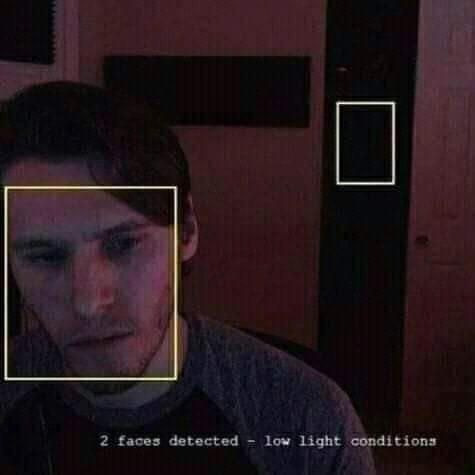
This is like playing “I spy” in a dark room. You can see your friend’s face, but then you also think a coat hanging in the corner might be another person. The computer is making that same mistake: it found the real face, then got fooled by a shadow. The funny part is how serious and confident the box looks while pointing at nothing.

Level 2: Confidence Problems

A false positive means software reports something is present when it is not. Here, the actual visible face is detected with one box, but the second box appears over a dark vertical area where no clear face is visible. That second box is the false positive.

Face recognition and face detection are related but different. Detection answers, “Is there a face here?” Recognition asks, “Whose face is it?” This meme is about detection: drawing boxes around areas that resemble faces. Many systems first locate possible faces, then pass those cropped regions to another system for identification.

Low light conditions matter because images are data. A camera in a dark room captures fewer useful details, and the missing detail gets replaced by grain, blur, blocky compression, and weird contrast. To a person, the white box on the right looks like an empty dark rectangle. To a detector, it may contain just enough edge and shadow structure to resemble facial features.

For junior developers, this is the lesson hidden under the joke: software often fails at the boundaries of its assumptions. The classifier was probably tested on images where faces were visible, reasonably lit, and similar to the examples it learned from. The meme shows what happens when input quality gets worse but the program still has to output an answer. It does not say “I am unsure and scared of the hallway.” It draws a box.

Level 3: Shadows as Users

The image shows a classic computer-vision indignity: a yellow rectangle correctly surrounds the visible human face, while a white rectangle confidently frames a dark, empty-looking patch in the doorway. The caption says:

2 faces detected - low light conditions

That is the whole joke, and also a pretty good incident report. A face detector is not actually “seeing a face” the way a human does. It is evaluating visual patterns: contrast around eye-like regions, nose-like geometry, edge arrangements, texture gradients, and whatever features its training or hand-tuned pipeline considers meaningful. In low light, the image loses clean detail and gains noise, compression artifacts, and harsh contrast. Suddenly a rectangular shadow can become “close enough” to the detector’s idea of a face. Congratulations, production has onboarded a doorway.

The humor lands because the software is simultaneously correct and very wrong. It finds the real person, so the system seems competent. Then it draws a second box around darkness, which exposes the brittle middle ground of pattern recognition: models do not need to understand a scene to make a prediction. They only need enough signal to pass a threshold. In an application with higher stakes, that threshold becomes the difference between a harmless false positive and a support ticket with the words “security camera thinks my closet is alive.”

This is the part experienced developers recognize from every AI/ML feature that looked brilliant in a clean demo. The model performs well under controlled lighting, centered subjects, known camera quality, and friendly examples. Then real users arrive with dim rooms, smudged lenses, strange angles, overcompressed uploads, half-lit faces, and backgrounds that accidentally resemble training data. The bug is not just “bad algorithm”; it is the gap between lab conditions and deployment conditions.

Debugging this kind of issue is miserable because the fix is rarely a single line. You can tune confidence thresholds, improve preprocessing, add denoising, require temporal consistency across frames, collect harder negative examples, or retrain with low-light data. Every option has trade-offs. Raise the threshold and you miss real faces. Lower it and the doorway gets promoted to user. Add preprocessing and you may smooth away details the detector needs. The meme is funny because the system is doing exactly what it was asked to do, just with the haunted confidence of software that has never paid rent in the real world.

Description

A dim webcam-style photo shows a man seated in a dark room, with a yellow detection box correctly drawn around his face and a white detection box incorrectly drawn over a dark rectangle in the doorway. The caption at the bottom reads, "2 faces detected - low light conditions." The joke is about computer vision systems confidently identifying nonexistent faces when lighting, contrast, and noisy input data degrade feature detection.

Comments

9
Anonymous ★ Top Pick The classifier found a second face in the shadows because apparently even Haar cascades get anxious during demos.
  1. Anonymous ★ Top Pick

    The classifier found a second face in the shadows because apparently even Haar cascades get anxious during demos.

  2. @obemenko 5y

    That's not a bug, that' s a feature

    1. @maxgraey 5y

      new features: - ghosts & evil spirits detector

  3. @zakharm1704sykhiv 5y

    jerma

  4. @Nsky24 5y

    😂😂

  5. Ievgen 5y

    ghost was training model to recognize his buddies detected unexpected human died again

  6. @Withouthatewithoutfear 5y

    Opencv

    1. Deleted Account 5y

      However much I read up on image recognition I never understand it

  7. @brbrmensch 5y

    jerma looking at this meme be like

Use J and K for navigation