The Eternal Wait for the Last Bug Fix
Why is this Bugs meme funny?
Level 1: Just a Minute
Imagine your dad is fixing your toy and he says, “Just one more minute, I almost got it.” You sit and wait... and wait... and that one minute turns into an hour. You even start feeling like you might grow old waiting! This meme is joking about that exact feeling. In the picture, a young woman says her friend has one little problem left to fix. But then the joke is that we see her again as a grandma, saying she’s still waiting. It’s a funny way to show how a quick promise (“I’ll be done really fast!”) can take a super long time. We laugh because we all know what it’s like when someone says “almost done!” and we end up waiting forever. The meme makes a silly, exaggerated point: fixing a little problem (a bug in computer code) wasn’t quick at all — it took so long that the person waiting felt like they aged a lifetime. It’s humor we can all understand, because nobody likes waiting much longer than they were told, right?
Level 2: The Last Bug Myth
Let’s break this down in simpler terms. In software, a bug is a mistake or flaw in the code that makes a program do the wrong thing. Debugging (also called troubleshooting) is the process of finding and fixing those mistakes. When a programmer says they have “just one more bug” to fix, it sounds like they’re almost done. It’s like saying, “I just have one small problem left to solve, then everything will work.”
But anyone who’s written code – even beginners – soon learns that fixing one bug can unexpectedly turn into fixing many bugs. Why? Sometimes that one error is hiding other errors, or the fix for it causes something else to break. It’s a bit like pulling a loose thread on a sweater: you think it’ll be a quick tug, but you end up unraveling a much bigger tangle. 🧶 For example, imagine your game has a bug that the score isn’t updating. You go in to fix that one line of code… and then suddenly discover the timer is now off, or the fix revealed that the score wasn’t updating because of a deeper issue in how points are calculated. One small fix led you to three more things that needed fixing. This is a common source of DebuggingPain for new developers: a task you thought would take 5 minutes eats up your whole afternoon.
Now, consider deadlines – those due dates or promised times by which work should be completed. When a developer confidently says “I just need a few more minutes to fix this last bug,” stakeholders (like managers, or a friend waiting for you to finish work) might relax, thinking the project will be wrapped up shortly. But if that bug fix uncovers more problems, those extra minutes stretch into hours or days. The developer misses the deadline, and everyone waiting is disappointed or frustrated. This is a classic scenario in software projects: we often underestimate how long bug fixing will take. There’s even a jokey saying about software schedules: “the first 90% of the code takes 90% of the time… the last 10% (which includes all the bug fixes) takes another 90%.” In short, finishing that “last bug” often takes way more time than anyone expected.
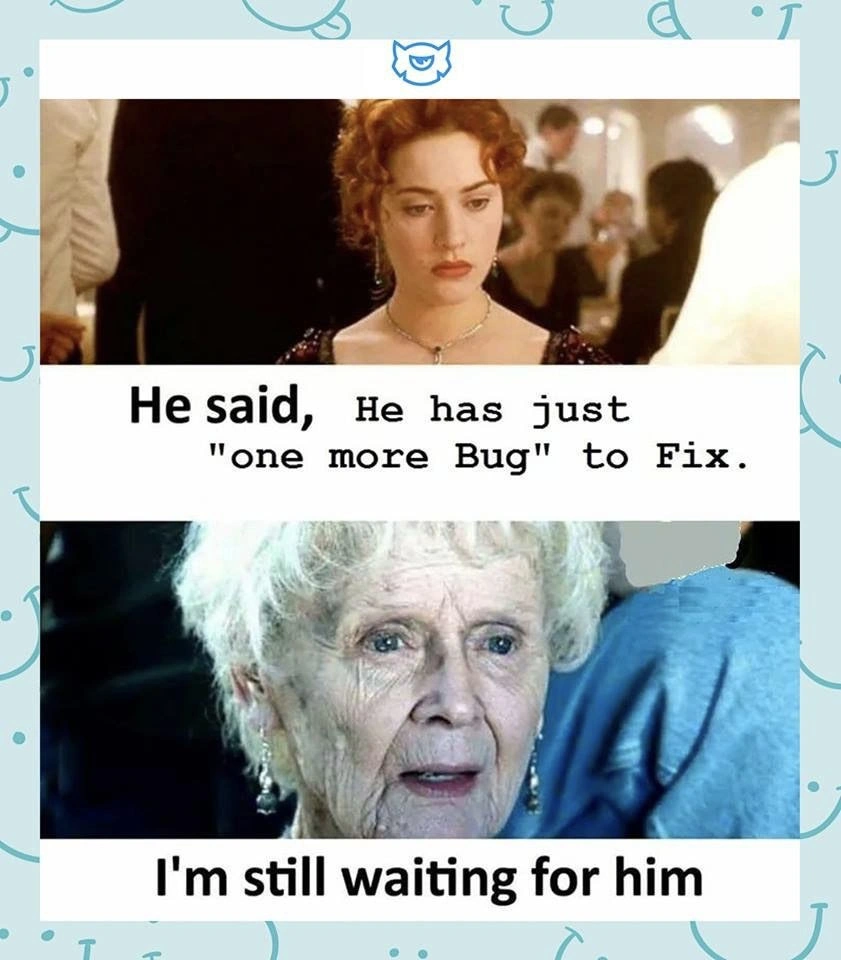
The meme in question uses a famous movie scene to illustrate this in a funny way. The images are from the film Titanic. In the first image, a young woman (Rose from Titanic) is all dressed up at a dinner, and the caption says: He said he has just “one more bug” to fix. In the second image, the same woman is shown as a very old lady, with the caption: I’m still waiting for him. It’s exaggerating that a person waited practically a lifetime for someone to finish fixing that “one last bug.” Of course, in reality no bug takes 80 years to fix, but it sure feels like forever when you’re waiting on a fix that was supposed to be quick!
For a junior developer or anyone new to coding, the takeaway is: time estimates in programming can be very unreliable, especially for debugging. A bug that seems simple can hide complicated issues. That’s why this meme is both funny and relatable. It’s common to tell your friend or family “I just need 5 more minutes to solve this,” only to have them check on you an hour later and find you still hunched over the screen. Everyone who’s written code has experienced that moment where “one more bug” turns into a series of mini-adventures in problem-solving. This meme humorously warns: don’t be surprised if “just a minute” in programmer-speak sometimes means “I have no idea how long this will actually take.” It’s all part of the learning process in debugging and troubleshooting code.
Level 3: The 84-Year Bugfix
This meme cleverly exaggerates a scenario every developer knows too well. It uses scenes from Titanic to poke fun at the chronic underestimation of debugging time. In the top panel, a young Rose (Kate Winslet) is at a fancy dinner, captioned with the promise “He said he has just one more bug to fix.” In the bottom panel, Rose is a 100-year-old woman (from the end of the movie) saying “I’m still waiting for him.” The joke lands because in software development, “just one more bug” often feels like an infinite wait – a quick fix turns into a lifetime debugging session.
Seasoned developers smirk at the phrase "one more bug," because it’s practically famous last words in our industry. Why is it so funny and painfully true? Because debugging is notoriously unpredictable. That one tiny bug could be hiding a Titanic-sized trove of problems beneath the surface. In other words, what looks like a fast fix can sink your evening – or your whole sprint. This meme nails that shared DebuggingFrustration by showing someone aging dramatically while waiting for a fix that was "almost done." It’s dark humor born from real experience: we've all told a teammate or loved one “give me 5 more minutes” and watched those minutes turn into hours.
Let’s break down why “one more bug” so often spirals into an epic delay:
- Hidden Complexity: That final bug is often just the tip of the iceberg. The visible error might be a symptom of a deeper logic flaw or multiple issues entwined in the code. Fixing what looks like a small glitch can uncover a dozen related bugs lurking beneath the surface. It’s like thinking you saw one cockroach, but when you turn on the light there’s a whole colony scurrying around – unpleasant surprises everywhere.
- Cascade Effects: Code is interconnected like a giant puzzle, so fixing one piece can break another. A quick change meant to solve the bug might introduce a new bug or revive an old one. (Ever play whack-a-mole? 👿 Squash one mole, two more pop up.) For example, you patch a function to stop a crash, but now a different feature starts misbehaving because of that patch. These ripple effects turn a simple bug fix into a game of bug whack-a-mole, where you’re chasing issues around the system.
- Optimistic Estimates: Developers, under pressure from Deadlines or hopeful to call it a day, often wildly underestimate debugging time. We say “it’ll only take a minute” with the best intentions, but reality laughs at our optimism. There’s even a sardonic rule about this: Hofstadter’s Law – It always takes longer than you expect, even when you take into account Hofstadter’s Law. In practice, the “one last bug” that we thought was a 10-minute fix often balloons into an all-nighter. (The classic 90/90 rule sums it up: The first 90% of the code accounts for the first 90% of development time, the last 10% of the code accounts for the other 90% of time. 😅 That last 10% is mostly testing and bug fixing, which never goes as fast as you hope.)
After wrestling with hidden complexities and cascade failures, that quick fix isn’t quick at all. The result? The person waiting for the deploy or the promised free time feels like they’ve aged decades. It’s a SharedPain in coding culture: whether it’s a project manager tapping their foot or a spouse who’s heard “one more bug” too many times, everyone ends up feeling the drag of that infinite debug loop. The meme’s punchline – an old woman saying “I’m still waiting” – resonates because we’ve all been there. It’s hilarious and a little tragic: debugging has no respect for your plans. As any battle-scarred engineer knows, “one more bug” usually means buckle up, we’ll be here a while. The code will get fixed eventually, but by then, like Rose, you might be whispering “It’s been 84 years…” in spirit.
Description
A two-panel meme that uses the 'Waiting' or 'It's Been 84 Years' format from the movie Titanic. The top panel shows a still of young Rose DeWitt Bukater looking sad and concerned, with the text: "He said, He has just 'one more Bug' to Fix." The bottom panel shows a still of the elderly Rose, looking weary and melancholic, with the caption: "I'm still waiting for him." The meme is set against a light blue, patterned background. This is a classic piece of developer humor that plays on the notorious unreliability of the phrase 'one more bug.' For any seasoned engineer, this statement is a red flag, as a seemingly minor bug can often unravel into a complex series of underlying issues, leading to a prolonged and frustrating debugging session that can last for hours, days, or, as the meme hyperbolically suggests, a lifetime

Comments
9Comment deleted
The 'one more bug' is a recursive function with no base case
He vanished to add one “quick” null check - four architectures, eight CTOs, and a monolith-to-microservices migration later, the only thing released on schedule was my retirement date
After 20 years in the industry, I've learned that 'one more bug' is actually a recursive function with no base case - it spawns two more bugs for every one you fix, and the only exit condition is retirement or switching to management
This meme perfectly captures the heat death of the universe timeline for fixing 'just one more bug' - a phrase that strikes existential dread into the hearts of project managers and stakeholders alike. Every senior engineer knows that bug fixes follow the Hydra principle: fix one, and two more emerge from the depths of your legacy codebase. The real tragedy isn't the Titanic sinking; it's realizing that 'one more bug' was actually a race condition that only manifests in production under specific load conditions on Tuesdays during a full moon. By the time you've traced it through six microservices, added observability, reproduced it locally, and discovered it was caused by a dependency three layers deep that changed its behavior in a patch release, you've aged exactly as shown. The most unrealistic part of this meme? That someone is still waiting - usually they've pivoted to a complete rewrite in a different tech stack by then
Refactored promise: from 'I'll be right back' to 'async/await(oneMoreBug).then(neverResolve)' - the eternal hang of JS debugging
“One more bug” is the halting problem wrapped in a Jira ticket - undecidable until after the code freeze
In a tightly coupled monolith, ‘one more bug’ is a recursive call with no base case - time complexity: O(backlog_years)
Admin respects people with slow internet) Comment deleted
I just noticed now that this is from titanic Comment deleted