Skip to content
DevMeme
2961 of 7435
When Agile is Just Waterfall with Sprints
Agile Post #3271, on Jun 17, 2021 in TG

When Agile is Just Waterfall with Sprints

Why is this Agile meme funny?

Level 1: Opposite Day at Work

Imagine you have a big school project and your teacher says, “Try a new approach: do a little bit of it each day and we’ll see how it’s going as we go along.” That’s the idea of being agile – working step by step and adjusting if needed. But now picture that, despite saying you’ll do that, you actually don’t do anything until the last minute and then rush the entire project in one go right before the deadline. That’s the old waterfall way – doing everything all at once at the end. This meme is funny because the person is basically claiming they’ll use the first approach (the flexible, bit-by-bit way) but ends up doing it the second way (the big all-at-once way). It’s like saying “I’ll clean my room a little every day” and then only cleaning it in one big sweep after a month of ignoring the mess. We can tell that’s silly, right? In the same way, the meme is joking about someone talking about using a quick, flexible method at work but actually behaving in the slow, do-it-all-at-once style. It’s an “opposite day” kind of joke: what they say and what they do are complete opposites, and that’s why it makes people who know the situation grin.

Level 2: Agile vs Waterfall 101

Let’s break down the basics behind this joke. Agile and Waterfall are two different approaches to building software in project management. Waterfall is the old-school method: it’s like a straight line of phases – first you gather all the requirements, then do all the design, then all the coding, then all the testing, and finally you deliver the product. Each stage flows into the next (like a waterfall) and once you finish a phase, it’s hard to go back. This waterfall_model is very rigid: imagine writing a 100-page plan at the start and then just following it step-by-step with no changes.

Agile, on the other hand, is a newer, more flexible approach. Instead of one big pass through all the steps, Agile breaks the work into small cycles (often 1-2 weeks long) called sprints. In each sprint, a team plans a bit of work, builds and tests it, and tries to have a small working piece of software by the end. Agile emphasizes being able to respond to change. For example, if the customers’ needs change or something isn’t working, the team can adjust in the next sprint instead of waiting till the very end. Scrum is a popular Agile framework that introduces specific ceremonies (structured meetings) like a daily stand-up (a quick team check-in each morning to share updates), sprint planning (to decide what to do in the next sprint), and retrospectives (to discuss how to improve). The key idea: Agile is iterative and incremental – build a little, learn, adjust, repeat – rather than “plan everything then build at once.”

Now, the meme is poking fun at when people say they’re doing Agile but aren’t actually being agile. The text joke “I do it like Waterfall” means that even though the team claims to use Agile process, they’re really following the Waterfall approach under the hood. This could happen if, for instance, a company holds all the Agile meetings but still demands a detailed plan up front and only delivers the product after many months. There’s even a term for this hybrid mishmash: “Water-Scrum-Fall.” In Water-Scrum-Fall, you might start with a big Waterfall-style requirements phase, then do some Scrum sprints in the middle, and end with a Waterfall-like long integration and release phase. It’s basically pretending to be Agile while behaving like Waterfall.

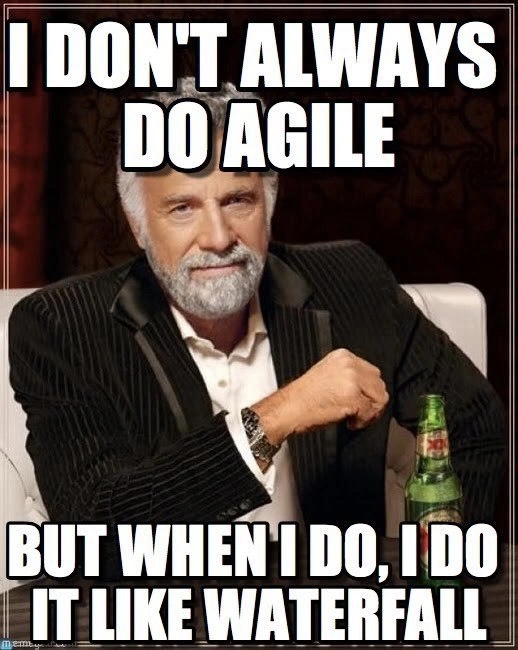
The image used is the “Most Interesting Man in the World” meme template – a famous silver-haired gentleman from a beer advertisement. Internet memes with him usually say, “I don’t always do X, but when I do, I Y.” It’s a way to make a tongue-in-cheek boast or joke. In this case, he’s joking that he doesn’t use Agile often, but when he does, he uses it incorrectly (like Waterfall). For a newcomer, the humor is about the contradiction: Agile is supposed to mean “we work in quick, adaptive cycles,” so doing Agile “like Waterfall” means the person is completely missing the point. It’s a lighthearted jab at teams or managers who use all the Agile buzzwords and rituals but still run projects in a slow, rigid way. Developers find it funny because it’s a common real-world headache – being told you’re doing modern Agile, yet feeling like you’re stuck in an old-fashioned Waterfall project.

Level 3: Agile in Name Only

This meme nails a classic AgilePainPoints scenario in software teams: they claim to be doing Agile but run things in a strict Waterfall way. It's essentially calling out Water-Scrum-Fall – when an organization rebrands a waterfall-style SDLC as “Agile” by sprinkling a few Scrum ceremonies on top. Seasoned developers recognize this immediately: the project is supposed to be iterative and flexible, yet everything still happens in fixed sequential stages.

In real life, this looks like a cargo cult of Agile practices. Teams hold daily stand-up meetings, do sprint planning, and maybe even call their manager a Scrum Master, but nothing fundamentally changes from the old waterfall_model. All requirements are locked in up front, every “sprint” ends with slide decks instead of shippable code, and deployment only happens at the very end of a long cycle. It’s Agile in name only – a parody of the methodology. The humor here comes from painful truth: so many of us have been through “Agile transformations” that were just waterfall with extra steps.

Why is it funny? Because we’ve all heard leadership proudly declare, “We’re an Agile shop now,” while still demanding a year-long Gantt chart and a fixed scope. The Most Interesting Man meme format drives the joke home: “I don’t always do Agile, but when I do, I do it like Waterfall.” It’s the voice of a jaded veteran joking that whenever they attempt Agile, it ends up being the same old Waterfall process anyway. The contrast is hilarious and frustrating at the same time. It highlights an industry-wide anti-pattern: ceremony over substance. The only thing agile in these environments is how quickly they rebrand traditional milestones as “sprints.” Everyone gets the joke because they’ve lived it – the stand-ups that feel like status meetings, the “sprints” that deliver nothing until a big bang release, and the retrospectives where nothing ever changes. This meme speaks to the collective déjà vu of developers who’ve seen Agile turned into a buzzword, and it’s both funny and a little tragic because it’s true.

Description

A classic meme using the 'The Most Interesting Man in the World' format. The image features a dapper, gray-bearded man in a suit, sitting at a table with a bottle of beer. The text, in a bold, white, impact font, is superimposed over the image. The top line reads, "I DON'T ALWAYS DO AGILE," and the bottom line says, "BUT WHEN I DO, I DO IT LIKE WATERFALL." This meme humorously critiques a common corporate anti-pattern where organizations adopt the terminology of Agile (like 'sprints' and 'standups') but fail to embrace its core principles of iterative development and flexibility. Instead, they continue to operate with a rigid, sequential Waterfall mindset, creating a dysfunctional hybrid often called 'Wagile' or 'Scrum-fall.' For experienced developers, this is a deeply relatable frustration, mocking the 'process theater' that prioritizes buzzwords over genuine improvement in the software development lifecycle
Comments

7
Anonymous ★ Top Pick We're so agile we plan our two-week sprints six months in advance and have a change advisory board to approve any deviation. It's the pinnacle of iterative design
  1. Anonymous ★ Top Pick

    We're so agile we plan our two-week sprints six months in advance and have a change advisory board to approve any deviation. It's the pinnacle of iterative design

  2. Anonymous

    We’re so ‘Agile’ we estimate in story points, convert them to hours, bolt them to a Gantt chart, and call the daily status meeting a stand-up - Waterfall in a hoodie

  3. Anonymous

    After 20 years in enterprise software, I've discovered the secret: every 'Agile transformation' is just Waterfall with more meetings, sticky notes, and a Jira board that somehow makes everything take longer than the Gantt charts we swore we'd never use again

  4. Anonymous

    Ah yes, the classic 'Agile transformation' where we keep all the Waterfall gates, approvals, and six-month planning cycles, but now we call our status meetings 'standups' and our Gantt charts 'sprint boards.' Nothing says 'embracing change' quite like requiring a change request form, three levels of approval, and a full regression test cycle before moving a story from 'In Progress' to 'Done.' At least the beer helps during those four-hour sprint planning sessions where we meticulously plan the next two weeks while pretending we're not locked into the architecture decisions made eighteen months ago

  5. Anonymous

    Our SAFe rollout is so ‘agile’ the PM added daily standups to the Gantt chart and wedged the change‑control board between sprint review and release - velocity stays green, delivery stays quarterly

  6. Anonymous

    Enterprise Agile: fixed scope, fixed date, fixed budget - just sliced into 26 sprints so the Gantt fits in Jira

  7. Anonymous

    Agile so iterative, our sprints cascade straight into Gantt chart oblivion

Use J and K for navigation