Skip to content
DevMeme
1399 of 7435
The Dunning-Kruger Effect of a 'Simple' Task
Debugging Troubleshooting Post #1572, on May 12, 2020 in TG

The Dunning-Kruger Effect of a 'Simple' Task

Why is this Debugging Troubleshooting meme funny?

Level 1: What Could Go Wrong?

Imagine you have a tall tower of building blocks. One block near the bottom is a little crooked. You think, “This will be easy, I’ll just fix that one block real quick.” You feel happy and confident as you start. But when you pull the crooked block out, uh-oh! the tower starts to wobble and a bunch of other blocks come tumbling down. Now the simple little fix has turned into a big task — you’re on the floor, gathering pieces, trying to rebuild half the tower while feeling totally frustrated.

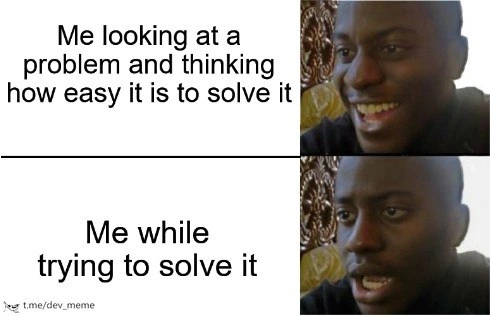
This is exactly what’s happening in the meme, but with coding. The first picture is like you thinking the block will be easy to straighten (feeling confident 😃). The second picture is like the moment the tower collapses and you’re surrounded by fallen blocks (feeling upset 😧). It’s funny and relatable because we’ve all been there: sometimes what seems super simple at first can end up being much more complicated. The meme uses this two-picture story to remind us of that feeling when something easy suddenly goes wrong and becomes a big problem. It’s a little joke that says, “Next time you ask ‘what could go wrong?’, remember it might be more than you think!”

Level 2: Hidden Complexity 101

Explained (Junior Dev Perspective):
At first glance, the meme shows a classic expectation vs. reality scenario that every programmer encounters. The two-panel format is a common meme style: the top panel shows the expectation (feeling confident, “This will be easy!”), and the bottom panel shows the reality (feeling frustrated, “Why is this so hard?”). Both panels use the same person’s face but with different expressions – in the first, he’s happy and excited; in the second, he looks shocked or worried. This contrast is exactly how a developer’s mood changes before and after they actually start coding a “simple” solution.

Let’s break down the terms and concepts here:

  • Debugging & Troubleshooting: These are the processes of finding and fixing problems (bugs) in your code or system. In the meme, when the person “tries to solve it,” they are deep in debugging mode. At first they thought they wouldn’t need much debugging at all – the fix seemed obvious. But as they troubleshoot, they likely run into errors or unexpected behavior. This causes that spiral of despair. Debugging often involves going through code line by line, checking values with print statements or a debugger tool, and figuring out why the program isn’t doing what you expected. It can be time-consuming and tricky, especially when the bug’s cause is not where you initially thought.
  • Hidden Complexity: This refers to all the complicated stuff beneath the surface that you didn’t anticipate. In software, a task that looks straightforward can have a lot of hidden complexity. For example, you might think adding a simple check (like if user is not null, then proceed) is easy. But maybe that user data comes from another service that sometimes fails, or perhaps a “simple” change triggers a chain reaction in other parts of the program. That’s hidden complexity. The meme’s bottom panel text “me while trying to solve it” implies the person has discovered unexpected complications while coding. In real life, you might find that fixing one bug reveals others: maybe the function you’re working on wasn’t handling edge cases (uncommon scenarios) correctly, and when you add a fix for one scenario, another scenario breaks.
  • Developer Expectations vs. Reality: This is a common theme in programming jokes. We often plan tasks thinking they’ll go smoothly (expectation), but when we actually implement them, we face roadblocks (reality). In the meme, the expectation was solving this problem will be a breeze. The reality became debugging is taking forever and nothing is working. This mismatch is DeveloperFrustration in a nutshell. Many junior developers start a task thinking “I know how to do this, it’s straightforward,” only to later realize there were a lot of details and gotchas they didn’t know about. It’s a normal part of learning: the more you code, the more you realize that even simple problems can have tricky parts.
  • Overconfidence Bias: This is a psychology term (also relevant in tech) for when someone is too sure of their abilities or the outcome. In a developer context, overconfidence bias might make you think you can fix a bug in 10 minutes because it seems obvious—like assuming you fully understand the code at first glance. The meme’s top caption “thinking how easy it is to solve it” is exactly this – the developer is overconfident before starting. Then reality hits and shows that confidence was premature. For a junior dev, it’s important to learn that being cautious and double-checking assumptions is good. Everyone falls for naive_estimation at times – that’s when you estimate work without accounting for the unknown complexities. Over time, you get better at guessing and always leave some wiggle room because surprises happen.
  • Real World Complexity: In school or tutorials, problems are often simplified. But in the real world, code runs in complex environments. There are things like different user inputs, network issues, performance considerations, legacy code (old code that nobody wants to touch), etc. These factors can turn a simple task into a complicated one. For example, suppose you need to fix a typo on a website. Easy, right? But then you realize the text comes from a database, which is down, or updating the text requires redeploying the entire application. Or you fix the typo but break a test case because the test expected the old text. Suddenly a 1-minute text change can take an hour. The meme’s second panel (the despairing look) represents that “oh no…” moment when a developer hits one of these real-world snags.
  • Meme Context (Why It’s Relatable): The image itself, with the split panels, is a common way to highlight before and after feelings. The fact that the person’s face is blurred but clearly going from happy to distressed is exactly how it feels internally to a programmer. The watermark t.me/dev_meme suggests this image is from a developer meme channel, meaning it’s content made by devs for devs. The reason this got shared is because it captures a frequent experience in a funny way. Every developer has had that quiet moment of frustration (often alone at their desk, probably with some debug console open) where they think “Why is this not working? It was supposed to be easy.” That’s the CodingFrustration the tags mention. It’s almost comforting to see it in a meme, because you realize it’s not just you — it’s a universal part of coding.

In simpler terms, the meme is teaching a little lesson: don’t underestimate problems. It highlights how naively planning a software fix can lead to surprise difficulties. For a newcomer, the takeaway is that it’s normal for tasks to become more complicated once you dive in. When you start coding something, you often uncover details that weren’t obvious at first. So if you ever catch yourself super excited that a bug will be solved in a snap, remember this meme. It’s a gentle reminder (with humor) that you should be prepared for the unexpected and that debugging is a skill of patience. The top caption is the confidence we all feel at the start, and the bottom caption is the humility we gain by the end. This shared experience across developers is why this meme resonates and why it lives under categories like Debugging_Troubleshooting (solving problems in code) and DeveloperProductivity (because misjudging difficulty can really mess with your productivity and schedule!). In short, hidden complexity is always lurking, and this meme captures that lesson in one quick visual joke.

Level 3: Simple Fix Trap

Deep Dive (Senior Dev Perspective):
This meme hits on a universal truth in software development: a “simple fix” is almost never simple. In the top panel, our developer confidently thinks the problem will be easy — perhaps just a one-line change. In the bottom panel, reality hits: the same developer’s face goes from optimistic grin to a wide-eyed look of quiet panic. Every seasoned programmer has experienced this exact arc from overconfidence to despair while debugging.

Why is this so funny (and painful)? Because it satirizes the classic DeveloperExpectationsVsReality scenario. We’ve all strolled into a task thinking “I’ll be done in 5 minutes, what could go wrong?” – only to end up knee-deep in a HiddenComplexity swamp for hours. This meme captures that overconfidence bias in the first frame, and the coding frustration in the second. The humor lands because it’s too real: the contrast between how simple something appears and the complicated truth under the hood.

Let’s unpack the technical reality behind that frozen, panicked stare in the bottom panel:

  • Edge Case Avalanche: Often a “small” bug fix unearths a cascade of unforeseen issues. You change one thing, and five new failing unit tests pop up. That one-liner fix might break a subtle assumption elsewhere in the code. It’s like a Hydra: cut off one bug’s head, and two more edge cases sprout. The codebase had hidden interconnected parts—one tweak and suddenly everything is on fire. No wonder the second frame’s smile is gone!
  • Underestimated Complexity: The meme tags mention naive_estimation and MisalignedExpectations. This refers to how we consistently underestimate tasks. Maybe the developer thought the bug was a simple null check issue, but actually it traced back to a deeper design flaw or a race condition. Oops. A senior dev reading this will nod knowingly: yep, been there, underestimated that. We call it the “simple fix” fallacy—assuming a quick patch will solve it, when in reality the problem is tangled in a web of complexities.
  • Real-World Complexity vs Theory: In theory, your plan made sense. In reality, systems have messy details: database constraints, API quirks, legacy code, technical debt that turns any change into Jenga. The meme highlights RealWorldComplexity biting back. For example, a seemingly straightforward UI bug might actually involve asynchronous calls, state management issues, and a timezone glitch (because of course timezones ruin everything). That bottom-panel expression? It’s the look of a developer discovering that “simple” fix spans multiple modules and maybe an unexpected database migration.
  • Silent Debugging Spiral: Notice the meme says “silent debugging spiral of despair.” The developer isn’t ranting; they’re quiet, staring at the screen, probably internally screaming. This is a hallmark of real debugging sessions: hours of tracing through logs and stack traces in silence, as confidence drains away. The top image’s happy face thinks they’ll be super productive (hello DeveloperProductivity optimism). The bottom face knows they’ve sunk half a day into troubleshooting with nothing to show. That silent stare often includes a loop of internal monologue: “Why isn’t this working? This makes no sense… What did I break now?!”
  • Shared Trauma & Humor: The reason developers find this meme hilarious is the shared trauma. It’s practically a rite of passage to promise a simple fix to your team or manager, and then suffer as it morphs into a multi-day debugging saga. The joke is on our overconfidence bias – we laugh to keep from crying. Senior engineers have war stories of “tiny” code changes bringing entire systems down (yes, deploying on Friday 5 PM, I’m looking at you!). This meme’s popularity in dev circles (note the dev_meme watermark) shows how cathartic it is to commiserate. We’ve all had that exact facial transition from “I got this 😃” to “I’m in trouble 😧” while chasing a bug through endless function calls.

In summary, the humor works on multiple levels: it’s a funny visual contrast, but also a biting commentary on the hidden complexity in coding tasks. It subtly educates newer developers (through pain and laughter) that no task is truly trivial until it’s finished. A veteran coder reading the top text “how easy it is to solve it” will smirk and think, “Oh you sweet summer child… brace yourself.” And the bottom text “Me while trying to solve it” – that hits home, recalling long nights hunched over the keyboard as a “quick fix” spirals out of control. The meme perfectly encapsulates the debugging troubleshooting journey from cocky start to humbling finish. It’s funny because it’s true: in programming, reality checks come fast and hard, and even a “simple fix” can lead you down the rabbit hole of a silent, desperate debug session.

Description

A two-panel meme that contrasts expectation with reality in problem-solving. Each panel has text on the left and a corresponding reaction image on the right, featuring a close-up of a Black man's face. In the top panel, the text reads, 'Me looking at a problem and thinking how easy it is to solve it'. The accompanying image shows the man smiling confidently and looking pleased. In the bottom panel, the text changes to, 'Me while trying to solve it'. The man's expression shifts dramatically to one of shock, concern, and dawning horror, with wide eyes and a slightly open mouth. This meme perfectly captures the developer's journey from initial overconfidence to the humbling realization of a task's true, hidden complexity. It's a classic representation of the Dunning-Kruger effect in software development, where a brief initial assessment often fails to account for technical debt, undocumented dependencies, or intricate business logic, turning a supposedly 'easy' fix into a major ordeal
Comments

7
Anonymous ★ Top Pick The most dangerous sentence in software development is 'This is just a five-minute fix.' It's the verbal equivalent of a `git push --force` to the main branch
  1. Anonymous ★ Top Pick

    The most dangerous sentence in software development is 'This is just a five-minute fix.' It's the verbal equivalent of a `git push --force` to the main branch

  2. Anonymous

    “In sprint planning: ‘Yeah, that’s a 2-pointer.’ 48 hours later I’m diff-ing JVM core dumps, sketching TLA+ state machines, and explaining to the PM how leap seconds bricked the entire cache cluster.”

  3. Anonymous

    After 20 years in tech, I've learned that the time it takes to solve a problem is inversely proportional to how confidently you estimated it in the standup. That 'quick fix' you promised? It's now a three-sprint epic with a dedicated war room and its own Slack channel for incident management

  4. Anonymous

    Every senior engineer knows this progression intimately: 'This is just a simple refactor' → 'Wait, why is this coupled to everything?' → 'Who wrote this architecture?' → *checks git blame* → 'Oh. I did.' The confidence curve inversely correlates with lines of code actually read, and directly correlates with years of experience telling you that 'simple' problems are just complex ones you haven't fully understood yet

  5. Anonymous

    Ticket screams 'simple config tweak'; reality: untangling a decade-old event sourcing saga across sharded clusters

  6. Anonymous

    Estimates start at O(5 minutes) and asymptotically approach O(n services x unknown unknowns) once the 'one-line change' touches our eventually consistent microservices

  7. Anonymous

    Every task looks trivial in standup - then you open the monorepo and it’s a distributed transaction across three bounded contexts, a feature flag from 2018, and an O(org-chart) approval flow

Use J and K for navigation