Skip to content
DevMeme
1400 of 7435
The Butterfly Effect of a One-Line Code Change
Bugs Post #1573, on May 13, 2020 in TG

The Butterfly Effect of a One-Line Code Change

Why is this Bugs meme funny?

Level 1: Jenga Tower Crash

Imagine you have a tall tower made of building blocks. It’s standing up just fine. You decide to remove or adjust just one little block near the bottom because it looks a bit off. But the moment you do that, the entire tower starts wobbling and then comes crashing down! You’re left holding that one small block in your hand, and all the other pieces are scattered in a huge mess on the floor. You meant to make a tiny fix, but ended up with a big disaster.

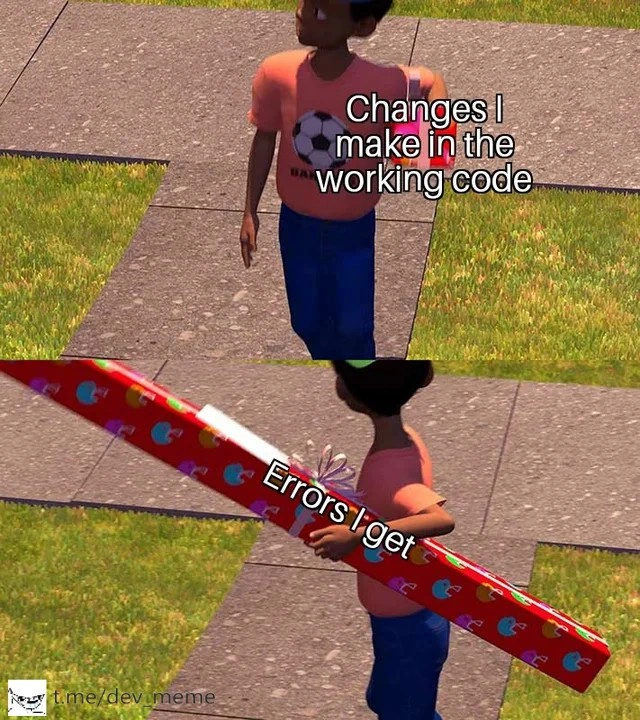
That’s the idea this meme is joking about, but with computer code. In the first picture, a kid is walking around with nothing in his hands – this represents the small, harmless change he made to a piece of code. In the next picture, the same kid is suddenly carrying a gigantic gift box (so big it hides half his body) labeled “Errors I get.” This huge, unwieldy package symbolizes all the problems that unexpectedly fell on him because of that little code change. It’s funny because it’s so exaggerated and surprising: how do you go from touching a tiny thing to being buried in big issues?

Anyone who’s tinkered with a complex toy or machine can relate. Sometimes fixing one small thing causes a bunch of other things to go wrong. You tighten one loose screw, and suddenly three other parts pop out; you pull one thread, and your whole sweater unravels. It’s that “uh-oh” moment the meme captures. We laugh at the kid with the huge present because we recognize the feeling: I did something tiny, and now look at this huge mess! The contrast in the pictures is just like the shock we feel in real life when a simple tweak leads to an avalanche of unintended consequences. That shared experience of surprise (and a bit of pain) is what makes the meme so relatable and hilarious, even if we’re laughing while wincing a little on the inside.

Level 2: The Domino Effect

In simpler terms, this meme describes a classic coding scenario: you have working code (the program runs fine), you make a tiny change to it, and then suddenly the code doesn’t work anymore. Instead, you get a whole bunch of error messages. It feels like you tipped over the first domino in a line and all the others fell down – a domino effect of failures.

Let’s break down some terms from this scenario:

  • Bug: a flaw or mistake in the code that causes it to produce an incorrect result or crash. When we make changes, we risk introducing new bugs.
  • Regression: when something that used to work in the software stops working after a change. If your app had a feature working yesterday, but after today’s “fix” it’s broken, that change caused a regression (a step backward in functionality).
  • Refactoring: reorganizing or cleaning up code without changing what it does. For example, renaming a function to a clearer name or splitting a big function into two smaller ones. Refactoring is supposed to not alter the program’s behavior. But if done incorrectly, it can inadvertently introduce bugs or change how things work.
  • Debugging: the process of finding out why something went wrong (why the program is throwing errors or behaving badly) and then fixing that problem in the code.

Now, why would a small change lead to a cascade of errors? Because in software, many parts of the program are connected. Imagine you have a function that's used all over your code. If you modify that function’s name or how it works, every place in the code that uses it might start complaining. For instance:

# Original code
def calculate_area(width, height):
    return width * height

# The code uses calculate_area in many places:
area1 = calculate_area(5, 4)
area2 = calculate_area(7, 3)

This works fine. Now suppose we make a "tiny" change: we decide the function name should be clearer and change it:

def calculate_rectangle_area(width, height):  # renamed function
    return width * height

# Old calls (not updated) will error out:
area1 = calculate_area(5, 4)   # Error! calculate_area is not defined now.

Suddenly, we get errors everywhere that calculate_area was used, because we changed the name but forgot to update those calls. The code that was working is now broken in multiple places. That’s a simple example of a small edit causing many errors.

It’s not always as obvious as a rename. Sometimes you adjust a minor detail – say, change how a value is calculated or formatted – and sections of the code that depended on the old way start failing. For example, maybe you thought a certain value could never be zero and removed a check for it, but somewhere else that zero does occur and now that part of the program crashes. These are unexpected side effects of changes.

The meme nails this feeling with its two images: first, you (the developer) confidently walk in with a tiny code change (the kid with empty hands, nothing to worry about), and next you’re suddenly overloaded with errors (the kid now holding a gigantic, unwieldy gift box labeled “Errors I get”). It exaggerates how it feels: “I only changed one little thing, and now everything is broken!” Any programmer new to debugging has experienced that sinking feeling. One minute you’re proud of a quick fix, and the next minute the program is yelling at you with a list of things that went wrong.

This situation is a common frustration in programming – hence all the knowing laughter from developers. It’s why we have practices like testing and version control to manage it. Version control (e.g. using Git) lets us save snapshots of code and undo changes if a tiny tweak goes haywire. Writing tests (small checks that our code returns the expected results) helps catch problems early: if one little change breaks ten different tests, those failures tell us exactly where things broke. Still, even with tests, seeing a wall of error messages can be overwhelming. As a newer developer, you quickly learn that no change is too small to potentially cause a big chain reaction. You start to anticipate the domino effect and get into the habit of checking what other parts of the code your “small change” might affect.

In short, the meme is showing the surprise and frustration of making a tiny tweak and then having to deal with a mountain of problems. It’s a funny exaggeration of that “uh-oh” moment every coder encounters, where you're left staring at the screen thinking, "But... I only changed one little thing!"

Level 3: House of Cards Architecture

Every experienced developer has a war story about the “tiny” code change that wreaked havoc. It's practically a rite of passage to patch a minor bug or tweak a single line, only to watch the build break spectacularly or the production logs light up with errors. The humor (and horror) in this meme comes from that disproportionate outcome: the first panel’s carefree kid (small change in a working codebase) versus the second panel’s kid staggering under an absurdly huge present labeled “Errors I get” (a deluge of new problems). It’s funny because it’s true.

Why does this happen so often? In many real-world projects, the architecture can be a fragile house of cards. One component leans on another, which leans on two more... everything is connected in ways nobody fully remembers (especially in old legacy systems or hastily-built spaghetti code). A supposedly isolated fix can trigger side effects in distant parts of the program. Maybe that tiny function you refactored is used by dozens of modules, or perhaps an “innocent” logic change altered an assumption that many other pieces of code were implicitly relying on. The code was working before – not necessarily because it was perfect, but sometimes because of a delicate balance (or even two bugs canceling each other out!). Change one part of that balancing act, and the whole tower can collapse. Congratulations, you’ve just introduced a regression bug – something that previously worked has now broken due to your change.

There's a dash of PTSD in this for seasoned engineers: we’ve learned the hard way that “fixing one thing can break ten others.” It’s why sayings like “no good deed goes unpunished” and “if it ain’t broke, don’t fix it” get tossed around in dev circles. Of course, we have to fix things and improve code, but wise developers do it carefully and with safety nets. That’s why we write extensive unit tests and integration tests – so when that one-line change does blow up, at least the continuous integration (CI) system catches it before the code goes live. Even then, seeing dozens of test failures from a tiny commit is a humbling experience. (Often those failures all stem from the same root cause, but they manifest as a cascade of red in your test report – an avalanche of error messages basically yelling “Undo! Undo!”). In compiled languages, there's the classic scenario of changing a widely-used function’s signature or a core data type: you hit compile and get flooded by errors in every file that calls that function or relies on that type. A one-character edit can literally produce pages of compiler errors. It's almost comedic when it happens – almost.

This meme resonates because it captures a universal developer experience: the unexpected regressions that turn a quick five-minute code edit into a five-hour debugging marathon. The Pixar-style boy with the giant gift is a perfect visual metaphor: it’s like strolling in to make a simple tweak, then ending up hauling a huge, unwieldy burden of new bugs and issues. Seasoned devs will chuckle (perhaps a bit ruefully) because they've been that kid – empty-handed and confident at first, then suddenly weighed down by a ridiculous pile of debugging and troubleshooting tasks. It’s a reminder to always be prepared for the worst, even when touching a single line of “stable” code. And yes, it often seems that the probability of disaster is directly proportional to how confident you were that “this change is no big deal.” Murphy’s Law has a special fondness for programmers.

Level 4: Chaos Theory in Code

In large and complex software systems, a seemingly trivial change can unleash a cascade of failures due to deep interconnections. This is analogous to the butterfly effect in chaos theory: small variations in initial conditions can produce dramatically different outcomes. Codebases with heavy coupling (where components depend tightly on each other) exhibit a sensitive dependence on changes. Altering one module’s behavior or interface can ripple outward through all modules that interact with it, often in non-intuitive ways.

For example, consider a widely-used utility function in a program. If you change its output format or error handling, every piece of code expecting the old behavior might misbehave or outright fail. Mathematically, if function F is called by N different parts of the program, one tweak in F could trigger up to N error points – a kind of multiplier effect. In reality it’s often worse: those N parts might pass that erroneous output further, causing second-order failures. The "tiny code tweak" effectively acts as a perturbation in an interconnected network, and faults propagate along the dependency graph like shockwaves.

In low-level systems or performance-critical code, even an innocuous change like reordering two lines or adding a no-op can alter memory layout or timing. This might bring latent Heisenbugs out of hiding. (A Heisenbug is a bug that seems to vanish or change behavior when you try to observe it, akin to how measuring a quantum system disturbs it – another chaos-like aspect in computing.) Similarly, a small code refactor might influence the compiler’s optimization decisions, leading to a different binary that could expose a race condition or memory corruption that was always there, just never triggered in the old build. It's sobering that such emergent behavior means the relationship between a change and its fallout can be highly non-linear.

From a theoretical standpoint, verifying that a tiny change won't break anything significant is related to the fundamental difficulty of program analysis. It's practically impossible to exhaustively prove the absence of unintended interactions (barring formal verification, which is rare and expensive). Even unit tests and integration tests, while crucial, only sample a subset of all possible execution paths. There’s a humorous but telling adage in software called Hyrum's Law: "With a sufficient number of users of an API, it does not matter what you promise in the contract: all observable behaviors of your system will be depended on by somebody." In other words, any observable aspect of your "working code," no matter how small or unintended, could be the very thing some other part of the system (or another system) relies on. Change that behavior, and you break that hidden dependency, resulting in an avalanche of issues.

This advanced view highlights the inherent complexity and chaotic nature of large software systems. Tiny code tweaks can have outsized consequences because our programs are not isolated equations but sprawling, interactive webs of logic. We might joke that a one-line change causing a hundred errors is just "chaos theory in action," but underneath that humor lies a real technical truth: as systems grow, they often behave less like predictable machines and more like ecosystems with feedback loops, where small disturbances can create storms. Tight coupling, unintended side effects, and invisible dependencies ensure that no change is truly small. The meme exaggerates it with a kid suddenly lugging a gigantic gift (i.e. a load of new problems) after making a tiny change, which is an apt metaphor for these non-linear cause-and-effect relationships in code. For seasoned engineers, it's a tongue-in-cheek reminder that in software, nothing occurs in isolation – and that reality can be equal parts fascinating and frustrating.

Description

A two-panel meme using a scene from an animated movie. In the top panel, a 3D-animated character is shown holding a small, manageable gift-wrapped box. The text overlay reads, 'Changes I make in the working code'. This represents a seemingly minor and contained modification. In the bottom panel, the same character is now struggling to hold a ridiculously long, oversized, and unwieldy gift-wrapped box, illustrating a dramatic increase in size and complexity. The text here says, 'Errors I get'. The humor comes from the stark and disproportionate contrast, a relatable experience for any developer who has made a small, innocent-looking change only to be met with a massive, cascading flood of unexpected errors, build failures, and broken tests. It perfectly visualizes the 'butterfly effect' in complex or brittle codebases, where one tiny tweak can have catastrophic and far-reaching consequences

Comments

7
Anonymous ★ Top Pick The fastest way to discover all the hidden architectural dependencies in a legacy system is to change one variable name and watch the CI/CD pipeline burn
  1. Anonymous ★ Top Pick

    The fastest way to discover all the hidden architectural dependencies in a legacy system is to change one variable name and watch the CI/CD pipeline burn

  2. Anonymous

    Tweaked one boolean in the 2009-era auth service; CI responds with a gift-wrapped 5-GB stack trace, eight failing microservices, and a gentle reminder that “stateless” is just a state of denial

  3. Anonymous

    After 20 years in this industry, I've learned that 'working code' is just code whose bugs haven't been discovered yet - and touching it is like performing surgery with a chainsaw while the patient is running a marathon

  4. Anonymous

    Ah yes, the classic 'change one CSS padding value and somehow break the authentication service' scenario. This meme perfectly encapsulates what every architect fears: that innocent-looking three-line refactor in a 'stable' module that somehow triggers a distributed transaction deadlock across four time zones, causes the cache invalidation strategy to enter an infinite loop, and makes the monitoring system alert that the database is now convinced it's a teapot. It's the production equivalent of quantum entanglement - touch one variable, and suddenly services you've never heard of are throwing stack traces in languages your company doesn't even use. The skateboard's absurd size ratio is actually a conservative estimate; in reality, that error log would need its own S3 bucket and a dedicated Elasticsearch cluster just to store the first hour of exceptions

  5. Anonymous

    One-line tweak to the “working” util; CI gift-wraps 600 failures - apparently its fan-out graph mirrors our org chart

  6. Anonymous

    That tiny refactor touched a 'stable' module; turns out it was the monolith's global singleton of chaos and our regression suite is mostly integration theater

  7. Anonymous

    Refactoring working code: O(1) lines touched, Ω(explosive) bugs unleashed

Use J and K for navigation