The Two Emotional States of Debugging
Why is this Debugging Troubleshooting meme funny?
Level 1: Forgot to Press Play
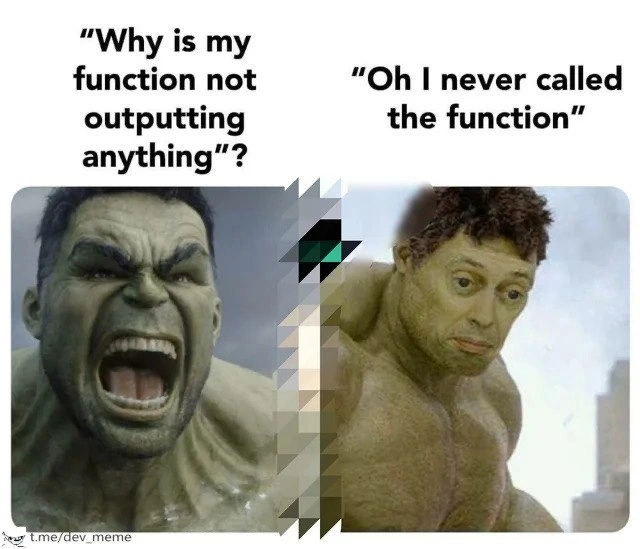
Imagine you set up a movie on TV, and you’re sitting on the couch waiting for it to start. But nothing is happening on the screen. You start getting upset, thinking “Why isn’t my movie playing? Is the TV broken?” Then you look down and realize... you never pressed the Play button. 🤦 It’s not that anything was wrong with the movie or the TV — you just forgot to start it. This meme is joking about the same kind of situation, but with computer code. The programmer was upset that nothing was coming out (no messages, no signs of life), only to discover they simply didn’t tell the computer to run that part at all. It’s funny because we can all relate to that silly mistake: getting frustrated at something not working, then finding out we just skipped the most obvious step. The big green Hulk getting angry in the picture is like how a person might feel — a mix of embarrassment and “oops!” — when they realize they only needed to press play (or in coding, call the function) to make things happen.
Level 2: Missing Function Call
At its core, this meme is about a simple coding mistake: writing a function but never actually calling it. In programming, a function (or method) is like a mini-program—a reusable block of code designed to perform a certain task. Calling a function means telling the computer to execute that block of code now. If you never call it, the code inside the function just sits there, never running. So any work that function is supposed to do (like printing output or updating a value) simply doesn’t happen. That’s why our poor developer in the first panel is confused that nothing is outputting: the program never went inside the function at all! This is a common CodingMistake for beginners (and yes, even tired pros at 3 AM): you define the logic, but forget the line of code that triggers it.
To make it clearer, consider this snippet of code:
def greet():
print("Hello, world!") # This is the output we expect from the function
# ... some other code here ...
greet() # This CALLS the function, without this, "Hello, world!" never prints
If we forget to call greet() (for example, maybe we commented it out or never wrote it), then "Hello, world!" will never appear. The function exists, but it’s never invoked, so the print inside never runs. It’s the programming equivalent of having a phone number but never dialing it. In debugging, when something “is not outputting anything,” one of the first things to check is “Did my code even run?” A quick way is to trace through the call stack – that’s the chain of function calls the program made. In this meme’s situation, the call stack would not include our function at all (because nothing called it), explaining the missing log line. Realizing you simply missed a function call often leads to a facepalm moment. It’s RelatableDeveloperExperience because every developer eventually encounters this: you’re staring at your screen, asking “Where are my logs? Is the database broken? Is the bug in the 3rd-party library?”, and then it dawns on you that the function with the log statement was never executed. It’s a gentle reminder that sometimes the bug isn’t in the complex system – it’s just a simple oversight in our own code.
And about the Hulk imagery: The meme uses The Hulk (a giant green Marvel superhero who appears when mild-mannered Bruce Banner gets angry) to represent the developer’s emotions. In the left image, Hulk looks weak or confused — that’s the developer in debugging mode, frustrated and not understanding why their code isn’t behaving. In the right image, Hulk is roaring fiercely — that’s the big reaction of the developer finally realizing the silly mistake (“D’oh! I never called the function!”). It’s humor through exaggeration: the tiny oversight of a missing call is blown up into a Hulk-sized comedic moment.
Level 3: Call Stack of Shame
This meme hits on a classic debugging frustration: you’re frantically scouring your code for why nothing is showing up in the logs, only to discover the function was never called at all. In the left panel, a distressed Hulk-like developer is raging "Why is my function not outputting anything?". The right panel reveals the punchline: "Oh, I never called the function." This dramatic Hulk transformation mirrors the dev’s emotional rollercoaster — from furious confusion to a self-directed roar of facepalm debugging.
For seasoned engineers, this scenario is painfully familiar. You’ve instrumented tons of logging, set breakpoints, even blamed the framework or observability tools for missing data, and then you find the real culprit: the code never ran! It’s a trivial bug with a brutally simple fix, yet it can waste hours. The humor is in the shared “call_stack_of_shame” moment — that sinking realization that the function you wrote is perfectly fine, but no part of the program ever invokes it. It’s like tearing apart a car engine to find why it won’t start, only to realize the keys were never in the ignition. We’ve all been there: scanning configuration files and thread dumps, suspecting cosmic rays or gremlins memory leaks, when in reality a single line of code (callTheDarnFunction();) was missing.
The meme exaggerates this with Hulk’s two extremes. On the left, the developer-Hulk is pale and weak, perplexed by the silent failure — which represents the code quietly doing nothing. On the right, Hulk is at full rage because the realization hits: the code wasn’t broken at all, it just wasn’t executed. It’s a mix of embarrassment and relief. Even advanced Debugging techniques can’t magically show logs from a function that never ran; no amount of monitoring or distributed tracing helps if your code never left the bench. This joke resonates because forgetting to actually invoke your freshly written function is a rite of passage in programming. The DeveloperHumor here hides a valuable lesson: always verify that your code is actually being called. And next time you’re about to Hulk-smash your laptop over “missing” output, remember to check the call stack for that missing invocation before the gamma radiation kicks in.
Description
A two-panel meme format that captures the emotional rollercoaster of debugging. The left panel features a close-up of the Incredible Hulk roaring in pure rage, with the caption above reading, '"Why is my function not outputting anything?"'. The right panel shows a comically unsettling image of actor Steve Buscemi's face photoshopped onto the Hulk's body, creating a defeated and sheepish expression. The caption for this panel is '"Oh I never called the function"'. The meme humorously illustrates the transition from intense frustration over a seemingly complex bug to the deflated, embarrassing realization that the problem was a simple, fundamental mistake. It's a universally relatable experience for developers at all levels. A watermark for 't.me/dev_meme' is visible in the bottom-left corner, and a pixelated graphic artifact partially obscures the transition between the two panels
Comments
7Comment deleted
It's the programming equivalent of searching for your glasses for 10 minutes only to realize they're on your head. The anger is real, but the shame is eternal
Three hours of distributed tracing later, we discovered the real outage: main() was never invoked - 99th-percentile latency straight to the developer’s ego
After 20 years in the industry, you'd think we'd remember to actually invoke our functions, but here we are, still discovering that our perfectly crafted, unit-tested, peer-reviewed, SOLID-principled masterpiece is just sitting there like a Ferrari with no keys - beautiful, expensive, and completely useless until someone remembers to add those two parentheses
The eternal debugging cycle: spending 3 hours investigating why your perfectly crafted function isn't producing output, checking logs, adding breakpoints, questioning your understanding of the language's execution model, only to discover you never actually invoked it. It's the software engineering equivalent of wondering why your car won't start when the keys are still in your pocket - except this happens to all of us, regardless of years of experience, and we still feel the same primal rage followed by sheepish embarrassment every single time
Architects battle CAP theorem daily, yet the real distributed failure is a function defined across services but never invoked
Added logs, tracing, and a feature flag, debated retries and idempotency - then realized the function had no call site; observability can’t instrument a no-op
Most “no output” incidents are immaculate functions that never joined the call graph - production-ready, fully documented, and waiting for a caller that doesn’t exist