Skip to content
DevMeme
841 of 7435
The Irony of Unplanned Programming
ProjectManagement Post #951, on Dec 30, 2019 in TG

The Irony of Unplanned Programming

Why is this ProjectManagement meme funny?

Level 1: Building Without Blueprints

Imagine you want to build a big fancy treehouse in your backyard. You’re so excited that you grab a hammer and nails and just start putting up boards randomly without any plan. You skip the boring step of sketching a quick design or measuring anything because you feel like you’re saving time. For a little while, you’re happily hammering away. But soon you realize the treehouse is lopsided, the door you built won’t even open, and the whole thing is unstable. Uh-oh! You end up tearing it apart and rebuilding it again and again to fix problems you could have avoided with a simple drawing and a measuring tape at the start.

This is exactly what the meme is joking about: doing a ton of extra work later because you didn’t spend a tiny bit of time planning first. It’s funny because it’s obviously backwards. It’s like trying to bake a cake by throwing ingredients together at random to avoid the “hassle” of reading the recipe for 10 minutes — and then having to bake the cake over and over because it keeps coming out wrong. The emotional punchline is that sometimes people (or teams) think they are being quick or heroic by jumping straight into action, but in reality they’re making things harder for themselves. The meme’s cheerful style of text makes it look like friendly advice, but it’s actually a gentle, sarcastic poke reminding us that spending a little time to plan can save a whole lot of time and trouble later. So it’s making us laugh and nod, because we all know the silly truth: avoiding a small chore now can create a huge chore for later.

Level 2: Agile Means No Plan?

Let's break down why that pink-text quote is funny (and a bit painful) for developers. The phrase "Weeks of programming can save you hours of planning" is sarcasm. In reality, good practice is usually the opposite: spending a few hours planning can save weeks of programming! The meme flips it around to poke fun at a common rookie mistake.

Planning vs Coding: In any software project (part of the SDLC, or Software Development Life Cycle), there's a phase for planning where you figure out what you’re going to build and how. This can include gathering requirements (what should the software do?), making designs or diagrams (often on a whiteboard, hence "whiteboard session"), and considering different approaches before writing a lot of code. Coding is the implementation phase where you actually write the software. The joke here is that some teams or programmers jump straight into weeks of coding without doing that couple of hours of planning first. It’s like diving into writing code with barely a plan in place. Initially it feels like you’re saving time (hey, you're not "wasting" hours in a meeting, right?), but later you discover you misunderstood the problem or built something off-target. Then you have to spend even more weeks fixing or redoing the code. Net result: you lost more time than you "saved."

Agile Methodology: Terms like Agile, Scrum, and sprint come up a lot in software teams. Agile is a popular way to manage projects that emphasizes short development cycles and frequent reassessment of plans. A sprint is a 1-2 week focused period where a team builds certain features. There’s a meeting at the start of each sprint (called sprint planning) to discuss what will be done. Agile encourages adaptability, but sometimes people misunderstand it as "we don't need to plan, we’ll just continuously build and change on the fly." In reality, Agile still requires planning — just in smaller, iterative chunks rather than one big plan upfront. The meme highlights the AgileHumor and AgilePainPoints around this: some teams claim to be "agile" but use it as an excuse to do zero upfront design. They might say, "We’re agile, we’ll figure it out as we go!" This can work for very small changes, but for anything complex, it often leads to chaos and wasted effort.

Whiteboard Aversion: The text mentions a "two-hour whiteboard session". Many developers joke about being allergic to meetings or design sessions (that’s the whiteboard aversion mentioned in the tags). A whiteboard session usually means the team is sketching architecture or brainstorming solutions. Skipping it might feel "efficient" to someone who just wants to code. But the meme is pointing out that avoiding a few hours of planning can result in weeks of extra work coding and recoding. In other words, not planning is a false shortcut. It’s a bit like a student skipping the step of outlining an essay, then having to rewrite the essay multiple times because their thoughts were unorganized.

Scope Creep: This term refers to continuous growth or change in a project's requirements (scope) over time. If you don’t have a clear plan or defined scope from the start, the project can suffer from scope creep – new features and changes keep "creeping" in because nothing was nailed down in a plan. For a junior developer, this often feels like, "Wait, now we have to add this too? We already built the other part!" Without a plan, you might end up coding things that get thrown away or need major changes when the real requirements finally become clear. That’s frustrating and hurts DeveloperProductivity because you’re doing work twice. A little planning upfront can define the scope better and prevent this constant churn.

Cowboy Coding: This is a slang term (no actual cowboys involved!) for when developers just start coding on their own without any planning, design, or coordination – much like a cowboy riding off wherever they please. If you hear someone say "our team went cowboy on this project," it means everyone just dived into coding without structure. It’s risky: things might work out if you’re lucky, but usually it leads to inconsistent code, integration problems, and a lot of "oh no, we need to redo this" moments. The meme is a tongue-in-cheek way of saying "Sure, skip the planning. What could go wrong? Only wasting several weeks!" – implying that premature_implementation (coding too early) is bound to cause troubles that proper planning could have easily avoided.

In summary, for someone newer to development: the meme is a joke about project management humor. It highlights a lesson you eventually learn in software teams: planning may feel like it slows you down, but not planning can slow you down a lot more in the long run. Agile workflows include planning for a reason – it's to save you from the nightmare of massive rework. The meme emphasizes this by exaggeration: spending weeks programming something that a few hours of careful planning could have made unnecessary. It’s funny in a sarcastic way, and it's a bit of a cautionary tale told with a smile.

Level 3: Rushing to Rework

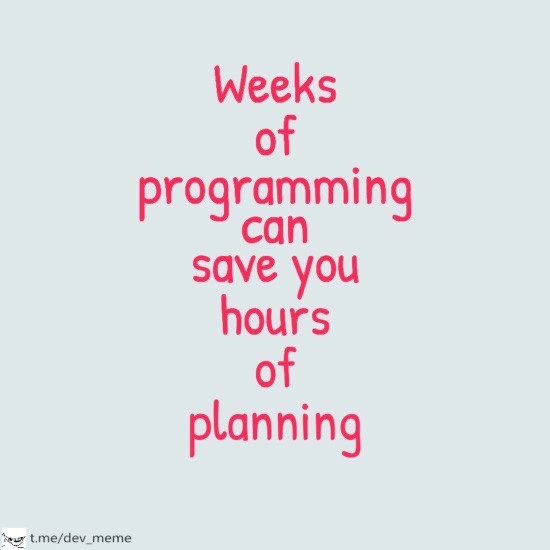
"Weeks of programming can save you hours of planning."

This meme nails a classic AgilePainPoints irony: teams charge ahead writing code for weeks to dodge a simple planning meeting, only to burn more time later. It's a sarcastic inversion of the common wisdom "hours of planning can save weeks of programming." Seasoned engineers recognize this premature implementation anti-pattern instantly. The humor cuts deep because we've all seen eager teams sprint into coding without a clear design — and then watch the project scope creep and code churn explode.

In the world of ProjectManagement and the SDLC (Software Development Life Cycle), skipping the planning phase is like skipping oil changes for your car: sure, you save time today, but you'll pay for it with a breakdown later. The meme’s pink, cheerful font screams sarcasm: it's styled like a motivational quote, yet every senior developer reading it is smirking (or maybe crying inside). Why? Because we've been in those projects where a "quick MVP" turns into a technical debt quagmire that takes weeks to untangle, all because the team was too "heroic" to spend a couple of hours on a whiteboard.

This is pointing at a recurring Agile anti-pattern: so-called "cowboy coding" under the banner of "fast progress". A team might proudly avoid a two-hour design session (the whiteboard aversion is real — who wants to draw boxes and lines when you can be a coding hero, right?). But inevitably they discover fundamental missteps: missing requirements, contradictory features, a module that doesn't scale, or an integration that was never considered. Suddenly those hours of planning they skipped turn into nightly on-call emergencies or frantic refactoring sessions. It's common to see commit histories like:

$ git log --oneline
f1e9c3c (HEAD -> main) Quick fix for design flaw found in QA (oops)
b2d4e2f Reimplement feature X properly after initial version fails
a8c9d01 Initial commit for feature X (no time for spec, just code it)

Each commit tells a painful story. The last one says "no time for spec, just code it". A week later: "reimplement feature X properly". Senior devs have lived this cycle and will chuckle (or groan) at how accurately the meme distills it: Weeks of programming later, you're essentially doing the planning you avoided, but now under pressure and with a mess of code to untangle. The meme text "Weeks of programming can save you hours of planning" is delivered with a wink – we all know it's a false heroism, a false economy.

Historically, this reflects a pendulum swing in software methodology. In old-school waterfall days, teams wrote 100-page design specs and did exhaustive up-front architecture (sometimes too much planning, leading to analysis paralysis). Modern Agile/Scrum preached "responding to change over following a plan," which is great in moderation. But some folks misinterpreted that as "no plan at all." They treat sprint planning or design discussions as optional. The result? Exactly what this meme jokes about: a team ends up doing design by trial-and-error in code. It's like reinventing your product five times because no one drew a simple diagram on day one. DeveloperProductivity actually tanks, even though it felt like productivity to be writing lots of code quickly. It's a bitter truth in ProjectManagementHumor: the boss sees code being written and thinks progress is great… until the demo date slips because half the code must be rewritten.

The shared trauma here comes from those “I told you so” moments. Perhaps a senior engineer suggested a brief architecture talk (maybe discuss database schema or API contracts), but it was brushed off in the rush to show velocity. Two sprints later, the team has a mountain of rework because they painted themselves into a corner. The meme’s wry tone perfectly captures that frustration: we keep doing this to ourselves even though we know better. The planning_vs_coding_irony is painful and funny – painful because it keeps happening, funny because the absurdity is obvious in hindsight.

In summary, the meme is a tongue-in-cheek reminder that "Just code it" is not always the heroic move it appears. Real heroes balance planning with coding. The text "Already was here, but better to remind" (from the post caption) even acknowledges that this lesson pops up again and again. So the experienced devs reading this meme will nod knowingly – perhaps while preparing an "I really think we need a planning session" speech for their team, trying to break the cycle of premature_implementation one project at a time.

Description

The image displays a sarcastic quote in a rounded, red font against a plain, light-gray background. The text reads, 'Weeks of programming can save you hours of planning'. A small watermark for 't.me/dev_meme' is present in the bottom-left corner. This phrase is a well-known ironic statement in the software development community. It humorously criticizes the common anti-pattern of developers skipping the crucial planning phase and jumping directly into coding. For senior engineers, this is a painfully relatable observation, as they have often witnessed or experienced how a lack of upfront planning leads to extensive rework, bugs, and accumulated technical debt, ultimately wasting far more time than was 'saved' by skipping the initial design and architecture phase

Comments

7
Anonymous ★ Top Pick This is the official motto of the 'move fast and break things' school of thought, conveniently omitting the 'then spend months fixing them' part of the curriculum
  1. Anonymous ★ Top Pick

    This is the official motto of the 'move fast and break things' school of thought, conveniently omitting the 'then spend months fixing them' part of the curriculum

  2. Anonymous

    Nothing says "enterprise agility" like refactoring for six sprints to replace the design document you never wrote

  3. Anonymous

    After 20 years in the industry, I've learned that the only thing more expensive than the six rewrites caused by poor planning is explaining to the board why your 'move fast and break things' approach broke the things that actually made money

  4. Anonymous

    This is the engineering equivalent of 'I don't have time to sharpen the axe, I'm too busy chopping trees.' We've all been that senior architect watching a team spend three sprints refactoring a monolith that could have been properly designed in two planning sessions - but hey, at least we got to learn about all the edge cases the hard way. The real kicker? The planning document you skipped is now a 47-page post-mortem explaining why the system needs a complete rewrite

  5. Anonymous

    Flipping the adage perfectly captures the architecture anti-pattern: emergent design via fire drills, where CAP theorem meets 'just ship it'

  6. Anonymous

    Skipped a two-hour inception and bought three quarters of rework - velocity cheered, the platform quietly scheduled a rewrite

  7. Anonymous

    Our sprint ritual: skip the design doc, build a microservice, then write an ADR explaining why a cron job would’ve sufficed

Use J and K for navigation