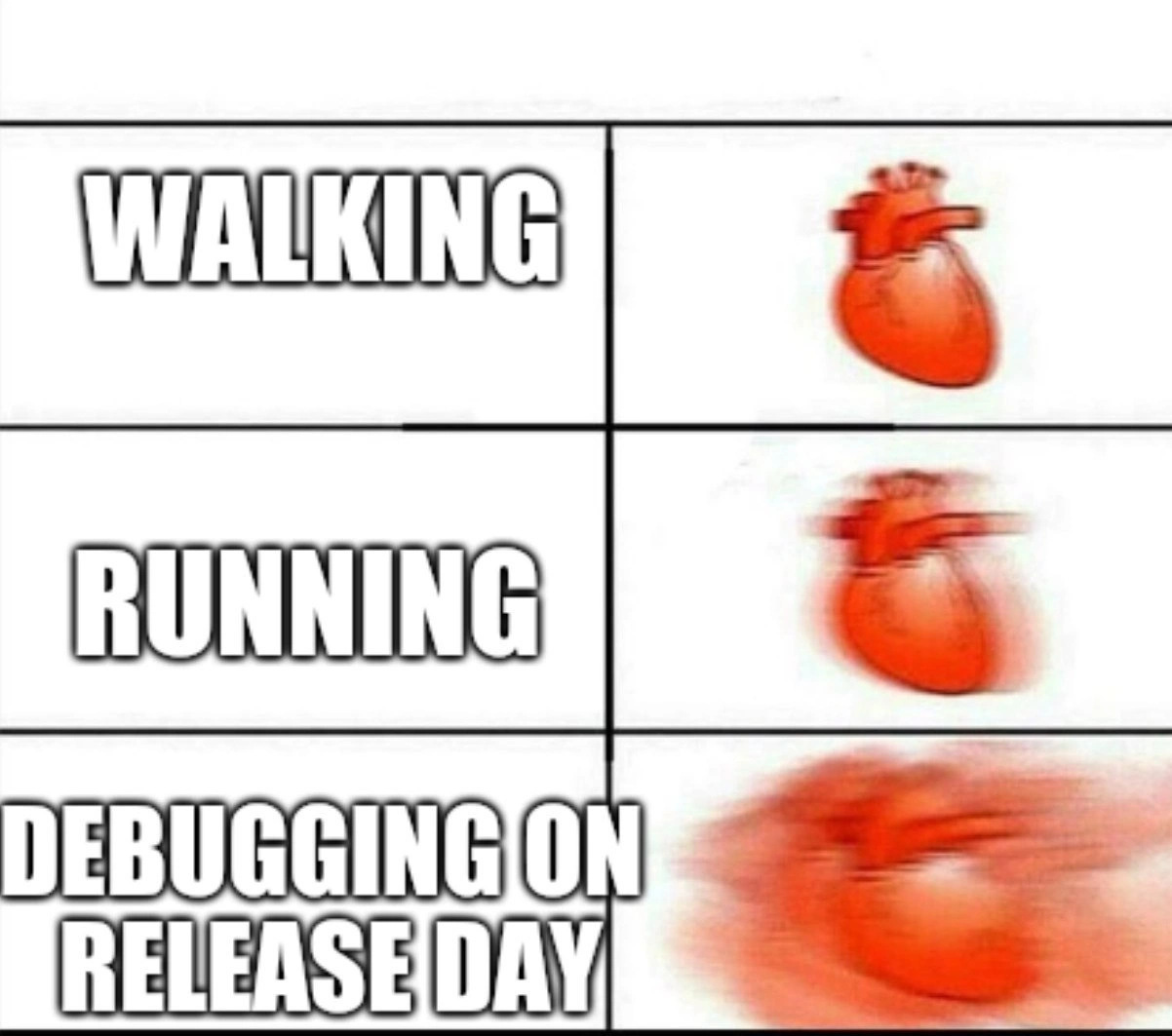
Heart Rate Escalation: Walking, Running, Dev Debugging on Release Day
Why is this Debugging Troubleshooting meme funny?
Level 1: The Wobbling Heart
Imagine your heart beats a little when you walk, faster when you run, and then there's a third thing — like being told to fix a broken toy while the birthday party is already happening and every kid is standing around watching you. That's what fixing computer problems on the day the software goes out feels like. The joke is that programmers sit perfectly still in a chair all day, yet this one situation gives them a harder workout than actual exercise. The heart in the last picture is blurry because it's beating too fast to even photograph — which is exactly how it feels.
Level 2: Why Release Day Hits Different
A few terms doing the heavy lifting here:
- Release day — the scheduled moment new code goes live to real users. Before this, bugs are private embarrassments; after this, they're incidents with paying customers attached.
- Debugging — the process of finding why code misbehaves: reading stack traces, adding log statements, reproducing the failure, and forming hypotheses. It requires calm, methodical thinking — precisely the resource release-day pressure destroys.
- Hotfix — an emergency patch shipped outside the normal process because something is broken in production right now. Debugging on release day usually ends in one.
The cruel irony juniors discover on their first launch: debugging is a search problem, and panic makes you search badly. Under stress you skip steps, assume instead of verify, and "fix" the wrong thing — which is how one bug on release day becomes three. Compare:
Tuesday, no deadline: read error → reproduce → isolate → fix → test → done
Release day, 4:47 PM: read error → guess → push → new error → guess → push → ...
That second loop is what the vibrating heart is rendering. The skill that separates seniors isn't typing speed during the fire — it's having built the habit (and the pipeline) that keeps them out of the fire, plus the hard-won ability to slow down on purpose while everyone around them is vibrating too.
Level 3: Tachycardia-Driven Development
The three-panel escalation here — a calm anatomical heart for WALKING, a slightly motion-blurred one for RUNNING, and a vibrating red smear for DEBUGGING ON RELEASE DAY — works because it quantifies something every engineer who has shipped software knows in their chest cavity: the body does not distinguish between a bear attack and a NullPointerException in the checkout flow at 4:47 PM on launch day. Cortisol is cortisol.
The deeper satire is about why anyone is debugging on release day at all. In a healthy delivery pipeline, release day should be the most boring day of the cycle — the artifact was built, tested, staged, and signed off days ago; the "release" is flipping a feature flag or promoting an image tag. The meme exists because that pipeline is a fairy tale most organizations tell themselves in retro meetings. In practice, release day is when:
- The code freeze thawed three times for "tiny, zero-risk" changes that absolutely were not zero-risk
- The staging environment turned out to differ from production in exactly one undocumented environment variable
- A dependency pinned with
^quietly resolved to a new minor version in the release build - The bug that "couldn't be reproduced" reproduces instantly, in front of stakeholders, on the dashboard everyone is watching
This is the deadline crunch pattern feeding the production firefighting pattern. The organizational physics are predictable: dates get promised before scope is understood, testing gets compressed because it sits at the end of the schedule, and the slack that should absorb surprises was spent in week two. The engineer in panel three isn't debugging a hard problem — they're debugging an ordinary problem under conditions where every minute is being counted aloud by someone in a Slack thread titled #release-war-room. The cognitive load isn't the stack trace; it's the audience.
There's also a darkly accurate physiological joke embedded in the format itself: sustained on-call and release-day stress is a documented contributor to burnout, sleep disruption, and the kind of alert fatigue that makes senior engineers quietly update their LinkedIn. The blur on that third heart isn't hyperbole. It's a sprint review of the human cost line item that never makes it into the project plan.
Description
The meme is a three-row, two-column grid on a white background. Each left cell contains bold, all-caps, white text with a black outline: “WALKING” in the top row, “RUNNING” in the middle row, and “DEBUGGING ON RELEASE DAY” in the bottom row. Each right cell shows an increasingly blurred red heart icon: a calm, stationary heart opposite “WALKING,” a slightly motion-blurred heart opposite “RUNNING,” and an extremely blurred, vibrating heart opposite “DEBUGGING ON RELEASE DAY.” The visual gag conveys how a developer’s heart rate - and therefore stress level - spikes dramatically when last-minute bugs appear just before a production release. Experienced engineers will recognise the surge of adrenaline that accompanies hotfixes during a deployment window and the heightened risk of shipping regressions under deadline pressure

Comments
7Comment deleted
Fitbit congratulated me on a HIIT workout - turns out it was just me SSH’ing into the lone stateful pod five minutes after the Helm upgrade started 404-ing checkout in prod
The same code that passed all tests in staging is now somehow violating the laws of physics in production, and the only person who understands the deployment pipeline is on vacation in a place with no cell service
Cardiologists recommend 30 minutes of elevated heart rate daily; the release calendar recommends it quarterly, all at once, at 4:55 PM on a Friday
The heart rate progression perfectly captures the developer experience: walking pace for feature development, running pace for code reviews, and full cardiac arrest when you realize the bug only reproduces in production with real user data at 5 PM on a Friday. The motion blur is actually just the heart trying to git revert to a calmer state, but merge conflicts prevent it
Prod debugging: where your heart races faster than a Kubernetes node drain during peak traffic
Release-day debugging: when your heart’s SLO breaches before prod’s p99 because the canary quietly bypassed the feature flag
CI is green, canary is green, SLO is red - nothing boosts VO2 max like a prod-only race condition you can only reproduce while hovering over rollback