When a Ph.D. in Mathematics Encounters a Medical Emergency
Why is this Mathematics meme funny?
Level 1: The Wrong Kind of Expert
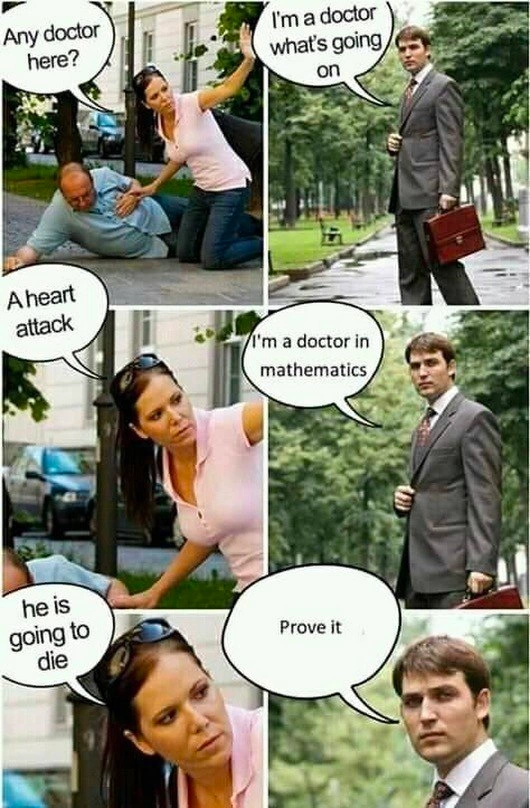
A man collapses on the sidewalk, a woman shouts "Any doctor here?" — and a man in a nice suit says yes, he's a doctor. Great! Except he's a mathematics doctor: the kind who's an expert at numbers and puzzles, not medicine. When the panicked woman cries "he is going to die," the man replies the only way his profession knows how: "Prove it." It's like a kid telling a referee "he pushed me!" and the referee — instead of helping — pulling out a rulebook and saying "show me your evidence." The joke is that some experts get so used to demanding proof for everything that they'd ask for it even when a man is literally dying at their feet — perfectly logical, perfectly useless.
Level 2: Doctors, Proofs, and Trust Boundaries
Two concepts unlock the joke:
- PhD vs MD: "Doctor" covers both physicians (MD) and anyone holding a doctorate — the highest academic degree, awarded in any field, including mathematics. Both legitimately answer "I'm a doctor." Only one is useful at a heart attack.
- Mathematical proof: in math, a claim is accepted only when logically derived, step by step, from established facts. Checking a million examples isn't proof; persuasion isn't proof; urgency definitely isn't proof. "Prove it" is the profession's reflexive quality gate.
The same instinct shows up everywhere in software, usually as a healthy habit:
"This function never gets a negative input." → add an assert anyway
"The cache makes it faster." → run the benchmark
"That branch is unreachable." → famous last words; log it
Early in your career you'll meet this as code review culture: claims need evidence — tests, benchmarks, repro steps. You'll also meet the comic's failure mode: rigor applied at the wrong moment, like demanding a full design doc for a hotfix while the outage clock runs. Knowing when to say "prove it" and when to grab the metaphorical defibrillator is roughly the difference between a junior engineer who has learned skepticism and a senior one who has learned judgment.
Level 3: An Unverified Edge Case
The six-panel stock-photo format is doing half the comedy. Each beat is a different awkwardly licensed photo — the woman kneeling over a collapsed older man ("Any doctor here?"), the suited man with the red briefcase striding through a park ("I'm a doctor, what's going on"), the escalation ("A heart attack"), the clarification that detonates the premise ("I'm a doctor in mathematics"), the desperate plea ("he is going to die") — and then the final panel, a tight close-up, his expression utterly level:
"Prove it."
The setup exploits a genuine linguistic ambiguity: doctor (Latin docere, to teach) belonged to academics centuries before it became shorthand for physicians. Every PhD has lived the airplane-announcement anxiety this comic weaponizes — the title promises emergency utility the degree does not deliver. But the joke's real engine is the second beat: instead of apologizing and stepping back, the mathematician engages on his own terms. He doesn't refuse to help; he initiates peer review.
What makes this beloved in developer circles specifically is how recognizable the reflex is. Engineering culture is built from people trained to reject unsubstantiated claims, and "prove it" is the load-bearing phrase of half our rituals: the code reviewer who won't accept "this can't be null here" without a guard or an invariant; the senior engineer who answers "it's faster" with "show me the benchmark"; the on-call veteran who replies to "the fix is deployed" with "link the dashboard." This is, most of the time, a virtue — the entire discipline of debugging is refusing to trust assertions ("it works on my machine" — prove it) — right up until the moment context demands action and the rigor becomes a denial-of-service attack on reality. Everyone has worked with the engineer who litigates the ticket's wording while production burns. The mathematician in panel six is that colleague, rendered in stock photography.
There's also a sly accuracy in the deadpan. Mathematicians genuinely do treat "obvious" as a challenge rather than a permission — entire careers exist because someone demanded a proof of something everyone believed (the Jordan curve theorem says a loop has an inside and an outside; proving it rigorously took serious machinery). "He is going to die" is, to be fair, probably true of any human on a long enough timeline — but the mathematician would note that the woman is asserting a much stronger claim about timing, and extraordinary deadlines require extraordinary lemmas.
Level 4: Q.E.D. or It Didn't Happen
"Prove it" is funny precisely because, in the mathematician's world, it is the only legitimate response to any claim. Mathematics runs on a different epistemology than every other discipline: a statement isn't knowledge until it's derived from axioms via valid inference rules. Empirical evidence — the standard of medicine, physics, and the woman kneeling on the sidewalk — counts for nothing. The Collatz conjecture has been checked for every integer up to astronomical bounds; mathematically, it remains an open question. "He's collapsed, he's gray, he's clutching his chest" is, to the man with the red briefcase, merely a large but finite set of supporting observations. The conjecture he is going to die remains unproven.
This standard has deep formal roots. Hilbert's program dreamed of grounding all mathematics in mechanically checkable derivations; Gödel's incompleteness theorems wrecked the dream's completeness ambitions but left the rigor intact. Modern proof assistants — Coq, Lean, Isabelle/HOL — realize the mechanical half: proofs as programs checked by a small trusted kernel, with the Curry-Howard correspondence revealing that propositions are types and proofs are terms inhabiting them. Under that lens, the mathematician's demand has a precise type-theoretic reading: the woman has asserted a proposition Dies(patient), and he is requesting a term of that type. Her evidence is a runtime observation; he requires a compile-time guarantee.
The software industry lives in the gap this comic dramatizes. Testing is the paramedic — empirical, fast, saves lives, proves nothing (Dijkstra: testing shows the presence of bugs, never their absence). Formal verification is the mathematician — seL4's microkernel proofs, CompCert's verified compiler, TLA+ specs for distributed protocols — magnificent, airtight, and so expensive that we deploy it roughly never, mostly for things where failure means planes or pacemakers. The comic's dark timing is the punchline of the whole field: by the time the proof is complete, the patient — like the market window for your formally verified startup — is dead.
Description
A six-panel comic strip meme depicting a medical emergency and a misunderstanding of the word 'doctor'. In the first panel, a woman is helping a man who has collapsed on the street, shouting, 'Any doctor here?'. A speech bubble from the man says, 'A heart attack'. In the second panel, a man in a business suit holding a briefcase approaches, saying, 'I'm a doctor what's going on'. The third and fourth panels show the man clarifying, 'I'm a doctor in mathematics'. In the fifth panel, the woman, looking distressed, states, 'he is going to die'. In the final panel, the mathematician looks on with a detached, serious expression and demands, 'Prove it'. The humor stems from the clash between the urgent, practical needs of a medical crisis and the abstract, theoretical mindset of a mathematician who defaults to requesting a formal proof for a real-world event. This is relatable to senior engineers who often have to bridge the gap between theoretical correctness and practical application, sometimes getting lost in the abstraction

Comments
8Comment deleted
That's the problem with a purely theoretical background. By the time you've formally proven the patient object is null, it's already been garbage collected
“Prod’s in cardiac arrest - SREs are doing chest compressions - and the formal-verification PhD strolls in asking, ‘Can you give me a Coq proof that liveness has actually failed before I help reboot?’”
This is like when production is down and someone yells "We need an engineer!" and the ML PhD shows up ready to discuss the mathematical elegance of gradient descent while the database is literally on fire
The mathematician isn't being cruel - he just refuses to ship anything to production without a formal proof. The patient is, regrettably, an unverified edge case
When your formal methods specialist insists on proving correctness before deploying the hotfix to production while the system is actively hemorrhaging user data. Sure, we could mathematically verify this cardiac arrest is occurring, but by the time we've constructed the proof in Coq and passed peer review, we'll need to prove the patient's existence in the afterlife instead
Coq on call: 'Admitted hypothesis: patient dying. Now prove termination.'
Sev-1 bridge with the formal-methods lead: “Prod is going to die.” “Prove it.” - cue a liveness spec, a minimal counterexample trace, and PagerDuty acting like a theorem prover
Senior code review mode: “Prod is having a heart attack” - “prove it with a minimal repro, a failing property test, and a latency histogram; lemmas optional, QED.”