The Em Dash Predates Your AI Detector
Why is this AI ML meme funny?
Level 1: The Suspicious Red Hat
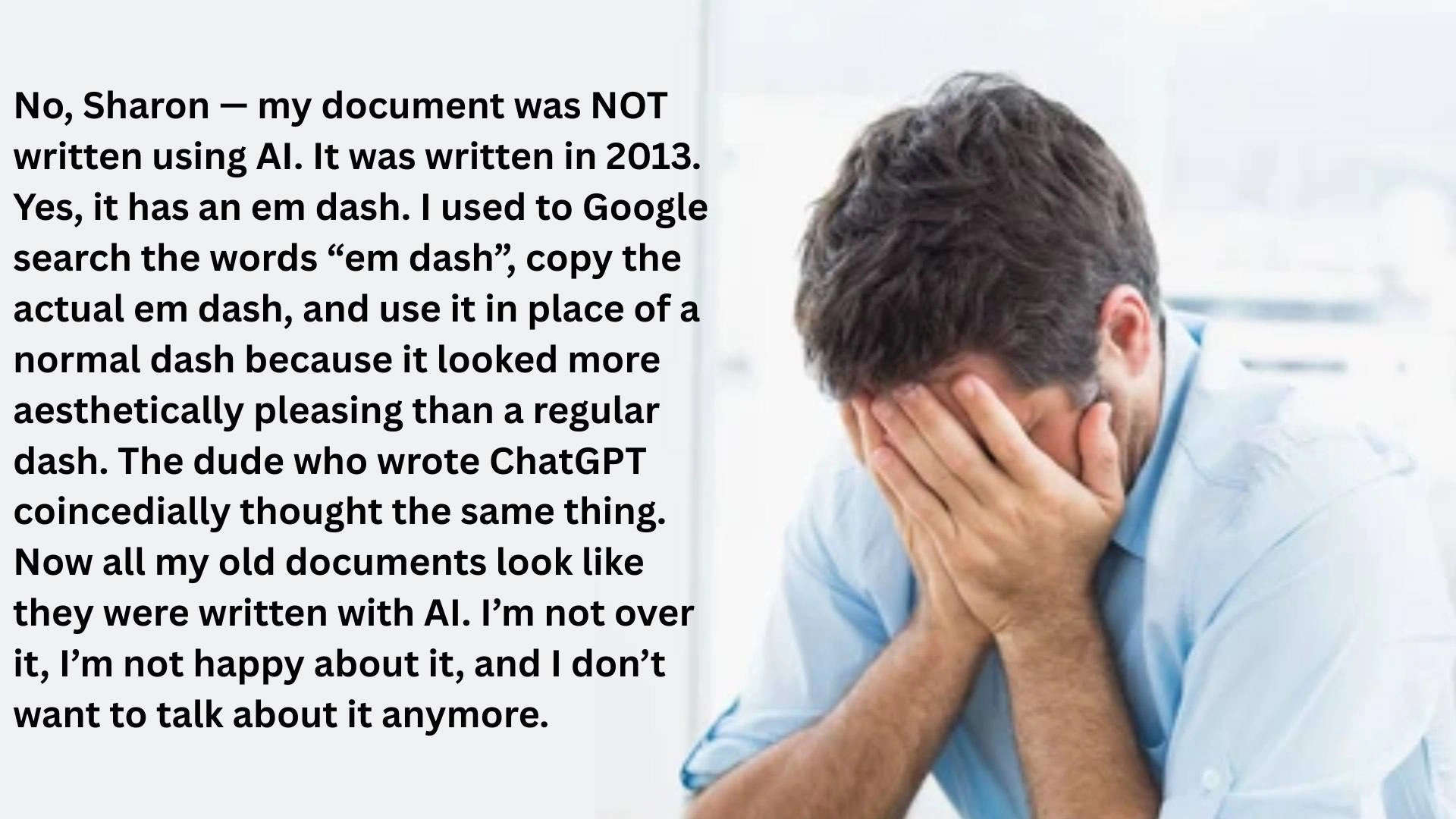
It is like owning an old photograph from years ago in which you wore a red hat, then being told a new robot also wears red hats, so the robot must have taken your photograph. The shared hat proves only that two writers liked the same thing. The man covers his face because something he chose to make his writing look nice has become the reason people doubt that the writing was ever his.
Level 2: One Dash, Many Authors
The mark in the first sentence is an em dash: —. In Unicode, the standard system that assigns numbers to text characters, it is U+2014. It differs from two nearby marks:
| Character | Common name | Typical job |
|---|---|---|
- |
Hyphen-minus | Joins words or stands in for several older keyboard marks |
– |
En dash | Often shows a range or a relationship |
— |
Em dash | Marks a strong break or inserted thought |
Traditional typography gave these marks different shapes and purposes, but ordinary keyboards made the short hyphen much easier to type. The meme’s claim that the writer used to search for “em dash” and copy the character is therefore plausible as a workflow. The character existed; the convenient key did not. Copy-and-paste was the artisanal keyboard shortcut.
ChatGPT does not have one author who deliberately decided that every answer should contain attractive punctuation. A large language model learns statistical patterns from extensive text data and generates text by predicting likely continuations. Books, articles, documentation, edited web pages, and other prose contain em dashes, so a model can learn contexts in which they fit. Later training and product behavior can influence style too, but the visible punctuation is generated from learned patterns, not from a line resembling:
if writing_style == "suspiciously polished":
insert("—")
An AI detector performs a different task: it examines text and estimates which source class resembles it. A false positive occurs when human text is labeled as AI; a false negative occurs when AI text is labeled as human. Short passages, unfamiliar genres, edited output, changing models, and formulaic human writing all complicate that judgment. A single em dash has almost no context, so using it alone is closer to a superstition than a test.
The image’s large block of text beside a stock facepalm makes the grievance deliberately excessive. The speaker insists, “I’m not over it, I’m not happy about it, and I don’t want to talk about it anymore,” after talking about it at considerable length. That escalating complaint is the joke’s human fingerprint—not proof of origin, just a very recognizable emotional pattern: a minor punctuation choice has become an unwanted argument about authenticity.
Level 3: Punctuation Crime Lab
“No, Sharon — my document was NOT written using AI. It was written in 2013.”
The date claim creates a clean contradiction: a document completed in 2013 cannot have been produced by ChatGPT, which arrived much later, yet its em dash now triggers a culturally learned accusation. The face-covering man supplies the emotional result of that false positive. A formerly personal stylistic habit has been retrospectively reclassified as machine evidence, as if typography could travel backward through time and contaminate the archive.
Treating one punctuation mark as proof confuses correlation with provenance. A language model may emit em dashes at a noticeable rate, but humans used them long before generative AI, and different human communities, genres, editors, keyboards, and house styles use them differently. At most, punctuation is a weak stylometric feature: one measurable aspect of writing style. Authorship inference needs a pattern across many features and a carefully matched comparison set. Even then, it produces a probability under particular assumptions, not a time-stamped confession from the keyboard.
The base-rate problem makes casual detection especially treacherous. If F means “the detector flags this text” and A means “the text is AI-generated,” the useful quantity is not merely how often the tool catches AI. It is:
$$ P(A\mid F)=\frac{P(F\mid A)P(A)}{P(F\mid A)P(A)+P(F\mid \neg A)P(\neg A)} $$
That last term contains the false-positive rate and the prevalence of human writing. When AI use is uncommon in the collection being checked, even a seemingly small false-positive rate can account for many flags. A detector can therefore look impressive on a balanced laboratory dataset and behave badly when “Sharon” deploys it against an archive whose actual base rate of ChatGPT authorship in 2013 is exactly zero.
Single-feature folklore is also trivially evaded. A user can remove —, ask for shorter sentences, or run a mechanical replacement after generation. Meanwhile, human writers who fear accusation may stop using their natural punctuation. The signal then decays from both directions: machine text loses the alleged tell, and human text is distorted to avoid it. This is feature drift accelerated by public awareness. The classifier does not merely observe the culture; once people learn its cues, it edits the culture. The em dash becomes linguistic collateral damage in an arms race nobody needed.
Reliable judgment should draw on evidence closer to the writing process: document history, drafts, source notes, repository commits, contemporaneous timestamps, disclosure, and a conversation in which the author can explain decisions. None of those is individually tamper-proof, but together they establish provenance far better than typographic vibes. Detector output may help prioritize review; it should not become a verdict with academic, professional, or reputational consequences. Even OpenAI withdrew an early public text classifier for low accuracy and has warned against using such detectors as primary decision tools. The people closest to the model could not turn prose alone into a dependable carbon-dating instrument, which should perhaps temper Sharon’s confidence in one long line.
The meme’s own imperfections sharpen the satire. Its writer proudly recalls choosing the prettier character, then visibly writes “coincedially” and reduces a large research-and-engineering effort to “The dude who wrote ChatGPT.” Neither the misspelling nor the casual explanation proves human authorship—models can misspell, and people can paste model output—but both clash amusingly with the stereotype of frictionless, uniformly polished AI prose. The text is fussy about one glyph and gloriously unbothered by several other details. Human style has always been a bundle of preferences, habits, mistakes, and edits, not a checkbox labeled uses_em_dash.
Description
The image splits a pale background between a long block of bold black text on the left and a stock photo of a man in a light blue shirt covering his face with both hands on the right. The text begins, "No, Sharon — my document was NOT written using AI. It was written in 2013." It continues that the writer used to Google "em dash," copy the character, and substitute it for a normal dash because it looked more aesthetically pleasing, then says, with the visible misspelling "coincedially," that "The dude who wrote ChatGPT" thought the same thing. It concludes, "Now all my old documents look like they were written with AI. I'm not over it, I'm not happy about it, and I don't want to talk about it anymore," satirizing how a once-personal punctuation preference has become an unreliable cultural fingerprint for generated prose.
Comments
1Comment deleted
The classifier has one feature, zero precision, and infinite confidence.