Skip to content
DevMeme
7455 of 7506
Game Jam Energy Versus Hackathon Reality
GameDev Post #8171 · source on Telegram

Game Jam Energy Versus Hackathon Reality

Level 1: Fort Versus Sales Booth

Both sides are like getting one weekend and a pile of cardboard. On the left, friends build a ridiculous castle because making it is fun, so every crooked tower becomes part of the adventure. On the right, they must build a neat booth and convince judges that it solves a serious problem. The materials and time are almost the same, but one feels like play while the other feels like a very fast job interview.

Level 2: Prototype Under Pressure

A game jam is a time-limited event where participants make a small game, often around a shared theme. A hackathon is a time-limited event where participants build a technical project or prototype. Neither term specifies an exact duration, level of competition, or corporate atmosphere; local rules matter more than the name.

Both teach rapid prototyping: building the smallest version that can test whether an idea is interesting or useful. In game development, that often means finding the core loop, the action a player repeats—move, choose, fight, build, solve—and proving that it feels good. In a product-oriented hackathon, it may mean validating a workflow such as uploading a file, analyzing it, and showing a useful result.

The best early-career lesson is scope control. Under a short deadline, a tiny complete experience beats a grand architecture with no visible result. A team might proceed like this:

  1. Agree on the single thing the demo must communicate.
  2. Build the riskiest piece early, while there is still time to change direction.
  3. Put the project in version control so teammates do not overwrite one another.
  4. Integrate continuously instead of combining every branch in the final hour.
  5. Freeze new features early enough to test, package, and rehearse.

That last step is routinely sacrificed to the ancient event tradition of adding one more feature eleven minutes before submission. The result is demo-driven development: the project works beautifully along one rehearsed route and becomes folklore if anyone clicks Back.

The image’s emotional contrast reflects what participants believe they are building. A jam project can be valuable because its creation was fun or educational, even if nobody uses it later. A hackathon entry is more often framed as a solution, so judges may expect utility, feasibility, and a persuasive pitch. That expectation can make identical coding pressure feel heavier. Yet the healthiest version of either event shares the same goal: give people protected time to learn together, try a risky idea cheaply, and leave with experience rather than merely a sleep deficit and a branded water bottle.

Level 3: Same Clock, Different Scoreboard

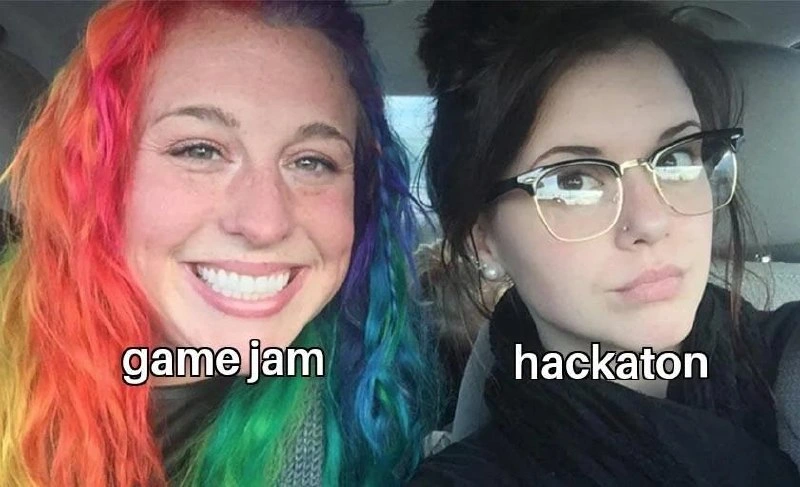
The image needs only two labels and two expressions. Under “game jam,” rainbow-colored hair frames an enormous, direct smile. Under the visibly misspelled “hackaton,” glasses and a flat sideways glance communicate deep reservations. Both events can involve teams building software under a brutal deadline, yet the meme assigns them opposite emotional weather: one is creative play; the other is a calendar invitation that has learned to code.

The important difference is not the programming loop but the incentive function wrapped around it. A game jam commonly begins with a theme or constraint and rewards novelty, atmosphere, humor, or an interesting mechanic. The artifact is allowed to be strange and unfinished because experimentation is the point. A hackathon can also be playful, but corporate and sponsored versions often add business problems, required APIs, judging criteria, prizes, recruiting, and a presentation. The team is no longer asking only, “Is this delightful?” It may also be asking, “Can this survive a three-minute demo and make the sponsor logo visible?”

That changes technical decisions. In a short event, nobody can maximize reliability, maintainability, feature depth, visual polish, and presentation quality at once. Teams optimize the path judges will see:

  • A game prototype may hard-code level data, ignore unusual inputs, and devote most effort to one satisfying core loop.
  • A hackathon prototype may use mocked services, scripted sample data, and a polished happy path that demonstrates the pitch.
  • Both may postpone tests, accessibility, security review, deployment automation, and failure recovery because those investments are difficult to show in a brief judging slot.

This is not automatically irresponsible engineering. Technical debt is a trade: accept a shortcut now in exchange for future work. For an experiment that will be discarded on Sunday evening, elaborate production architecture could be the wasteful choice. The trouble starts on Monday when a winning prototype is called an “almost finished product,” its temporary assumptions become a roadmap, and the original team learns that the mock payment gateway is now somehow a quarterly commitment. Prototype code has a remarkable promotion track.

The two formats also produce different kinds of psychological safety. A jam’s shared theme can give participants permission to fail publicly: everyone expects odd ideas, rough art, and a build that occasionally launches upside down. A business-focused hackathon can feel evaluative, especially when managers, recruiters, or investors are watching. Participants may perform enthusiasm while wondering whether “voluntary innovation” means unpaid product discovery after a full workweek. Conversely, a well-run hackathon can offer autonomy and cross-team collaboration that normal planning rarely permits, while a competitive game jam can produce sleep deprivation, crunch, and comparison anxiety. The faces encode a recognizable stereotype, not a universal survey result.

Historically, both names promise informal intensity. A jam borrows the spirit of musicians improvising together; a hackathon combines exploratory “hacking” with a marathon. In this context, hack means making or experimenting with technology, not necessarily breaking into systems. Over time, each format has been adopted by communities, schools, companies, governments, and marketers. The same container—small team, short clock, public demo—can hold communal learning or institutional theater depending on who chooses the problem, owns the result, and defines success.

The missing second h in “hackaton” supplies a final accidental-looking grace note. It could be nothing more than the meme maker’s spelling error, but it suits a format built around shipping before polishing: even the label reached the demo stage before copy review. Meanwhile, the game-jam side radiates the dangerous confidence of someone who has not yet tried to export the build for a different graphics driver.

Description

A car selfie places two women side by side: the woman on the left has vivid rainbow-colored hair and an enormous cheerful smile, while the dark-haired woman on the right wears glasses and gives a flat, skeptical sideways look. White outlined labels identify the exuberant left side as "game jam" and the unimpressed right side as "hackaton," with the latter visibly spelled without the second "h" in "hackathon." The contrast depicts game jams as playful, creative rapid prototyping and hackathons as their more serious or corporate cousin, where similar time-boxed coding pressure is repackaged around demos, judging, recruiting, or product pitches.

Comments

1
Anonymous ★ Top Pick Same 48-hour loop; one ships joy, the other ships a pitch deck.
  1. Anonymous ★ Top Pick

    Same 48-hour loop; one ships joy, the other ships a pitch deck.

Use J and K for navigation